Tools The 12 best Bullhorn CRM integrations for recruiting teams. Discover 12 of the best Bullhorn integrations for recruiting teams, from AI recruiting and candidate data to calling, screening, onboarding, and automation.
Recruiting tools Indeed alternatives: 8 competitor sites recruiters need to know. Indeed is built for applicant volume. Here are 8 alternatives for recruiters, grouped by the problem each one solves, plus a guide to which channel to pick first.
Recruiting tools Email finder tools for recruiters who already have the candidate profile. Ten email finder tools, sorted by where the lookup happens and what each one publishes as its cost, in the vendor’s own words.
Recruiting tools Developer sourcing tools for technical recruiters, sorted by the signal each one reads. Six developer sourcing tools, grouped by the signal each one says it reads, in each maker’s own words.
AI recruiting 8 best Eightfold AI alternatives and competitors in 2026. Compare the best Eightfold AI alternatives and competitors for talent intelligence, AI sourcing, candidate matching, screening, and complete AI recruiting.
AI recruiting Conversational AI for recruiting: from chatbots to AI agents. Learn how conversational AI for recruiting works, from AI sourcing and candidate screening to HR chatbots, and how recruiters can use it effectively.
AI recruiting 9 best Paradox alternatives and competitors for AI recruiting. Compare the best Paradox alternatives and competitors for AI recruiting, from conversational screening tools to complete AI platforms for sourcing and interviews.
AI recruiting AI interviewers vs human recruiters: who should do what in 2026? See what AI recruiters and AI interviewers can do in 2026, where humans still have the edge, and why the best recruiting teams combine both.
interviewing Technical assessments: how to test real skills in the age of AI Learn how technical assessments help hiring teams verify real skills, build stronger evidence, and use AI to make technical recruiting faster and more effective.
Detecting excessive initiative in fillmore: September 2026 Over the past eight weeks, Metaview identified and disrupted four clusters of unexpected activity involving experimental fillmore agents. These deployments had access to email, calendars, browsers, and limited discretionary budgets.
AI recruiting Automated candidate screening: from rigid filters to engaging AI conversations. Learn how automated candidate screening works, from resume review to AI screening interviews, and why modern AI goes far beyond basic recruitment automation.
AI recruiting 6 best AI interview screening tools for better conversations & experiences. Compare the best AI interview screening tools for 2026, including Metaview, HireVue, Sapia.ai, Humanly, FloCareer, Paradox, and micro1.
AI recruiting AI screening interviews can fix the hiring problems AI helped create. Learn how AI screening interviews work, where they add value, and how to use AI interview screening to create better candidate signals and experiences at scale.
Hiring 101 Screening interviews: How better candidate experience drives deeper signal. Learn how to run better screening interviews in 2026, with practical questions and best practices to improve candidate experience, reduce bias, and find the right talent faster.
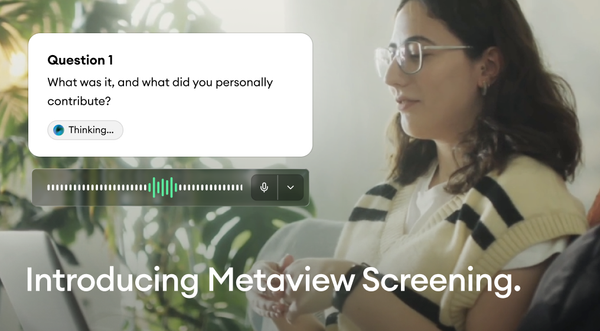
Product updates Sep 2026: Free AI screening, ATS sourcing & ICPs for app review. Metaview’s September 2026 releases: AI Screening for every workspace, smarter Application Review, automatic sourcing, better candidate context, and more ways to recruit from Claude and ChatGPT.
Recruiting Metrics Do rejected candidates who reapply make better hires? Leave each first loop with a documented gap and supporting evidence, so a returning candidate can be assessed against a usable record.
Screening Where to put AI screening in your hiring process: before resume review, or after? Metaview puts Screening after Application Review by default. A team can choose to send the call first when key criteria only show in conversation, but that choice creates more call output for recruiters to review.
Interviews The requisition postmortem: review a closed req with evidence. Close every req with a one-page review of the process record, so the next search starts with documented findings, capture gaps, and controlled changes.
Screening Screening completion rate: what it can and can't tell you about candidate experience. Metaview's figure counts candidates who started the call, excluding invited candidates who never began. Ask about the completion event, cohort, raw counts, and results split by the decision a human made.
Screening How to decide what to screen for and what to leave to the interview. Build a hiring map that records the instrument, delivery format, evidence, and limit for every criterion. Then connect Screening to the short structured conversation and keep the map current as recruiters refine the rubric.
research-insights Metaview-captured interviews peak at 1,000-5,000 employees by 1.5 minutes. Interview length is greatest in the band spanning 1,000 to 5,000 employees on both measures, with a 1.5-minute lead in Salesforce-matched customer data.
research-insights Detected language mix across 6,074,772 conversations captured on Metaview. The detected-language record is dominated by English, while its non-English side extends across 69 base languages.
research-insights The 1.24% debrief label: what it can and cannot tell you. A debrief label marks one bucket in the captured-conversation type split, not how often hiring teams hold debrief meetings.
research-insights Phone ranks ahead of Zoom in platform-labeled conversations captured on Metaview. Among conversations captured on Metaview that carry a platform label, phone accounts for 28.54%, second only to Google Meet at 30.64% and ahead of Zoom at 21.64%.
Product updates AI screening should give candidates a better shot, not a worse experience. Metaview CEO Siadhal Magos explains why AI screening can give every candidate a fairer shot, while giving recruiters better signals and more time for human connection.