

Indeed gives you volume. ZipRecruiter gives you reach.
Neither gives you the candidate you actually want.
If your inbox fills up but your interview pipeline stays empty, you don’t have a job-board problem. You have a sourcing-channel problem.
The strongest hires for senior, technical, or specialized roles are employed, busy, and never going to scroll through a job listing on a lunch break.
Sendwave cut interviews per hire by 28% the year they stopped relying on inbound boards alone and added an outbound sourcing layer.
Catawiki used the same shift to hire 300+ engineers in 12 months. The story under both numbers is the same one: the boards do a job, just not the whole job.
Here’s where each platform actually wins, where they overlap, and what to do about the work both of them leave behind.
The two platforms at a glance.
Indeed is a marketplace. ZipRecruiter is a distribution network. Both work in the same lane (active job seekers), but the mechanics differ enough to matter when you’re picking one.
| Indeed | ZipRecruiter | |
|---|---|---|
| Core model | Central job marketplace | Job distribution network |
| Candidate pool | Very large, broad | Smaller internal marketplace |
| Application flow | Mostly inbound applicants | Inbound + invite to apply |
| Resume search | Large active-seeker database | Smaller candidate pool |
| Job visibility | Inside Indeed’s ecosystem | Syndicated to partner boards |
| Pricing model | Pay-per-click sponsorship | Subscription |
Where ZipRecruiter and Indeed overlap.
Both are inbound channels. Both serve active job seekers. Both reward employers who pay for placement.
And neither learns from your hires. After a quarter of running the same role, the candidates surfaced this month look like the ones surfaced last month, even if the last batch produced zero offers.
- Reach active job seekers only
- Compete against every other employer who posted that week
- Keyword and filter targeting, no context
- No learning loop from who you actually hired
- Reaches passive candidates who’d never apply on their own
- Agent runs the search continuously, 24/7
- Targeting is context-aware and learns from your past hires
- Output lands in your ATS with structured fields, not a CSV
How to choose between them.
You’re hiring high-volume, active-seeker roles (admin, support, retail, hospitality, frontline). Indeed first, ZipRecruiter as a secondary sponsorship layer. The volume from Indeed alone is usually enough; ZipRecruiter helps when your local market is thin.
You’re hiring mid-volume or niche roles (specialist, regional, regulated, multi-location). ZipRecruiter’s syndication tends to win here because the candidate pool isn’t centralized on any one platform. Indeed alone gives you the loudest single signal but misses board-specific pockets.
You’re hiring senior, technical, or specialized talent (engineering, product, design, leadership, security-cleared). Neither platform alone will get you there. Keep one of them for inbound coverage and layer an outbound sourcing system on top.
Where Metaview fits.
Metaview’s AI Sourcing isn’t a substitute for either job board. It’s the outbound layer that fills the gap both leave behind.
Indeed and ZipRecruiter cover the active-seeker traffic. Metaview surfaces the passive candidates who’d never have applied, scores them against your actual rubric, and pushes them into your ATS with the context attached.
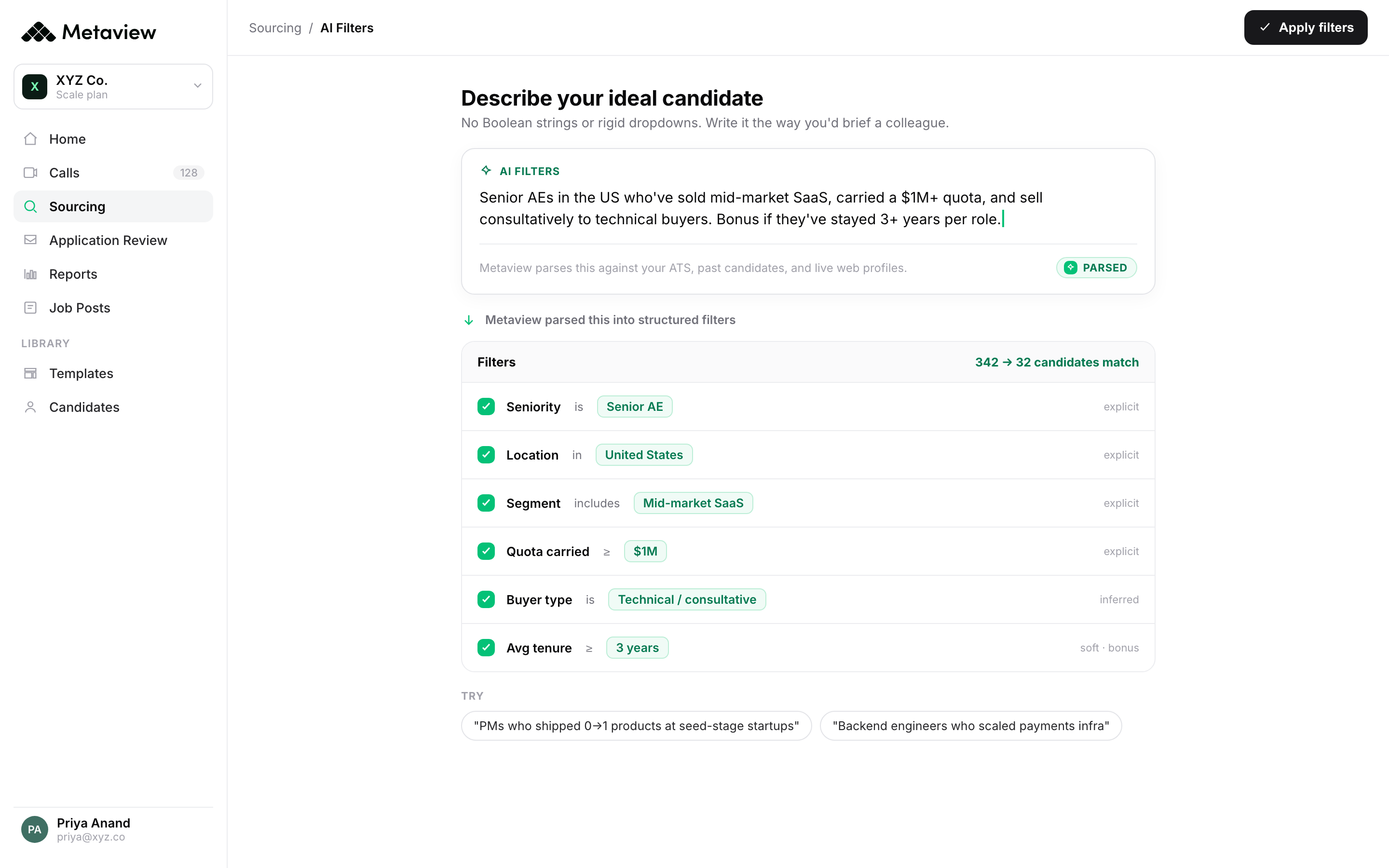
Every hire you make through the loop sharpens the next search. Every reject the recruiter marks feeds the ideal-candidate profile.
That’s how Sendwave got to a 28% cut in interviews per hire, and how Catawiki kept the engineering pipeline healthy through 300+ hires in a year.
The pairing is the part to internalize. Keep one inbound board for the active-seeker traffic where it earns its keep. Add AI sourcing on top for the roles where quality matters more than volume.
For a deeper read, our ZipRecruiter alternatives guide walks through where AI sourcing slots into the broader stack.
Every time the AI presents a candidate, the recruiter says fit or not. That feedback flows into the ideal-candidate profile. Over time, it becomes a company-wide read on what good looks like.”

Bring Metaview into your hiring stack.
Live notes, structured scorecards, and ATS sync - set up in under 10 minutes.
Frequently asked.
Which is better for high-volume hiring, Indeed or ZipRecruiter?
Indeed in most cases. The raw active-seeker volume is larger, and the pay-per-click model lets you control spend per role. ZipRecruiter is a useful secondary channel when your local market is thin or the role straddles multiple niche boards.
Why do recruiters say Indeed and ZipRecruiter feel the same?
Because at the candidate end, they are. Both pull from the active-job-seeker pool, both reward employers who pay for placement, and both put your role in the same scroll alongside every other employer’s. The mechanics differ but the candidate experience converges.
Where does AI sourcing fit if I’m already on Indeed?
As the outbound layer above your inbound channel. Indeed brings active applicants; AI sourcing surfaces the passive candidates who never apply. The two compound. Most teams pair them for any role where quality matters more than raw volume.
Should I cancel ZipRecruiter and switch to AI sourcing?
Usually no. Keep ZipRecruiter or Indeed for the high-volume active-seeker work where they earn their keep. Add AI sourcing on top for the senior, technical, or specialized roles where boards alone cap your pipeline quality. The boards are a channel, not a strategy.
How does AI sourcing integrate with my ATS?
Native integration. Metaview Sourcing pushes candidates directly into Greenhouse, Ashby, Lever, Workday, and 43 other ATSs as structured candidate records with the context attached, not as a CSV your team has to reconcile.
