
HR teams are expected to attract great candidates, support employees, manage performance, oversee compliance, and help businesses plan for the future. Often without adding more people to the team.
AI offers a way to make this manageable. The best AI tools for HR automate repetitive processes, uncover workforce insights, and take ownership of entire workflows.
But there's no single AI tool that solves every HR challenge. A recruiting team needs different capabilities from an HR operations manager or a learning and development specialist.
We've selected 12 of the best AI tools for HR teams, covering everything from recruiting and onboarding to employee engagement, payroll, and compliance. Here's what each does best, and how to choose the right tools for your team.
The best AI tools for HR teams at a glance.
HR teams have different priorities. Some need to hire more effectively, while others want to simplify administration, improve employee experiences, or make better workforce decisions.
Here's how our 12 recommended tools compare.
| AI tool | Best for | Key AI capability |
|---|---|---|
| Metaview | Recruiting and talent acquisition | AI agents for sourcing, application review, screening, interview notes, and reports |
| Rippling | HR administration | Automated employee workflows across HR, IT, and finance |
| BambooHR | Employee onboarding | AI-assisted HR administration and employee management |
| Leena AI | Employee HR support | Conversational AI for employee questions and service requests |
| Lattice | Performance management | AI-assisted performance reviews, feedback, and manager insights |
| Culture Amp | Employee engagement | AI-powered analysis of employee feedback and sentiment |
| 360Learning | Learning and development | AI-assisted course creation and employee training |
| Visier | People analytics | AI-powered workforce insights and natural-language analytics |
| Deel | Global HR and payroll | AI-assisted global workforce administration and employee support |
| Textio | Inclusive HR communication | AI guidance for job descriptions and performance feedback |
| Workday | Enterprise HR management | AI-powered workforce planning, talent management, and HCM |
| Mineral | HR compliance | AI-assisted employment law guidance and compliance monitoring |
Each platform addresses a different part of the HR workload. Some are comprehensive HR systems with AI capabilities built in, while others are specialized tools designed to solve one particular challenge.
The right choice depends on where your team spends the most time, which processes create the most friction, and what you want AI to take off your plate.
What are AI HR tools?
AI tools for HR are software platforms that use artificial intelligence to automate tasks, analyze workforce information, and support decisions throughout the employee lifecycle.
They help HR professionals with everything from sourcing candidates and reviewing applications to answering employee questions, creating training programs, and identifying workforce trends.
Most AI tools for HR fall into three broad categories:
- AI assistants: Help HR professionals draft content, summarize information, answer questions, and complete individual tasks.
- AI-powered HR platforms: Add intelligent features to established processes such as payroll, performance management, onboarding, and workforce analytics.
- AI agents: Independently complete multistep workflows, such as finding and screening candidates or resolving routine employee requests.
The most valuable tools don't simply help HR teams work faster. They reduce the amount of repetitive work required in the first place, freeing HR professionals to focus on employees, managers, and strategic priorities.
The 12 best AI tools for HR teams in 2026.
1. Metaview: Best AI recruiting and talent acquisition platform.
Best for: Recruiting teams that want AI to handle more of the hiring process, from finding candidates to screening applicants and capturing interview insights.
Metaview is an agentic recruiting platform that helps teams hire faster and more effectively. Its connected AI agents support the entire recruiting process, helping recruiters identify, engage, evaluate, and hire great candidates.
Metaview goes beyond traditional recruiting automation. Its AI agents can independently source candidates, review incoming applications, and conduct natural screening conversations. They also capture structured evidence from interviews, giving hiring teams better information to make decisions.
This makes Metaview particularly valuable for teams managing high application volumes, repetitive screening work, or ambitious hiring targets without additional recruiting headcount.
Key AI features
- AI Sourcing: Find and evaluate promising candidates across the web and existing talent databases, based on your team's hiring criteria.
- Application Review: Analyze incoming applications, identify strong matches, and prioritize candidates for recruiter review.
- AI Screening: Conduct conversational screening interviews with adaptive follow-up questions and role-specific evaluations.
- AI Notetaker: Automatically capture interview notes, generate structured scorecards, and preserve evidence for hiring decisions.
- Connected recruiting intelligence: Use insights from candidate conversations and hiring decisions to improve recruiting workflows.
- ATS integrations: Keep candidate records, interview notes, and recruiting activity connected to your existing systems.
Why choose Metaview?
Metaview is a strong choice for recruiting teams that want AI to do meaningful work, rather than simply help recruiters complete individual tasks faster.
Metaview isn't here to replace that human connection. If anything, it scales and amplifies it. It allows us as hiring leaders to show up more authentically, listen more deeply, and be more present in the moments that matter. Because the future success of any company rests in the hands of its people.”
2. Rippling: Best AI tool for HR admin.
Best for: HR teams that want to automate repetitive administrative tasks and manage employee operations across multiple systems.
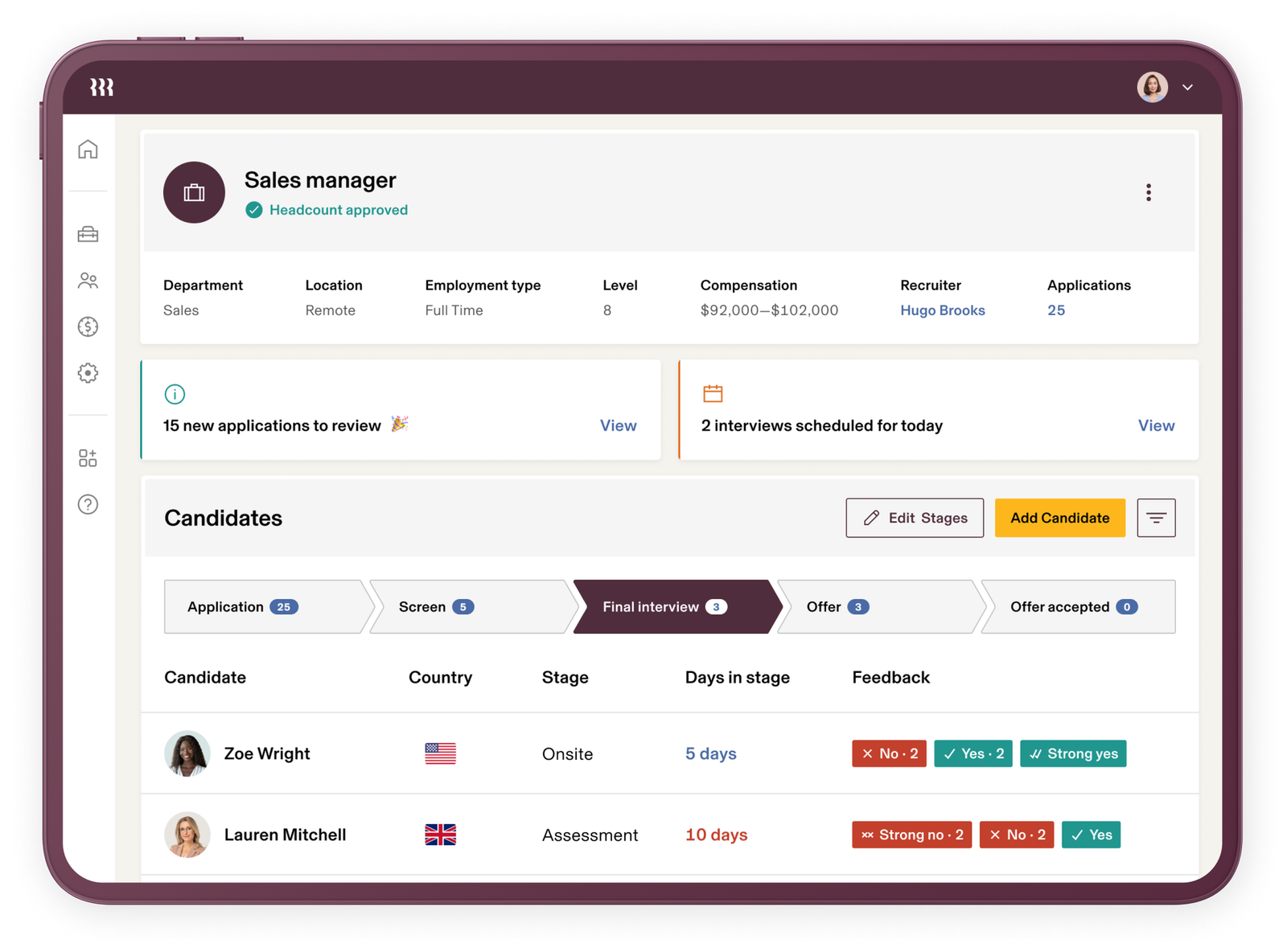
Rippling is a workforce management platform that brings HR, payroll, IT, and finance operations into one system. Automation helps HR teams manage employee data, approvals, onboarding, and offboarding without constantly switching between applications.
Rippling combines workflow automation with AI-powered tools for reporting, employee support, and administrative tasks. Because its modules share employee data, teams can coordinate processes across departments without duplicating information.
It's particularly useful for growing businesses that want to reduce manual administration while keeping their HR processes consistent.
Key AI features
- AI-powered reporting: Explore workforce data and generate insights to support HR decisions.
- Workflow automation: Automate approvals, employee updates, and recurring administrative processes.
- Employee self-service: Help employees find information and complete routine requests.
- Automated onboarding and offboarding: Coordinate employee documentation, access permissions, and equipment provisioning.
- Unified employee data: Connect HR, payroll, and IT information to reduce manual updates.
Why choose Rippling?
Rippling’s biggest advantage is combining employee data and automated workflows in one platform, rather than relying on disconnected HR and IT tools.
3. BambooHR: Best AI tool for employee onboarding.
Best for: Small and midsize HR teams that want to create consistent onboarding experiences and simplify employee administration.
BambooHR is an HR management platform that helps businesses organize employee records, onboarding, time off, performance management, and other core people processes.
Its onboarding workflows help HR teams coordinate paperwork, welcome communications, and essential tasks before and after an employee's first day. BambooHR also offers AI-assisted features that help users access information and work more efficiently with HR data.
While BambooHR isn't primarily an AI automation platform, it provides a practical foundation for teams that want to modernize HR operations without introducing unnecessary complexity.
Key AI features
- AI-assisted HR insights: Help HR professionals access and interpret employee information.
- Automated onboarding: Coordinate new-hire paperwork, task assignments, and welcome activities.
- Employee self-service: Give employees access to relevant information and routine HR requests.
- HR reporting: Track workforce trends and key employee metrics.
- Workflow automation: Reduce manual work across employee administration and approvals.
Why choose BambooHR?
Its combination of intuitive employee management and onboarding automation helps create a smoother experience for new hires and HR administrators, particularly in leaner teams.
4. Leena AI: Best AI tool for employee HR support.
Best for: HR teams that want to answer employee questions, resolve routine requests, and reduce the workload on internal support teams.
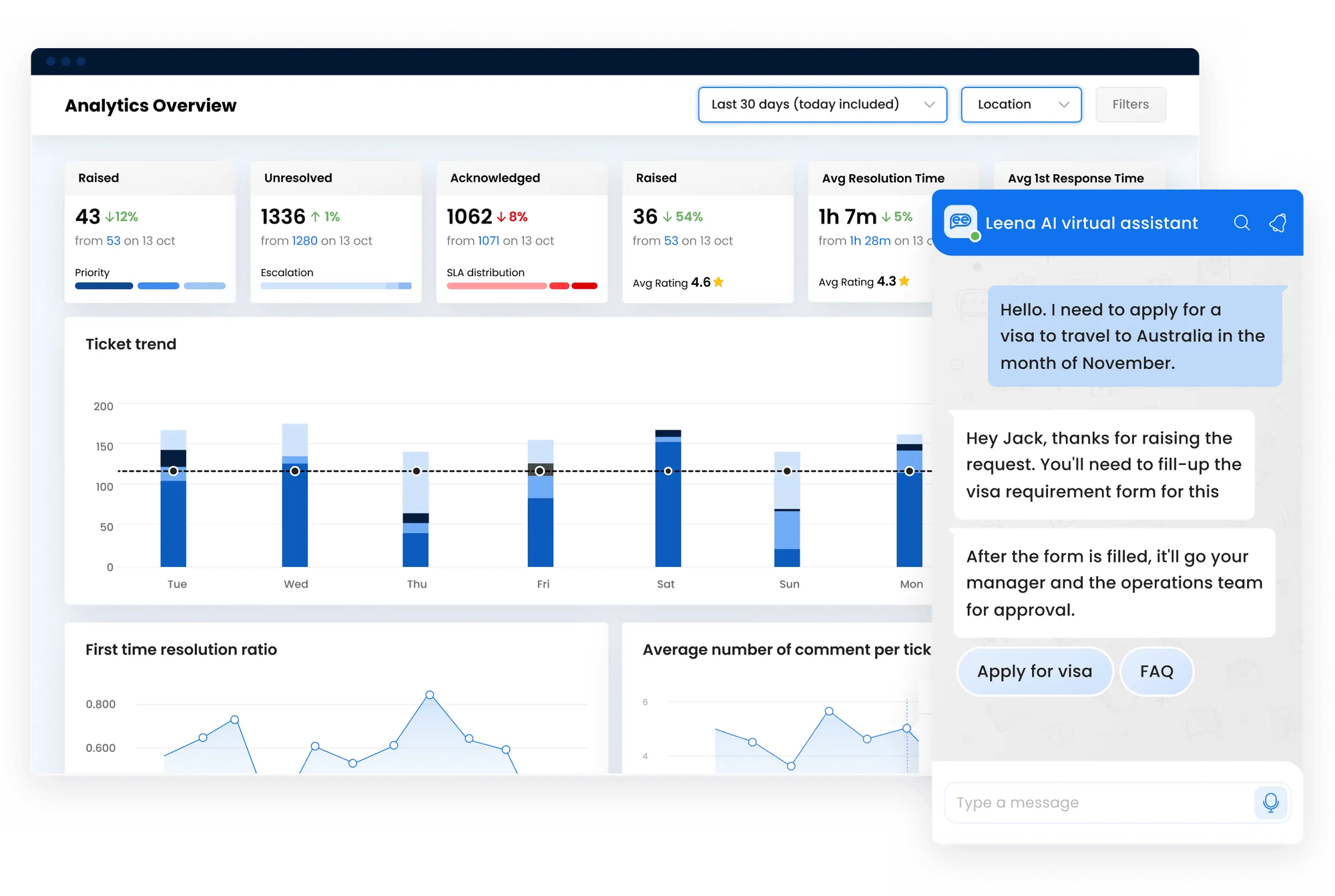
Leena AI is an AI-powered employee support platform designed to automate common HR service requests. Its conversational AI assistant helps employees find information, understand company policies, and complete routine tasks without waiting for an HR representative.
The platform connects with existing enterprise systems and knowledge sources to provide answers based on company-specific information. It can also help manage more complex requests by collecting details, initiating workflows, or routing issues to the appropriate team.
This makes Leena AI especially valuable for larger organizations where HR teams spend significant time responding to repetitive employee questions.
Key AI features
- Conversational HR assistant: Answer employee questions about policies, benefits, leave, and other HR topics.
- AI-powered knowledge search: Retrieve relevant information from company policies and internal resources.
- Automated request resolution: Handle routine HR service requests without manual intervention.
- HR ticket management: Categorize, route, and support the resolution of employee issues.
- Multilingual employee support: Help distributed teams access HR information in different languages.
Why choose Leena AI?
Rather than replacing an existing HRIS, Leena AI adds an intelligent support layer that makes HR information and services easier to access.
5. Lattice: Best AI tool for performance management.
Best for: HR teams and managers that want to improve performance reviews, employee feedback, and professional development.
Lattice is a people management platform that helps organizations run performance reviews, track goals, gather feedback, and support employee development.
Its AI capabilities help managers prepare more useful performance evaluations, summarize feedback, and identify relevant themes across employee performance data. This reduces the administrative burden of review cycles while helping managers have more informed conversations with their teams.
Lattice also connects performance management with employee engagement and development, giving HR teams a broader understanding of how employees are progressing.
Key AI features
- AI-assisted performance reviews: Help managers draft clearer, more comprehensive evaluations using available feedback.
- Feedback summaries: Consolidate employee feedback into useful themes and insights.
- Goal management: Track individual and team objectives to support performance discussions.
- Employee development: Support growth plans and career conversations with relevant performance context.
- People insights: Identify patterns across performance, engagement, and employee feedback.
Why choose Lattice?
Lattice is particularly valuable for organizations that want to make performance management more consistent and less time-consuming.
6. Culture Amp: Best AI tool for employee engagement.
Best for: HR teams that want to understand employee sentiment, improve engagement, and identify potential retention challenges.
Culture Amp is an employee experience platform that helps organizations collect feedback, measure engagement, and understand what drives employee satisfaction.
Its AI analyzes survey responses, identifies recurring themes, and helps HR teams turn employee feedback into actionable insights. Rather than manually reviewing hundreds of comments, teams can quickly understand common concerns and opportunities for improvement.
Culture Amp also provides benchmarking and reporting tools to help HR leaders measure progress and understand how their employee experience compares with similar organizations.
Key AI features
- AI-powered sentiment analysis: Identify patterns and themes across employee survey responses.
- Feedback summaries: Turn large volumes of qualitative feedback into digestible insights.
- Engagement analytics: Understand the factors influencing employee satisfaction and retention.
- AI-assisted action planning: Help managers identify practical steps to address employee concerns.
- Employee experience benchmarking: Compare engagement results against relevant industry benchmarks.
Why choose Culture Amp?
Culture Amp’s AI-powered analysis helps HR teams identify meaningful trends and prioritize improvements that support engagement and retention.
7. 360Learning: Best AI tool for learning and development.
Best for: HR and L&D teams that want to create employee training faster and make internal knowledge easier to share.
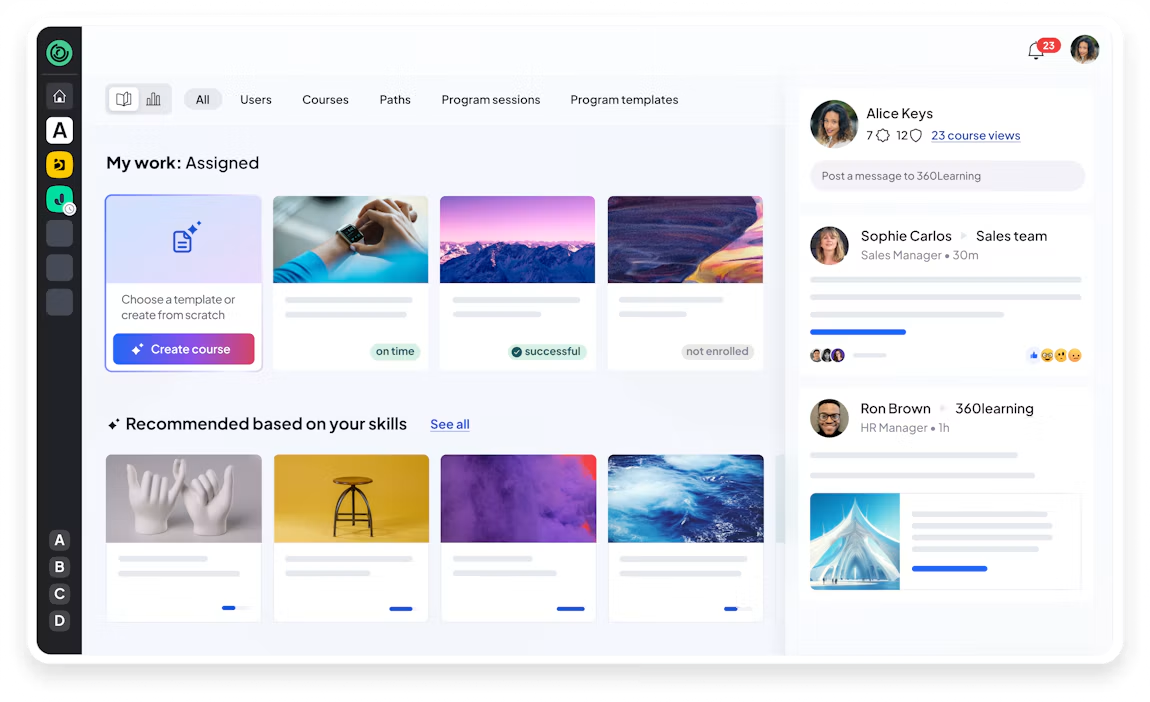
360Learning is a collaborative learning platform that helps organizations create, deliver, and manage employee training. Its approach emphasizes learning from internal experts rather than relying entirely on dedicated instructional designers.
AI-powered course creation helps teams turn existing documents, knowledge, and subject matter expertise into structured learning content. This makes it easier to develop onboarding programs, compliance training, and professional development resources without lengthy production cycles.
The platform also supports collaborative learning, allowing employees to contribute expertise and keep training materials relevant.
Key AI features
- AI course creation: Generate training content and course structures from existing resources.
- AI-assisted assessments: Create quizzes and knowledge checks to reinforce learning.
- Content recommendations: Help employees discover training relevant to their needs.
- Collaborative content development: Capture internal expertise and turn it into reusable learning materials.
- Learning analytics: Track participation, progress, and training effectiveness.
Why choose 360Learning?
The combination of AI-assisted content creation and collaborative learning helps L&D teams scale employee development without taking on all the content production themselves.
8. Visier: Best AI tool for people analytics.
Best for: HR leaders who want to understand workforce trends, improve planning, and make more informed people decisions.
Visier is a people analytics platform that helps organizations understand their workforce through data. It brings together information from HR systems to analyze headcount, employee turnover, compensation, productivity, and other important workforce metrics.
And it makes workforce data more accessible. Ask questions in natural language, explore trends, and uncover insights without relying entirely on specialist analysts.
Visier is particularly valuable for larger organizations that need to connect HR decisions with broader business outcomes.
Key AI features
- Conversational people analytics: Ask questions about workforce data using natural language.
- Predictive workforce insights: Identify trends and potential risks related to turnover and workforce changes.
- Workforce planning: Analyze headcount, organizational structures, and future staffing needs.
- Employee retention analysis: Understand patterns associated with employee departures.
- AI-powered reporting: Generate insights and visualizations from connected HR data.
Why choose Visier?
Visier’s AI-powered analytics make it easier to identify problems, evaluate options, and support important people decisions with evidence.
9. Deel: Best AI tool for global HR and payroll.
Best for: HR teams managing international employees, contractors, and payroll across multiple countries.
Deel is a global HR and payroll platform that helps businesses hire, pay, and manage workers internationally. It combines payroll, workforce administration, compliance support, and employee management in one system.
Its AI-powered assistant gives you information about global employment requirements, internal processes, and workforce administration. Deel also automates routine workflows, reducing the manual coordination involved in managing employees across different countries.
This makes it especially useful for distributed companies dealing with different employment regulations, payroll requirements, and local HR processes.
Key AI features
- AI HR assistant: Get answers to questions about global HR processes and employment requirements.
- Global payroll automation: Streamline payroll administration across different countries and currencies.
- Compliance guidance: Access information to support international employment and workforce management.
- Automated HR workflows: Coordinate onboarding, documentation, and employee administration.
- Global workforce reporting: Access employee and payroll information across international teams.
Why choose Deel?
Deel combines AI assistance, payroll infrastructure, and HR automation to manage complex international operations without building separate processes for every country.
10. Textio: Best AI tool for inclusive HR communication.
Best for: HR teams that want to write clearer, more inclusive job descriptions, performance reviews, and employee communications.
Textio is an AI-powered writing platform designed to improve workplace communication. It helps recruiters and managers identify potentially biased language, improve clarity, and create more effective written feedback.
Unlike general-purpose AI writing assistants, Textio focuses specifically on language used in hiring and employee performance management. It analyzes writing patterns and provides suggestions to help teams communicate more consistently and fairly.
This makes it particularly valuable for organizations that want to improve the quality of their HR communications without relying on subjective writing guidelines alone.
Key AI features
- Inclusive language analysis: Identify potentially biased or exclusionary wording in job descriptions and employee feedback.
- AI writing suggestions: Recommend clearer, more effective alternatives to existing text.
- Performance feedback guidance: Help managers write specific, actionable, and balanced employee evaluations.
- Job description optimization: Improve the language and accessibility of recruitment content.
- Writing insights: Identify communication patterns and opportunities for improvement across teams.
Why choose Textio?
Textio is a strong choice to improve communication quality and consistency. It helps managers and recruiters write more thoughtfully, particularly for important documents that influence hiring and employee development.
11. Workday: Best AI tool for enterprise HR management.
Best for: Large organizations that want AI capabilities integrated across their core HR, talent management, and workforce planning processes.
Workday is an enterprise human capital management (HCM) platform that brings together HR administration, talent management, payroll, and workforce planning.
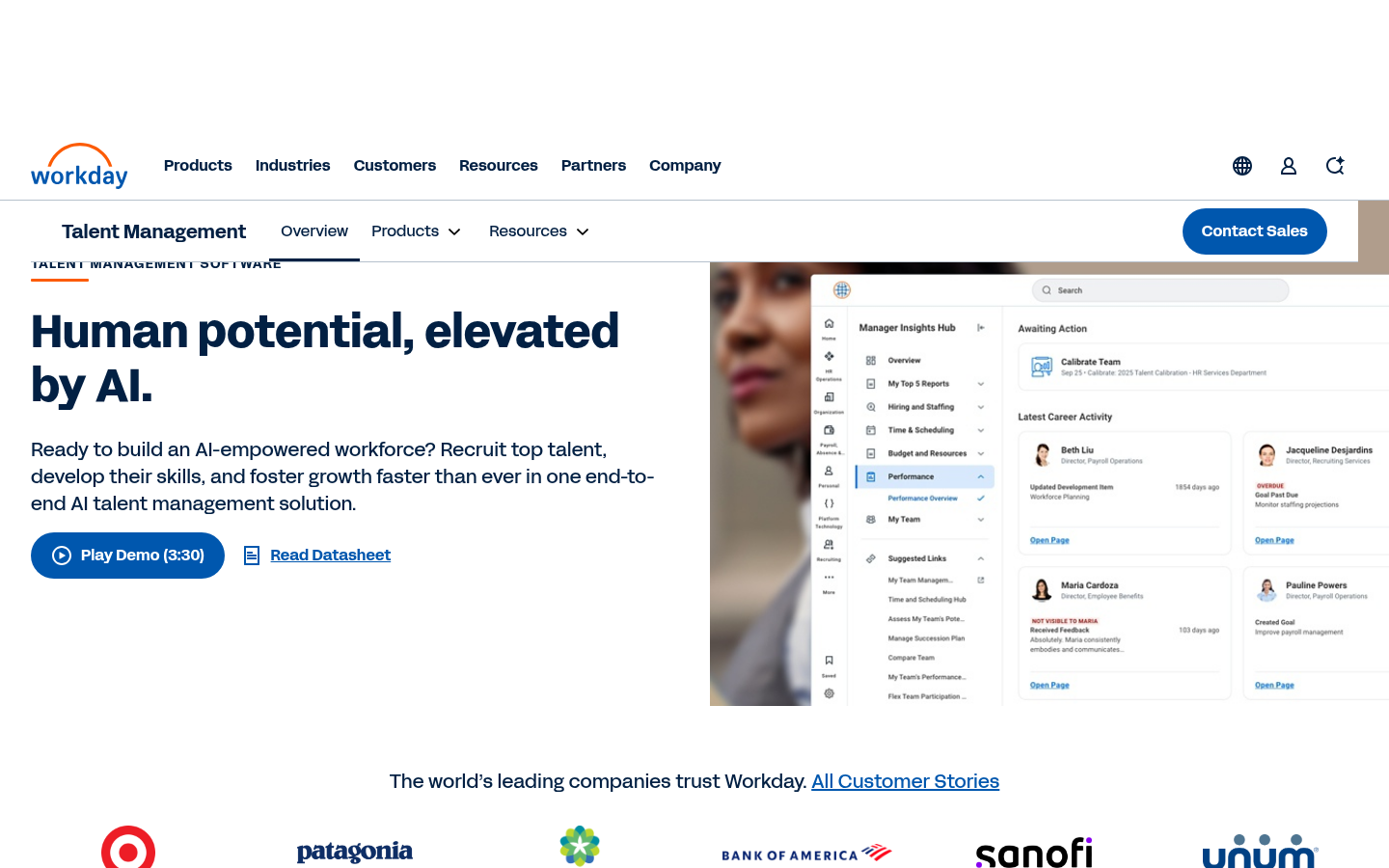
Its AI capabilities help you analyze workforce data, identify skills, support employee development, and automate complex HR workflows. Because these features operate within a broader enterprise platform, HR teams can use connected employee information to support decisions across multiple functions.
Workday is particularly suited to organizations with complex structures, large workforces, and established enterprise HR processes.
Key AI features
- AI-powered talent intelligence: Identify employee skills and support internal mobility and development.
- Workforce planning: Analyze staffing needs, organizational trends, and future talent requirements.
- Intelligent HR automation: Streamline administrative workflows and routine employee processes.
- AI-assisted employee experiences: Help employees access relevant information and complete HR tasks.
- People analytics: Generate workforce insights from connected HR and business data.
Why choose Workday?
Workday is a strong choice for enterprises that want AI embedded throughout their HR infrastructure. Its greatest advantage is connecting workforce intelligence with core HR operations, although its scope and implementation requirements make it more suitable for larger organizations than smaller HR teams.
12. Mineral: Best AI tool for HR compliance.
Best for: US-based HR teams that need reliable guidance on employment regulations, workplace policies, and compliance requirements.
Mineral is an HR compliance and advisory platform that helps businesses navigate employment laws and changing regulatory requirements. It combines expert-maintained HR resources with AI-powered assistance to make complex compliance information easier to access.
Its AI assistant, ARIES, finds answers to common employment law and workplace policy questions. Mineral also monitors regulatory developments and provides relevant updates, helping teams identify changes that may affect their policies and practices.
This makes it particularly useful for smaller HR departments that need compliance support but don't have extensive in-house legal resources.
Key AI features
- AI compliance assistant: Get answers to HR and employment law questions using expert-maintained resources.
- Employment law guidance: Access information about workplace regulations and employer obligations.
- Regulatory change monitoring: Receive updates about relevant employment law developments.
- Compliance recommendations: Identify actions that may help organizations respond to changing requirements.
- HR knowledge resources: Access policy guidance, templates, and expert HR information.
Why choose Mineral?
Mineral is a practical choice for US HR teams that want to stay informed about employment regulations without spending hours researching every question. AI assistance and expert-maintained guidance helps reduce compliance administration, although significant legal decisions should still involve qualified professionals.
What HR tasks can AI automate?
AI can support almost every stage of the employee lifecycle, from individual administrative tasks to entire workflows. Here are six of the most valuable applications:
- Recruiting and candidate screening. AI can source candidates, review applications, conduct screening interviews, and capture interview notes. Platforms like Metaview automate these workflows while keeping recruiters in control of hiring decisions.
- Onboarding and employee administration. AI helps coordinate paperwork, employee records, approvals, and routine HR tasks. Tools like BambooHR and Rippling reduce manual work and streamline onboarding.
- Performance management. AI summarizes feedback, supports performance reviews, and identifies development opportunities. Platforms like Lattice help managers deliver more useful feedback with less preparation.
- Employee engagement and retention. AI analyzes surveys, identifies recurring concerns, and highlights workforce trends. Tools like Culture Amp help HR teams improve employee satisfaction and retention.
- Learning and development. AI generates training content, creates assessments, and recommends learning resources. Platforms like 360Learning help teams build effective training programs faster.
- HR reporting and workforce planning. AI analyzes headcount, turnover, skills gaps, and staffing needs. Tools like Visier turn workforce data into actionable insights for HR leaders.
How to choose the best AI tool for your HR team.
The best AI tool for HR isn't always the platform with the most features. Here are five things to consider before investing.
1. Start with the big bottlenecks.
Identify processes that consume the most time or consistently create problems. This might be screening hundreds of applications, responding to repetitive employee questions, or preparing performance reviews.
Choose tools that address these challenges directly, with outcomes you can measure.
2. Look for AI that does meaningful work.
There's a significant difference between AI that helps you write an email and AI that independently completes a recruiting or administrative workflow.
Prioritize tools that actually reduce the number of tasks, rather than simply adding another interface or assistant to manage.
3. Check integrations with your existing HR systems.
AI tools should work with the systems your team already relies on, integrating with your ATS, HRIS, payroll software, and employee management platforms.
Strong integrations reduce duplicate data entry and help maintain accurate information across your HR processes.
4. Evaluate security, privacy, and compliance.
HR teams handle sensitive employee and candidate information. Any AI platform should provide appropriate data protection, access controls, and transparency about how information is processed.
Check relevant security certifications, privacy requirements, and data retention policies before introducing new tools.
5. Keep people responsible for important decisions.
AI can help HR professionals gather evidence, identify patterns, and make more informed decisions. But hiring, promotion, performance management, and other consequential employment decisions require appropriate human oversight.
Look for platforms that make their outputs understandable and let HR teams review the underlying information.
Build an HR team that spends less time on admin and more time on people.
AI is changing how HR teams work, from finding and hiring talent to supporting employees and planning for the future.
The biggest opportunity isn't simply completing existing tasks faster. It's removing repetitive work entirely, so HR professionals can focus on the decisions, relationships, and initiatives that create lasting value.
Want to start with recruiting? Metaview helps your team source, screen, and evaluate candidates with connected AI agents, giving recruiters more time to focus on great hiring decisions.
Bring Metaview into your hiring stack.
Live notes, structured scorecards, and ATS sync - set up in under 10 minutes.
FAQ: AI tools for HR
What is the best AI tool for HR?
The best AI tool depends on your team's responsibilities. Metaview is the choice for recruiting and talent acquisition, while Rippling helps automate HR administration, Lattice supports performance management, and Visier specializes in workforce analytics.
Start by identifying your biggest HR challenge, then choose a platform designed to solve it.
an AI replace HR professionals?
C
AI can automate many repetitive HR tasks, but it can't replace the full range of responsibilities HR professionals manage.
Employee relationships, sensitive conversations, organizational strategy, and important people decisions still require human judgment. AI is most valuable when it gives HR teams more time to focus on these responsibilities.
What's the difference between AI for HR and AI for recruiting?
AI for HR covers the entire employee lifecycle, including hiring, onboarding, payroll, performance management, learning, and retention.
AI for recruiting focuses specifically on attracting, assessing, and hiring candidates. Recruiting platforms like Metaview are therefore one category within the broader HR technology landscape.
Are there free AI tools for HR teams?
Yes. Some AI platforms offer free plans, trials, or limited features that HR teams can use to explore their capabilities.
However, specialized HR tools typically require paid subscriptions for advanced automation, integrations, security controls, and access to organizational data. Avoid entering sensitive employee information into unapproved free AI tools.
How can small HR teams start using AI?
Start with one repetitive, time-consuming process that has a clear impact on your team. Common examples include candidate screening, onboarding administration, and employee questions.
Choose a tool that integrates with your existing systems, test it on a manageable workflow, and measure the time saved and quality of results before expanding.
