
Finding candidates is getting easier. But finding the right candidates is still a challenge.
Traditional sourcing still involves hours of searching profiles, evaluating experience, and narrowing long lists into a handful of people worth contacting.
AI sourcing tools are changing that. Modern platforms understand hiring requirements, search across talent sources, evaluate candidate fit, and learn from recruiter feedback. Some even handle personalized outreach and book introductory calls automatically.
But not all AI sourcing tools work the same way. Some help recruiters search faster, while others take ownership of entire sourcing workflows.
We've compared 10 leading AI sourcing platforms to help you understand their strengths, limitations, and ideal use cases. Here's how to choose the right one for your recruiting team.
Best AI sourcing tools in 2026: At a glance
| AI sourcing tool | Best for | Main differentiator |
|---|---|---|
| Metaview | Connected AI recruiting | Feedback-driven sourcing agents integrated with screening and interviews |
| fillmore | Autonomous outbound recruiting | Candidate research, personalized outreach, follow-ups, and scheduling |
| SeekOut | Technical and specialized sourcing | Talent discovery and detailed candidate intelligence |
| hireEZ | Multichannel candidate sourcing | AI-powered candidate search and engagement |
| Juicebox | Conversational candidate search | Natural-language sourcing and candidate discovery |
| Findem | Talent intelligence | Attribute-based candidate discovery and matching |
| Gem | Recruiting CRM and analytics | Candidate engagement, pipeline management, and reporting |
| Fetcher | Automated sourcing and outreach | AI-assisted candidate recommendations and engagement |
| AmazingHiring | Technical recruiting | Developer-focused candidate discovery and research |
| Loxo | Recruiting agencies | AI sourcing combined with ATS and CRM capabilities |
These platforms represent different approaches to AI talent sourcing, from improving individual searches to automating complete recruiting workflows. The right AI sourcing tool depends on your hiring needs.
Below, we'll examine what each tool does best, where it falls short, and which recruiting teams should consider it.
1. Metaview: Best for AI sourcing in a complete recruiting process
Best for: Recruiting teams that want AI agents to find better candidates, learn their hiring preferences, and connect sourcing with the rest of the hiring process.
Metaview goes beyond traditional AI candidate search. Its sourcing agents understand your hiring requirements, discover relevant talent, and refine their recommendations based on recruiter and hiring manager feedback.
Metaview evaluates candidates against your exact ICP. Agents consider experience, technical expertise, professional projects, and other signals that indicate whether someone could succeed in the role.
And unlike standalone sourcing tools, Metaview feeds discovery into application review, screening, interview intelligence, and recruiting insights. Teams use context from across the hiring process to make better sourcing decisions.
Key features
- Feedback-driven AI sourcing: Give agents a job description, intake notes, or example candidates. They learn from approvals and rejections to refine their understanding of your hiring bar.
- Deep candidate evaluation: Assess relevant experience, projects, and professional backgrounds rather than relying on keyword matches alone.
- Search across multiple sources: Discover candidates across the web and rediscover promising talent already in your ATS or CRM.
- Connected recruiting intelligence: Use Metaview's broader platform to link sourcing with application review, screening, interviews, and hiring insights.
- ATS integration: Keep candidate information connected to your existing recruiting workflows without unnecessary manual data entry.
Limitations: Metaview is designed specifically for recruiters. Organizations primarily looking for general-purpose people search or broad workforce intelligence may prefer another platform.
2. fillmore: Best for autonomous outbound recruiting
Best for: Recruiting teams that want to automate the complete outbound process, from finding candidates to booking introductory calls.
Most AI sourcing tools help recruiters fill their database with promising candidates. fillmore by Metaview actually manages the work required to turn those candidates into conversations.
fillmore researches candidates, evaluates their suitability, writes personalized outreach, handles follow ups, and books calls. Instead of manually coordinating each stage, recruiters can delegate the workflow to an AI agent.
You always have control over how fillmore operates. Set different autonomy levels for each role, review messaging preferences, and establish guardrails around candidate engagement.
Key features
- Autonomous candidate discovery: Find and evaluate candidates against role-specific hiring requirements.
- Individual candidate research: Investigate professional backgrounds, projects, and experience to understand why someone could be a strong fit.
- Personalized outreach: Write messages based on each candidate's background and the opportunity, rather than relying on generic templates.
- Automated follow-ups and scheduling: Manage candidate engagement and book introductory calls without constant recruiter involvement.
- Configurable autonomy: Adjust the level of recruiter oversight, outreach pacing, and messaging controls for each role.
Limitations: fillmore is designed for outbound recruiting. Teams looking only for candidate search or talent market intelligence may not need this much automation.
3. SeekOut: Technical and specialized talent sourcing
Best for: Recruiting teams sourcing technical specialists, hard-to-find candidates, and talent with highly specific experience.
SeekOut is an AI-powered talent sourcing and intelligence platform that helps recruiters discover candidates across professional networks and other talent sources.
It's useful for specialized searches where job titles alone don't provide enough information. Explore candidates' skills, experience, and professional backgrounds to identify people who meet complex hiring requirements.
SeekOut also offers AI-assisted search and talent intelligence features that help you understand candidate pools and refine your sourcing strategies.
Key features
- AI-powered candidate search: Discover potential candidates using detailed hiring requirements and search criteria.
- Technical talent discovery: Identify candidates with specialized engineering, technical, and professional expertise.
- Talent intelligence: Explore candidate backgrounds and talent market information to inform sourcing decisions.
- Candidate engagement: Support outreach and communication with promising candidates.
Limitations: SeekOut is particularly strong in talent discovery and intelligence. Teams looking for a connected platform spanning application review, AI screening, and interview intelligence may need additional recruiting tools.
4. hireEZ: Multichannel candidate sourcing
Best for: Recruiting teams that want to discover candidates across multiple sources and streamline outbound engagement.
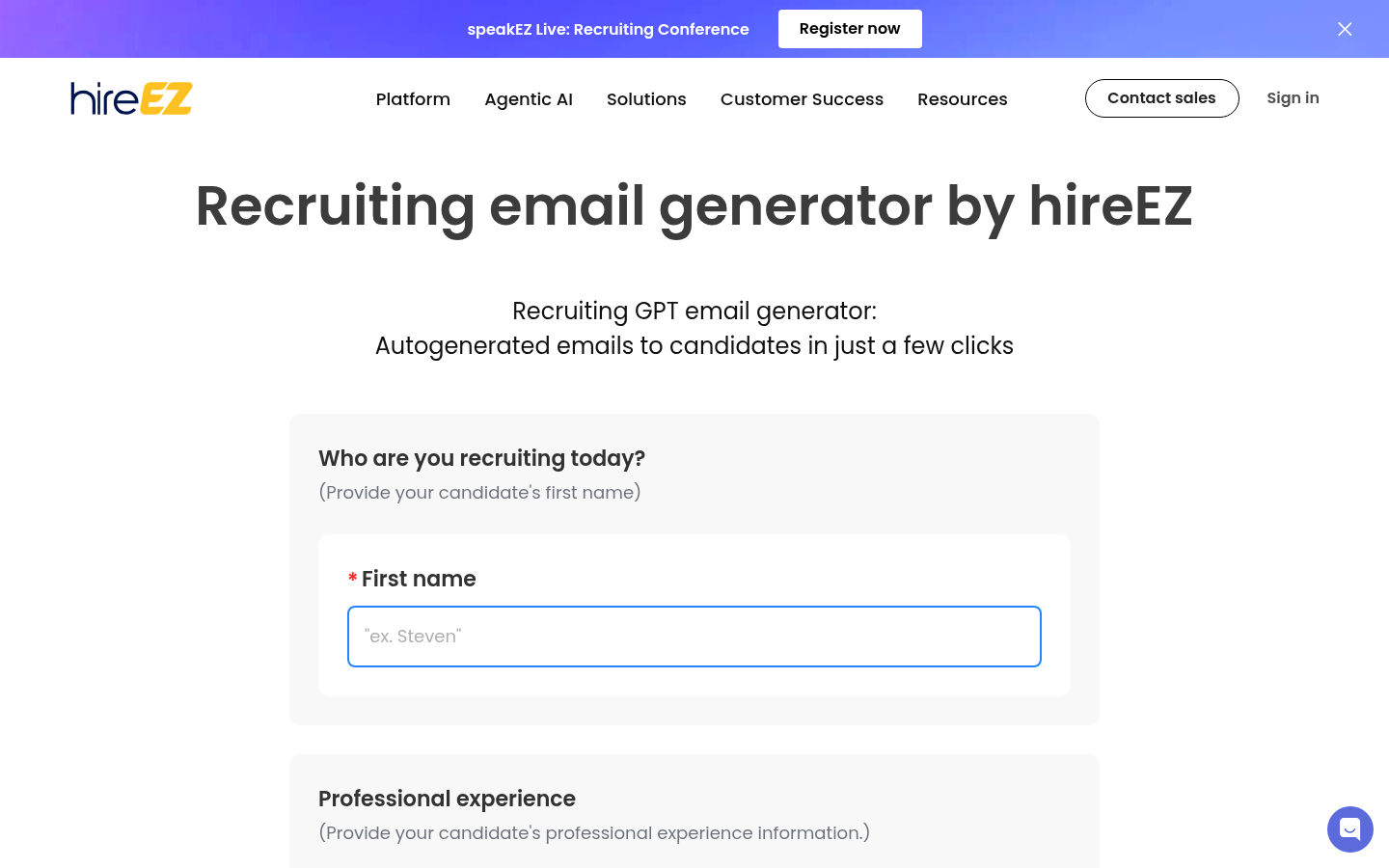
hireEZ helps teams find, evaluate, and engage potential candidates. It combines candidate discovery with contact enrichment, outreach automation, and pipeline management.
The platform is particularly useful for recruiters who want to expand search beyond LinkedIn and manage sourcing activity across different channels. Its AI capabilities help identify relevant candidates and reduce the manual work involved in building talent pipelines.
hireEZ also does candidate engagement, making it a useful option for teams that want sourcing and outreach capabilities in one platform.
Key features
- Multichannel candidate discovery: Search for candidates across professional networks and other online sources.
- AI matching: Identify potential candidates based on skills, experience, and hiring requirements.
- Contact enrichment: Find professional contact information to support outbound recruiting.
- Automated outreach: Create and manage candidate engagement campaigns.
- Recruiting integrations: Connect sourcing activity with existing ATS and recruiting workflows.
Limitations: Evaluate how much manual oversight is required to refine searches and manage outreach. For a complete AI recruiting platform, you may also need additional tools for screening and interview intelligence.
5. Juicebox: Conversational candidate search
Best for: Recruiters who want to find candidates using natural-language search instead of complex Boolean strings.
Juicebox is a people search platform built around conversational candidate discovery. Its PeopleGPT lets recruiters describe the candidates they're looking for in everyday language, then identifies profiles that match those requirements.
It’s particularly accessible to recruiters who want to move quickly from a hiring brief to a shortlist without detailed search queries.
Juicebox also supports candidate research and outreach workflows, helping teams move from identifying potential matches to engaging them.
Key features
- Natural-language candidate search: Describe ideal candidates conversationally instead of relying on Boolean search strings.
- AI-powered candidate matching: Find profiles based on experience, skills, and other hiring criteria.
- Candidate research: Explore professional backgrounds and relevant experience to assess potential matches.
- Outreach capabilities: Find contact information and support personalized candidate engagement.
- Search refinement: Adjust search requirements to improve the relevance of candidate recommendations.
Limitations: Recruiters looking for connected AI workflows across application review, screening, interviews, and hiring intelligence need a broader platform.
6. Findem: attribute-based talent intelligence
Best for: Enterprise recruiting teams that want deeper candidate intelligence and a more data-driven approach to talent discovery.

Findem is an AI talent acquisition platform that uses candidate attributes and professional signals to identify potential hires.
Rather than job titles, keywords, or self-reported skills, Findem uses candidate experience, employers, career progression, and professional accomplishments. This approach helps for complex searches where candidates need specific combinations of experience, or recruiters want to understand broader talent market trends.
Findem also offers candidate engagement and talent pipeline management, useful for organizations with sophisticated recruiting operations.
Key features
- Attribute-based candidate discovery: Identify candidates using detailed professional attributes and career signals.
- AI-powered matching: Evaluate potential candidates against complex hiring requirements.
- Talent intelligence: Analyze talent pools and professional backgrounds to inform sourcing strategies.
- Candidate rediscovery: Identify relevant candidates within existing talent databases.
- Recruiting workflow integration: Connect candidate intelligence with broader talent acquisition processes.
Limitations: Findem's emphasis on detailed talent intelligence may be more than most recruiting teams need. Compare its workflow capabilities with more agentic alternatives.
7. Gem: recruiting CRM and pipeline analytics
Best for: Combining AI sourcing with candidate relationship management and detailed pipeline reporting.
Gem is a recruiting platform that brings together candidate sourcing, CRM, outreach, and analytics. Discover talent, build relationships with potential candidates, and understand how sourcing activity contributes to hiring outcomes.
AI supports candidate discovery and engagement, while CRM tools help you maintain relationships with promising candidates over time.
Gem is particularly useful for larger talent acquisition teams that want greater visibility into sourcing performance, and a more structured approach to managing candidate pipelines.
Key features
- AI-powered sourcing: Discover and prioritize potential candidates based on hiring requirements.
- Recruiting CRM: Organize talent pools, manage candidate relationships, and nurture prospects over time.
- Outreach automation: Build personalized engagement campaigns and manage follow-ups.
- Recruiting analytics: Track sourcing activity, candidate engagement, and pipeline conversion rates.
- ATS integrations: Connect sourcing and CRM activity with existing applicant tracking systems.
Limitations: Broad recruiting CRM and analytics capabilities may be more than you need if your primary goal is candidate discovery. And you may already have a suitable CRM in place.
8. Fetcher: automated sourcing and outreach
Best for: Recruiting teams that want a steady flow of candidate recommendations without constantly running manual searches.
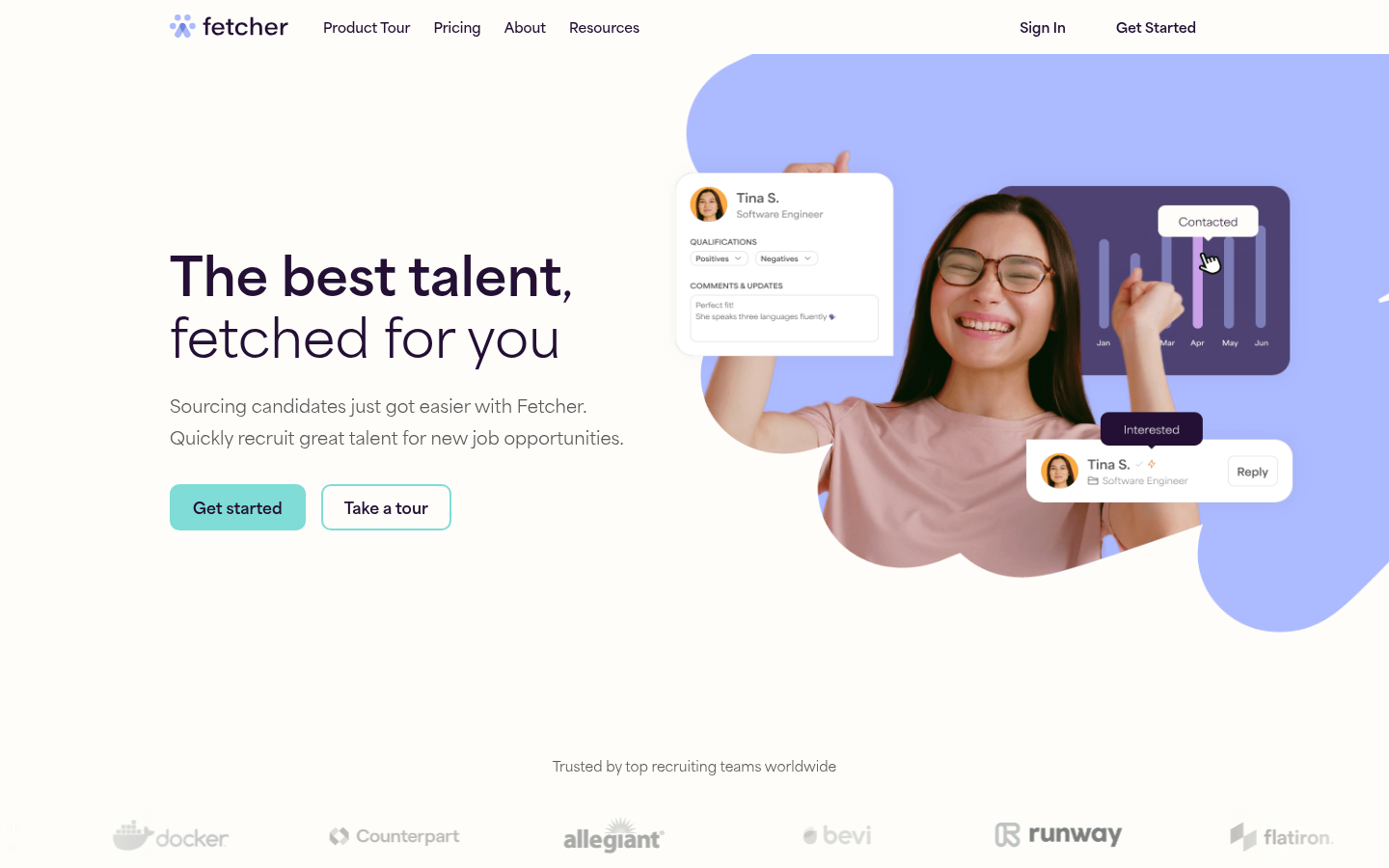
Fetcher combines AI candidate sourcing with automated outreach to help recruiters build and engage talent pipelines.
Rather than conducting every search yourself, Fetcher delivers candidate recommendations based on hiring requirements. You review the results and provide feedback to improve future recommendations.
The platform also supports email outreach and follow-up sequences, helping teams engage potential candidates without manually managing every interaction.
Key features
- Automated candidate discovery: Receive candidate recommendations based on role-specific requirements.
- Feedback-driven sourcing: Refine future recommendations by approving or rejecting suggested candidates.
- Candidate outreach: Create and manage personalized email campaigns.
- Automated follow ups: Maintain candidate engagement through scheduled outreach sequences.
- Recruiting integrations: Connect candidate sourcing and engagement with existing hiring systems.
Limitations: Fetcher focuses primarily on candidate sourcing and outbound engagement. For application review, screening interviews, or interview intelligence, you’ll need additional platforms.
9. AmazingHiring: developer and engineering sourcing
Best for: Technical recruiters looking for software engineers, developers, and other specialized technology professionals.
AmazingHiring is a talent platform focused on technical sourcing. It helps recruiters discover candidates by combining professional profiles with information from developer communities and other technical sources.
This gives recruiters a more complete view of candidates' technical backgrounds, including key skills and publicly visible projects.
AmazingHiring is particularly useful for recruiters filling hard-to-hire engineering roles, where technical experience matters more than a job title.
Key features
- Technical candidate discovery: Find developers and engineers across professional and technical platforms.
- Aggregated candidate profiles: Combine information from multiple sources to build a more complete view of technical experience.
- Developer community insights: Explore publicly available technical projects and professional activity.
- Advanced candidate search: Identify talent based on technical skills, experience, and other specialized criteria.
- Contact discovery: Find professional contact information to support candidate outreach.
Limitations: Teams recruiting across a wide range of business functions may prefer a general-purpose AI sourcing platform with broader workflow automation.
10. Loxo: for recruiting agencies that want sourcing and CRM together
Best for: Staffing agencies and recruiting teams that want AI sourcing, candidate relationship management, and applicant tracking in one platform.
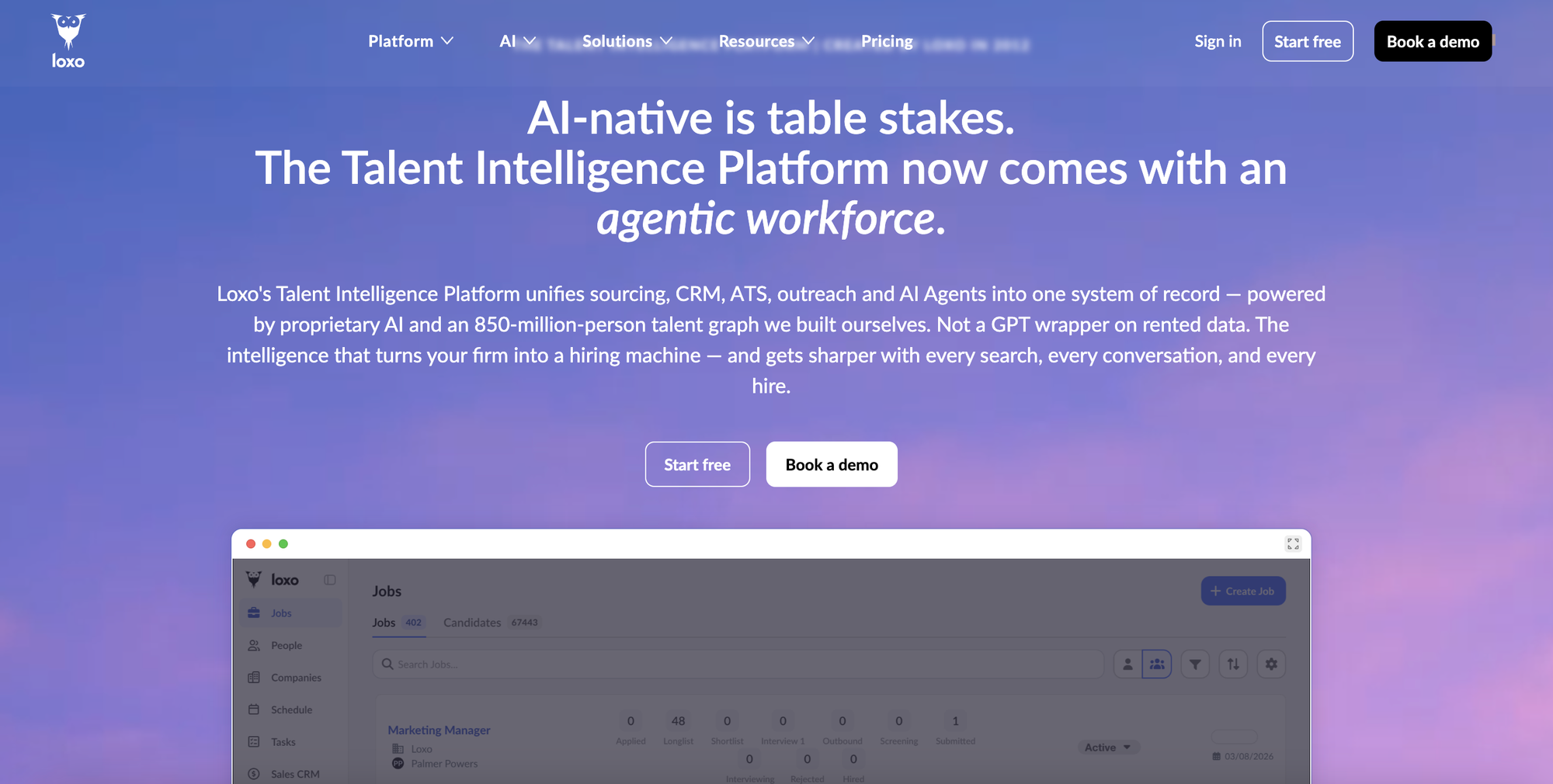
Loxo combines candidate sourcing, CRM, ATS, and outreach automation. It's particularly suited to recruiting agencies that want to manage candidate discovery and client hiring workflows without switching between tools.
AI sourcing identifies candidates based on hiring requirements, while the talent database and contact information support outbound engagement.
Loxo also includes pipeline management and recruiting automation, making it a broader operational platform rather than a standalone sourcing tool.
Key features
- AI-powered candidate sourcing: Discover potential candidates using AI-assisted search and matching.
- Talent database: Search a large database of professional profiles and candidate information.
- Integrated ATS and CRM: Manage candidate relationships, hiring pipelines, and recruiting workflows in one system.
- Contact discovery: Access professional contact information to support candidate engagement.
- Outreach automation: Create and manage candidate communication campaigns.
Limitations: Teams already committed to an ATS or CRM should assess whether its broader capabilities would duplicate existing systems.
How we selected these AI sourcing tools
We selected these platforms based on their candidate discovery capabilities, AI-powered matching, sourcing automation, recruiting integrations, and suitability for different hiring teams.
We also considered how each platform supports the broader sourcing workflow, from identifying potential candidates to engaging them and measuring results.
This guide is published by Metaview, which offers two of the products featured: Metaview Sourcing and fillmore. Our recommendations reflect our assessment of each platform's capabilities and intended use cases, rather than independent hands-on testing of every product.
How to choose the best AI sourcing tool
The right AI sourcing platform depends on your hiring challenges, existing technology, and how much of the sourcing process you want to automate.
Here are five factors to consider before making a decision.
Candidate discovery and matching quality
Look for tools that evaluate candidates against detailed hiring requirements, including relevant experience, projects, and career progression. Platforms that learn from recruiter feedback can also improve recommendation quality over time.
Automation depth
Some AI sourcing tools help recruiters search faster. Others can independently discover candidates, evaluate their suitability, research their backgrounds, and manage outreach.
If your team spends most of its time moving candidates between disconnected workflows, more autonomous agents may deliver greater value.
ATS and CRM integration
Look for integrations that let recruiters search existing candidate records, rediscover overlooked talent, and synchronize information without manual data entry. This helps prevent duplicate records and keeps candidate context available throughout the hiring process.
Recruiter control and transparency
Prioritize tools that explain why candidates match your requirements, let recruiters refine hiring criteria, and provide appropriate oversight of automated actions. This becomes particularly important when agents are contacting candidates on your behalf.
Pricing and return on investment
AI sourcing platforms use different pricing models, including subscriptions, per-seat fees, and usage-based charges.
Compare total costs against the work each platform eliminates. Time saved, shortlist quality, candidate response rates, and interview conversions are more meaningful measures of value than the number of profiles a tool can search.
AI sourcing tools vs. autonomous recruiting agents
Traditional AI sourcing tools primarily help recruiters find and evaluate candidates faster. AI sourcing agents can take greater ownership of discovery and qualification, while autonomous recruiting agents extend automation into outreach and scheduling.
| Capability | AI search tools | AI sourcing agents | Autonomous recruiting agents |
|---|---|---|---|
| Natural-language candidate search | Yes | Yes | Yes |
| AI candidate evaluation | Varies | Yes | Yes |
| Feedback-driven calibration | Varies | Often | Often |
| Continuous candidate discovery | Limited | Yes | Yes |
| Personalized outreach | Varies | Varies | Yes |
| Automated follow-ups | Usually separate | Varies | Yes |
| Interview scheduling | Usually separate | Varies | Yes |
For example, Juicebox makes it easier to discover candidates through natural-language searches. Metaview's AI sourcing agents go further by learning from recruiter feedback and refining candidate recommendations.
fillmore by Metaview automates the entire outbound process, from candidate research and personalized outreach to follow-ups and booked introductory calls.
Making individual sourcing tasks faster isn't the same as eliminating the manual work between those tasks.
Choose AI sourcing tools that improve hiring outcomes
The best AI sourcing tools don't just help recruiters find more candidates. They help teams identify better matches, reduce manual work, and turn promising profiles into meaningful conversations.
For some teams, a specialized search platform or recruiting CRM will be enough. Others will benefit from AI agents that learn their hiring preferences and automate more of the sourcing process.
Metaview brings these capabilities together, with AI sourcing agents that continuously refine candidate recommendations and connect sourcing with screening, interviews, and the wider hiring process. And with fillmore, teams can automate outbound recruiting all the way through to booked calls.
AI sourcing tools FAQs
What is the best AI sourcing tool for recruiters?
The best tool depends on your hiring needs. Metaview is a strong choice for teams seeking AI sourcing connected to screening and interviews, while SeekOut and AmazingHiring specialize in technical talent discovery.
Juicebox focuses on conversational candidate search, and fillmore is best for autonomous outbound recruiting.
How are AI sourcing tools different from LinkedIn Recruiter?
LinkedIn Recruiter primarily helps recruiters search and engage candidates within LinkedIn's professional network. AI sourcing tools can search across multiple sources, interpret natural-language hiring requirements, and evaluate candidates against more detailed criteria. Some also learn from recruiter feedback and automate outreach.
Can AI sourcing tools find passive candidates?
Yes. Many AI sourcing platforms search professional profiles, technical communities, and other public sources to identify people who aren't actively applying for jobs. Some tools also provide contact information and outreach capabilities to help recruiters engage these candidates.
Are there free AI sourcing tools?
Some AI sourcing platforms offer free trials or limited free plans, but advanced capabilities such as large-scale candidate discovery, contact enrichment, and automated outreach typically require paid subscriptions. Recruiters should compare usage limits, candidate data access, and integration capabilities before choosing a free option.
Can AI sourcing tools automate candidate outreach?
Yes. Platforms such as hireEZ, Gem, and Fetcher offer outreach automation alongside sourcing capabilities. More autonomous tools like fillmore by Metaview can also research candidates, generate personalized messages, manage follow-ups, and schedule introductory calls with configurable recruiter oversight.
How much do AI sourcing tools cost?
Pricing varies by platform, team size, and features. Some providers offer self-service subscriptions, while enterprise platforms often use custom pricing based on seats, usage, or recruiting requirements.
Compare the total cost with the recruiter time saved and the quality of candidates progressing through your pipeline.
