
Applications are up 3x since 2022. Recs per recruiter are up 55%. Time-to-fill is up 8 days. That is how Steve Bartel framed the 2025 recruiting load on a recent Metaview podcast, and the math is now a structural problem: the median open req takes about eight days longer to close than it did three years ago, and the headcount answering for it has not moved.
But those eight days do not sit where most TTF articles say they do. Sourcing speed has not regressed. Application volume has not collapsed. The drag has crept into the soft tissue of the loop, in the gap between a final-round interview ending and a scorecard landing, and in the gap between a scorecard landing and a hiring manager being ready to debrief. Jordan Mazer, who runs talent at the a16z speedrun program, frames it from the other side: companies that treat hiring as a cost try to minimize the time it takes; companies that treat it as an investment build systems and expectations around doing it well. Both frames point at the same lever. The compression that matters is administrative latency, not interview rigor.
This is a feedback-loop problem dressed up as a hiring-process problem. Time-to-fill is not five stages of generic friction. It is two stages where most of the variance lives: capture and scorecard turnaround. Customers running Metaview report 20 to 40% time-to-fill compression once those two windows collapse from days to minutes. That happens because the lift is not “make recruiters faster.” It is “remove the wait between a conversation finishing and a decision being makeable.” Everything below is what that looks like in practice.
Time-to-fill vs. time-to-hire (and what executives actually care about).
Time-to-fill is the number of days from job requisition approval to offer acceptance. Time-to-hire is narrower: it measures the candidate’s journey from entering the pipeline to accepting an offer.
A simple example: if a requisition opens January 1, the candidate applies January 15, and the offer is accepted February 15, time-to-fill is 45 days and time-to-hire is 31 days. The 14-day gap is the requisition-to-candidate window. Time-to-hire is the candidate’s clock. Time-to-fill is the org’s clock.
Executives anchor on the second one. Time-to-fill is the metric that lands on the operating review, because it reflects how fast the business can respond to a talent need. Recruiters track time-to-hire because it isolates pipeline efficiency from upstream noise. Both numbers matter, but only one of them moves business decisions, and that is the longer one.
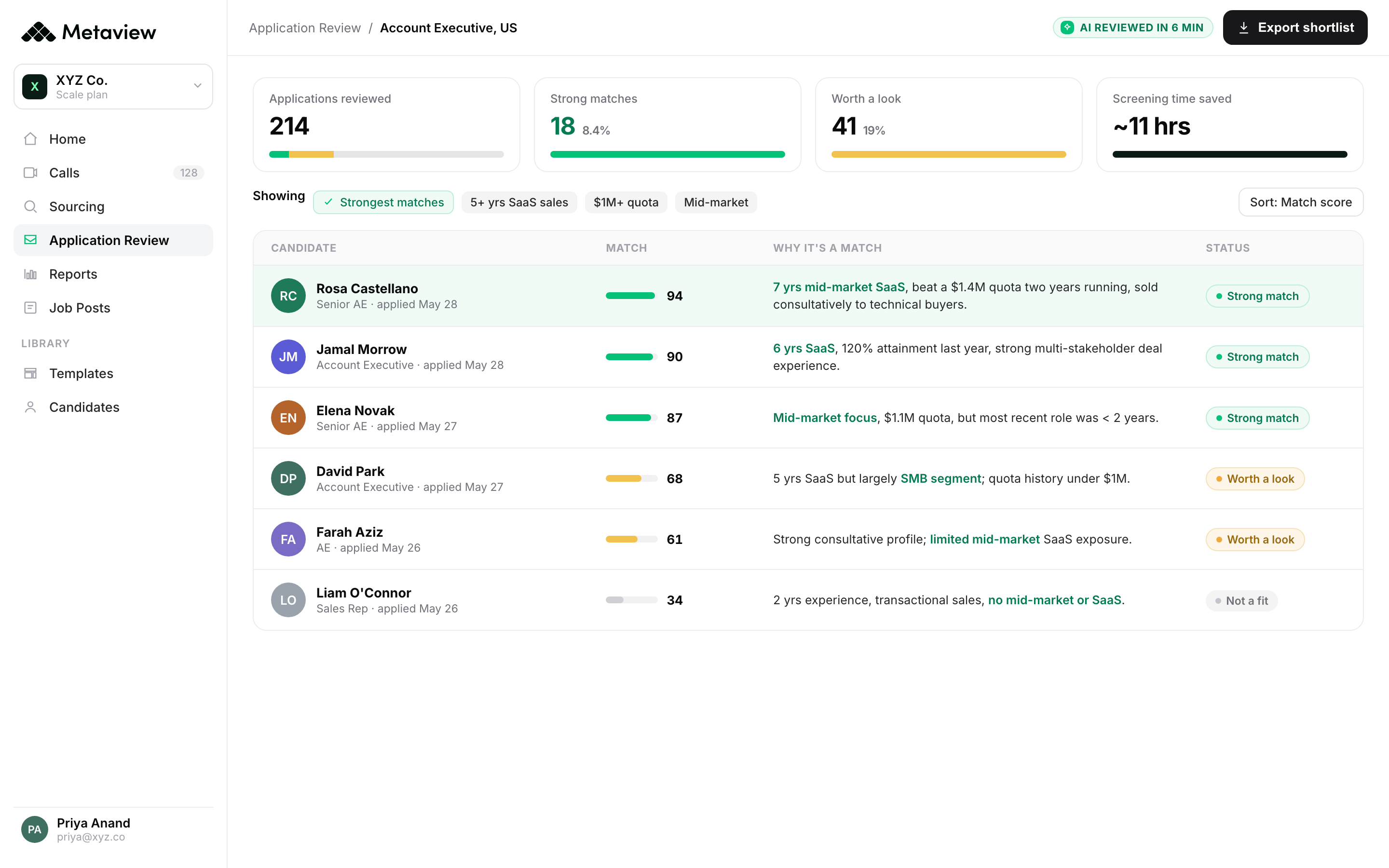
A high time-to-fill is rarely a sourcing problem. According to Metaview’s 2026 AI & Hiring Alignment Report - surveying 505 recruiting leaders and hiring managers across North America and EMEA - 67% of teams lose qualified candidates to faster-moving competitors every month. That number lives in the back half of the funnel, not the front. The candidates are arriving. The decision velocity is not keeping up.
Applications are up 3x compared to 2021 to 2022. More than 20% of our customers get thousands of applicants for a single role. Recs per recruiter is up 55%, and time-to-fill is up 8 days. It’s a perfect storm, recruiting teams are completely underwater.”

Where the days actually go.
Most TTF posts list the same six sources of drag as a flat bullet list. That is structurally accurate but operationally useless. Here is the same breakdown, ordered by where the variance actually lives, and with what each one costs in days for a typical individual contributor search.
1. Unclear or stale job descriptions (1 to 3 days).
The job description is the first artifact every downstream stage trusts. If it is generic, sourcing pulls the wrong shape of candidate, screens spend 20 minutes finding out the candidate does not match, and the loop restarts. The cost looks like a sourcing problem, but it is an intake problem.
2. Misaligned intake (2 to 4 days).
A misaligned intake meeting is the single most expensive 60-minute window in the entire process. If the recruiter leaves intake with a different mental model than the hiring manager, the first three or four candidates will fail at the hiring manager screen for reasons no one wrote down. Those failed screens get counted as “candidate quality” and the loop tightens its filters in the wrong direction.
3. Slow scheduling and the back-and-forth tax (1 to 3 days per round).
The classic visible drag. Every round that lives in email threads adds 1 to 3 days. Calendar coordination tools have reduced this from “weeks” to “days,” but it is still the most pageable part of the visible loop, which is why it tends to get blamed for the parts it is not actually responsible for.
4. Inconsistent evaluations (3 to 7 days).
This is where most of the hidden TTF lives. If three interviewers write up three different freeform scorecards on three different timelines, the debrief slips. The debrief slip cascades into the next round, which delays the next decision, which delays the offer. None of it shows up on the dashboard as a single big lag. It shows up as everything taking a little longer than it should.
5. Slow scorecard turnaround (2 to 3 days every round, every candidate).
The compounding one. A scorecard that lands 48 hours after the interview means the panel walks into the debrief with stale memory and a tendency to defer the decision. Multiply by 4 rounds. Multiply by 6 candidates per role. The number gets big quickly. This is the stage the auditor’s angle was pointing at, and it is the stage Metaview compresses hardest.
6. Offer-stage approvals (1 to 5 days).
Internal approvals, compensation banding, recruiter-to-candidate handshakes. This is the only stage where the bottleneck is human and the right answer might be “it should take a day or two.” The compression here is mostly process discipline, not tooling.
The two stages that actually compress.
Five of the six stages compress modestly with normal process discipline. Two of them, capture and scorecard turnaround, compress dramatically when the work shifts from “after the call” to “during the call.” This is the operating thesis of Metaview’s product, and the auditor’s angle that motivated this revamp.
Capture means structured interview notes generated as the conversation happens. Not “summarized after the meeting from a transcript dump.” Generated during, against the role’s competency map, with the interviewer’s attention free to actually listen and probe.
Scorecard turnaround is what that capture unlocks. Because structured notes already exist when the interview ends, the scorecard is not a 30-minute creative writing assignment that a tired interviewer punts to tomorrow. It is a 90-second review-and-submit on a pre-populated draft.
The 8-day TTF gap Bartel named is, mathematically, mostly these two windows. The math: 4 rounds times 6 active candidates times 2-day scorecard lag is a process that runs 8 to 14 days slower than it has to. When the lag falls to under an hour, the math collapses. This is also why “do better intake” or “add more interviewers” never moves the dial. The bottleneck is not capacity. It is the wait between conversations and decisions.
Without auto-scorecards vs. with: the binary that matters.
The contrast that runs the cycle is not Manual vs. AI. It is whether the structured scorecard exists by the time the interview ends, or three days later. Same interviewers, same candidates, completely different TTF curve.
- Scorecards trickle in 24 to 72 hours after the interview, sometimes longer.
- Interviewers reconstruct the call from memory and a few sentences of typed notes.
- Debriefs slip 3 to 5 days because one panelist’s scorecard is “coming Monday.”
- Best candidates churn to competitors who moved while the panel was still writing.
- Notes are captured live and structured by competency during the conversation.
- Scorecard autofills within minutes of the call ending, ready for 90-second review.
- Debriefs happen the same week, sometimes the same day. Decision velocity goes up.
- Time-to-fill compresses 20 to 40% on the same headcount, same interview rigor.
The four levers Metaview pulls (and the video proof).
The interview-intelligence layer compresses the two stages above through four product surfaces. Not “AI features.” Specific levers, each tied to a sub-stage of the loop.
What this looks like at scale: Deel hires more than 3,000 people a year through Metaview. The team walked through what that velocity actually requires on the 10x Recruiting podcast, including how the scorecard-tracking workflow keeps the loop from stalling.
What customers running this play are seeing.
Three patterns show up across customer cohorts running this play.
The first is the obvious one. Scorecard turnaround collapses from 48 to 72 hours to under an hour. The next round gets scheduled before the candidate has left their inbox. Debriefs happen the same week the interviews did, not the next sprint.
The second is the relationship pattern. The 2026 Alignment Report finds that teams using AI in hiring are 3.8x more likely to rate their cross-functional working relationship excellent. That is not a softer signal than time-to-fill: relationship quality is the leading indicator that predicts whether a team will compress its loop at all, because the cost of poor TTF is paid in disagreements that never get resolved on time.
Hiring managers now see our recruiting team as strategic partners rather than people filling roles. When a hire takes longer than expected, everyone understands why, based on the data, which builds trust and sets appropriate expectations.”

The third pattern is what changes downstream when a single recruiter adopts the workflow. Nolan Church, who hosts the 10x Recruiting podcast and runs the workflow himself, talked through his own time savings on a solo episode. The numbers are concrete enough to put in a card.

The 7-day audit (where to start tomorrow).
You do not need a tool to find your TTF compression. You need an honest measurement of where the wait actually is. Here is a one-week sequence a TA leader can run before adding any new software to the stack.
- Day 1. Pull every interview that happened in the past 14 days. For each, find the timestamp the scorecard was submitted. Plot the gap. The distribution will tell you where the eight days went.
- Day 2. Identify the top 3 interviewers by scorecard lag. Talk to them. They are not bad interviewers. They are the ones whose calendars protect interview time but not write-up time.
- Day 3. For every active candidate, find the next scheduled debrief. Count how many scorecards are still outstanding for that debrief. Anything over 30% outstanding is the reason that debrief will slip.
- Day 4. Look at last quarter’s offer accepts. For each, find the time between final interview and offer extended. That number is your TTF compression ceiling for any process improvement that does not change interview quality.
- Day 5. Walk through the hiring manager screen for the last 10 candidates who failed it. Read the rejection reason. If four or more cite “fit” or “alignment” without specifics, the bottleneck is upstream, in intake, not downstream in the loop.
- Day 6. Talk to your top 3 hiring managers. Ask the single question: “What is the longest you have waited for a recruiter scorecard?” The honest answers are the gap you are paying for.
- Day 7. Now decide what to fix. Capture and scorecard turnaround are the two highest-yield levers in nearly every case. The audit just told you which one is bigger for your loop specifically.
 Siadhal Magos
Bring Metaview into your hiring stack.
Live notes, structured scorecards, and ATS sync - set up in under 10 minutes.
Frequently asked.
What is the difference between time-to-fill and time-to-hire?
Time-to-fill measures the org’s clock: the days from job requisition approval to offer acceptance. Time-to-hire is narrower: it measures the days from a candidate entering the pipeline to that same offer acceptance. Time-to-fill includes the requisition-to-candidate window; time-to-hire does not. Executives anchor on time-to-fill because it reflects how fast the business can respond to a talent need.
What is a good benchmark for time-to-fill in 2026?
Most published industry benchmarks land between 30 and 45 days for individual contributor roles, and longer for senior or technical searches. The honest answer is that benchmarks are less useful than your own quarter-over-quarter trend. The Bartel benchmark (an 8-day TTF increase between 2021 and 2024) is a more useful frame, because it isolates the recent administrative drag from underlying role complexity.
Which stages drag time-to-fill the most?
Five of the six commonly cited TTF stages compress modestly. Two compress dramatically when restructured: capture (the interview itself, when notes are generated live rather than after) and scorecard turnaround (the gap between the conversation ending and structured feedback being submitted). The compounding nature of scorecard lag is why it shows up bigger than any single stage’s average.
Does AI in hiring make time-to-fill faster or slower?
Both, depending on where it is applied. AI applied to top-of-funnel volume (application review, sourcing) speeds up triage without compressing the back half of the funnel where most TTF variance lives. AI applied to capture and scorecard turnaround is where the structural compression happens. Per the 2026 AI & Hiring Alignment Report, teams that put AI at the core of hiring are 3.8x more likely to rate their cross-functional relationship as excellent, which is itself a leading indicator of TTF compression.
How does Metaview compress the interview and feedback stages specifically?
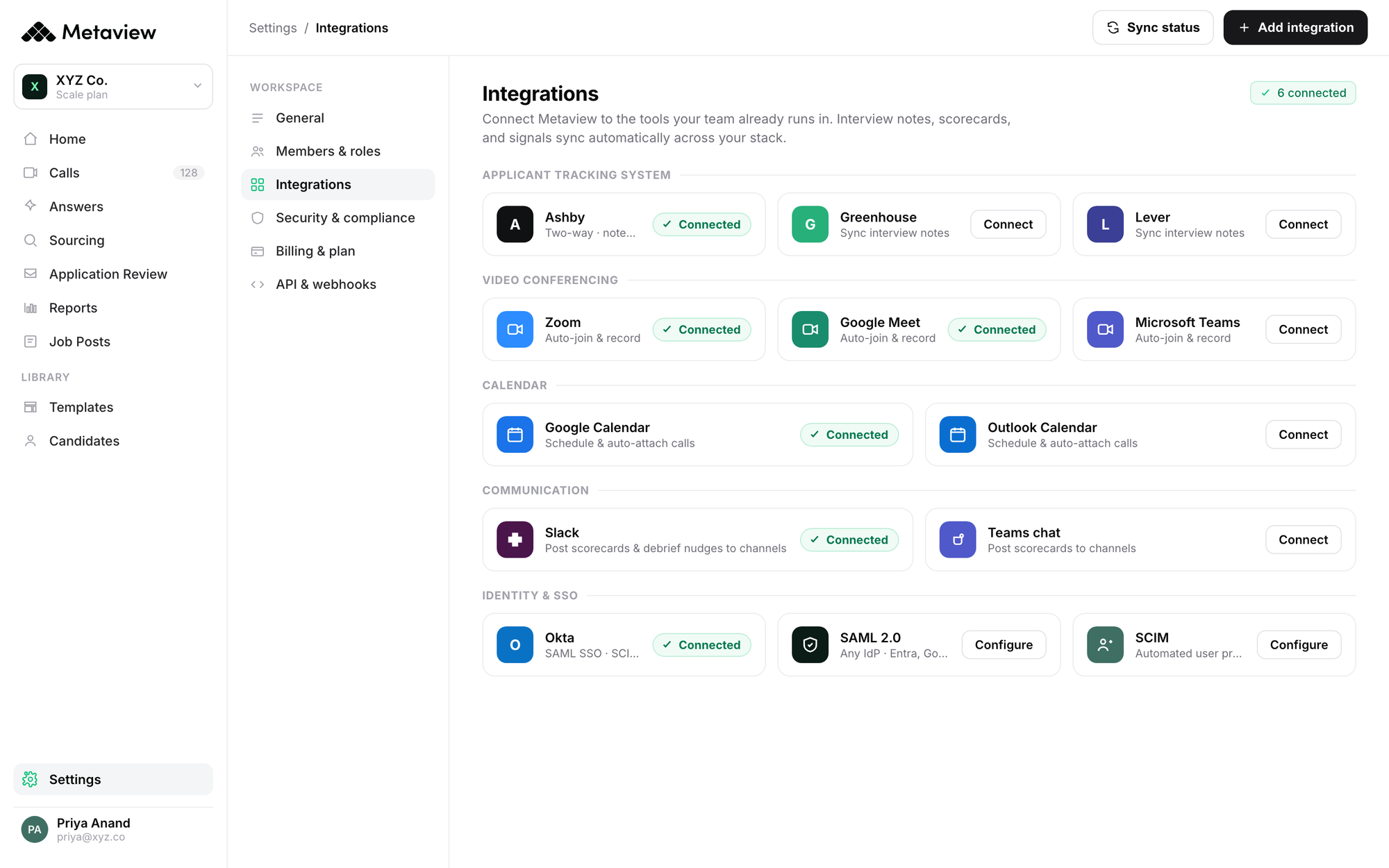
Through four product surfaces: live structured capture during the call, scorecard autofill from that capture, cross-panel Multi-Source AI Notes that synthesize across every conversation a candidate has had, and ATS sync that delivers all of it back into Ashby, Greenhouse, Lever, Workday, SmartRecruiters, Workable, or Teamtailor. The combined effect on customer cohorts is a 20 to 40% time-to-fill reduction.
Should time-to-fill always be minimized?
No. The right TTF for a given role is whatever produces a confident, durable hire fastest. The compression that holds is in administrative latency (capture, scorecard turnaround, ATS sync), not in evaluation rigor. Cutting interview stages or lowering the hiring bar will reduce TTF on this quarter’s dashboard and increase attrition and replacement-hire load next quarter.
