
Most recruiting teams have plenty of hiring data. Almost none of them can answer the questions that actually matter.
Every job post, application, interview, and offer generates information that should reveal how well your hiring process is working.
The problem is where the data sits. Scattered across the ATS, buried in recruiter notes, locked inside interview transcripts nobody re-watches.
That's where recruitment analytics tools come in. The right one turns the noise into a signal you can actually act on.
Here are the six recruitment analytics tools worth knowing right now: what they do, what the data layer underneath them actually reveals, and where each one falls short.
All six tools at a glance.
| Tool | Best for | Data source | Free tier |
|---|---|---|---|
| Metaview | Interview-conversation analytics | Captured interview data, ATS records | Free with work email |
| LinkedIn Talent Insights | Labor-market and sourcing analytics | LinkedIn member graph | None (enterprise only) |
| Greenhouse Recruiting Analytics | Funnel reporting inside the ATS | Greenhouse ATS data | Bundled with Greenhouse |
| HireVue | High-volume async video screening | Video and assessment scores | None (demo only) |
| Eightfold AI | Workforce planning and skills matching | Candidate, employee, and skills graph | None (enterprise only) |
| Tableau | Custom dashboards across HR data | Whatever you can connect | Free trial only |
1. Metaview.
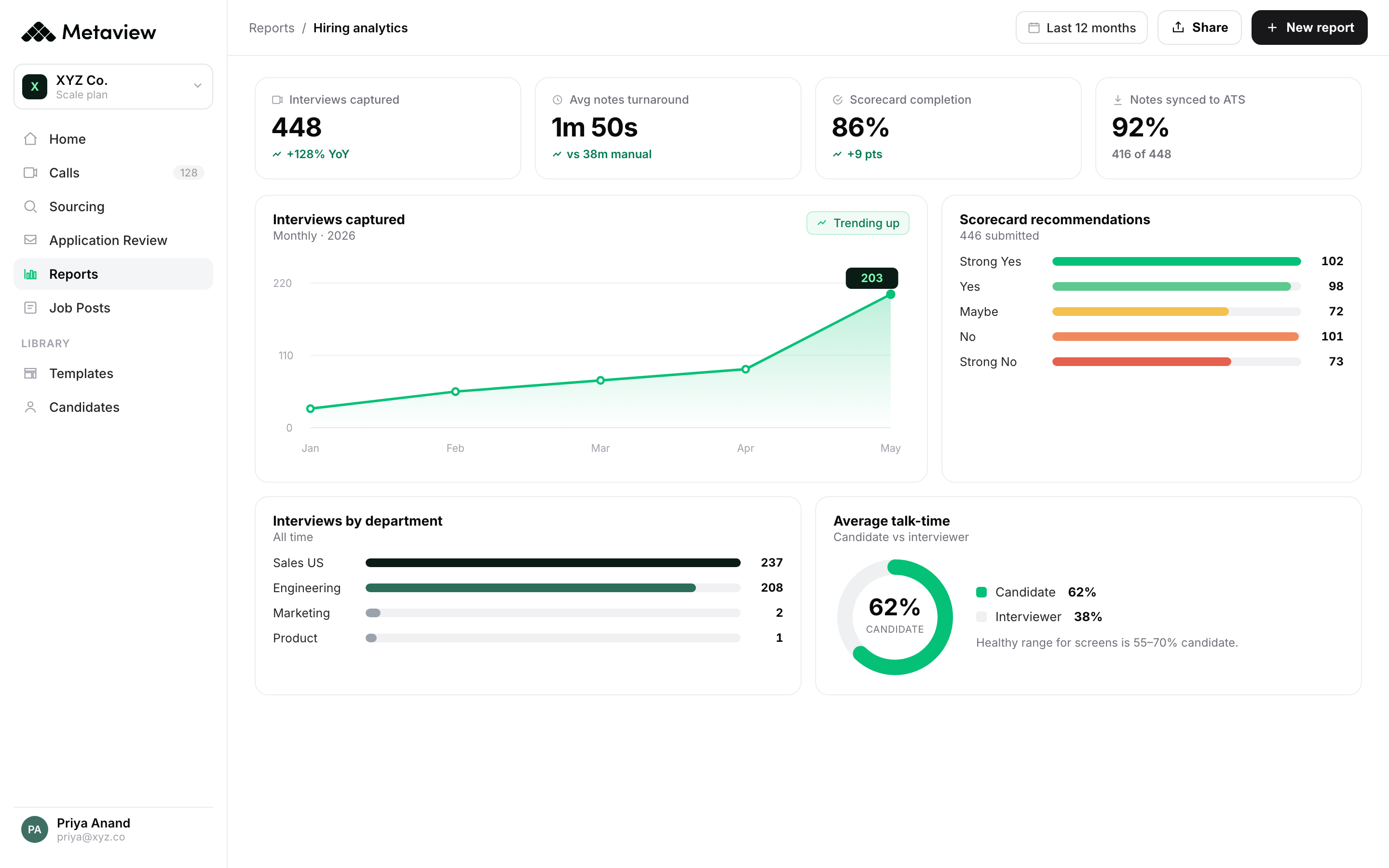
Metaview is the only platform on this list built for analyzing interview conversations, not just stage data.
It captures every interview, transcribes in 50+ languages, structures every answer against a competency rubric, and pushes the result back to your ATS as a scorecard.
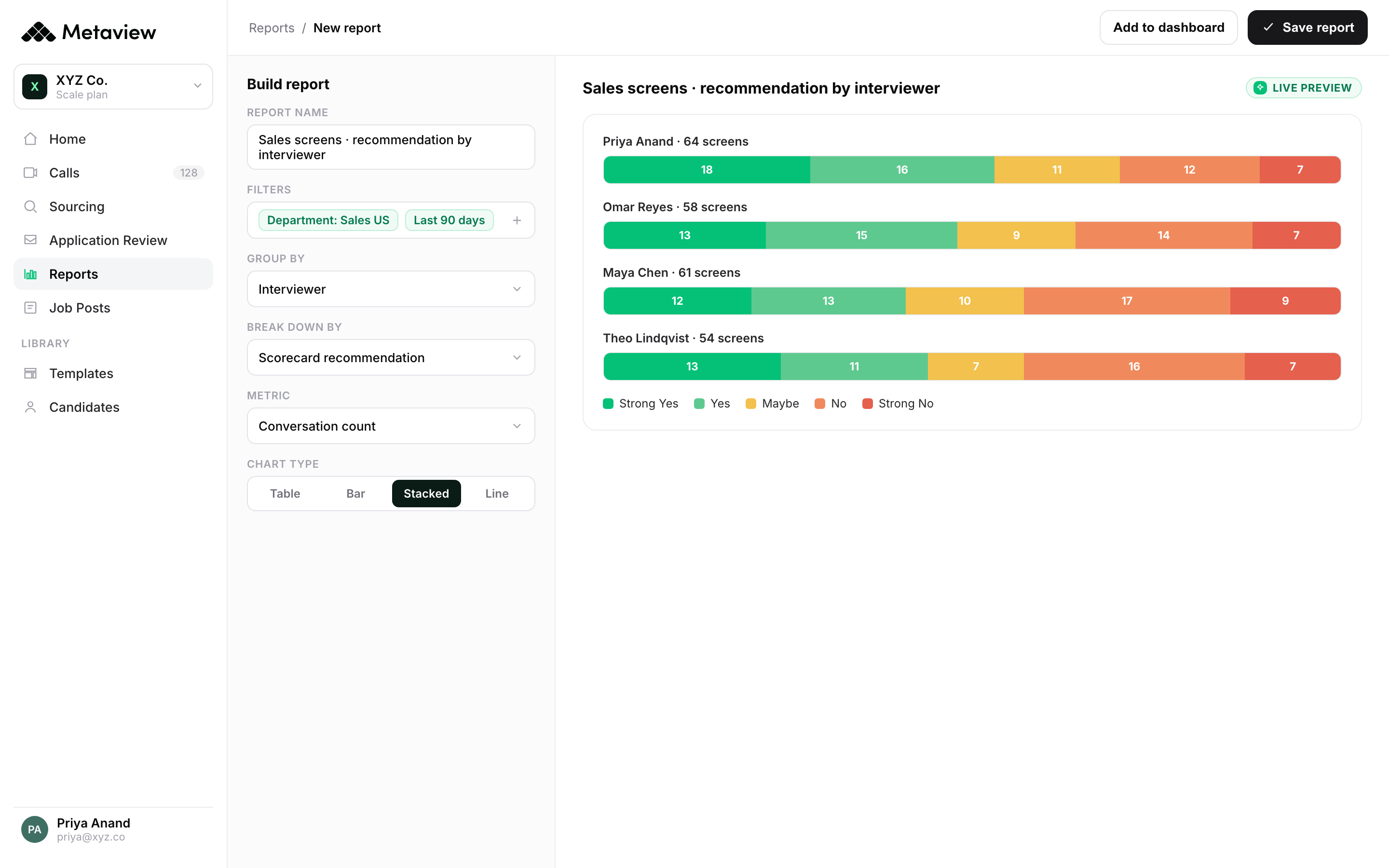
The analytics layer on top means you can ask the questions you actually care about. "Which AE candidates in the past 3 months discussed deals over $100K?" Or "Which engineers in our current pipeline mentioned interviewing with other companies?"
What you get on day one:
- Structured interview notes mapped to your competency rubric, not a plain meeting summary.
- AI Reports: a customizable engine to track interviewer effectiveness, time-in-stage by competency, and quality-of-hire signals.
- AI Filters: natural-language query across every captured interview.
- Native ATS integration with Greenhouse, Ashby, Lever, Workday, and 60+ others. See our ATS integrations roundup for the full list.
- Free to sign up with a work email.
Recruiters save 20 minutes per interview on notes and scorecards. Per month, that's 53 hours saved across the team.”

Where it falls short: Metaview only does recruiting. If you also want to analyze sales calls or product meetings on the same platform, this isn't it. The value lands when interviews are the data you most need to understand.
Our pick: recruiting teams running 50+ hires per year who want to understand what was said in the room, not just what stage candidates moved through.
2. LinkedIn Talent Insights.
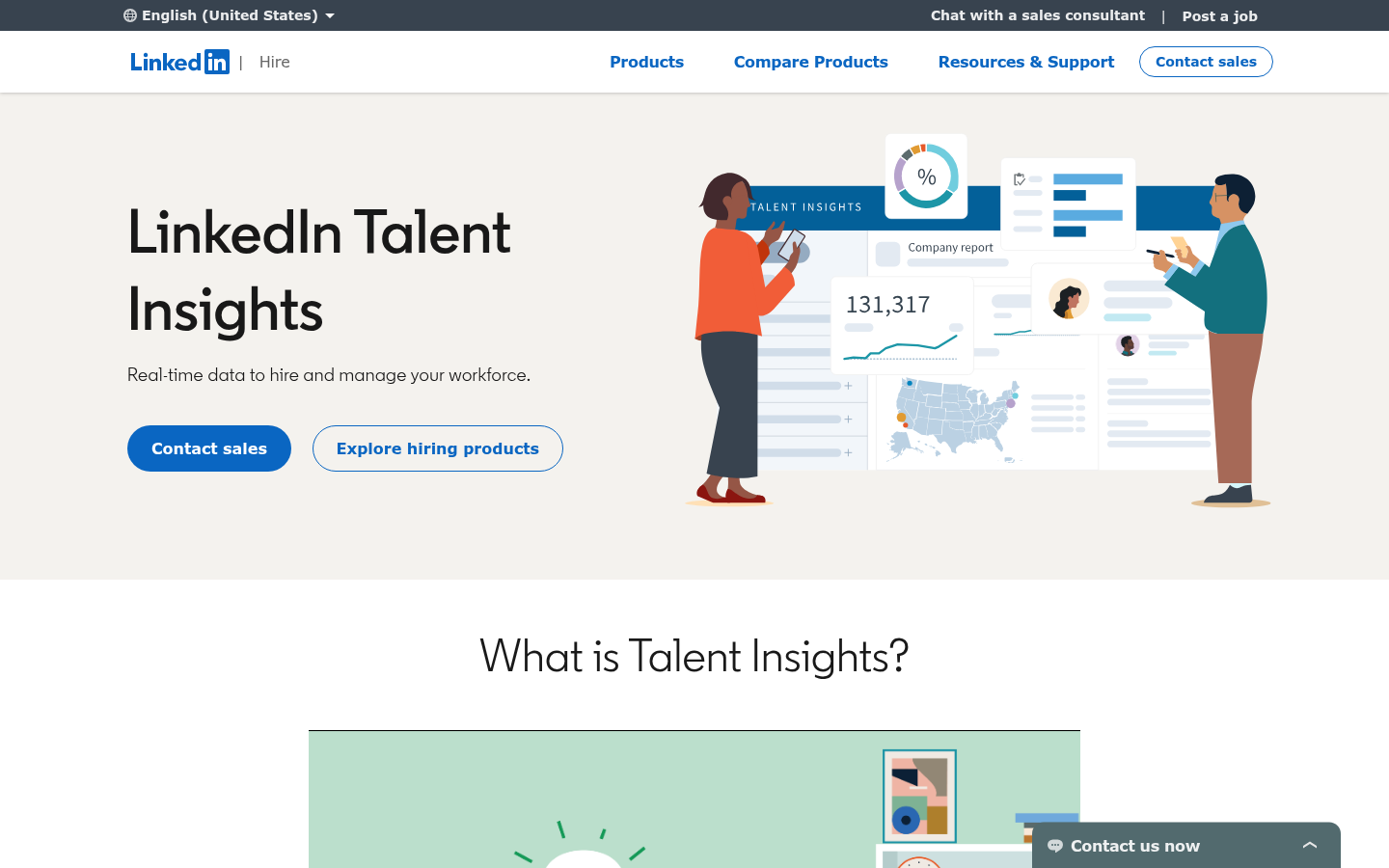
LinkedIn Talent Insights is the labor-market analytics layer on top of LinkedIn's 1B+ member graph.
It answers a different question to every other tool on this list. Not "how is my pipeline moving?" but "where is the talent I need actually located, what are competitors paying, and how is supply shifting?"
What it covers:
- Talent Pool reports: where engineers (or any role) cluster geographically.
- Company reports: who's hiring whom, attrition signals, talent migration patterns.
- Compensation benchmarking across roles, regions, and industries.
- Diversity-of-supply analysis when planning where to source.
Where it falls short: Pricing is enterprise-only and opaque (typically $30K+ per year). The data is all about external supply; it does nothing for analyzing your own interview pipeline.
Our pick: TA leaders doing strategic workforce planning at scale. Not the right tool if your bottleneck is the conversation in the room, not the pool outside it.
3. Greenhouse Recruiting Analytics.
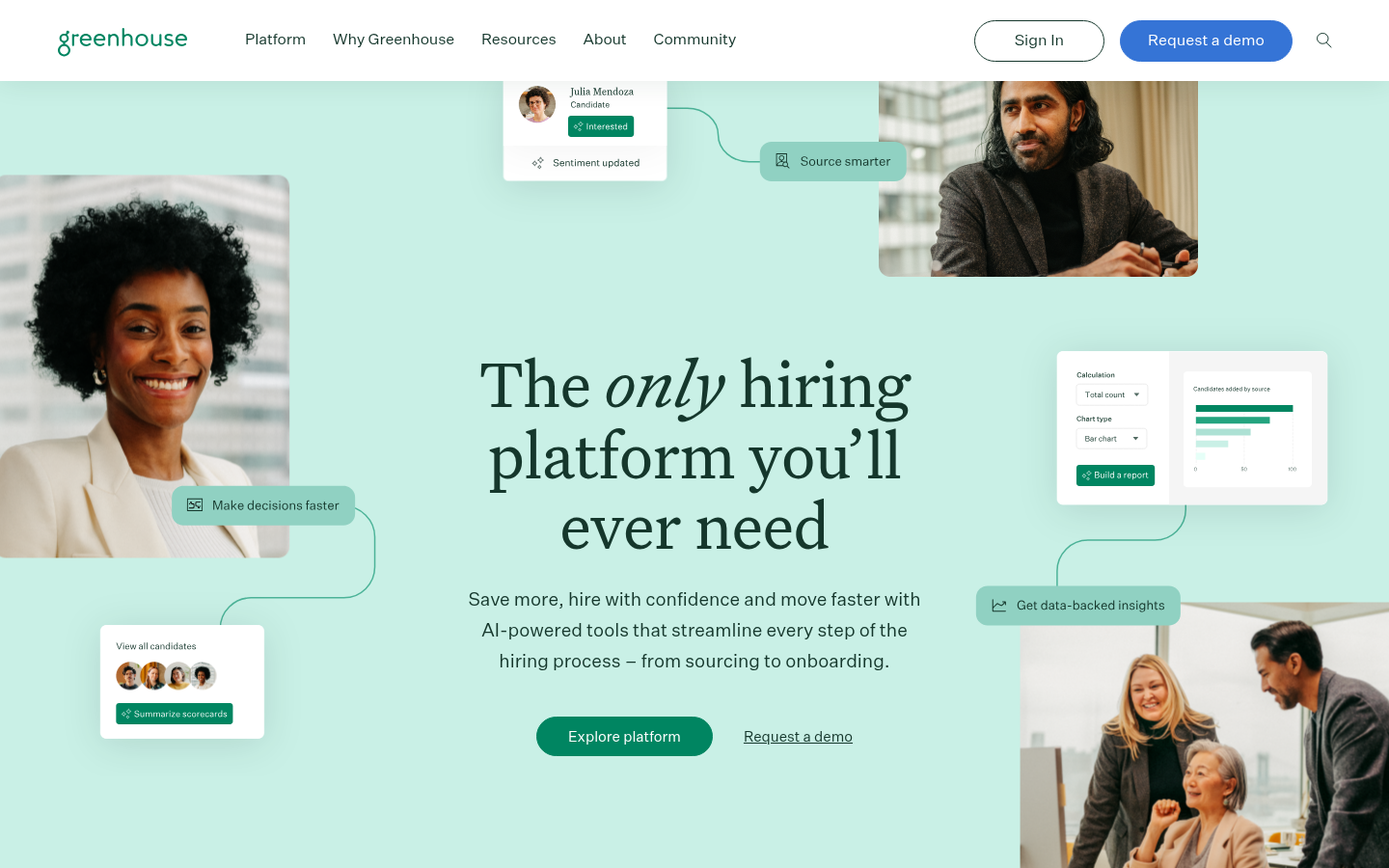
Greenhouse's built-in analytics is the default for any team already running on the platform.
It covers the obvious things well. Pipeline conversion rates, time-in-stage, source-of-hire, offer-acceptance rates, hiring-manager throughput. Standard funnel reporting, but tied directly to the system of record so the numbers stay current.
What it covers:
- Real-time funnel dashboards across every open req.
- Source-of-hire attribution with credit splitting between channels.
- Time-in-stage by hiring manager, recruiter, and role family.
- Insights Plus tier adds custom report builder, predictive forecasting, and a Tableau-style explorer.
Where it falls short: Stage data only. Greenhouse Insights doesn't know what was said in any interview. If the question you're trying to answer is "why are top candidates falling out at the technical screen?", the stage report tells you that they fell out, not why.
Our pick: any team already on Greenhouse. Insights Plus for teams over 200 hires a year who need custom funnel reporting. Pair with Metaview for the conversation-content layer.
4. HireVue.
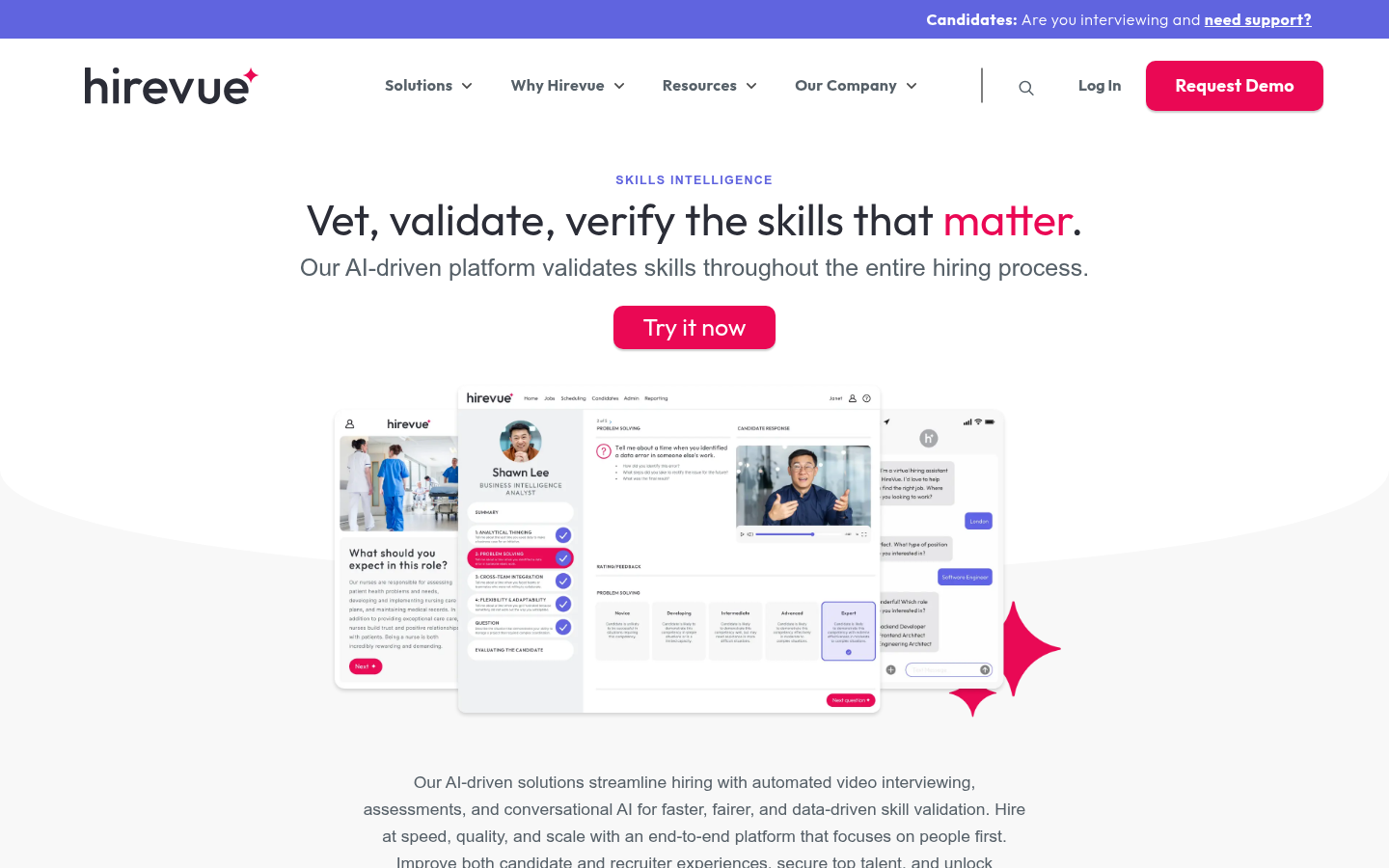
HireVue is async video interviewing plus AI skills assessment, aimed at high-volume entry-level hiring (retail, hospitality, contact-center, frontline).
The analytics layer scores candidates against a competency model and produces a ranked shortlist. For 500+ hires of the same role per year, the throughput advantage is real.
What it covers:
- Async video assessments scored against a configurable competency model.
- Game-based and cognitive assessments alongside the video.
- Funnel reporting on assessment scores by stage and source.
- Live interview scheduling and structured-question prompts for the recruiter.
Where it falls short: No employer free tier; pricing starts around $25K-$40K per year on contract. Candidate sentiment toward async video is notoriously mixed.
And the EU AI Act treats AI that evaluates candidates as high-risk, with the obligations for that category applying from 2 December 2027.
Our pick: high-volume entry-level hiring at 500+ per year where async screening is structurally required. Not a serious option for knowledge-worker hiring under 200 hires per year.
5. Eightfold AI.
Eightfold AI is a talent-intelligence platform that ties hiring analytics to broader workforce planning.
It indexes a candidate's full career history against a skills graph, then predicts adjacency and growth potential rather than scoring against a single job description.
What it covers:
- Skills-graph candidate matching across internal and external pools.
- Predictive analytics on candidate fit, attrition risk, and growth trajectory.
- Diversity analytics across the funnel.
- Workforce-planning views connecting hiring decisions to broader org needs.
Where it falls short: Enterprise-only pricing and a long implementation cycle (typically 3-6 months). The predictive layer is opaque; you don't always see why a candidate ranks where they do, which is a hard sell under the EU AI Act's transparency requirements.
Our pick: 5,000+ person enterprises with mature workforce-planning teams. Overkill for any team under 200 hires a year.
6. Tableau.
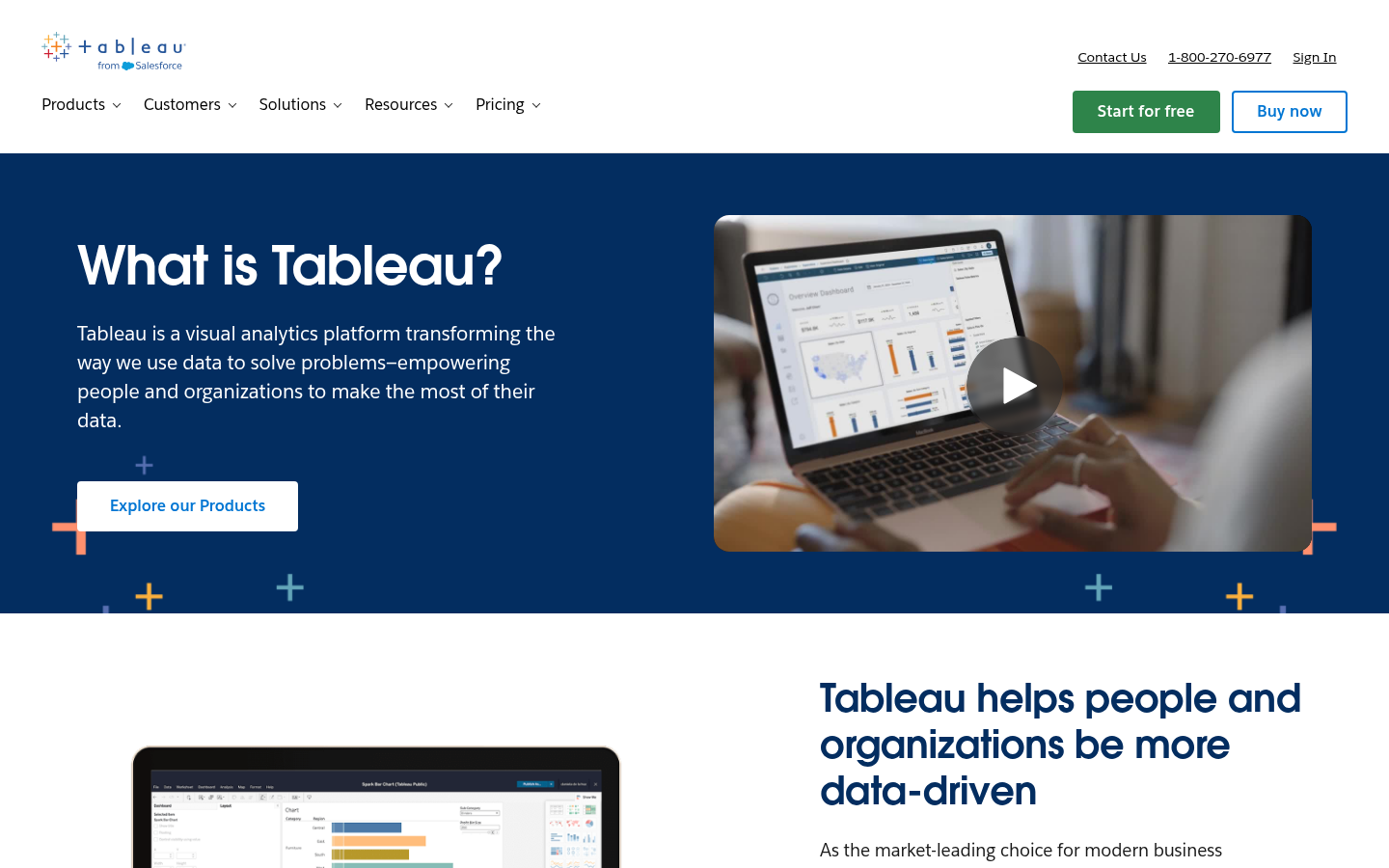
Tableau isn't a recruiting tool. It's a general-purpose dashboard layer.
That's the entire point. If your team has a data engineer or analyst, Tableau lets you connect to whatever data sources you want, including the BI export from your ATS, and build dashboards no off-the-shelf tool will give you.
What it covers:
- Connectors for Greenhouse, Lever, Workday, and most modern HR systems via API or warehouse.
- Custom dashboards across hiring, finance, and operations data.
- Scheduled refresh, alerting, and embedded views inside other tools.
- Salesforce data-cloud integration since the acquisition.
Where it falls short: You need someone who can build the dashboards. There's no recruiting-native template library. Setting up source-of-hire attribution from scratch in Tableau is a sprint, not an afternoon.
Our pick: data-mature teams with internal BI capability that need cross-functional dashboards. For TA-only reporting, a recruiting-native tool gets you 80% of the value in 20% of the setup time.
How to choose the best tool.
You want to understand what happens inside interviews. Pick Metaview. No other tool on this list captures, structures, and reports on interview-conversation data. The analytics that matter most for quality-of-hire live inside the conversation itself.
You want strategic workforce planning and external market data. Pick LinkedIn Talent Insights. It's the only one looking outside your funnel at the broader supply picture.
You sell to companies that are hiring, or you are building a recruiting product that needs the job data underneath it. Pick JobsPipe. Its job postings API covers live postings from more than 30 job boards and ATS sources, deduplicates them into one record, and updates or removes them within 24 hours. Use it to treat new postings as buying signals and trigger outreach, build recruiting and sourcing products, or run market and labor research with 12 months of history.
You want funnel reporting tied to your ATS. Use Greenhouse's native analytics or Insights Plus if you're already on Greenhouse. Pair with Metaview for the content-of-conversation layer.
You're running high-volume entry-level hiring. HireVue covers the async-video assessment use case. Watch the candidate-experience cost.
You're a 5,000+ person enterprise. Eightfold AI for connected workforce planning, Tableau for custom dashboards. Most teams will want both.
For more on transcribing and structuring the conversation data underneath these tools, see our interview transcription roundup.
Bring Metaview into your hiring stack.
Live notes, structured scorecards, and ATS sync - set up in under 10 minutes.
Frequently asked.
What are recruitment analytics tools?
Software that captures, structures, and analyzes hiring data so recruiting teams can move from gut-feel decisions to evidence-based ones. The data source varies: some tools report on ATS stage data, some on candidate skills graphs, some on interview-conversation data. Pick the one whose data source matches the question you actually want to answer.
What's the difference between ATS analytics and dedicated recruitment analytics tools?
ATS analytics (Greenhouse Insights, Lever Visual Insights) report on stage data: time-in-stage, source-of-hire, offer-acceptance rates. Dedicated tools layer on top with content analysis (Metaview on interview conversations), labor-market data (LinkedIn Talent Insights), or custom dashboards (Tableau). Most mature teams use both.
Which recruitment analytics tool has a free tier?
Metaview's free tier is open to anyone with a work email. The others on this list are either enterprise-only (LinkedIn Talent Insights, Eightfold, HireVue) or bundled with their parent product (Greenhouse Insights). Tableau offers a free trial but no permanent free tier.
Will recruitment analytics tools comply with the EU AI Act?
AI used to filter applications or evaluate candidates is high-risk under the EU AI Act, and those obligations apply from 2 December 2027 (for a system already on the EU market before then, only once its design changes significantly). Tools that score or rank candidates (HireVue, Eightfold) need the heaviest compliance posture. Reporting tools (Metaview, Greenhouse Insights, Tableau) are lighter-touch.
How many recruitment analytics tools should I use?
Two to three, layered. ATS-native analytics for stage data, a content-of-interview layer for quality-of-hire signal, and a custom-dashboard layer if you have internal BI capability. More tools means more context-switching, not more insight.
What's the best recruitment analytics tool for small teams?
Metaview on the free tier plus your ATS's native analytics. The combination covers what was said in interviews and how the funnel moved. Anything more is overhead until you're running 200+ hires a year.
