
Metaview records interviews. The median one runs 35.5 minutes across 5.2 million recorded candidate interviews, and that figure is exact, because the two events behind it are as plain as events get: a recording starts, and a recording stops. No calendar-based hiring metric gets measured that cleanly.
Time to hire runs on different events. It starts the day the eventual hire enters the pipeline and stops the day an offer is accepted, and its wider cousin, time to fill, starts the clock the day the role opens. None of those dates appear in an interview recording. Every recording carries that limit, whatever product made it: the requisition, the offer, and the acceptance live in the applicant tracking system, and the conversation lives in the recording. So a role-level time-to-hire benchmark cannot be built from interview data, and this article won't pretend otherwise. Interview data does measure one part of the process precisely, the part nobody times, and it moves far less by role than most teams expect.
What time to hire asks for, and what a recording holds
People swap the two calendar metrics for each other constantly, and they don't measure the same thing. Time to fill counts the days from the moment a role opens to the moment someone accepts the offer. Time to hire is narrower, and starts when the eventual hire first enters the pipeline. Both need at least two dates, and both of those dates sit in the applicant tracking system.
An interview recording holds neither date. It holds when a conversation began, when it ended, and whatever role and seniority tags the customer's connected system passed along with it. There's no days-to-hire query in this dataset because there's nothing to run one against. Interview-to-hire rate is logged as not queryable for the same reason: it needs outcome data that lives on the other side of the integration.
So every calendar figure quoted below belongs to somebody else. Gem's 2025 benchmark report puts the average sales role at roughly 35 days and 21 interviews per hire, and the average engineering role at 53 days and 39 interviews. Ashby reports a median 30 days to hire for business roles against 40 for technical ones, plus about 5 interview events per technical hire against 4 for business roles. SHRM's 2025 data puts median time to fill near 45 days, for executive and non-executive roles alike.
Three datasets, three populations, three definitions of what counts as an interview and when the clock starts. Keep them separate from what follows. Recordings time conversations; those reports time processes. Role-level time-to-hire benchmarks usually come apart right here, when someone treats the two as one measure.
Interview length by role
Recordings do measure a single conversation well. Mean length runs from 45.7 minutes in engineering down to 36.9 in sales, across the interviews that could be matched to a role family. That's the whole spread: 8.8 minutes between the longest role family and the shortest.
| Role family | Interviews | Mean length | Median length |
|---|---|---|---|
| Engineering | 35,247 | 45.7 min | 42.6 min |
| Design | 1,840 | 45.0 min | 44.3 min |
| Product | 2,983 | 44.5 min | 44.5 min |
| Data | 2,788 | 41.9 min | 41.9 min |
| Recruiting and people | 1,770 | 40.0 min | 41.1 min |
| Operations | 2,085 | 39.4 min | 38.2 min |
| Marketing | 2,987 | 38.9 min | 41.4 min |
| Finance | 1,199 | 37.8 min | 37.9 min |
| Sales | 9,724 | 36.9 min | 38.5 min |
Read two things off that table before you quote a line from it. First, the order changes with the statistic: engineering holds the highest mean while product and design hold the highest medians, and sales sits below finance and operations on the mean but above both on the median. Second, the medians span a narrower range than the means, running from 44.5 minutes in product to 37.9 in finance.
That table also rests on a thin slice. The nine named families add up to roughly 60,000 interviews out of 5.2 million, a little over one percent of the corpus, and they're there because a customer connected an applicant tracking system and tagged the role. Nobody has tested whether teams that connect a tracking system and tag roles interview the way everyone else does. Finance stands on 1,199 sessions. Read the table as a description of the interviews that could be tagged, because the corpus publishes no company, role, or region mix that would support a market average.
Seniority, read on both statistics
Seniority moves length more than function does. How much more depends on which column you read, and the two columns disagree.
| Seniority band | Interviews | Mean length | Median length |
|---|---|---|---|
| Entry | 1,871 | 35.3 min | 34.0 min |
| Mid or unspecified | 34,668 | 38.5 min | 36.2 min |
| Senior | 17,159 | 44.6 min | 42.5 min |
| Staff or principal | 9,499 | 44.9 min | 41.7 min |
| Manager | 17,038 | 43.6 min | 43.5 min |
| Director | 7,384 | 44.4 min | 43.5 min |
| VP | 1,080 | 43.6 min | 45.9 min |
| C-level | 630 | 44.4 min | 48.8 min |
The median looks like a ladder, though a wobbly one: 34.0 minutes at entry level, 42.5 for senior individual contributors, 48.8 at C-level, with staff and principal roles dipping back to 41.7 in between. The mean gives you a step and then a plateau. Entry runs 35.3 and mid 38.5, then every band from senior upward sits within about a minute of 44, and the C-level mean of 44.4 lands fractionally below the senior mean of 44.6. That C-level row rests on 630 interviews. It's the thinnest cell in the table.
So take the narrow reading. A single interview gets longer somewhere between entry level and senior, then stops getting longer. An executive premium may well sit inside those medians, and that many interviews aren't enough to insist on it. The comparison people reach for next is uneven too: the seniority range above is a range of medians, while the role range in the previous section is a range of means, so putting the two side by side compares different statistics.
Why the role gap cannot be assembled from these sources
The arithmetic suggests itself by now. Gem counts 39 interviews for the average engineering hire against 21 for sales. The table above gives 45.7 minutes per engineering interview against 36.9 for sales. Multiply the pairs and you appear to have interviewer hours per hire by function. That number would be wrong, and it's worth being exact about why.
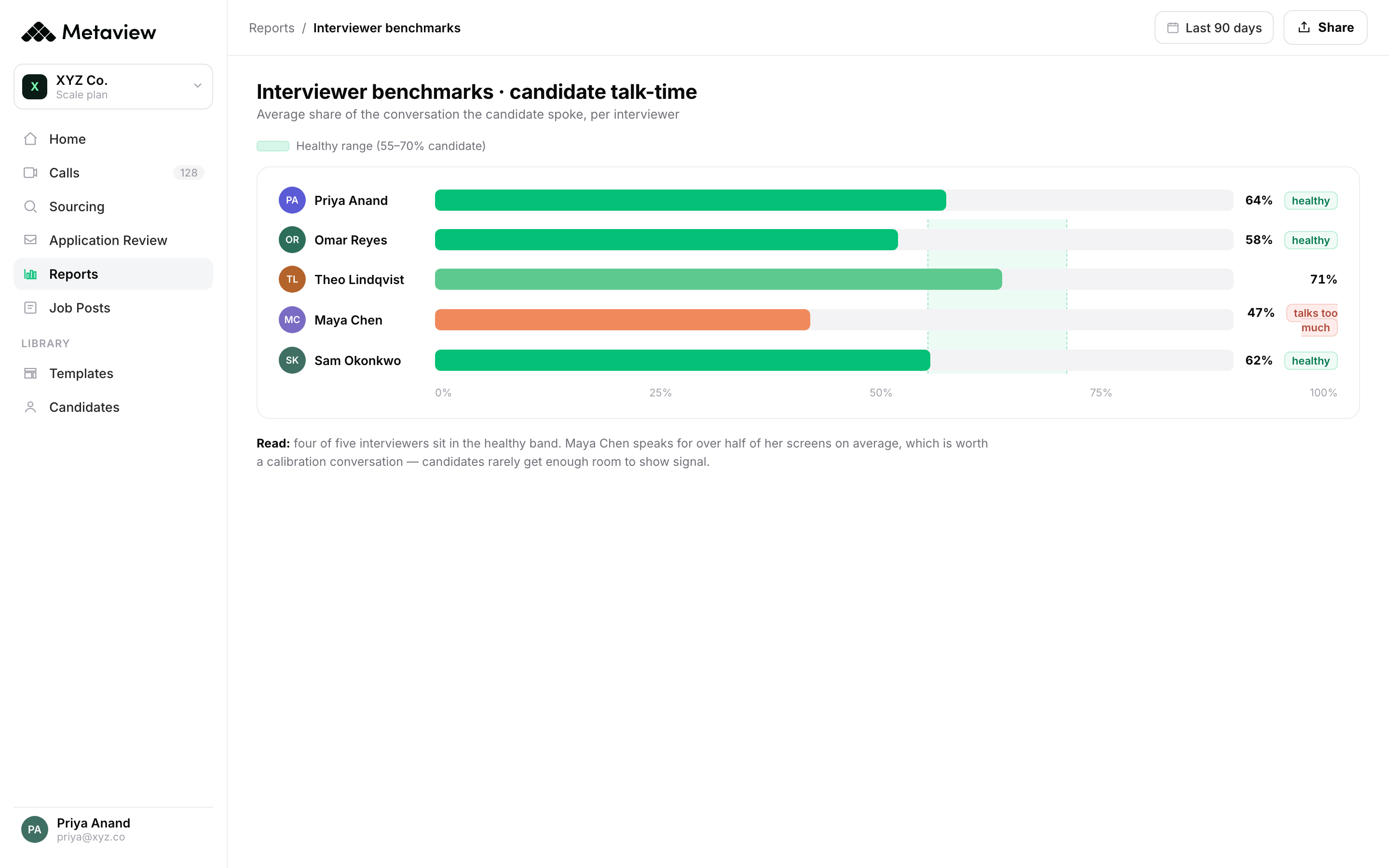
Metaview's own round data can't close that gap either, because it counts captured links between a candidate and a job. The median across 1,425,761 candidate and job pairings is 1.00 captured rounds, and the mean is 1.34. Only 20.8% ever show a second captured round. One pairing carries 155, which tells you about record linkage and nothing about a hiring process. Rounds that happened on a call nobody recorded are missing by construction.
The same limit runs through every measure built on top of it. Continuation from a second captured round to a third is 35.9%, and from a third to a fourth 43.7%. A narrowing field and an incomplete record would both draw that rising line, and nothing here separates them. Continuation by length reads 14.2% for interviews of half an hour or less, 21.5% from 31 to 60 minutes, 30.4% from 61 to 90, then 30.0% above 90 minutes, where the line goes flat. Advancing means only that a later round was recorded, in every one of those cuts, so a candidate who was rejected and a candidate whose next interview was never captured look identical.
A smaller and more useful claim survives all that. Among the 174,595 interviews with both a stage label and a duration, technical sessions are the longest classified kind, with a mean length of 62.6 minutes against 30.5 minutes for debriefs. That interview-length sample contains 4,054 technical sessions (2.32%) and 2,151 debriefs (1.23%), so those two labels cover very little of it. A separate base of 5,519,394 captured conversations with type labels puts 86.06% in the generic bucket and 7.46% in the unclassified bucket. Those figures describe labels in the capture record and cannot show how often teams hold technical sessions or debriefs. If an engineering loop runs more technical rounds than a sales loop, each of those rounds is longer. Only your own record can answer how much longer in total, for a given role at a given company. A bar raiser program or a shared interview kit changes how many rounds a loop runs and what each one is for. Neither effect shows up here.
What the trend line can and cannot say
Median interview length inside the corpus fell from 38.6 minutes in the second quarter of 2024 to 32.6 in the same quarter of 2026. Quarterly volume went from 202,083 recorded interviews to 924,535 over that same window, so the set of companies behind the second figure barely resembles the set behind the first. The corpus median moved. Whether interviews across the market got shorter is a separate question, and this data doesn't answer it.
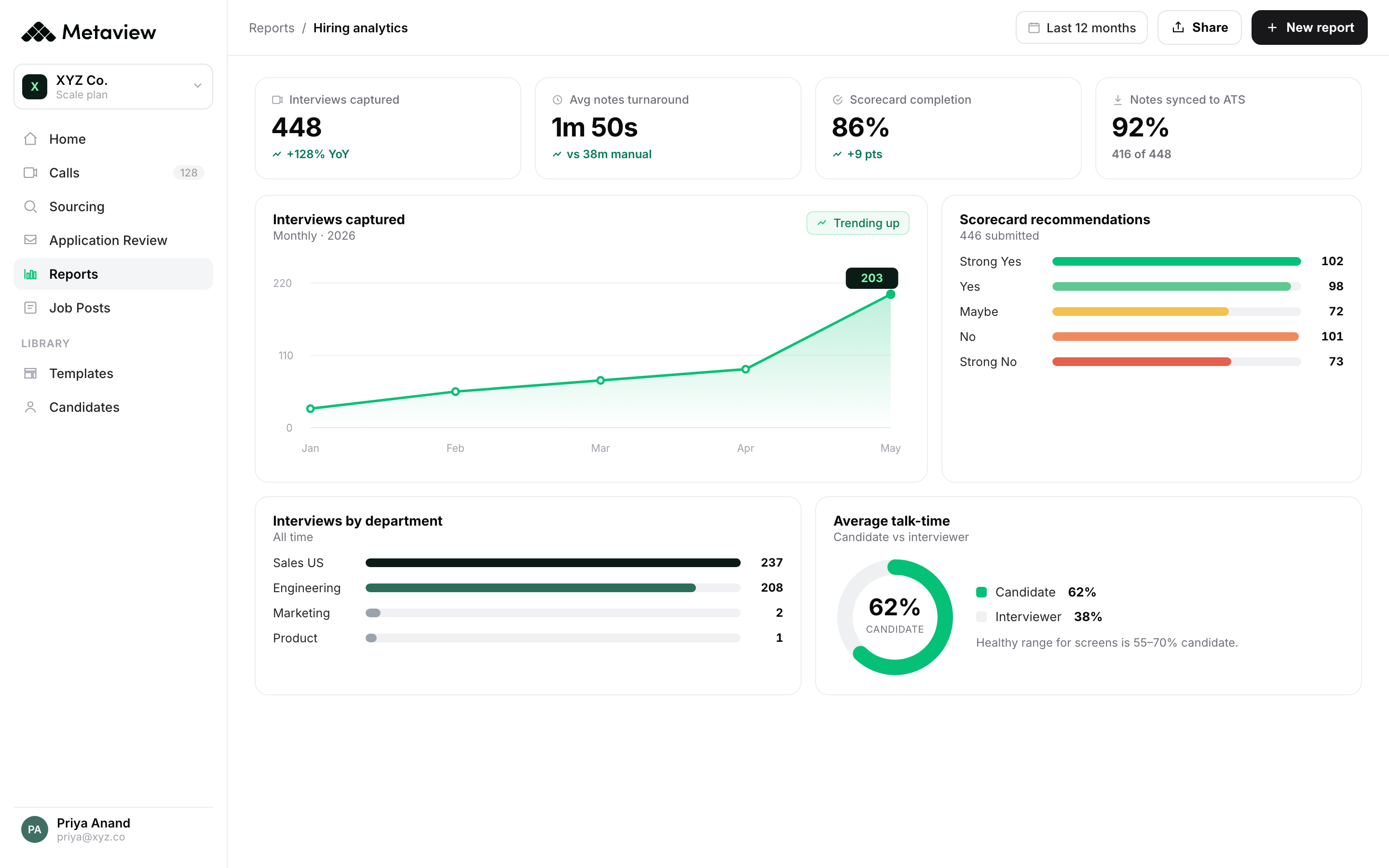
Two more measures carry the same warning. Interviews with a guide loaded run a mean 39.5 minutes against 34.7 without one, on 33,285 and 141,291 interviews respectively. A loaded guide only records that a structure was available, and says nothing about whether the interviewer worked through it. Of the 174,558 interviews that had a scheduled length recorded, roughly 3% of the corpus, 54.3% ran over, with a median overrun of 11.9 minutes. Only teams scheduling inside a connected calendar show up in that count at all.
None of this settles whether a longer interview is a better one. The case for a structured interview rests on decades of selection research, and these durations add nothing to it. They show a length difference and say nothing about what fills the extra minutes.
Count your own interviewer hours
You can work out one figure here honestly, with no market benchmark involved. Take your own recorded interviews for a role, multiply each by the number of interviewers who were in the room, and add them up. That gives you interviewer hours consumed per role, from your own record, on your own definitions. It answers what people are usually asking when they ask about time to hire by role: what this process costs the people running it, and which rounds are worth that cost.
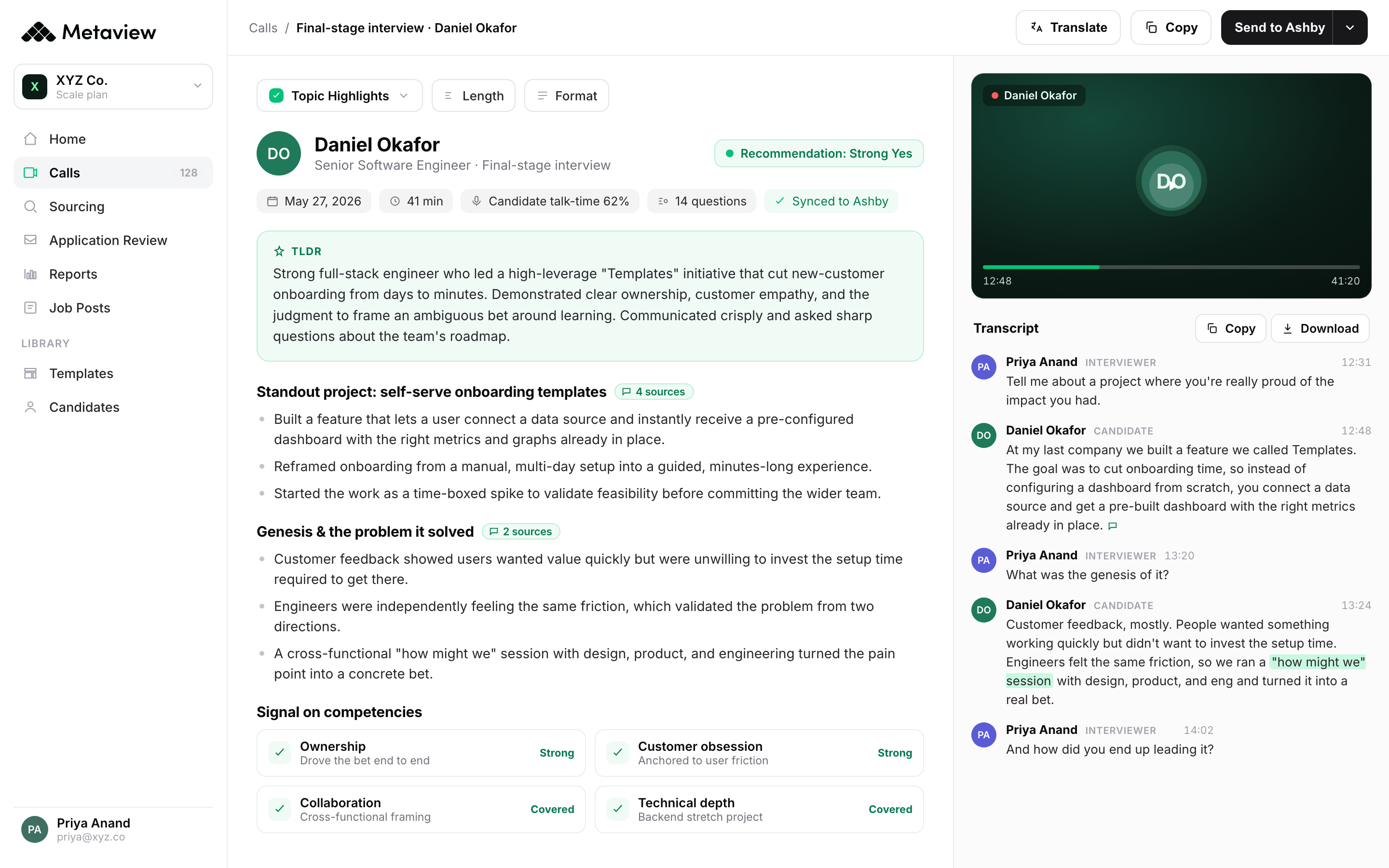
Metaview's Notetaker joins the interview as a visible participant with consent and records the conversation, which is why there are durations to count in the first place. Reports queries an organization's own interview data, including length and captured round counts by role and stage. It won't hand you a time-to-hire figure, for the same reason nothing else here does: the requisition, offer, and acceptance dates sit in the applicant tracking system, and that's where such a figure has to be built. The boundary holds further up the funnel too, where Application Review reads inbound applications against the criteria a team approved, and further down it, where the interview scorecard records what an interviewer concluded. Every one of those measures something inside the process, and none of them measures the calendar around it.
Using Metaview Reports, we could analyze those interviews at scale instead of treating them as isolated stories.”

The honest version of a role-level benchmark is two numbers kept apart: a calendar figure from the system that holds your hire dates, and an interview-hours figure from the system that holds your recordings. If you're weighing up tools for the second of those, our comparison of interview intelligence options covers what each one records and what it leaves to the applicant tracking system.
Measure your own interview hours with Metaview.
Live notes, structured scorecards, and reporting over your own recorded interviews.
Frequently asked questions
Can time to hire be measured from interview recordings?
No. Time to hire runs from a pipeline entry date to an offer acceptance date, and neither event appears in a recording. What a recording measures precisely is the length of one conversation. A time-to-hire figure has to come from the applicant tracking system that holds those dates.
How long is the average job interview?
Across interviews recorded between December 2020 and June 2026, the median runs 35.5 minutes and the mean 38.8. Half sit between 24.1 and 48.1 minutes, and about one in eight runs longer than an hour. Those figures cover the whole recording period rather than a single year.
Which roles have the longest interviews?
Among interviews that could be matched to a role family, engineering runs the longest mean at 45.7 minutes, with design at 45.0 and product at 44.5. Sales runs the shortest mean at 36.9. The role-tagged set is roughly 60,000 interviews rather than the full corpus, so treat it as a description of those interviews rather than a market average.
Do executive interviews take longer than junior ones?
On the median, yes: 34.0 minutes at entry level, 42.5 for senior individual contributors, and 48.8 at C-level. On the mean the picture flattens, with every band from senior upward sitting near 44 minutes and the C-level mean landing just below the senior one. The C-level row rests on 630 interviews, so the executive figure is the thinnest in the set.
Why does engineering take longer to hire than sales?
Third-party benchmarks report a calendar gap, with Gem putting the average engineering role at 53 days against 35 for sales. Interview recordings cannot explain it. A single engineering interview runs roughly nine minutes longer on the mean than a sales one, which cannot account for weeks, and a recording holds no requisition, offer, or hire date to test any other explanation against. Sourcing difficulty, panel scheduling, and the number of rounds all sit outside what a recording measures.
