
English accounts for 92.6% of the 6,074,772 conversations captured on Metaview with a detected language.¹ Across the remainder, the source records 69 base languages other than English.
The headline split isn’t enough to plan from. The non-English remainder is concentrated, and a company’s distribution won’t necessarily match the aggregate.
Teams should use this all-time aggregate as a rough shape rather than a benchmark and compare period to period only inside their own data, but they shouldn’t assume the patterns will match. The source covers captured conversations, so it can’t establish an individual team’s interview mix or priorities.
What the language split holds
English combines the en and en-GB rows, which together account for 5,623,057 conversations. The remaining 451,715 conversations form the non-English side of the same base.
Those totals show scale. The table gives the largest non-English rows; the next section examines how the remainder concentrates and tapers.
The table shows English split into its two locale-code rows, followed by the five largest non-English locale-code rows, so en-GB appears before the non-English entries.
| Detected language, by locale code | Captured conversations | Share of the base |
|---|---|---|
| English (en) | 5,613,907 | 92.41% |
| English (en-GB) | 9,150 | 0.15% |
| Spanish (es) | 75,874 | 1.25% |
| German (de) | 60,426 | 0.99% |
| French (fr) | 57,722 | 0.95% |
| Russian (ru) | 36,736 | 0.60% |
| Portuguese (pt) | 35,659 | 0.59% |
| The other 65 locale-code rows, combined | 185,298 | 3.05% |
| Total | 6,074,772 | 100% |
About the data. This table covers 6,074,772 conversations captured on Metaview that carry a detected-language label. Its 72 locale-code rows sum to that base and collapse to 70 base languages when en-GB is grouped with en and de-CH with de. The source publishes the individual row shares, while the combined English share was recomputed. Shares are rounded to two decimal places and may not sum to 100%. The source doesn’t establish how the labels were produced or whether each label is correct. The source contains no measure of process quality or hiring outcomes. The table is one all-time snapshot and doesn’t include a period column, so it can’t show whether the mix is changing.
The shape of the remainder
The five largest non-English base languages contain 266,417 of the 451,715 non-English conversations, just under 59%. At the other end, 36 base languages share 5,601 conversations. A flat list of 69 non-English base languages doesn’t show that concentration.
Among the non-English base languages, 33 have at least 1,000 conversations each. Using all base languages, including English, 48 have at least 50 conversations and 39 have at least 500.
These thresholds describe the aggregate. An individual company may have a different mix. A team should rank its own interviews over a defined period before deciding which scorecard templates and product support need attention first. Volume shows where conversations occur; it does not determine priority by itself.
Detection and support answer different questions
Detected-language labels are attached to conversations already captured. Support is a stated commitment for a product surface rather than a measurement. They answer different questions and cannot be compared.
As of 2026-09-01, the live integrations FAQ says: "Metaview supports 50+ languages, including French, German, Dutch, Portuguese, Spanish, Japanese, Mandarin, and Hindi."
As of 2026-09-01, the Screening FAQ names 18 supported languages. It says: "Most major languages including English, Spanish, French, German, Italian, Portuguese, Arabic, Danish, Dutch, Hebrew, Hindi, Japanese, Mandarin, Vietnamese, Finnish, Norwegian, Swedish, and Turkish."
Calling 92.6% English proof that "language is a solved problem" overlooks every non-English conversation. The number of detected base languages does not determine how many language processes a team needs, because workload and product support require separate reviews.
Getting this number for your own process
Use the team’s own interview records to build the language view. Choose a period the team can compare consistently and a language field it already records. Don’t hide unknown or missing values by dropping them.
Rank the conversations by language, then use the guidance on writing effective interview scorecards to review the scorecard templates used for interviews conducted in the languages that appear most often. Check each product against its own published support list. Don’t let lower-volume languages disappear from the language view.
TA Operations can own the source field and the count, then review the relevant scorecard templates and product support with the team.
Where Metaview fits
Metaview’s Notetaker joins the conversation as a visible participant. Metaview tells candidates that the Notetaker appears if both parties consent: "If both you and the interviewer consent, you will see a ‘Metaview Notetaker’ appear as a participant during the interview."
For conversations in a supported language, the Notetaker captures every spoken word. Recruiters can then review the transcript and structured notes after the interview, so they don’t have to rely on memory alone.
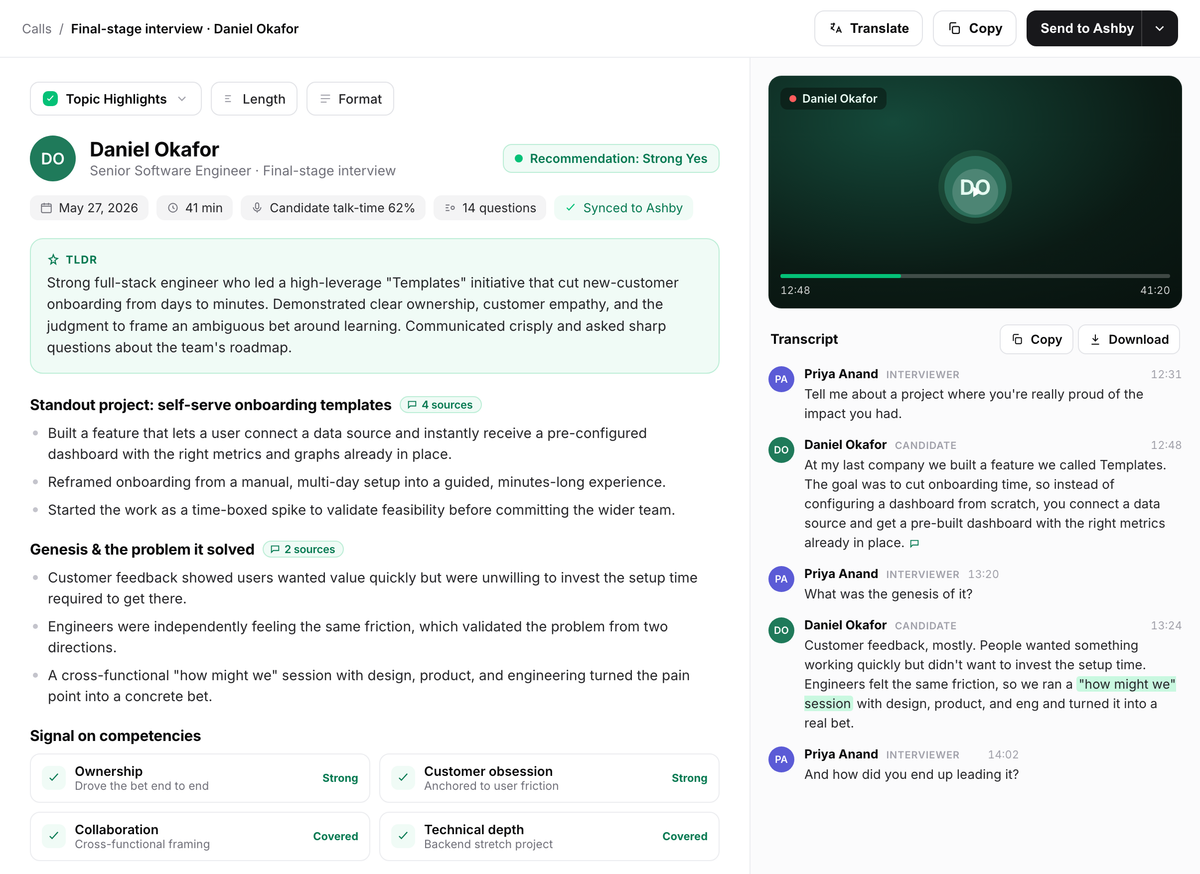
- 1Structured notes sit beside the recorded interview.
- 2The transcript keeps each speaker’s words available for review.
Look beyond the headline share and you’ll see a distinct shape in the non-English remainder. A small group of languages accounts for much of it, while many others form a thin long tail.
Create a ranked language view from the team’s interview records for a period you define. Check each product surface’s own supported-language list before assuming coverage.
Capture interviews in the languages Notetaker supports
When consent is in place and the interview language is supported, Metaview’s Notetaker joins as a visible participant. It records and transcribes the conversation, then creates structured notes.
Frequently asked questions
What if interview language is not recorded?
Don’t infer it from candidate location or the requisition. Start recording interview language prospectively and use the same field consistently before building the ranked view.
How should mixed-language conversations be counted?
This source doesn’t establish how mixed-language conversations were classified. Use one documented rule across your own analysis, and keep a separate mixed-language label if your source system allows it.
Should teams keep locale codes after grouping them into base languages?
Keep the original locale code and document the grouping rule. Don’t overwrite the source value, because the team may need it to audit the rollup later.
Which support list applies when a team uses Notetaker and Screening?
Check each surface against its own current product page. Notetaker and Screening perform different jobs, so each support statement applies only to that surface.
¹ Source: aggregated, anonymized Metaview product data, 2026. No individual, company, or candidate is identifiable.
