
Most recruiting leaders I talk to in 2026 have at least one AI tool bolted somewhere into the hiring process. A notetaker on Zoom. A resume screener on inbound. A scheduling bot in the candidate flow. And the reasonable question they all ask afterward, sometimes weeks in, sometimes months in, is the same: where is the leverage? The numbers should be bigger by now.
Here is what we have learned, sitting inside Metaview as the AI capture layer for thousands of interviews a week across hundreds of recruiting teams: the leverage is not in one AI tool. It is in four workflows that compound. And it shows up in the data. 55% of teams that put AI at the core of hiring rate their cross-functional relationship as excellent, against 14% of teams that do not use AI, according to Metaview’s 2026 AI & Hiring Alignment Report - surveying 505 recruiting leaders and hiring managers across North America and EMEA. The gap is not the tool. The gap is whether the workflows feed each other.
This guide walks through the four AI workflows that change what a hiring team can actually do in a week, in the order they need to be wired: interview notes, candidate assessment, candidate experience, interviewer training. None of them are new in 2026. What is new is the operating model where they share one structured interview signal, instead of each one solving for itself. That is the part most teams are getting wrong.
Why "AI in the hiring process" is usually mis-scoped.
Walk into any recruiting team in 2026 and ask ‘do you use AI in your hiring process,’ and the answer is yes. Walk in and ask ‘where exactly,’ and you get a list of point tools, each one solving for one moment. The notetaker handles the interview. The resume screener handles the inbox. The scheduling bot handles the back-and-forth. The interviewer training session handles the coaching. They are all running. They are all saving minutes. And the team is still missing on the metric they actually care about, which is whether the right person gets the offer fast enough to take it.
The reason is structural. In a point-tool world, each AI workflow generates its own format of output and stores it somewhere only it can read. The notetaker fills a Google Doc. The screener writes to the ATS. The scheduling bot logs to a calendar. The trainer scores a rubric in a spreadsheet. None of them know what the others saw. So when the recruiter writes the client report or the hiring manager debriefs the panel, the AI signal that should compound across stages collapses back into a free-text recap. That is the part that gets generic AI tone, and that is what the audit on this article called out on the original draft.
The teams that get real leverage out of AI in the hiring process are the ones who treat it as four connected workflows, not four point tools.
The most concrete proof that these four workflows compound, not just stack, comes from the report this team published earlier this year. According to Metaview’s 2026 AI & Hiring Alignment Report - surveying 505 recruiting leaders and hiring managers across North America and EMEA, teams that put AI at the core of hiring are dramatically more likely to rate their cross-functional relationship as excellent, start their searches with high alignment, exceed business goals, and avoid losing qualified candidates to faster-moving competitors. Four different outcomes, one root cause. That is what compounding looks like.
After implementing Metaview for our HR interviews, the common quote from my team has been ‘it’s amazing, I don’t think I can go back to taking notes myself’. It has also given back hours of time that has been redirected to sourcing and finding ideal candidates, which helps the business get the talent they need. Personally, it has allowed me to return to being fully engaged with the candidate and truly listen.”
Workflow 1: AI interview notes (the foundation layer).
Interview notes are the foundation workflow because every other AI workflow downstream depends on the quality of what got captured. If the recruiter is typing during a screen, the notes are partial. If they are not typing, the notes are absent. Either way, the AI further down the funnel has nothing to score against. Get this layer right and the others compound. Skip it and the others are guessing.
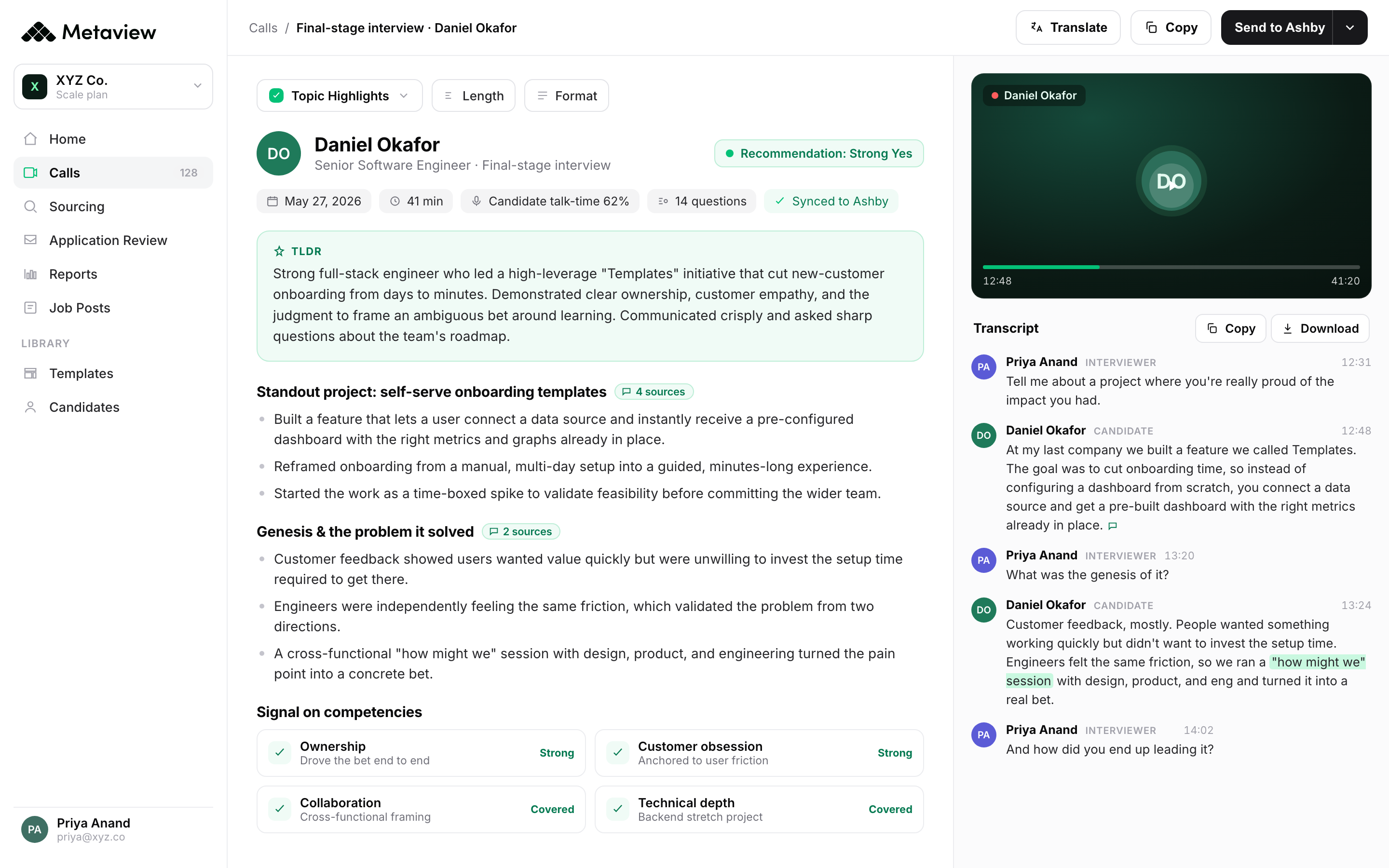
The version of this workflow that works in 2026 is live capture during every interview, not a recording you transcribe later. Metaview’s AI Notes joins the call as a participant, transcribes the conversation, tags answers against the rubric for the role, and produces a structured summary the second the call ends. The recruiter does not type. The hiring manager does not skim three pages of free text afterward. The note format follows the team’s interview style, whether that is question-and-answer, topic highlights, or a competency rubric.
Below is what comes out the other side of an interview when this layer is wired in: a tidy post-meeting summary, organized by topic, with each candidate response captured verbatim and the AI’s structured pull-out underneath. That is what every other workflow gets to work on. It is also what the recruiter writes the scorecard from in under five minutes instead of forty-five.
The real signal of whether this layer is working is not whether the notes look pretty. It is whether the recruiter is fully present during the conversation. Craig Single at Hexagon said it cleaner than I can: ‘allowed me to return to being fully engaged with the candidate and truly listen.’ That is the unlock that downstream AI workflows cannot generate on their own.
Workflow 2: AI candidate assessment (cutting through volume).
The second workflow is what most teams think of first when they hear ‘AI in the hiring process,’ because the volume problem is the loudest. Roles get hundreds, sometimes thousands of inbound applications. Recruiters cannot read them all. The screener-tool answer is to rank applicants against a job description and surface the top ten. That is fine as a starting point. It is not enough on its own.
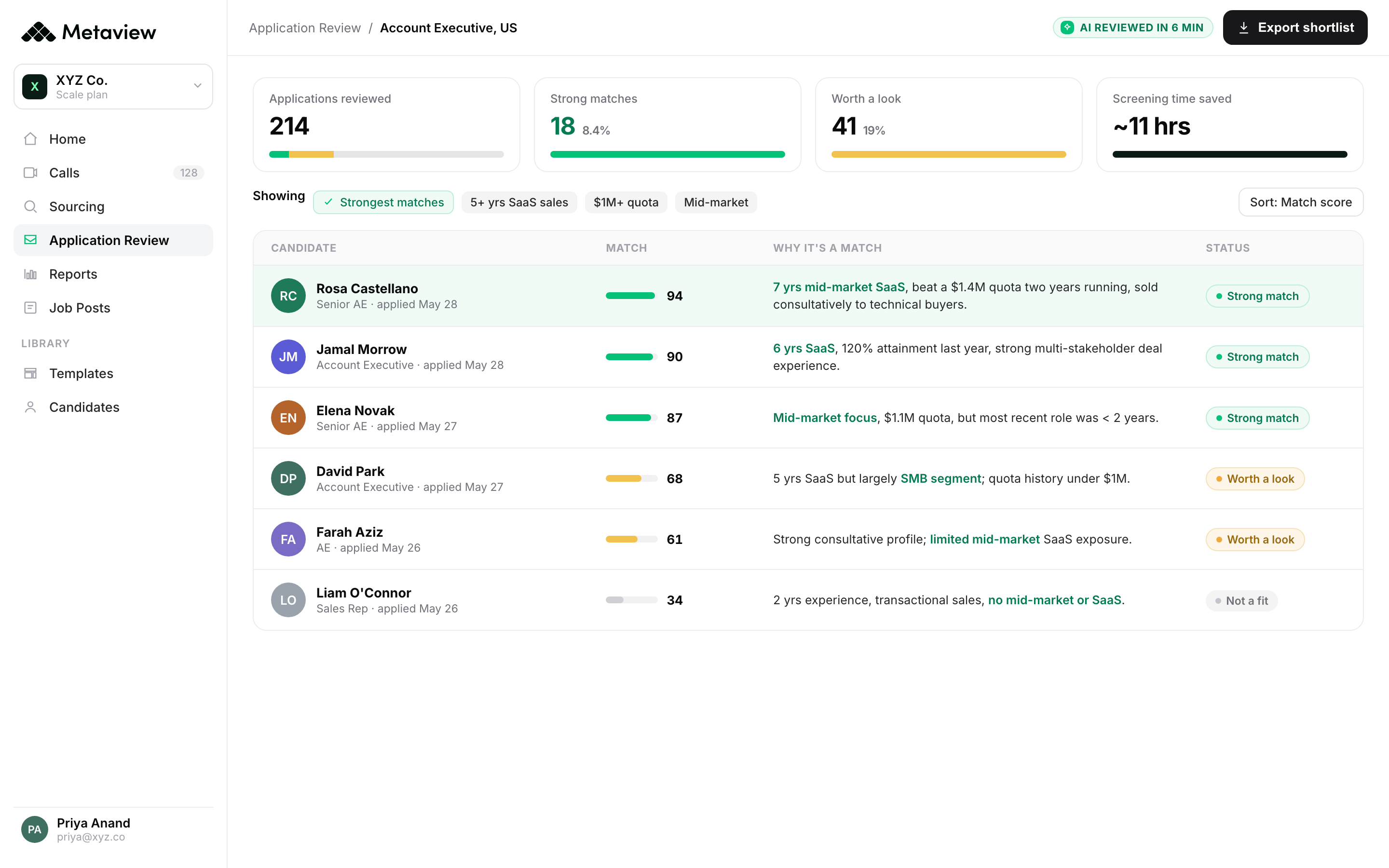
What actually works in 2026 is candidate assessment that learns from what happened in the previous workflow. Metaview’s Application Review ranks inbound against the ideal-candidate profile for the role, not just the job spec. The profile updates over time, because every recruiter and hiring manager decision feeds back into it. The AI flags AI-generated and likely-fraudulent applications so recruiters do not waste cycles on them. And when a candidate moves into interviews, the scorecard autofills from the AI Notes, so the hiring manager is not retyping from free text.
The change in workflow shape is the part that takes most teams by surprise. Old workflow: recruiter scrolls through resumes, eyeballs fit, copy-pastes notes into a free-text field, hopes the next interviewer reads them. New workflow: AI runs the first pass against an ICP that updates, the recruiter spends time on the marginal-fit twenty, and scorecards autofill across the entire panel from the interview transcripts. Side by side, it looks like this.
- Recruiters scroll through hundreds of resumes per role, eyeballing fit against a static job spec.
- Top-of-funnel triage feels arbitrary because no two recruiters apply the same mental rubric.
- AI-generated and fraudulent applications waste days of screen time before they get caught.
- Scorecards get filled in from memory, hours or days after the interview, by people typing while they think.
- Inbound is ranked against an ideal-candidate profile that updates every time a recruiter or hiring manager makes a fit call.
- Triage is consistent across the team because the same rubric runs every application.
- AI-generated content and likely fraud surface in the queue as flags, before the screen call.
- Scorecards autofill from the AI Notes the moment the interview ends, with structured pull-outs the panel can edit.
This is also where the audit on the original draft of this article called out ‘no tables.’ Hard to argue with: a workflow comparison is exactly the kind of thing that needs a side-by-side, not three more paragraphs of prose.
Workflow 3: AI for candidate experience (fast + human).
The third workflow is candidate experience, which sounds like a soft topic until you remember that 80% of teams with good-or-below internal partnerships lose qualified candidates to faster-moving competitors every month, per the same 2026 report. The candidate who waits five days to hear back from one team and one hour to hear back from another is not picking the slow one out of loyalty. They are picking the fast one because it signals respect for their time.
AI workflow 3 closes the response-time gap and protects the human part of the experience at the same time. The candidate-experience layer shows up in three places: at inbound, where Application Review surfaces the genuine high-fit applications fast enough for the recruiter to reach out the same day; during scheduling, where the back-and-forth on times and rooms gets handled by automation instead of three emails; and during the interview itself, where the recruiter is fully present because the note-taking is handled.
The trap most teams fall into is treating candidate experience as a comms problem instead of a workflow problem. They write a better candidate email template and call it a day. The real lift comes from cutting the time between an application landing and a real human acknowledging it. When the first three workflows compound, that delay is hours, not days. When they do not, the better email is decorating a slow process.
Workflow 4: AI interviewer training (the signal flywheel).
The fourth workflow is the one almost every team underbuilds, and the one with the highest compounding value. Interviewers learn on the job, they get one piece of feedback per quarter if they are lucky, and the data they actually need (did I assess for the right things, did I run my time well, did I leave the candidate informed) is locked inside their own memory of how the call went. Interviewer training is the workflow that fixes that.
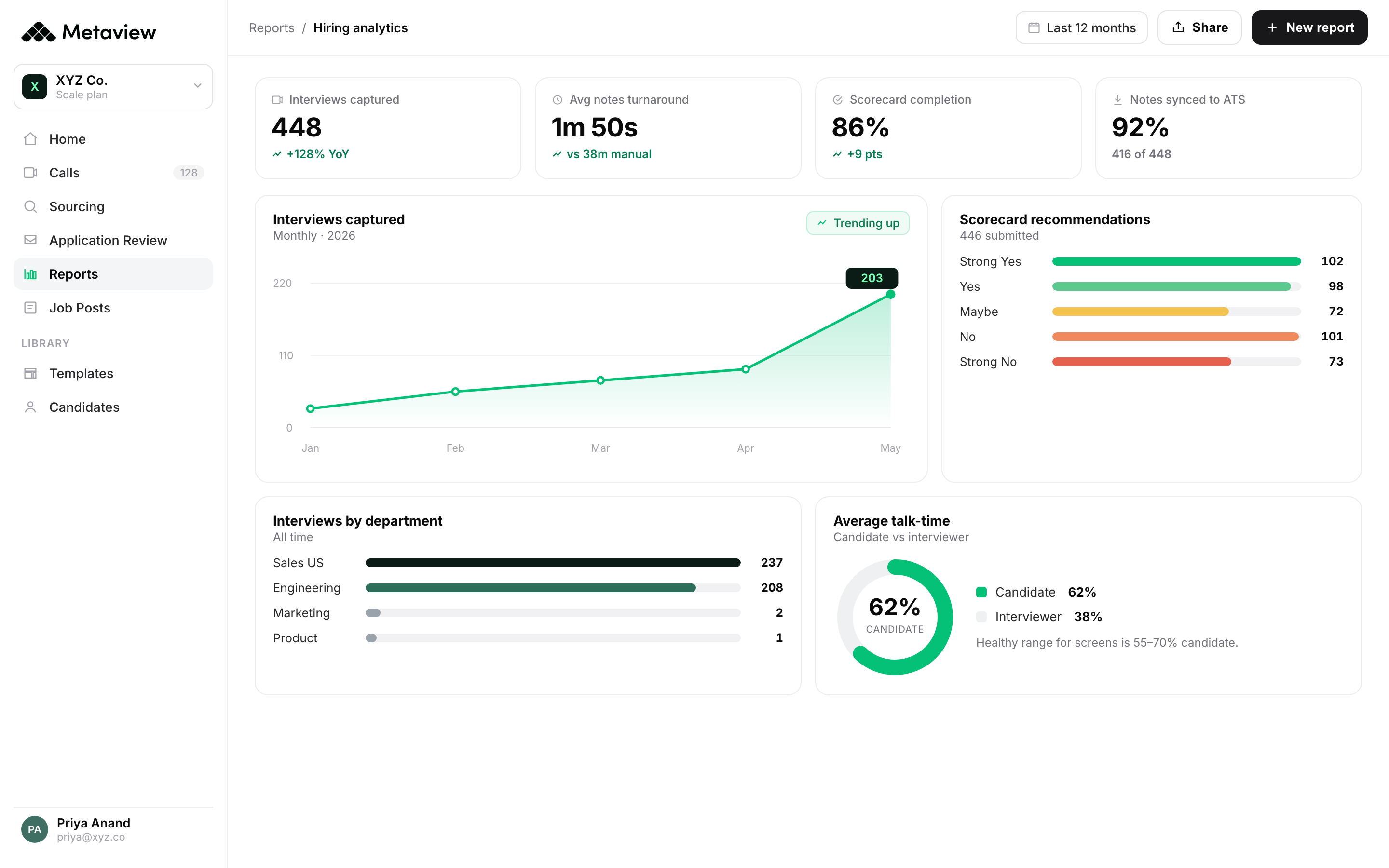
Wired correctly, this workflow uses the same interview signal that the first three workflows produce, and turns it back into coaching. Interviewer-level dashboards in Metaview show who is consistently asking the right questions, who is drifting off-rubric, who is dominating airtime in the panel, and which interviewers’ assessments correlate with successful hires. The hiring lead does not have to watch every interview back. The data does that, the report flags the patterns, and the coaching conversation gets to be about what to change, not what happened.
The part of this workflow that makes it the signal flywheel is the feedback loop into the other three. The team improves at running interviews. The notes get richer because the questions are sharper. The candidate assessment gets more accurate because the scorecards reflect real signal. The candidate experience gets better because the interviewer is present and prepared. Each of the previous three workflows gets a quality lift from the fourth without anyone wiring a new integration.
The clearest articulation I have heard of this loop is from Andy Pittman at ShipBob. He runs a 24-hour feedback SLA across the entire interview team, and his point about why it works is the one that ties this whole workflow back to the data layer.
We have a 24-hour SLA on interview feedback. We’ve been doing this for two and a half years now, which means we have unbelievable data. When we make the wrong hiring decision and go back to the feedback, nine times out of ten we’re like, oh yep, there it is.”

How the 4 workflows compound (30-day wire-on plan).
The four workflows are not a checklist. They are a sequence. Once all four are running on the same signal layer, the team experiences something most teams never see: the AI gets better at hiring the longer it runs, because every interview is feeding the rubric, every fit call is updating the ICP, every panel debrief is sharpening the next one. This is what ‘AI is core to hiring’ actually looks like inside a real team. The compounding shows up in the numbers slowly, then all at once.
The fastest version of wiring this up, for a team starting from a notetaker-only setup in May 2026, is a four-week plan.
- Week 1: turn on AI Notes in every interview, with the rubric for each role loaded into the room. Stop the typing. Watch the post-meeting summary land before the recruiter has closed Zoom.
- Week 2: wire Application Review onto inbound for two open roles. Let the AI rank, surface AI-content flags, and feed scorecard autofill into the ATS for every interviewer on those roles.
- Week 3: tighten the candidate experience layer. Same-day acknowledgement on every genuine application Application Review surfaces, scheduling automation on, and a 24-hour SLA on first interviewer feedback so candidates do not stall in the panel.
- Week 4: switch on the interviewer dashboards. Pick three interviewers with very different styles and run a coaching conversation against the data, not the recall. By the end of the week, the team is reading its own signal.
If ‘where is the leverage’ was the question we started with, this is the answer: leverage is what happens when conversations become structured signal that every later step uses. Metaview’s own product team made the point on LinkedIn recently, and the framing is worth pulling in.
 Metaview Technologies
Bring Metaview into your hiring stack.
Live notes, structured scorecards, and ATS sync - set up in under 10 minutes.
Frequently asked.
What does ‘AI in the hiring process’ actually mean in practice in 2026?
In practice, it means four connected workflows: AI interview notes for capture, AI candidate assessment for triage and scorecard fit, AI candidate experience for speed and fairness at the front of the funnel, and AI interviewer training for consistency and coaching. Most teams have one or two of these running. The leverage comes from running all four on the same structured interview signal layer.
Which AI workflow should we wire first?
AI interview notes, because every other workflow downstream depends on the quality of the signal coming out of the conversation. With Metaview, the notes write themselves during the interview and feed the rubric for the role automatically, which is what the assessment, experience, and training workflows pull from later. Skipping this layer and starting with assessment is the most common reason AI hiring projects stall in week three.
Does AI candidate assessment replace recruiter judgment?
No. It replaces the part of the workflow where the recruiter is scrolling through hundreds of resumes per role to find the genuine high-fit applications, and the part where AI-generated or fraudulent applications waste days of screen time. The recruiter still makes the fit calls. The difference is that they spend their judgment on the twenty marginal candidates, not the four hundred clearly out-of-scope ones.
How does AI improve candidate experience without making it feel robotic?
The experience layer is mostly about speed and presence, not chatbots. AI-driven candidate assessment surfaces the genuine high-fit applications fast enough that recruiters can respond the same day. Scheduling automation cuts the email back-and-forth. AI Notes lets the recruiter and hiring manager stay fully present during the interview because nobody is typing. The candidate ends up talking to a real human who is faster and more focused, not to a bot.
What does AI interviewer training look like day-to-day?
It is mostly a Reports view, not a separate workflow. Interviewer-level dashboards show who is consistent against the rubric, who is asking the right questions, who is dominating airtime in panels, and which interviewers’ assessments correlate with successful hires. The hiring lead reviews the patterns weekly, picks the coaching conversations that matter, and runs them with data instead of recall. Andy Pittman at ShipBob describes it as a 24-hour feedback SLA that compounds over years into ‘unbelievable data’.
How long does it take to wire the four workflows?
About four weeks if you do it in order. Week 1: turn on AI Notes in every interview. Week 2: wire Application Review onto inbound for two open roles, with scorecard autofill into the ATS. Week 3: tighten candidate experience with same-day acknowledgement on genuine applications and a 24-hour panel-feedback SLA. Week 4: switch on the interviewer dashboards and run the first coaching conversation against the data. From there, the workflows compound on their own.
