

Outreach to public-sector candidates runs into two problems. First, government job titles often hide what people do, so the right candidates are easy to miss in a search. Second, once you find them, they’ll weigh your offer against the public-sector pay and benefits they know well, and a vague first message won’t give them enough to go on.
This guide is for recruiters hiring from government bodies and publicly owned employers, such as public hospitals and universities. It shows you how to find these candidates by the work they’ve done, and what to put in a first message so they can decide whether to reply.
Where to find public-sector candidates.
Job titles won’t get you far. Public employers often use titles and grade systems that don’t line up with private-sector ones. So a search on the title your company uses for the role will miss people doing the same work under another name.
Search for the work instead, such as the programs someone ran and the systems they bought or built. For a procurement role, that means looking for people who ran tenders or vendor selection at a public employer, whatever their title says.
Here’s where I’d look, and the catch with each:
| Where to look | What it tells you | The catch |
|---|---|---|
| Professional profiles that name a public employer | The role and team, and often the programs the person ran | Titles can hide the scope, so read the descriptions |
| Reports and conference talks with named authors | Who did the work on a specific subject | Some staff can’t list that work publicly, so a thin profile can still belong to someone senior |
| Professional associations in the field | People who keep up with a specialty | Member lists are often closed, so events are the easier way in |
| Former public-sector staff on your own team | Introductions, and a read on what the move was like | Ask before you use their name in a message |
| People who applied to you before | People who already showed interest in your company | Check what they applied for and why it didn’t go ahead |
I’d start with colleagues who left public service themselves. They can tell you which parts of your offer a public-sector candidate will ask about before you write a word.
Read the experience before you write.
Public-sector resumes often describe the work in the employer’s own language: grade levels and acronyms used only inside that agency.
Look for the scope behind the title. These details map onto your role far better than the title does:
- The size of the budget they controlled.
- How many teams or agencies they coordinated.
- Which vendors they managed.
- The rules they worked under.
Compare two opening lines. “Your background in government would be a great fit” could go to anyone. “You ran the vendor selection for a statewide case management system, the exact project I need someone to lead” could only go to one person.
If you can’t name the part of their work that matches the role, keep reading their profile before you write.
Write to a channel the candidate controls.
Don’t send recruiting messages to a government work email. Depending on the employer, work inboxes can be monitored or released under public records rules. And a candidate shouldn’t have to explain your message to anyone.
If a tool finds contact details for you, check that the address isn’t a government one before you send anything.
Use a personal channel, such as a message on a professional network, or a personal email address the person has published.
The one exception: if a work address is all you have, send two lines that name no role and no terms, and ask for a better way to reach them.
What to put in the first message.
Someone leaving a public job will compare your offer with the package they already have. Make that comparison easy: state four terms plainly in your first message.
This table shows what each line should say and what to keep out of it:
| Line | What it says | What to leave out |
|---|---|---|
| Pay | The base range for this role | A request for their current salary, or references to “competitive pay” |
| Pension or retirement plan | The new employer’s plan, by name, in one line | Anything about the pension they’d give up |
| Leave | The role’s paid time off | “Generous time off” with no detail behind it |
| Job security | Permanent or fixed-term, and anything you can share about its funding | Guarantees such as “this role is safe” |
If the role carries a bonus or equity, include it since it’s part of what they’ll compare.
Focus on the new role only. Pension rules vary by employer and by country, so a line like “you’ll keep your vested pension” is a promise the hiring team can’t make. Name the retirement plan on offer and say where the full terms live.
If you draft messages with artificial intelligence, check the pension line in particular. A tool may guess what the candidate earns or saves now, so delete any guess and write the terms your hiring team approved.
On job security, say where the role’s funding comes from if you can, such as a client contract or a grant. Someone used to public funding cycles is likely to ask.
And finally, two common pitches to avoid:
- “Escape the bureaucracy” tells someone their current job is a waste of their time.
- “We move fast” says nothing about the job or its terms, which are what they’re weighing.
I’d sell the work instead: the problems they’d get to work on, and how their week would run.
Ask about rules on leaving before the first call.
Some public roles come with rules about what former staff can do next, such as which employers they can join or which projects they can work on. Some also cover the job search itself, such as talking to a company they deal with in their current job.
This depends on the person’s role and where they work, and the candidate is the one who can find out.
So ask about leaving rules when you first write. It costs one sentence, and a restriction is far easier to handle now than after several rounds of interviews.
If a restriction does come up, your legal team decides what it means for the role. Your job is to make it easy to mention.
A five-sentence first message you can adapt.
Here’s the shape I’d use in five sentences: an opening line about their work, two for the terms, one for the rules question, and one to ask for a call.
Give it a plain subject line that names the role and your company. The words in curly braces are slots for your approved terms:
- The hook: one sentence on what they’ve done that this role needs.
- “The role is {seniority, in your company’s words}, paying {base range}, with {retirement plan} and {paid leave}.”
- “It’s a {permanent or fixed-term} role, and {what the hiring team can say about funding}.”
- The question about rules (the box above has one way to word it).
- “Would a call next week work, or would you like the full terms in writing first?”
The last line gives the candidate a way to say “yes” without committing to a call, which suits someone who wants to compare before they talk.
Here’s the template filled in for a senior procurement hire (the terms stay as slots, because they have to come from your hiring team):
Subject line: Head of Procurement at {your company}
Hi {first name},
You ran your state’s bidding process for a new case management system, and managing a vendor choice that size is the core of a role I’m hiring for.
The role is Head of Procurement, a director-level post, paying {base salary range}, with {name of the retirement plan} and {days of paid leave}. It’s permanent, funded by {the client contract or grant behind it}.
Does anything about your current job, such as the notice you have to give or limits on who you can join next, change how we’d plan this?
Would a short call next week suit you, or would you prefer to read the terms in full before we talk?
Follow up, and answer every reply.
If there’s no reply, follow up once or twice with about a week between messages. Add something new each time, such as the full benefits summary or the team they’d join.
When a reply comes, answer it in writing and quickly. A candidate who asks for details of your pension plan before agreeing to a call is doing the comparison your message invited, so treat the question as interest.
If replies tend to sit in a shared inbox on your team, give each one an owner and a deadline. We have a separate article on this problem: “Why candidate replies get lost after outbound outreach.” It explains how to set up a shared reply queue and a one-working-day reply rule.
Plan for an exit that may take longer.
Before they can move, a candidate may need to hand over a program or wait for the end of a budget year. Ask about timing on the first call, and build the process around the answer rather than your usual schedule.
If the answer is months rather than weeks, tell the hiring manager before the final interview, so the start date isn’t a surprise at the offer. Then agree with the candidate how you’ll keep in touch until they start.
Where Metaview fits.
Two parts of this method are slow by hand: searching by past work, and sending one set of approved terms to everyone on a shortlist.
- Metaview AI Sourcing takes a plain-language description of the work, such as vendor selection for large public systems. It searches the web and your connected applicant tracking system, and gives the reasoning for each person it finds. For people already in your system, it also matches based on what they said in past Metaview conversations.
- Metaview Outreach then sends automated email sequences with personalization to the candidates you add from an AI Sourcing shortlist or a file upload.
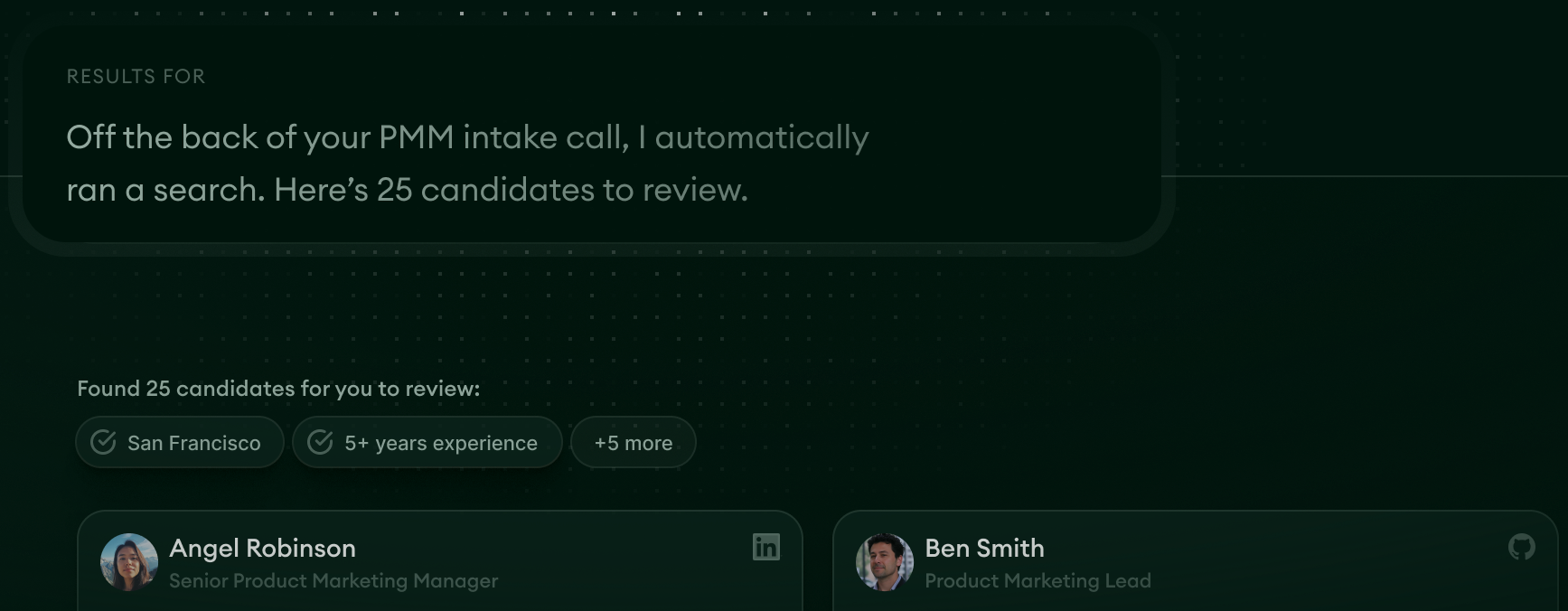
AI Sourcing can also start a search on its own after an intake call recorded with Metaview. The illustration below shows the kind of results it returns:
How to tell whether your outreach to public-sector candidates is working.
Read the replies, and listen to the questions candidates ask on first calls. These patterns tell you what to fix first:
- They ask for the range on the call. It was missing from the message or buried in it. Move it into the second sentence.
- A restriction turns up after the interviews. The question came too late or read as a formality. Ask it in the message itself, before any call.
- Hardly anyone replies. Check the search before the wording, because a message sent to people whose work doesn’t fit the role won’t be rescued by a better hook.
A good first message gives someone in public service enough to decide whether the move is worth a call. If they can see the terms they’d compare and have already been asked about the rules, replying is an easy next step.
Reach public-sector candidates with terms they can compare.
Search on the experience you need, then send each match a personalized first email.
Frequently asked.
Can government employees talk to recruiters while they still work there?
That depends on the employer and the role. If the candidate isn’t sure, suggest they check with their own human resources or ethics contact first, and keep your messages to the basics until they have.
What if my company doesn’t share salary ranges in outreach?
Then say when the candidate will see the range, and keep that promise. “I’ll share the full range on our first call” tells them when to expect it, and the pay conversation then starts from a number you offered.
Can I mention the candidate’s current pension or benefits?
Only once they’ve raised it, and then as a question about what they need from you. Someone keeping a public pension may ask how the new plan works alongside it. Share the new plan’s documents and leave that comparison to them.
How do I personalize outreach when much of their work is confidential?
Use what’s public: their employer and any work they’ve published or presented. Don’t guess at the rest, and don’t ask them to share what they can’t. Showing you understand the kind of work is enough to open the conversation.
Should I use AI to personalize messages to government employees?
For the hook, it can help, as long as you check every detail it mentions about the person’s background before you send it. A wrong detail in the first line can cost more trust than a plain, generic opening would.
