

When one role is open in several cities and to remote candidates, the easiest lift is to run one big talent search covering every possible location. That standard then has to speak to every market at once.
The city with the most names looks deep and the one with only a handful looks thin. And the first messages go out promising remote work for a role the team will probably fill in one city. That’s where multi-location sourcing goes wrong.
Instead, I’d treat the role as one search with one brief, and run it once per market: a list for each city and one for remote candidates, all judged against the same bar. Where remote candidates fit gets written down before anyone is messaged, so the first message can state the terms that apply to the person reading it.
This guide walks through splitting your search by market, comparing what each market’s list produces, and placing remote candidates. It ends on four checks for a search you have open now.
What multi-location sourcing asks of one search.
Multi-location sourcing means finding candidates for the same role in more than one city, and often in remote regions too. The practical answer is to keep one brief, run it once per market, compare the markets on what their lists produce, and settle where remote fits before anyone is messaged.
From one description, a single search can cover the web, your applicant tracking system (ATS), and your team’s past candidate conversations. (The guide to AI candidate discovery platforms lays this out.)
Metaview’s AI Sourcing agent, can start a search from the first intake call. In fact, across all searches started that way, the first list arrives a median of 17.6 minutes after the call ended.¹ You can search at scale without any real effort.
Whether the role is one market or five has to be settled on the call itself, before a mixed list comes back and starts doing the deciding. Because a mixed search won’t give you a fair read on each market. AI Sourcing returns a median of 48 candidates to a list,² each with the reasoning behind it.
A mixed list also puts remote profiles and local ones on the same page before anyone has said which the role wants.
Split the search with just one brief.
A single brief means the hiring bar stays the same everywhere. What changes from market to market is just the location, where the hire will work. I’d write the rest down before the first search runs:
| Part of the brief | Across markets | Why it sits here |
|---|---|---|
| Must-haves and level | The same in every market | Markets judged against different bars can’t be compared |
| Location line | One city per search, or the remote terms | It decides which market a search covers |
| Where you can employ someone | Confirmed per country or state | Your people team or employment counsel signs it off before a place goes into a search |
| Pay range | Set per market by whoever owns compensation | A candidate should hear the range for the place they’d work |
| Employers worth searching | Listed per city | A list of companies built for Austin misses the ones in Denver |
| The hiring manager’s ranking of the markets | Set at intake, revisited when the lists disagree with it | It says which market wins a tie, and when a weak one gets dropped |
Crucially, if the must-haves or rejection reasons down differ by city, you actually have several roles under one title. Each needs its own intake. The intake call is where the ranking and the location lines get agreed, with the hiring manager putting the markets in order out loud.
For more, our guide to talent mapping covers the research behind each location line. That includes where the people you want work today, and the one-page brief a hiring manager calibrates against.
Compare markets on the yeses each list produces.
Using Metaview Sourcing, recruiters still make the call to progress every candidate on the list. On average, 41.5% of AI Sourcing candidates get a yes.³.
A market’s yeses tell you it’s producing people you’d advance for this role. They say less about how many such people it holds, because each list holds only what one search returned.
For that, I’d watch repetition as well. When new searches in a market keep returning people you’ve already rated, read it as a sign the market is thin for this brief. Then tell the hiring manager before widening your search or dropping it.
Both readings depend on the same bar doing the rating:
Some teams make that market research a step of its own. Samy Aumar is the people systems excellence manager at Qonto, and in episode 11 of Metaview’s 10x Recruiting podcast he shows the market intelligence agent his team uses for market and competitive research.
Research like that is for choosing which markets to search in the first place.
Further reading
- The talent intelligence roundup covers workforce data on how deep a pool runs in a city.
- The guide to sourcing tools for recruiters compares which pools of talent each tool searches.
Decide where remote candidates fit before the first message.
Remote is a market too, with borders of its own. You're limited to the countries or states where your company can actually employ someone (ask your people team or employment counsel). It also covers the working hours a new hire needs to share with the team.
Once those are written down, remote candidates can go in one of two places. A separate remote search measures these employees against the same yeses. Or you maintain a remote allowance within each city’s search.
I’d run remote as its own market when the hiring manager would hire a remote candidate over a local one, and inside each city when the office is the reason for the role.
I’d want that early flag in a market’s brief before its first message goes out, because a candidate who reads remote terms that don’t apply to them has been promised something the team can’t keep. So each market gets its own sequence, carrying the location terms for the people in it.
An example in action.
Candidates in one market can also expect working arrangements the offer doesn’t give them. Catawiki, a marketplace for special objects, recruits from Amsterdam and had a hard time hiring engineers in Lisbon. Justin den Hamer, its lead tech recruiter, describes the questions his team can put to Metaview Reports, which answers questions about a team’s own interview data, such as the main reasons for rejection across the backend engineers it had interviewed, and whether wanting to work hybrid was one of them.
“It’s still a process, but it’s really helped us define our offer. And we can flag early if people don’t want the hybrid environment we have,” he says.
How Metaview Sourcing tracks the "yeses".
Metaview's AI Sourcing searches the web, your connected ATS, and your team’s past Metaview conversations from a plain-language description, and returns candidates with the reasoning for each.
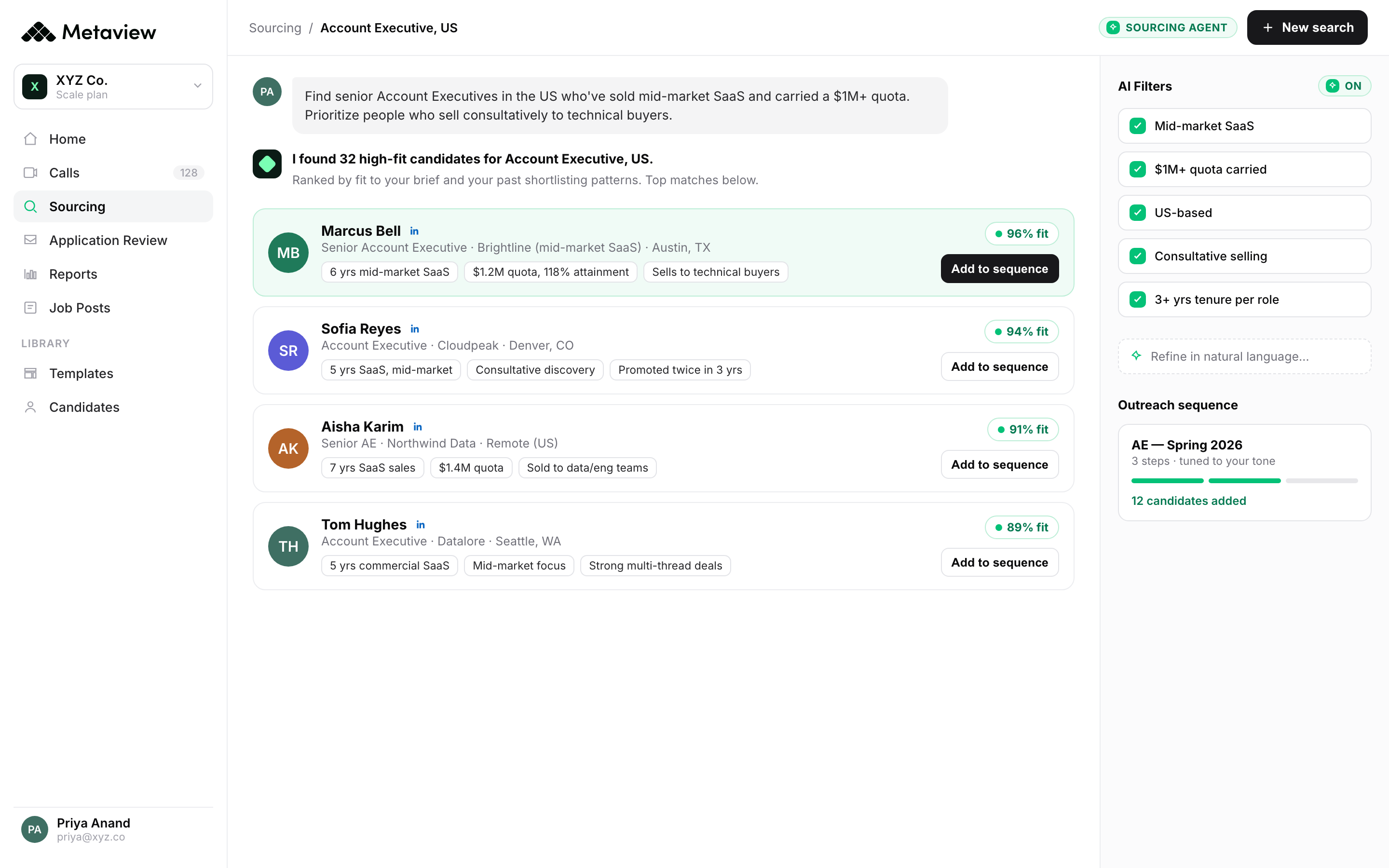
The list above is the mixed kind this guide splits, with several cities and a remote candidate side by side and the reasons beside each one.
Accuracy and the data underneath it is our obsession. It’s how we built our notetaker. It’s how we built our sourcing agent.”

Accuracy is the most important thing to check on your own lists. Read the reasons beside each candidate before you count anyone as a yes.
Four checks before the next round of outreach.
Run these on the multi-city search you have open now, ahead of the next send.
- Does each market have its own list? Split the shared list, starting with the market the hiring manager ranked first.
- Are the markets compared on yeses? Count yeses per market, and take any change to the ranking back to the hiring manager.
- Does every message carry its own market’s terms? Fix the sequences, starting with the remote one.
- Is any market repeating names? Tell the hiring manager, and agree whether to widen that market or drop it.
Run this way, one search across several cities and remote regions is one brief with a list for each market. You compare the markets on the people a recruiter would advance and settle the remote terms first, so every candidate who hears from you hears terms that apply to them.
Find candidates candidates across cities, with the reasons beside them.
See how Metaview AI Sourcing explains every candidate it returns.
Frequently asked.
What if the hiring manager won’t rank the markets?
Ask which market they’d fill first if only one hire came through this quarter, and record that as the ranking. If they still call the markets equal, treat them as tied and let the yeses settle it, with a note of that in the brief.
How many markets can one brief cover?
As many as one recruiter, or a pair working to one bar, can read in the same week. Past that, I’d drop the market ranked last before handing a market to someone rating against a different bar.
What about a strong candidate who lives outside every market on the list?
Ask whether they’d move to one of the cities or work within your remote terms, and put them on that market’s list if so. When neither fits, a note of them is worth keeping for a search in a market they’d join.
Should pay differ from one city to the next?
That’s a compensation decision, made by whoever owns pay at your company before the search starts. The search needs each market’s range written into that market’s brief, so a candidate hears the range for the place they’d work.
What if one city’s search comes back nearly empty?
Check the brief first. A location line that names the wrong place, or draws the area narrower than the hiring manager meant, empties a list as fast as a thin market does. If the line is right, run one more search there and see whether it brings new people or the same few.
Sources.
¹ Minutes from the end of an intake call to the first list of candidates, median, for searches started from that call.
² The median number of candidates on each list a search run with AI Sourcing returned.
³ The share rated yes among the candidates recruiters rated yes or no.
