
The median interview scorecard is submitted about two hours after the interview ends. That figure, and every timing number in this piece, comes from 811,298 submitted scorecards, counted across every interview stage, final rounds among them.¹
Of the scorecards that were eventually submitted, a quarter took more than a day to arrive, and roughly one in twenty took more than a week.² Scorecards that were never submitted at all are not in this sample, so these wait times describe feedback that did land, only late.
The distance between the two-hour median and the week-long tail is where a final-round loop gets stuck. A decision waits on the last scorecard in, so the slowest interviewer sets the pace. Applying the all-stage numbers to a single final-round loop is an inference, and a fair one.
The median is fast, the tail is what you feel
The median scorecard is submitted 2.3 hours after the interview, and the bulk of them land the same day: 74.7% are in within 24 hours, and 82.1% within two days.² For most interviewers, most of the time, feedback is quick.
The average sits at 36 hours, dragged up by a long tail. Nearly one in five scorecards takes longer than two days, and roughly one in twenty takes longer than a week.²
That tail is what a hiring team feels, and the reason is structural. A final-round loop cannot close until the last scorecard is in.
So the loop moves at the speed of its slowest interviewer, and one lagging write-up holds up the whole decision.
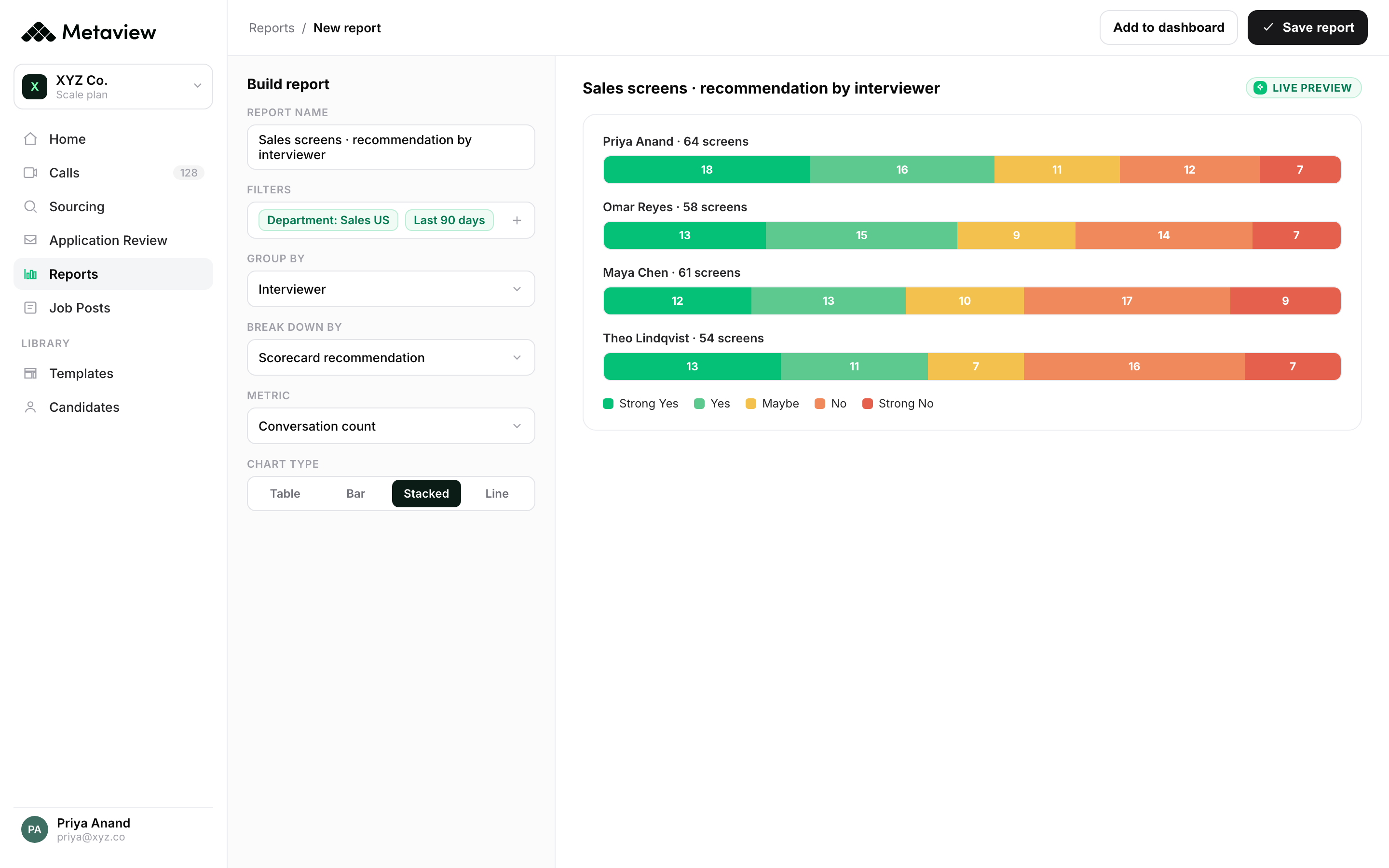
You can see this pattern in your own data. Metaview Reports runs over your team's interviews, so you can group submission behavior by interviewer, by stage, and by department, and find the specific people and loops where the tail lives.
What a slow decision costs
A candidate who reaches your final round is usually in someone else's process too. While your loop waits on its last scorecard, the clock the candidate is watching keeps running, and the recruiter on the other side may already be scheduling an offer conversation.
None of that shows up in interview data, which only sees your own process. What it can tell you is how long that process makes people wait.
Teams that make the write-up fast get the time back, and they feel it. Nitin Moorjani, who runs talent operations at Automattic, put a number on it:
The most clear impact is the time saved. Recruiters save 20 minutes per interview from wrangling notes and submitting scorecards. Per month, that's 53 hours saved in total.”
Cut that write-up time and the effects compound. The scorecard lands sooner, the loop closes sooner, and the window in which a strong candidate is weighing you against someone else gets shorter.
Decision speed is one of the few parts of the race you fully control, which is why it belongs on the same dashboard as time to fill.
What the extra rounds actually buy
The instinct, when a decision feels hard, is to add another round. For just over half of candidates scored twice, the two recommendations pointed the same way.³
Agreement is a weaker claim than accuracy, since the data has no measure of who turned out to be the right hire. Just over half is also well above a coin flip, because a recommendation can take more than two values.
For the roughly 46% of candidates where the two reads diverged, the later round changed the call. That is a large amount of movement, and it is a real argument for keeping the round.
The slow part of a final-round decision is usually the writing up, and that is a separate problem from whether the round earns its place. When the recommendation was going to hold anyway, the days spent waiting for it on paper are pure delay, and you can remove that delay without touching the rigor of the loop.
The lever you control
If the delay is in the writing, that is where the fix is. The strongest association in the data is a difference in submission rate by how the scorecard was started.
Of the scorecards that began as a generated draft, 50.3% were submitted; of the ones interviewers wrote from a blank page, 28.6% were, across a sample of 93,502 generated and 26,498 manual scorecards.⁴ The drafted ones also arrived fuller, carrying 7.85 completed fields on average against 2.61.⁴ The comparison is observational, so treat it as a lever to test rather than a guarantee.
Our AI Notetaker captures every spoken word of the interview, so the moment the call ends there is already a draft on the screen with each competency rated and every rating linked to what the candidate actually said.
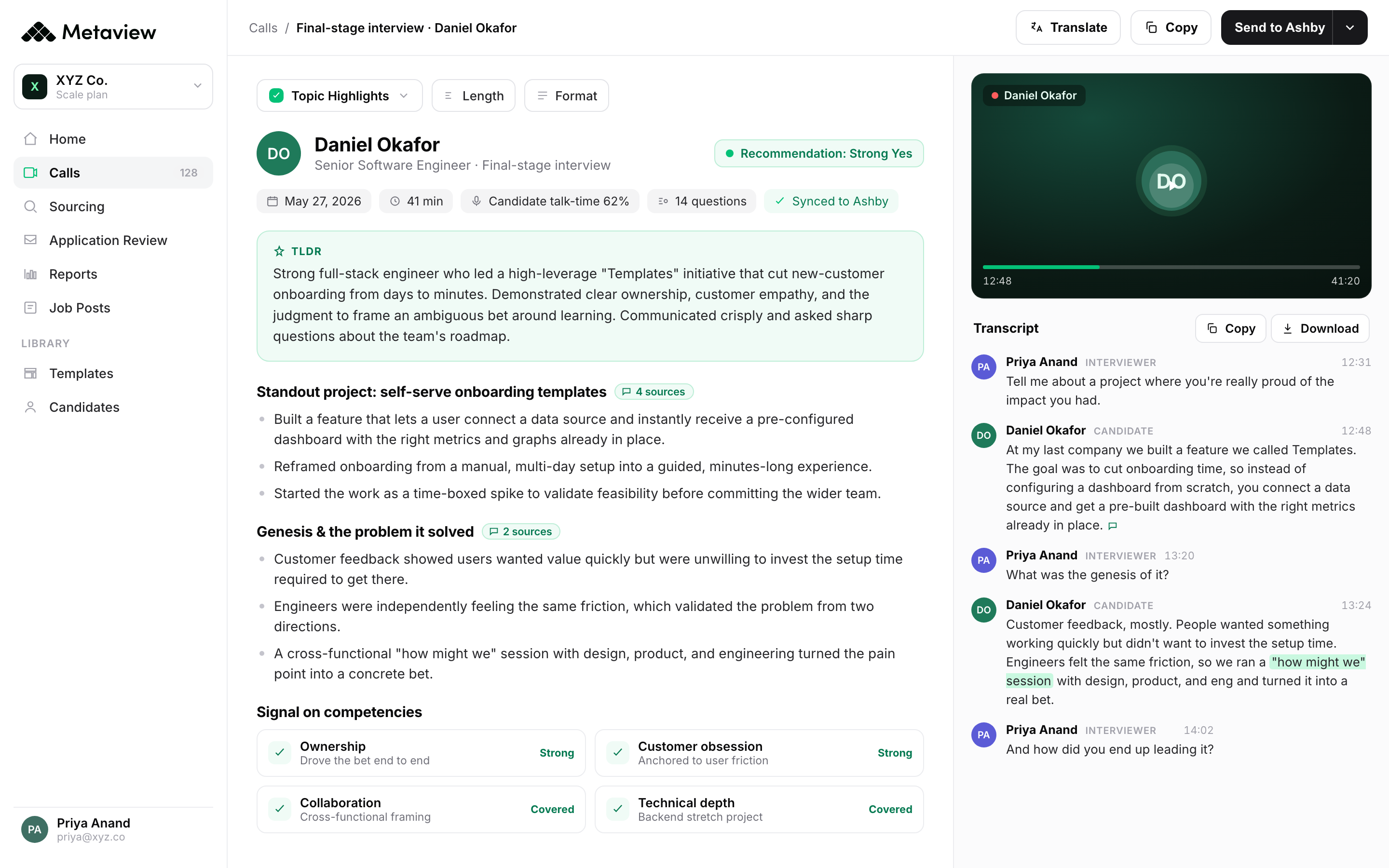
The interviewer reads the draft and corrects it, filling what is thin and adding their own judgment before submitting. Nothing is scored or decided on its own; every rating and the final recommendation stay with the human, who then submits the scorecard into the ATS through Metaview's integrations.
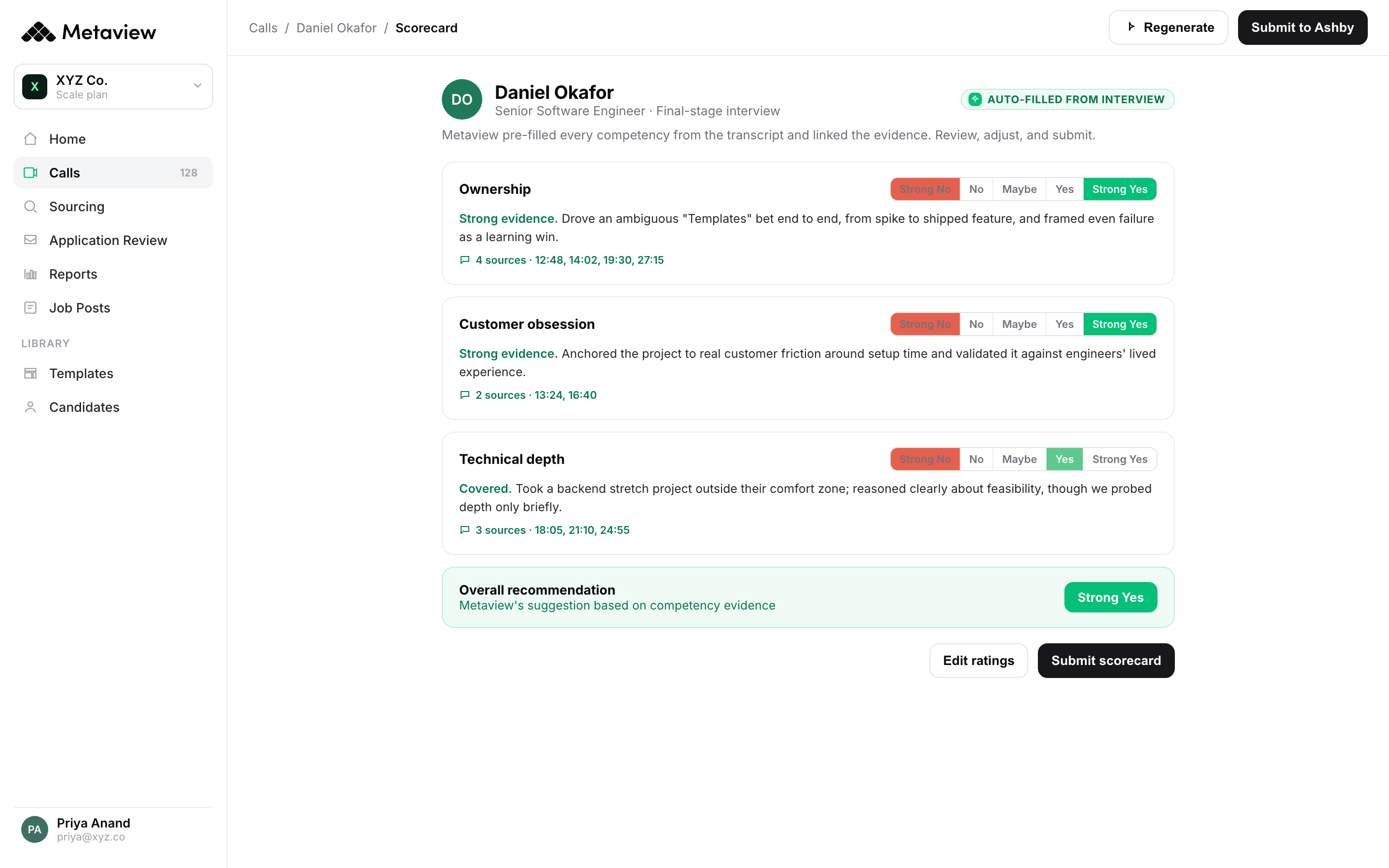
Getting the draft in front of the interviewer while the conversation is fresh is the cheapest version of this. A write-up reviewed in the quarter hour after the call is checked against a clear memory.
The same draft opened next week has to be checked against a week-old memory of the conversation.
Where to start
Pull 90 days of your own numbers before you change anything. Three are enough to find the problem: the median and 75th-percentile time from interview to submitted scorecard, the share of loops still waiting on at least one scorecard after 48 hours, and the submission rate on drafts against blank-page scorecards.
One of those will be obviously the worst. Start there.
Then fix the cheapest thing first. For most teams the weakest number is the review step, and it is also the one that costs nothing to change.
Move the scorecard review inside the interview slot, start every write-up from the draft, and fit each stage's template to what that stage can actually assess. Our structured interview guide covers the last part.
The rigor of your loop and its speed are independent. You can keep every round and still stop losing days to the paperwork that follows it.
See where your final-round decisions stall.
Track scorecard submission speed across your hiring team in Metaview, stage by stage and interviewer by interviewer.
Frequently asked questions
How long does it take to submit an interview scorecard?
Across 811,298 submitted scorecards, the median scorecard was submitted 2.32 hours after the interview. About 95.5% are in within a week, so roughly one in twenty takes longer than that.
Does Metaview make the hiring decision?
No. Metaview drafts the scorecard from the conversation and links each suggestion to what was said. Recruiters and hiring managers review the draft, edit it, and make every rating and final recommendation themselves.
How often does the early-round read match the final decision?
Across 139,336 candidates scored in both an early and a later round, the two recommendations agreed 54.4% of the time. That measures how often two reads matched, and just over half sits well above chance because a recommendation can take several values.
It says nothing about which call was the right hire. About 46% of the time the later round changed the call, which is part of why the extra round exists.
How can we speed up final-round decisions?
Start every scorecard from a generated draft, review it while the call is fresh, and track submission timing by team and stage in Reports.
In the data, 50.3% of the scorecards that started from a draft were submitted, against 28.6% of the ones written from a blank page. The comparison is observational, so treat these as levers to test rather than guarantees.
What data is this based on?
Aggregated, anonymized Metaview product data across roughly 5.5 million captured conversations, about 5.2 million of them candidate interviews.
Submission timing covers 811,298 scorecards. The draft-versus-manual comparison covers 120,000 scorecards (26,498 manual and 93,502 generated), and the early-versus-final comparison covers 139,336 candidates scored in two rounds. No individual, company, or candidate is identifiable.
¹ Submission timing: 811,298 submitted scorecards; median 2.32 hours from interview end, mean 36.16 hours, 25th percentile 0.43 hours, 75th percentile 24.28 hours. ² Same sample: 74.7% within 24 hours, 82.1% within 48 hours, 95.5% within 7 days.
³ Early-versus-final agreement: 139,336 candidates with both an early-round and a later-round scorecard; recommendations agreed 54.4% of the time, a measure of agreement between two reads only. ⁴ Draft-versus-manual: 50.3% of 93,502 generated scorecards submitted against 28.6% of 26,498 manual ones; completed-field counts (7.85 versus 2.61) from a separate 80,000-scorecard sample. The comparison is observational rather than a controlled experiment.
Source: Metaview's corpus of roughly 5.5 million captured conversations (about 5.2 million candidate interviews), 2026. All figures are aggregated and anonymized.
