
In the median interview, the person asking the questions holds a little under half the floor, slightly less than the candidate.¹
That cuts against the most common worry in interviewer training, that interviewers talk too much. On average, the fear does not hold up.
The average is only half the story. Only about half of interviews land in the range where the candidate does most of the talking, and the ones that miss run both ways.²
Plenty of individual interviews sit a long way from that balanced middle, and an average cannot tell you which of yours are which.
The median room is more balanced than you think.
The figures here come from a specific slice of Metaview's data: interviews where the transcript cleanly separates who was speaking, so talk-share can be measured at all. That is a sample of about 2,700 interviews, drawn from a much larger capture corpus but held to the ones where both roles are attributed with timing.
Read it as a benchmark to compare your own numbers against. It does not describe every interview ever run.
On that sample, the split is close to even. The median interviewer talks 46.8% of the time, and the candidate takes the other 53.2%.¹
Interviewers do talk a little faster when they have the floor, a median 172 words a minute against the candidate's 159, but they hold it for less of the hour.³
The turn-taking looks healthy too. In a typical interview the longest stretch either side talks without a break is short: about 1.9 minutes for the interviewer and 2.1 for the candidate.⁴
The transcript shows no interruptions at all in most interviews, so the median is zero. The average of roughly 18 is pulled up by a handful of cross-talk-heavy conversations, and when it happens it runs close to evenly in both directions.⁵
None of that matches the caricature of the interviewer who will not stop talking. For most interviews, the conversation is balanced and the candidate is doing slightly more of the talking. That is the good news, and it is also the reason the average is the wrong thing to watch.
The spread is the story.
Behind that even median, interviewer talk-share runs from 27.9% at the 10th percentile to 65.1% at the 90th, so the quietest interviewers and the most dominant ones sit worlds apart while the middle stays close to even.⁶
A healthy interview is one where the candidate does most of the talking, with the interviewer staying out of the dominant range, above about 70% of the floor. By that measure, 46.6% of interviews land in the band, and the rest fall outside it.²
Only 5.6% of interviews were interviewer-dominated, with the candidate squeezed into what was left.² That is the failure everyone worries about, and it is real, but it is the smaller tail.
At the 10th percentile the interviewer speaks just 27.9% of the time, which leaves the candidate doing more than 70% of the talking with no one steering.⁶ That other tail is the one interviewer training tends to ignore. A rambling monologue and a candidate left to fill silence both leave you with less to go on, and only one of them is the kind interviewers get warned about.
What a balanced room actually buys.
Talk-share matters because of what a talking candidate gives you that a quiet one cannot. When the candidate is talking, you get answers you can score against the rubric. Your own talking mostly tells you what you already knew.
- The candidate reveals less, so the scorecard rests on a thin slice of evidence.
- Questions get answered by the interviewer's own framing before the candidate can shape one.
- The candidate leaves having learned little about the role, which does not help you close.
- The candidate talks through real examples, giving you evidence to rate rather than impressions.
- Short interviewer questions and follow-ups steer the conversation without taking it over.
- The candidate leaves feeling heard, which is part of how a strong one decides to say yes.
For interviewers, the practical change is simple: with the notes handled, they can pay attention. Alicia Weaver, a talent acquisition and engagement specialist at Benchmark Construction Company, put it this way:
I've been using Metaview and have been a big fan of the opportunity it gives me to focus on the person I am speaking with and to truly hear what they are saying.”
An interviewer who is not typing can listen and ask a real follow-up instead of scrambling to write the last answer down. That leaves more of the floor to the candidate.
The practical route to a healthier talk-share is having one less thing competing for your attention, so more of it goes to the candidate. It is also part of what separates a good interviewer from a rushed one.
You can't measure talk-share from memory.
No interviewer finishes a conversation knowing exactly how much of the floor they held, and no hiring manager can eyeball it across a loop.
A benchmark like this one exists only because the conversation was captured and measured in the first place.
Metaview's Notetaker captures every spoken word of an interview and attributes it to the right speaker, with the timing kept intact. That is what turns a conversation into a talk-share number at all.
That capture across a whole team is the raw material behind every figure above. Metaview records the conversation first, and analysis like this benchmark comes out of those recordings afterward, the same way the rest of its agentic recruiting platform works.
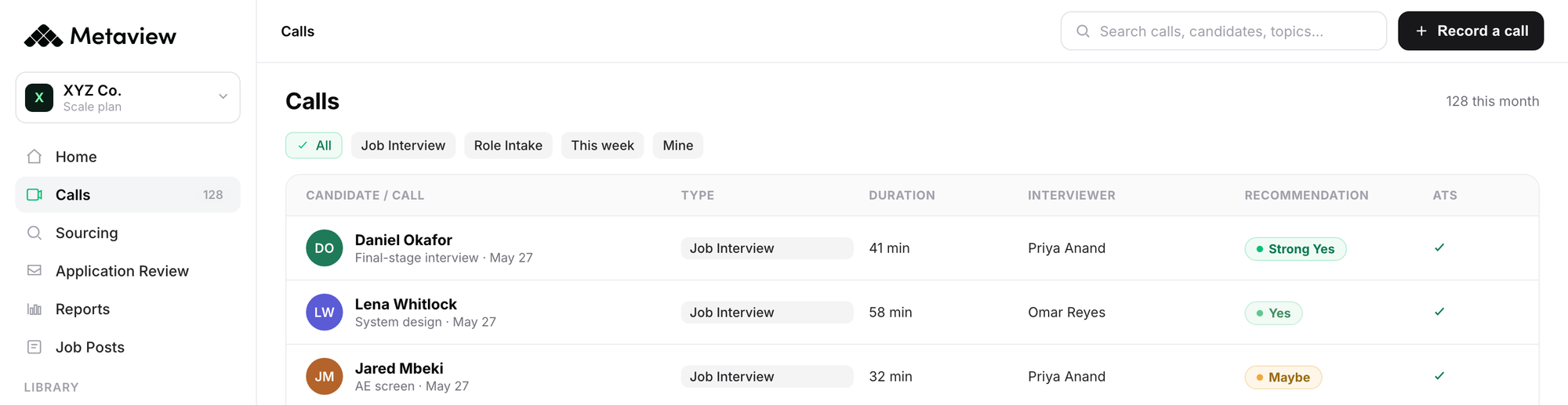
Once the interviews are captured, you can stop guessing at your talk-time and read it off a distribution instead.
| What you want to know | From memory | With Metaview Reports |
|---|---|---|
| Your median talk-share | A gut sense, usually that you talked less than you did | An exact figure across every captured interview |
| Which interviewers sit at the edges | Whoever someone happened to sit in on | The full spread, by interviewer |
| Whether screens differ from onsites | Unknown | Talk-share broken down by stage |
| Whether it is getting better | No baseline to compare against | The trend over time, against the benchmark |
Metaview Reports runs over your team's own interviews. You can pull talk-share by interviewer and by stage and set it next to this benchmark. The interviewers and loops sitting at the edges are the ones to look at.
The interviews stay captured through Metaview's integrations with your ATS and calendar, so the analysis covers the whole team rather than the few interviews someone happened to shadow.
Where to start.
Start by finding the interviews at the edges, before you roll out any target.
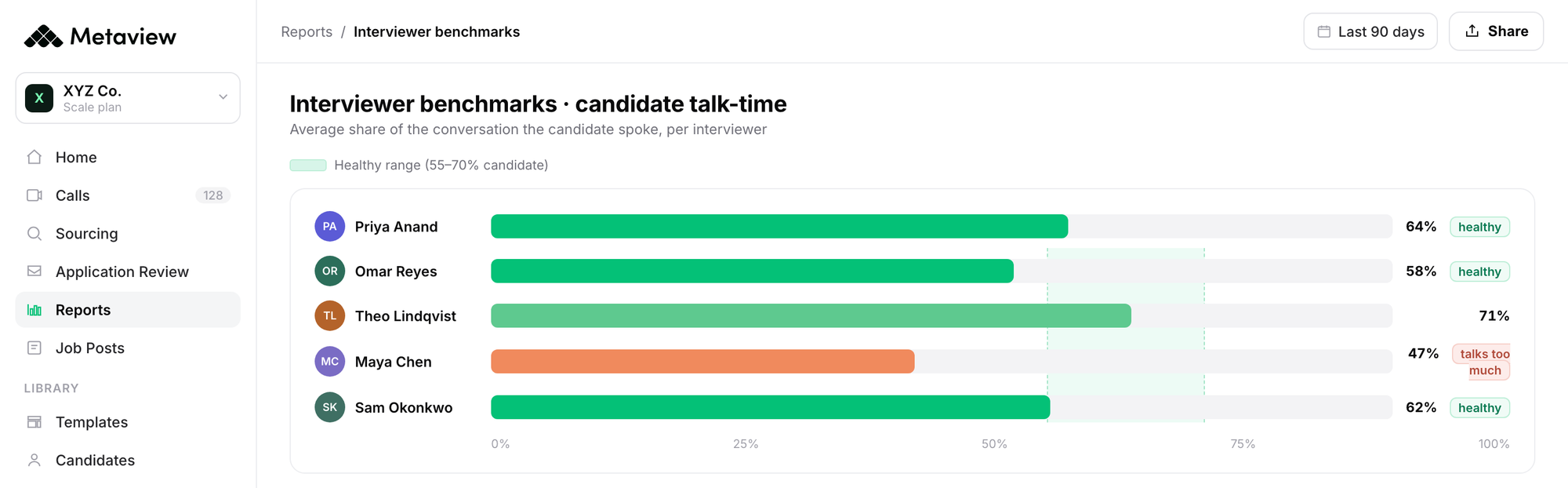
Pull your team's talk-share distribution and sort by the interviewers furthest from the healthy band. Read a couple of transcripts from each end, because the dominated interviews and the candidate-left-to-ramble ones will tell you different things.
Then coach the tail and leave the middle alone. Most of your interviewers are already close to balanced, so a blanket message about talking less would miss them and annoy the ones who are fine.
The gain comes from the handful of interviewers at the extremes, and a short conversation with the transcript open does more than a training deck for the whole team.
Beyond coaching, the setup itself helps. A structured interview guide gives the candidate room to talk by design, and a clear interview scorecard keeps the interviewer listening for evidence.
Balance in the room is a proxy for the thing you actually want: a candidate who revealed enough for you to make a real decision.
So spend your attention on the interviews at the edges and leave the balanced middle alone. If you are weighing tools that can surface numbers like these across your team, a good next read is our guide to the best interview intelligence software.
Put a number on your interview talk-time.
Capture every interview with Metaview and track talk-share across your team, interviewer by interviewer and stage by stage.
Frequently asked questions.
How much should an interviewer talk during an interview?
Aim to let the candidate do most of the talking. In practice that means asking a question, then following up on the answer, while the candidate carries the substance. The healthy split shifts with the format: a first screen where you explain the role runs closer to even, while a behavioral or technical round tilts further toward the candidate. If a scorecard felt thin on evidence afterward, that is the interview to go back and check your own share on.
Do interviewers actually talk too much?
On average, no, but the reputation is not baseless. A handful of interviews where someone talks over the candidate are the ones people remember, and they color the impression of every interview after. Interviewers also tend to underestimate their own share, so the person doing too much of the talking is usually the last to know. That is why a team average that looks healthy can still hide a few interviews worth fixing.
What is a good interviewer-to-candidate talk ratio?
There is no single ratio that fits every interview, and chasing one can mislead you. The number says nothing about whether the talking was useful. A candidate can hold most of the floor and still give you little to score against your rubric, while a more even conversation can be dense with evidence. So read the ratio as a prompt to go look at an interview, and judge the interview itself on whether the candidate gave you enough to decide.
How can I measure talk time across my interviews?
The measurement is automatic, computed from the recording. Once interviews are being captured, talk-share comes off the transcript, so there is nothing to tally during the conversation and nothing to change about how you interview. Because it runs off interviews you are already capturing, you can look back at earlier ones instead of waiting months to build a baseline. The one limit is that only interviews with clean speaker separation can be measured, which is why this benchmark is drawn from a subset rather than every recording.
What data is this based on?
It is aggregated, anonymized product data from across the companies that use Metaview, so it spans many industries, roles, and interview styles rather than one team's habits. The talk-share figures are measured from interview transcripts, so they do not depend on anyone's self-report, which is what makes them reliable. They come from the interviews where the transcript cleanly separates each speaker, about 2,700 of them, because that separation is what lets talk-share be calculated at all. No individual, company, or candidate is identifiable.
¹ Talk-share: 2,657 interviews with speaker-attributed transcripts; median interviewer share 46.8%, candidate 53.2%. ² Talk pattern, 2,542 interviews: 46.6% with the candidate holding the majority of the talking (the healthy band), 5.6% interviewer-dominated with the interviewer above 70%. ³ Speaking pace, 1,186 interviews: median interviewer 172.2 words per minute, candidate 158.6. ⁴ Longest uninterrupted stretch, 1,274 interviews: median interviewer 114.1 seconds, candidate 127.7 seconds. ⁵ Interruptions, 1,202 interviews: median 0, mean 18.21, split about evenly by direction. ⁶ Talk-share spread, 2,688 interviews: 10th percentile 27.9%, 25th 36.8%, 75th 56.7%, 90th 65.1% (median in note 1). Source: Metaview's corpus of roughly 5.5 million captured conversations (about 5.2 million candidate interviews), 2026. All figures are aggregated and anonymized, and talk-time figures are limited to interviews with usable speaker-attributed transcripts.
