
The candidates who interview best are often the most polished, and it's easy to read polish as judgment. A resume shows what someone has been near. In an interview, a fluent candidate shows they can tell a clean story about it. Neither shows you how a person reasons when there's no obvious answer, whether they own a decision once it goes wrong, or how they move people who don't report to them. Those are the parts of the job you're hiring for, and a smooth loop is where they slip past you.
A good strategic question gets at this, up to a point. You put a specific past decision in front of the candidate, with the constraints they actually had, and ask them to walk you through what they did and why. The follow-ups are where the reasoning shows up. You still end up with the candidate's account of that decision, though, and an account can be rehearsed, or quietly tidied to make them look better. So a strategic question hands you evidence to test in the room. It doesn't let you watch the candidate decide, and for the claims that carry the most weight you'll still want a work sample, a reference, or corroboration from outside the interview.
Below is a working set of these questions, organized by the risks they tend to expose, with the strong answer and the red flag for each. You pick the risks that matter for each role, and they change from job to job. A revealing answer is only worth something if it survives the walk to the debrief, so the last sections cover how to hold on to what you heard and check that your interviewers are weighing it the same way.
Why generic questions tell you so little.
"Tell me about a time you faced a challenge" turns up on every list of competency-based interview questions, and it's easy to prepare for. It rewards whoever rehearsed the smoothest version over whoever thought hardest about the problem. A confident answer tells you the candidate can package experience well. It says much less about the thinking underneath, and that's what you needed to see.
The interview is the one moment set up to get at that, and it only works when you push the candidate to show their reasoning. A summary won't do it.
Being able to identify someone on paper doesn't necessarily mean they're going to be great in person, or doing the job. You have to talk to them.”
Most loops never get there. They run on impression, and the impression that carries the room is usually confidence, which is exactly what a polished but risky candidate has to spare. So decide before the interview which risks you actually care about for this role, then build the questions around them.
Three risks worth probing, and the ones your role adds.
These three come up again and again in senior hiring, which makes them a reasonable place to start. Treat them as examples to reason from, and build your own list. Before you choose questions, name the one or two risks this particular role actually carries. A security lead and a first-time sales manager fail in different ways, and a question aimed at the wrong risk just buys you another polished story.
Judgment under ambiguity.
The risk is someone who's strong with a playbook and lost without one. They can run a known plan well, then stall or bluff when the situation is genuinely unclear and no answer is obviously right. Senior work is full of those moments. Watch a candidate handle one before you're counting on them to.
Ownership when it went wrong.
The risk is the person who's always one step removed from their own failures. The project slipped, and it was the org, the manager, the timeline, the other team. They'll happily own the wins. You're listening for whether they can name a real failure and point to their own part in it. The tell is whether they can say what they did differently afterward.
Influence without authority.
The risk is someone who can only move people they manage. Most real work happens across teams nobody controls. A candidate who avoids conflict, or who only gets things done by escalating to a boss, stalls the moment the org chart stops helping them. You want evidence they can change a mind with a good argument and a real relationship.
The strategic questions, by risk.
How you ask matters more than which question you pick. Ask for one real, specific example. A hypothetical gets you a hypothetical. Then follow the work: what they decided, what went wrong, what they changed, and who else was involved. The follow-ups are where a rehearsed story either gets more specific or starts to thin out, so keep pulling until you hit something concrete or realize there's nothing under it. End on the red flag you're testing for, so a smooth delivery doesn't carry the answer on its own.
Questions that test judgment under ambiguity.
- The reversal. “Tell me about a decision you made with solid information that still turned out wrong. What did you do next?” A revealing answer owns both the call and the correction, and can separate a good process from a bad outcome. The red flag: a story where nothing was the candidate’s fault.
- The trade-off. “Walk me through a time you had to choose between two things you genuinely cared about, with no clean answer.” Strong answers name what they gave up and why it was worth it. The red flag: pretending there was no cost, or that the right move was obvious.
- The cut. “If you joined and had to drop a third of your responsibilities in week one, what goes, and how would you defend it?” Good answers prioritize by impact rather than comfort. The red flag: cutting the hard, unglamorous work and keeping the visible work.
- The borrowed view. “What’s a common belief in your field you think is wrong, and what changed your mind?” You want a specific position they can defend with reasoning. The red flag: a safe contrarian take with nothing underneath it.
Questions that test ownership.
- The real failure. “Tell me about something you owned that genuinely failed. What was your part in it?” A strong answer gives a specific failure, their role in it, and what they changed afterward. The red flag: a humblebrag, or a failure that quietly turns out to be someone else’s.
- The line. “Where did your responsibility end on that project, and did you ever step over it?” You’re listening for ownership that didn’t stop at the job description. The red flag: a tight, defensive boundary drawn to keep blame out.
- The credit. “Tell me about a win you’re proud of, then tell me who else made it happen.” Strong candidates name real contributors specifically. The red flag: a solo story for work that obviously took a team.
- The bystander. “When something was going wrong and it wasn’t strictly your job, what did you do?” A good answer steps in, or raises it early with a plan. The red flag: watching it happen and filing it under not my problem.
Questions that test influence without authority.
- The disagreement. “Tell me about a time you disagreed with a leader and turned out to be right. How did you handle it?” Strong answers make the case with evidence and keep the relationship intact. The red flag: either rolling over, or winning by going around the person.
- The skeptic. “Describe convincing someone who started out against you. What moved them?” You want a candidate who understood the other side’s incentive and spoke to it. The red flag: ‘I just kept pushing until they gave in.’
- The lost room. “Tell me about a time you failed to get buy-in. Why?” A strong answer shows a clear read on what they misjudged about the audience. The red flag: blaming the room for not getting it.
- The handoff. “Describe getting a team you don’t manage to deliver something for you.” Good answers trade value, build the relationship, and make it easy to say yes. The red flag: relying entirely on a manager or a mandate.
A good answer to any of these gives you a lead, and a lead still needs checking. You get a claim specific enough to test: the artifact they made, the number that moved, the colleague who was in the room. For the one or two claims that will actually decide the hire, confirm them outside the interview with a work sample or a reference.
Score from what the candidate actually said.
A sharp question is only half the job. The answer still has to survive the walk to the debrief, and often it doesn't. Write the scorecard from memory afterward and you keep the impression and lose the specifics. The precise thing the candidate said flattens into a general read, and the risk you worked to expose goes with it.
Good intentions won't fix that. When the interview is recorded, with the candidate's consent, the example they actually gave sits on the record and the debrief can work from what was said. Metaview drafts the scorecard from that conversation against the criteria you set, so the interviewer reviews the evidence and rates each risk without rebuilding the hour from scratch. The rating stays with the interviewer, and so does the hiring decision.
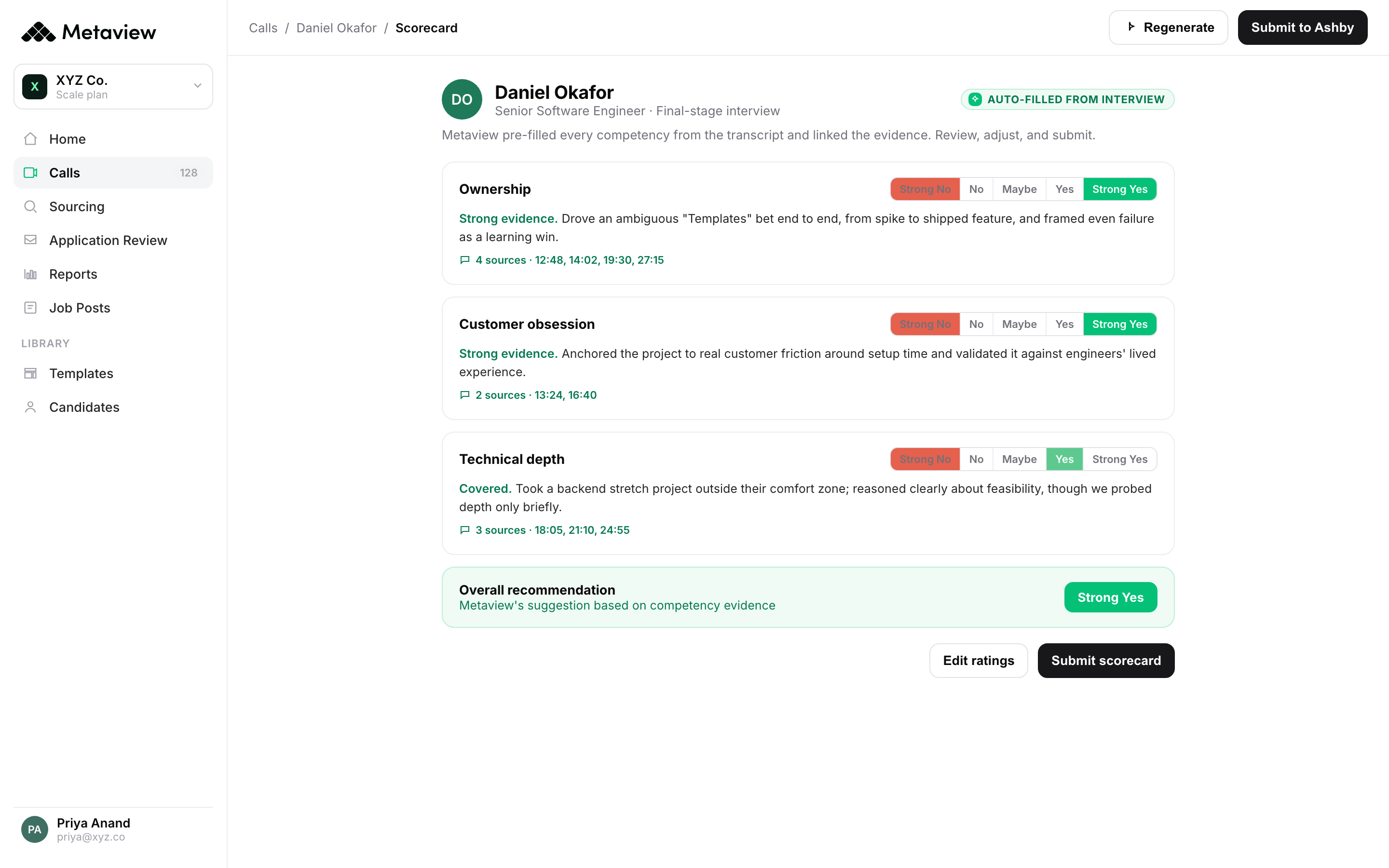
Keeping the evidence also lets you check something most loops just assume: that a strong yes from one interviewer means the same thing as a strong yes from another. With the answers on the record, you can compare how two people rated the same kind of response, and see whether each interviewer actually probed the risk they were assigned. That comparison is the raw material for calibrating a panel, and calibration is still something the panel works out in conversation. The record makes that conversation possible: everyone points at the same answers, and nobody is left with two conflicting memories.
A Vercel recruiting leader described one interviewer whose calls tracked the panel closely:
For every candidate Gasper gave a strong yes, 87% ended up with the offer.”

That tells you Gasper's strong yes lined up with where the panel ended up almost every time. It doesn't tell you those hires worked out, and matching the eventual offer is not proof the read was right. The transcripts were the reason it went anywhere. Viet Nguyen went back to them and pulled out the specific behaviors behind Gasper's strong yes, which gave the rest of the panel something concrete to look for.
How to put this to work with your team.
You don't automatically need a longer interview loop. Before you add a stage, check whether the loop you already run tests the risks this role carries. Plenty don't, since the questions are generic, and another round of generic questions just produces more polished stories. Sharper questions usually beat more questions.
So start small: pick one open role. With the recruiter, name the one or two risks worth probing hardest here. Choose the three or four questions that go straight at them, and agree out loud what a strong answer sounds like before anyone walks into the room. Put those questions in your question bank and interview templates so every panelist asks them, keep the answers on the record, and after a few loops look hard at whether your interviewers are grading the same way.
Better questions get you a better account of how someone works. It's still an account, so weigh it as evidence and back up the claims that will decide the hire. Keep the record, and two interviewers who disagree will at least be arguing about the same evidence.
Run the strategic questions in your real interviews.
Ask the questions that fit the role and keep the answers on the record, so you can see whether your interviewers are grading the same thing.
Frequently asked questions.
What are strategic interview questions?
Strategic interview questions ask a candidate to walk through a specific decision or failure from their own experience, then probe it with follow-ups. They skip the request to describe a strength and get at how the person handled real ambiguity, ownership, and other people, the things a polished resume and a smooth interview can both hide. You end up with an account you can test in the room, so the follow-ups matter as much as the question, and the claims that would decide the hire still need checking outside the interview.
What if a candidate's strongest examples are confidential?
You don't need the proprietary details to test the thinking. Ask how they framed the decision, what they traded off, who disagreed and why, and how they'd explain the call to someone outside the room. If the specifics matter for a senior hire, a reference who was there can confirm the shape of it without anyone breaking a confidence.
When is a work sample or a reference better than an interview question?
When the claim will decide the hire. An interview answer is the candidate's own account, so for the one or two things you most need to be true, a work sample shows the ability directly and a reference checks the account against someone who saw it. Use the questions to find what you need to verify, then go verify it.
How do you handle two interviewers who rate the same answer differently?
Treat the disagreement as the useful part. Go back to what the candidate actually said. An interviewer's summary is already a step removed. Work out whether they were weighing different things or reading the same evidence differently. That conversation is how a panel calibrates, and it doesn't happen if the answer only survives as two conflicting memories.
