
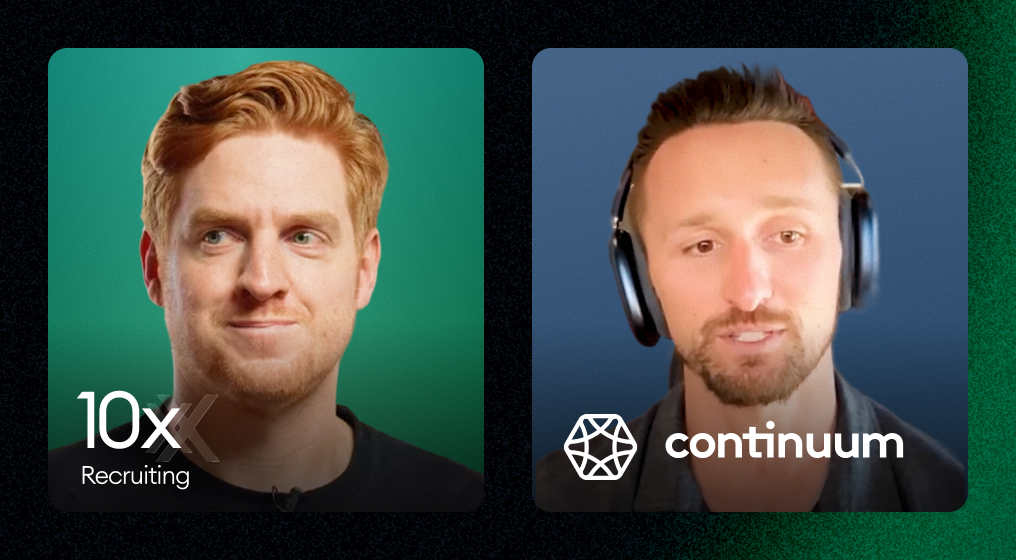
Nolan Church sat down on 10x Recruiting with two things on his desk: a notebook full of CEO hot takes from Day One Ventures' CEO Converge, and a working session on the AI hacks recruiters can actually run this week. The mash-up is the post: what CEOs think about hiring, and the moves that turn an AI-curious recruiter into one who ships real time back.
The CEO hot takes land hard because they come from founders saying the quiet part out loud. Team chemistry beats raw talent on a small team. Glassdoor reviews are less reliable than the people you call. The best salespeople aren't the ones with the cleanest resume. And the AI hacks are not strategy decks. They are two concrete workflows Nolan runs every week: a custom GPT that drafts his LinkedIn posts in his voice, and a set of Metaview templates that compress candidate write-ups from forty-five minutes to under five.
The 2026 reframe is what makes this episode worth re-reading nine months later. The recruiters who treated AI as a productivity hack in 2025 are running the desk in 2026. The ones who waited are watching their best candidates get moved through other people's pipelines in days, not weeks. The gap is no longer theoretical. The data is in.
What CEOs actually look for in a hire
The CEO Converge takeaway that hit hardest was about team chemistry. On a team of fifteen, one bad hire is not a minor friction. It is a 7 percent culture drag. CEOs at the event said they would hire a B-plus candidate who lifts the room than an A candidate who pulls energy. The recruiter's job in that world is not to ship the best resume. It is to protect the chemistry of the team through the screen.
The second takeaway was the question CEOs ask before any offer: "who else would hire this person?" Not in a credentialing sense, but in a back-channel sense. If the hiring manager can name three respected operators who would say yes on the spot, the offer goes out. If not, the loop runs longer. That is a signal recruiters can engineer into the process by surfacing references early.
The third was about sales hires specifically. Nolan's read from the room: the best salespeople are not the polished ones with the cleanest pitches. They are the ones who can read a room and adjust in real time. That maps to interviewing for adaptability, not for script delivery. A structured interview that records the actual conversation, not just the talking points, is the only honest way to measure that.
The Glassdoor and pedigree problem
CEOs in the room had a shared frustration: Glassdoor is noise. Disgruntled former employees over-index. The truly engaged ones rarely write reviews. The signal-to-noise ratio is too low to drive a hiring decision, and the founders who treat it as one are working off a distorted picture. The replacement is a real back-channel: two or three calls with people who managed the candidate in the last role.
The same applies to pedigree. A candidate from a name-brand company is not automatically a better hire than one from a less recognizable place. CEOs at the event said they had been burned more by pedigree hires than helped by them. The pattern: pedigree candidates often over-index on optics and under-index on grit. The recruiters who screen for output, not affiliation, win those rounds.
Glassdoor reviews are the noisiest signal we have. The best hires we ever made came from a five-minute back-channel call with someone we already trusted.”

Nolan's custom GPT for LinkedIn
Hack one: a custom GPT trained on a year of Nolan's own LinkedIn posts. The setup is mechanical. Export every post you have written. Drop them in as the GPT's reference corpus. Give it a system prompt that says "write in this voice, with these structural patterns, on topics in this domain." The output is not perfect on the first pass. It is 70 percent there, which is the threshold where the editing time drops below the writing time.
The recruiter version of this is the same shape. Pick a recruiter on your team whose outreach converts. Export their last 50 outbound messages, with the candidate's role and the result. Train a GPT on that corpus and a system prompt that names the role, the company stage, and the candidate persona. You now have a voice-cloned drafting assistant that produces messages the team can ship with light edits, not rewrites.
The trap is calibration. A GPT trained on one recruiter's voice will not write in another recruiter's voice. The fix is to maintain a small library, one GPT per voice, and let each recruiter use their own. The team uses the same underlying LLM principles Nolan applies for posts; the assets are personal.
The Metaview template move
Hack two is where the 40-plus minutes come back. Nolan's previous workflow: take an interview call, hand-write notes during, type them up after, summarize into a Slack message, ping the hiring manager, attach the resume, write a recommendation. Forty-five minutes minimum, often an hour. Now: Metaview captures the call, transcribes verbatim, runs the structured template that asks the questions the hiring manager wants answered, and produces a debrief that drops into Slack with one click.
The template is the secret. Without a template, a Metaview transcript is still a long document the recruiter has to summarize. With a template, the AI fills the template structure during the call: strengths, concerns, evidence, recommendation. The recruiter reviews and ships. The 40 minutes saved per candidate compound across a desk that runs 30 interviews a week. That is 20 hours of recruiter time back per week. One full working day.
The template move also closes the consistency gap. Every interviewer on a panel produces a write-up in the same structure, which means the hiring manager reads four debriefs that compare directly instead of four prose narratives with different framings. The decision quality lifts because the comparison is cleaner.
- Hand-write notes during interview, type them up after
- Write outreach messages from scratch in your inbox
- Summarize 45-minute calls into Slack messages by hand
- Read four prose debriefs with different framings
- Metaview captures the call and fills the template live
- Voice-cloned custom GPT drafts in your team's tone
- One-click structured debrief drops into Slack post-call
- Four debriefs in identical structure that compare directly
Beyond AI slop: the bar for real work
Nolan's framing on AI slop is the most useful in the episode. AI slop is content that an AI could have written and a reader can tell. Generic, structureless, no voice, no evidence. The recruiter who copies and pastes a generic GPT output into a LinkedIn post is producing slop. The recruiter who feeds the GPT their own corpus, edits the output, and adds a real story is producing work the reader cannot distinguish from a hand-written post. The line is feedback, not the underlying tool.
The same applies to interview write-ups. A generic AI summary is slop. A templated Metaview debrief, structured around what the hiring manager needs to decide, with verbatim candidate quotes and the recruiter's recommendation, is real work. The AI is the typist, not the author.
AI slop is what you get when you skip the input. Real work happens when you feed it your voice, your context, and your judgement, and let it carry the typing.”
Where AI gives recruiting teams use
Voice-cloned outreach that lifts response rates without the generic-template tell that gets messages ignored.
Top-of-funnel triage against the role's actual rubric, not a keyword scan that surfaces the wrong shortlists.
Templated debriefs that capture the interview and structure the write-up in one pass, 40 minutes saved per candidate.
A consistent comparison layer across interviewers so hiring managers read structured evidence, not prose.
According to Metaview's 2026 AI & Hiring Alignment Report, surveying 505 recruiting leaders and hiring managers across North America and EMEA, the recruiting teams that have moved AI from experiment to operating system are hitting their goals at twice the rate of the ones still piloting. The CEO hot takes from the September 2025 event read like a preview of the report's findings: chemistry over pedigree, back-channels over Glassdoor, output over optics.
The hacks Nolan ran on the show were single-recruiter moves. The report data shows the same moves at team scale: AI-augmented recruiters running multi-thread workflows with structured templates produce the structured evidence that hiring managers actually want. The teams that have made that shift are three times more likely to hit hiring goals than the teams that have not.
The teams in the report's top quartile shared a profile: AI handles the writing and the structure, the recruiter handles the judgement and the candidate relationship. The teams in the bottom quartile were still hand-typing notes after every call. The gap was not skill. It was tooling, and the tooling decision sat at the head-of-talent level, not the individual-recruiter level. The tool choice is the strategy, in other words.
The operating shift
The shift Nolan was modelling on the show is not "use AI to do recruiting faster." It is "redefine what a recruiter spends their time on." Three concrete moves close the 2026 gap.
One: train a voice-cloned GPT for outreach. Pick the recruiter on the team whose response rates are best. Export their last 50 outbound messages with role, candidate persona, and result. Build the GPT in an hour. Every other recruiter drafts in that voice and edits, instead of writing from scratch.
Two: template every interview type. Screening, hiring manager, technical, panel, final. Each template asks the questions the hiring manager actually decides on, and the AI fills the structure during the call. The recruiter reviews and ships. Forty minutes back per candidate, every candidate.
Three: kill the prose debrief. Hiring managers do not want a paragraph that says "this candidate was strong but had concerns around scope." They want strengths, concerns, evidence, and a recommendation in the same shape across every interviewer. The structured template is the deliverable. The recruiter who still writes prose is doing the hiring manager's comparison work for them, badly.
Bring Metaview into your hiring stack.
Live notes, structured scorecards, and ATS sync - set up in under 10 minutes.
Frequently asked questions
What is a custom GPT and how is it different from regular ChatGPT?
A custom GPT is a version of ChatGPT trained on a specific corpus and given a fixed system prompt that describes voice, tone, and use case. For a recruiter, that means feeding it your team's best outreach messages and writing samples so the drafts come back in your voice, not the generic LLM voice that produces AI slop.
How long does it take to set up a custom GPT for LinkedIn or outreach?
Under an hour for the first pass. Export the writing samples, drop them into the GPT builder, write a system prompt that names the role and the target persona, and run five test drafts to calibrate. Most of the setup time is in the calibration loop, not the upload.
How does Metaview save 40 minutes per candidate write-up?
Metaview captures the interview live, transcribes it, runs the recruiter's chosen template against the transcript, and produces a structured debrief with strengths, concerns, evidence, and recommendation. The recruiter reviews the output and ships it, instead of writing notes by hand and summarizing them into Slack after the call.
Why are CEOs skeptical of Glassdoor reviews?
The Day One Ventures CEO Converge consensus: Glassdoor over-indexes on disgruntled former employees and under-indexes on engaged current ones. The signal-to-noise ratio is too low to drive a hiring decision. The replacement is a short back-channel call with two or three people who have managed the candidate in a recent role.
What does AI slop mean and how do recruiters avoid it?
AI slop is content a reader can tell was written by an AI without any human input. Generic, structureless, no voice, no specifics. Recruiters avoid it by feeding the AI their own corpus, their own context, and their own judgement, and using the AI as the typist, not the author. The bar is whether the reader can tell.
