
Here's a competency-structured interview notes template you can copy today. Take it, use it this week, and read the rest if you want the argument underneath it.
The argument is narrower than the one these guides usually make. A template can't make the hire come out right. The data doesn't measure whether better notes make better hires, and it never will: interview records stop at the decision and hold no post-hire performance data. Note quality isn't scored anywhere either.
What you can check is smaller than that. A candidate advances or gets turned down, and someone who wasn't in the room comes looking. Is there anything written they could open and follow? That's the whole test, and it's the one this template is built to pass.
The interview notes template you can copy.
Two parts: a header you fill in once, and a block you repeat for each competency the round is assessing.
The competencies come from the intake call, so write them down before the interview starts. Four to six per role is what tends to fit into an hour. There's no study behind that number.
Header
- Candidate, role, interviewer, date
- The competencies this round is assessing
- One line on what a strong answer looks like for this role
For each competency
- Competency name, and what you're listening for
- Evidence: the specific things the candidate said or did, in their words where you can
- Follow-ups you asked, and what they turned up
- Rating on your scale, with one line tying it to the evidence above
Overall
- Recommendation: advance, hold, or no
- The specific things the recommendation rests on
That last line carries more than it looks like it does. A rating has nothing underneath it when you can't name something specific the candidate said, and the debrief won't either.
What structure fixes, and what it does not.
Freeform notes are quick to write and slow to use. A page of prose leaves you with an impression of the candidate and no way to hold it up against the next one.
File each piece of evidence under the competency it belongs to and the second half of that problem goes away. Two candidates end up scored on the same fields, and a third person can see which answer each rating came from. Now there's something to compare. You still can't tell which candidate is stronger from a form, and a template that claimed otherwise would be selling you something.
- A page of prose you skim before the debrief
- Impressions: "seemed sharp," "good energy"
- Nothing lines up between two candidates
- Evidence filed under the competency it belongs to
- What the candidate said, with the rating beside it
- Both candidates sit on the same fields
You feel it in the debrief. A panel trading impressions has nothing specific to disagree about, and the disagreement is the part that does the work. Put the same evidence in front of them against one interview rubric and there's something concrete on the table to fight over.
Where interview records actually fail.
Most notes guides run on the same premise: the interviewer writes up the conversation days later, from memory, and the details are gone by then. It's a tidy story. The timing doesn't back it up.
The median write-up landed 2.32 hours after the interview ended, and 74.7% were in within 24 hours, across 811,298 scorecard submissions captured on Metaview. The mean sits much higher at 36.16 hours, which points to a slow tail and a fast middle. Most write-ups are a same-day job.
Those figures count only the scorecards that were eventually submitted. A write-up that never happened has no submission time attached to it, so the numbers describe the people who did the work and say nothing about the ones who didn't.
That's where the real gap sits. Submission runs at 50.3% when Metaview generates the scorecard from the interview, against 28.6% when the interviewer starts from a blank page, in a capped sample of 120,000 scorecards. The base underneath that comparison is thin. Across a corpus of 5.2 million candidate interviews, 31.2% carry at least one scorecard, and of 296,555 candidates who advanced to a later round, 41.9% moved on with no submitted scorecard behind them.
All a missing scorecard tells you is that the platform held no submitted scorecard when the candidate moved on. Nobody can say from that whether the decision came out of memory or got settled in a corridor. The narrower claim is the harder one to argue with. Whatever the reasoning was, there's nothing on file to read it from.
Then there's length. Written feedback ran to five words or fewer in 26.6% of the 13,382 scorecards that carried any. Five words logs that an interview happened. It says nothing about what the interview found.
A template handles the thin write-up. It gives every one the same shape, and it makes the five-word version look as thin as it is. What it can't handle is the write-up nobody had time to start. The thing in the way there is time and attention, and no form fixes that.
What a first draft changes.
The missing-record number moves when somebody else does the first draft. Reminders have had a long run at it. Metaview's generated scorecards carried a mean of 7.85 filled fields against 2.61 for manual ones, in a separate capped sample of 80,000.
A field count measures completeness, and completeness is a different thing from quality. Three specific things the candidate actually said are worth more than a form with every box filled by generic text, and the count can't tell those two apart. The comparison is observational too. Teams that switch generated scorecards on may already run tighter loops, so the gap shouldn't be read as the drafting on its own.
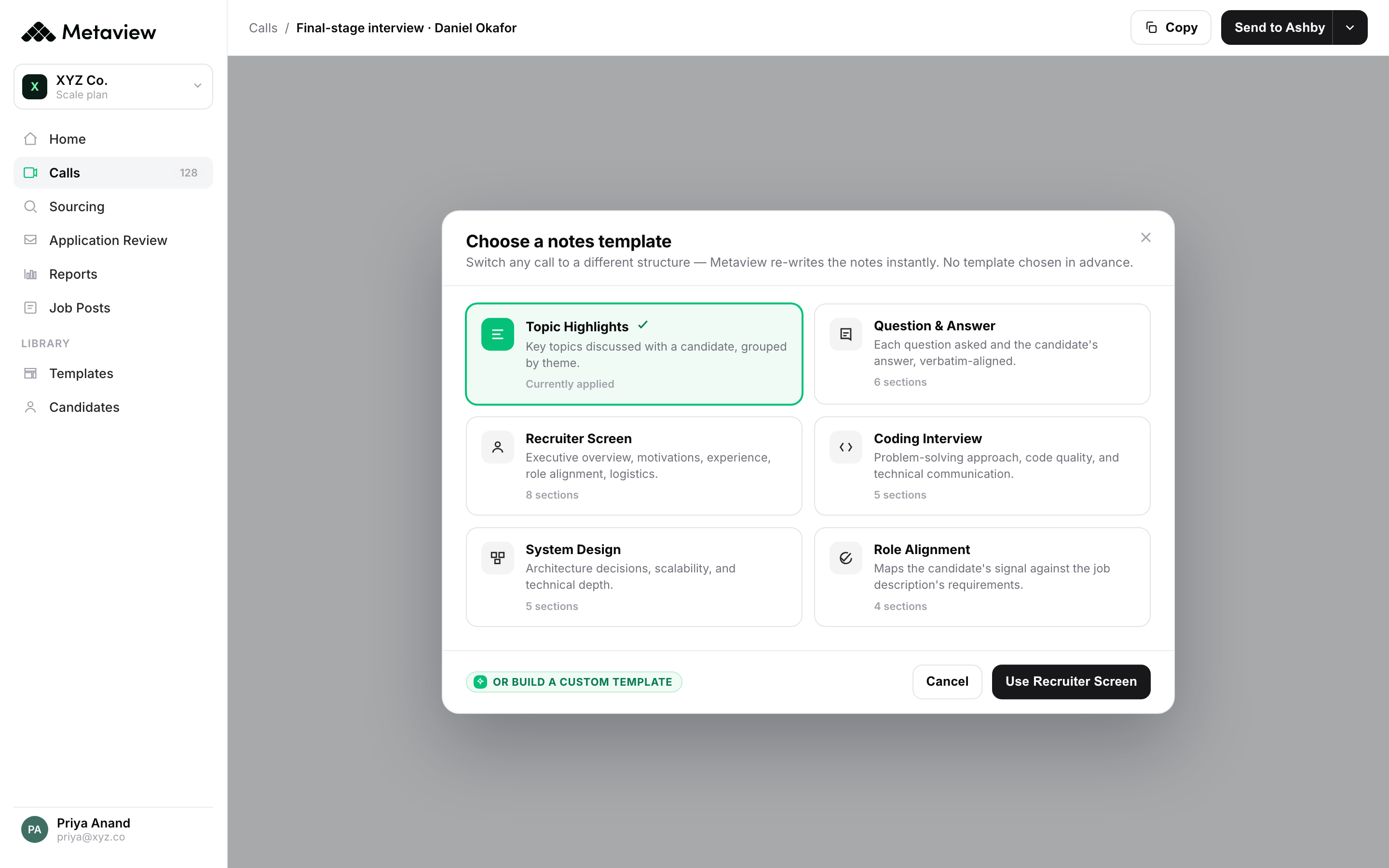
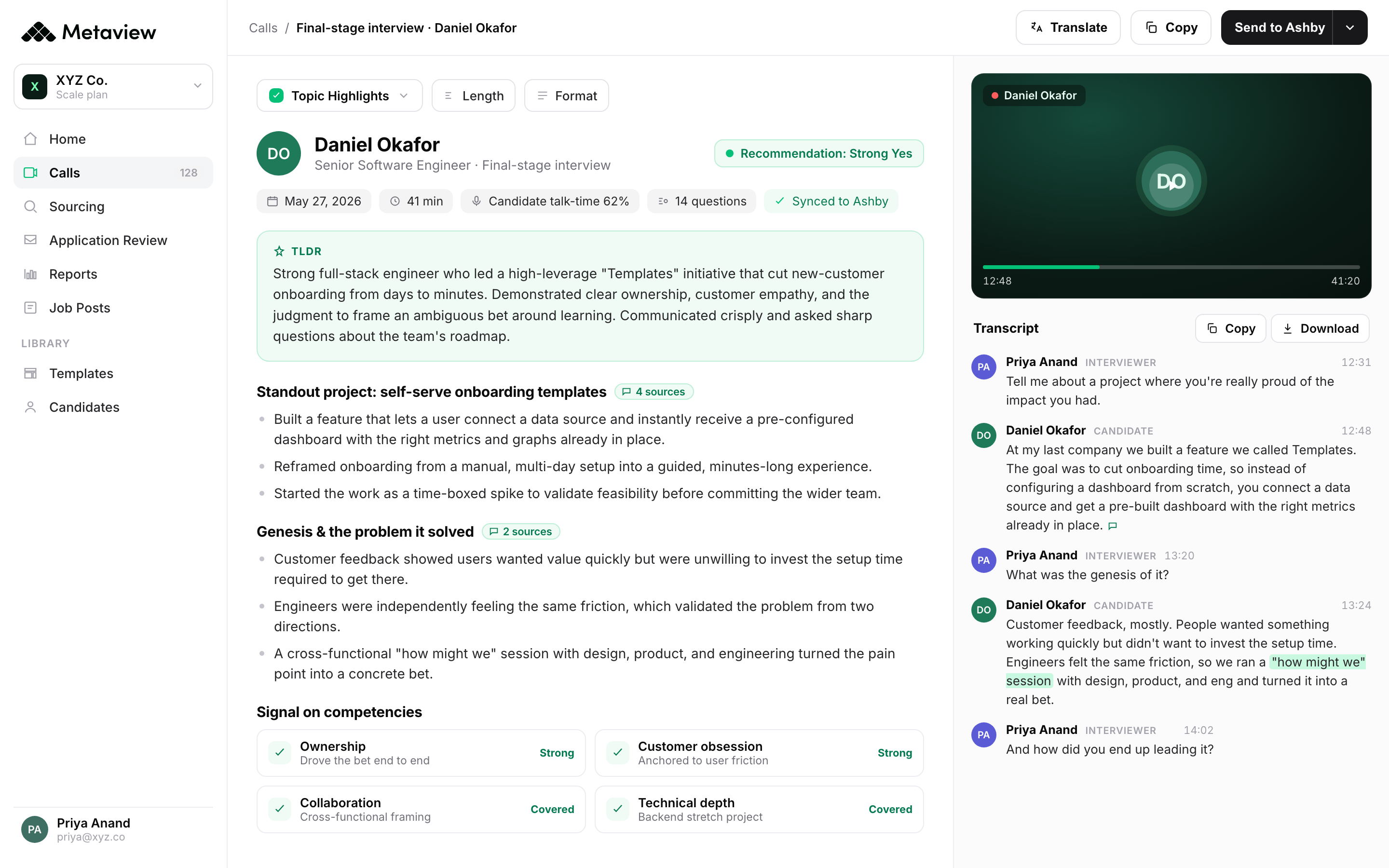
Here's what changes on the ground. Metaview records the interview as a participant, with consent from both sides, and turns it into structured notes against the competencies you set. Each note section links back to the moment in the transcript it came from, so you can check any line in the write-up against what was actually said.
Metaview then drafts the scorecard from what the candidate said, and the interviewer reads it, corrects what's wrong, and submits it. Submitting straight from Metaview works on Ashby and Lever. On Greenhouse the interviewer pastes it in.
AI takes away the crud, relational recruiting is what's left.

The crud, in this case, is the typing. The judgment stays with the interviewer. Metaview doesn't decide who advances, and a generated draft nobody reads is a worse record than three honest sentences somebody wrote themselves.
A record only counts if the next person can find it. Nobody goes hunting through a document on somebody else's laptop. Metaview syncs with the ATS you already use, so the notes and the scorecard land on the candidate's record where the rest of the team is already looking.
How to make it stick.
A template only helps when the whole loop uses it the same way. Four habits get you most of the way there.
- Close the write-up before the day ends, which is already when most of them happen
- Give each interviewer one or two competencies to own instead of the whole candidate
- Keep one rating scale across the loop and reset it now and then with regular calibration
- Pair the template with competency-based interviewing so the questions and the fields match
Every one of those habits competes with the next interview on the calendar. Time decides whether the record exists at all, which is why one customer's own time figures belong here as a documentation result.

The most clear impact is the time saved. Recruiters save 20 minutes per interview from wrangling notes and submitting scorecards. Per month, that's 53 hours saved in total.

Both figures are Automattic's own, from their case study. They measure minutes, and nothing about the hires those minutes went into.
The template is the part you can use tomorrow. The test stays the same either way. Can someone who wasn't in the room open the record six weeks from now and see what the decision rested on? A better form was never going to fix a no.
See what the interview record looks like when you stop typing.
Structured notes against your competencies, a scorecard draft you edit, and every line traceable to the moment it came from.
Frequently asked.
What should an interview notes template include?
A header you fill in once (candidate, role, interviewer, date, and the competencies this round is assessing), then a repeatable block per competency holding what the candidate said, the follow-ups you asked, and a rating tied to that evidence. Close with a recommendation and the specific things it rested on.
How do you take good interview notes?
Write down what was said rather than what you concluded from it. Keep fragments in the candidate's own words where you can, note who asked the follow-up, and file each fragment under the competency it belongs to. A rating with no fragment under it can't be checked by anyone afterwards.
Should you write interview notes during the interview?
You can, and plenty of good interviewers do. The cost is attention: typing while someone is answering means you're half in the conversation. Many teams now let a notetaker capture the conversation, with consent from both sides, and review the structured notes once the call ends.
What is the difference between interview notes and a scorecard?
Notes are the record of what was said. The scorecard is the rating you give each competency. The rating is what your team acts on, and the notes are the only reason anyone can go back and see what it was based on.
Can interview notes sync to your ATS?
Yes, and the detail varies by system. Metaview syncs with the ATS you already use, so notes and scorecards sit on the candidate's record. Submitting the scorecard straight from Metaview works on Ashby and Lever; on Greenhouse the interviewer pastes it in.
