
Ask most teams whether their interviews are structured and they'll say yes. Our data says otherwise.
A relaxed, unscripted chat can feel like the better way to get to know someone. Structure is what tells you which of them can do the job.
Structure doesn't guarantee a great hire, nothing does. But when every candidate answers the same questions, you can see who's stronger instead of guessing. And structure probably isn't what you think it is...
What separates structured from unstructured.
A structured interview looks like this: you're hiring a senior developer, six candidates are in the running, and every one of them gets the same job-relevant questions, scored against the same rubric.
You can measure them against each other on the points that matter for the job, and still get into who they really are.
An unstructured interview is whatever the conversation becomes on the day. You find out the candidate worked at your old company, half the interview disappears into stories, and you walk out with a great feeling and nothing you can score.
Structured doesn't mean rigid.
There's still room for the conversation to breathe and to get to know the person behind the resume. But when you're competing for a niche role, the best candidate is deciding on you too, and a consistent process tells them you know what you're doing.
- Different questions for each candidate
- Scored on overall impression
- Hard to compare two people fairly
- Rapport stands in for evidence
- Same core questions, role-relevant
- Scored against a defined rubric
- Candidates line up on the same scale
- Evidence stands in for rapport
What the data shows about structure.
Truly structured interviews are quite rare. Of all the conversations we captured in the last 12 months, only 30.5% had a structured guide.¹
Technical interviews usually have some sort of structure but intake calls and screens at the start of the process almost never do.
The gap is stark: 68.8% of technical interviews ran with a guide loaded, and for intake calls it was 0.4%.
A major part of running a structured interview is the scorecard. The guide keeps the questions consistent; the scorecard is where each interviewer rates what they heard against the rubric, so the panel has something to compare.
Most teams do create scorecards. The writing up is the part that slips, which is why more of them now hand the first draft to AI.
In our data that helps, at least with getting the thing finished: 28.6% of manually created scorecards get submitted, against 50.3% when the draft is AI-generated.¹
A submitted scorecard isn't automatically a useful one, though. What's inside it counts: about a quarter of the scorecards teams create never get a single field filled in.¹
It also has to be used on every interview for the role, by every interviewer, or the comparisons fall apart. About 42% of candidates who advance do so without a submitted scorecard on record, which usually means the call was made on memory rather than the rubric.¹
AI can carry this work, but it has to know what it's scoring. A general-purpose assistant will summarize the transcript well enough; it doesn't know your competencies or your rubric, and the summary stops at the chat window.
If you're going to hand the scorecard to AI, use one built for recruiting.
That's the job Metaview's Notetaker was built for. It sits in the interview and writes the notes as the conversation happens, and by the time you're out, the scorecard is drafted: every competency from your interview template rated, with the evidence and the timestamps it came from.
The interviewer reviews and adjusts instead of writing from memory, and the finished scorecard goes into your ATS, where the panel makes the decision.
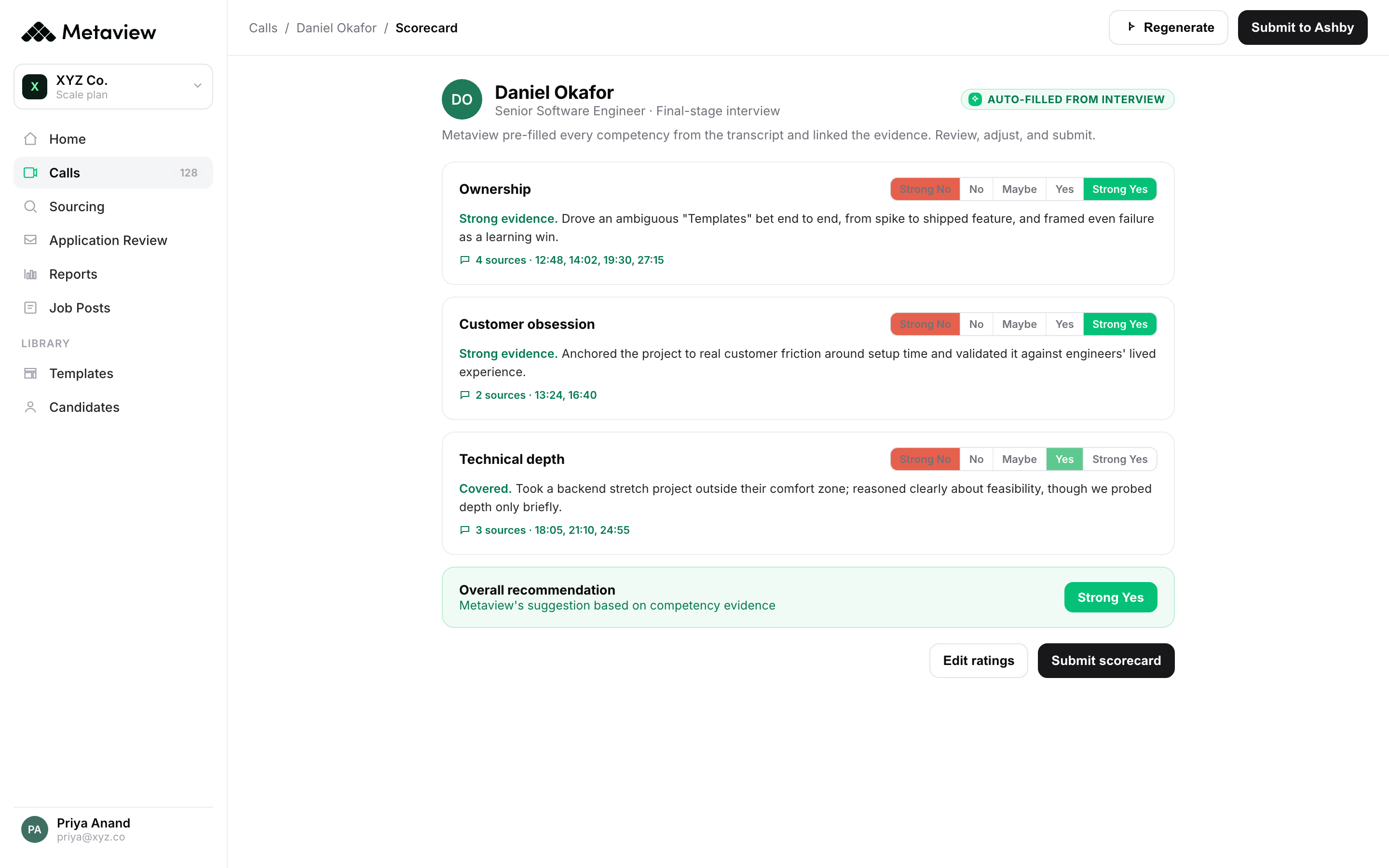
The screenshot above shows how that pans out for a final-stage engineering interview. Each competency the panel agreed on has a rating, a one-line read on the evidence, and the timestamps it came from, so anyone who doubts a rating can jump to that moment in the conversation and check.
The interviewer's job shrinks to reviewing the draft, editing anything they'd score differently, and hitting submit.
If you want this on your own interviews, the setup in Metaview is choosing a template: pick one for the role from the template library, or build your own from the competencies you agreed at intake. The Notetaker takes it from there on your next call.
Do structured interviews lead to higher offer acceptance?
No single factor decides whether an offer gets accepted, so we won't pin it all on structure. A structured process tends to help in two ways.
The first is candidate experience. Candidates can tell when every interviewer comes prepared and the process is going somewhere.
They can also tell when it isn't: when three interviewers ask the same question because nobody split the ground between them, the candidate reads it as a preview of how the company runs. That matters to someone weighing more than one offer.
The second is speed and conviction. When the panel is aligned on the bar, the hire/no-hire decision and the offer come faster, and a slow offer gives a strong candidate time to take the other process seriously.
Scored evidence shortens the debrief too: the panel compares ratings on the same competencies instead of reconstructing the interview from memory.
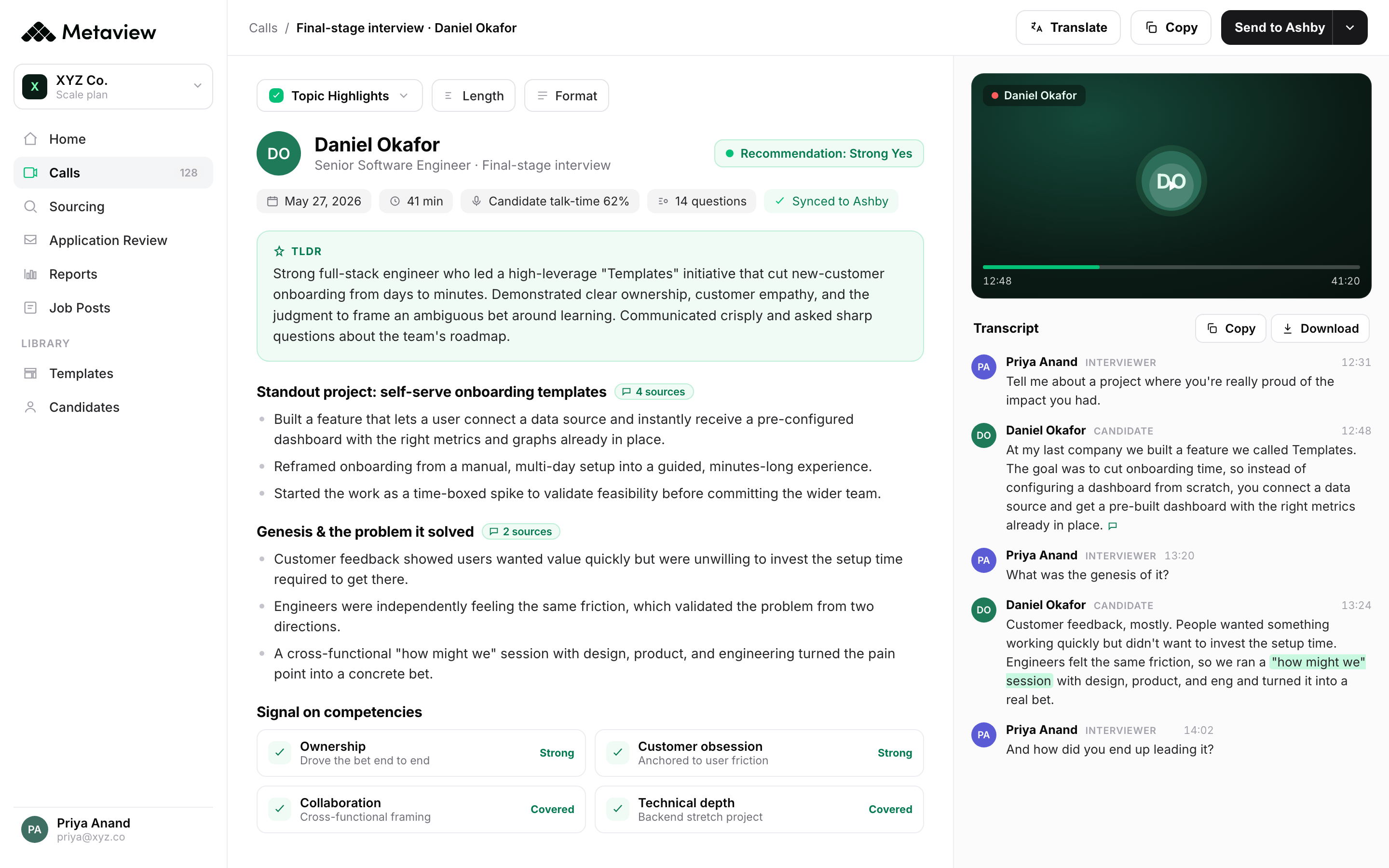
Below is what the evidence side looks like: a final-stage interview captured with Metaview. The notes were written while the conversation ran, the competency ratings are already tallied, and everything is synced to the ATS by the time the panel sits down. The decision doesn't wait for anyone's write-up.
How to set up a structured interview.
The fear is that structure makes interviews cold. It doesn't, if you separate the two jobs: be warm as a host, be consistent as an evaluator.
Structure does come with a small time cost. In our data, interviews with a structured guide ran about 7 minutes longer, which is not much against everything else a hire takes.
Most of the work happens before anyone sits down with a candidate. Here's what to have ready.
- Pick four or five competencies at the intake call, before anyone interviews, and write down what a strong answer looks like for each one. That's what stops two interviewers scoring the same answer differently.
- Write two or three questions per competency and split them across the panel, so every competency gets covered without two interviewers going over the same ground.
- Ask everyone the same core questions, then follow your curiosity on the follow-ups. The follow-ups are where the interview stays human.
- Score against the rubric during the interview or straight after it, and quote the evidence behind each rating. Leave it to the next day and you're scoring a memory.
- Recalibrate the bar every few hires, so scores don't drift as the panel changes.
That's a lot of setup, and it's the honest reason most interviews never get any. Metaview does most of it for you, off the back of conversations you're already having.
Point by point:
- Record the intake call with Metaview and the competencies you agreed on stay on record. Metaview drafts the job post from them instead of you starting from a blank page.
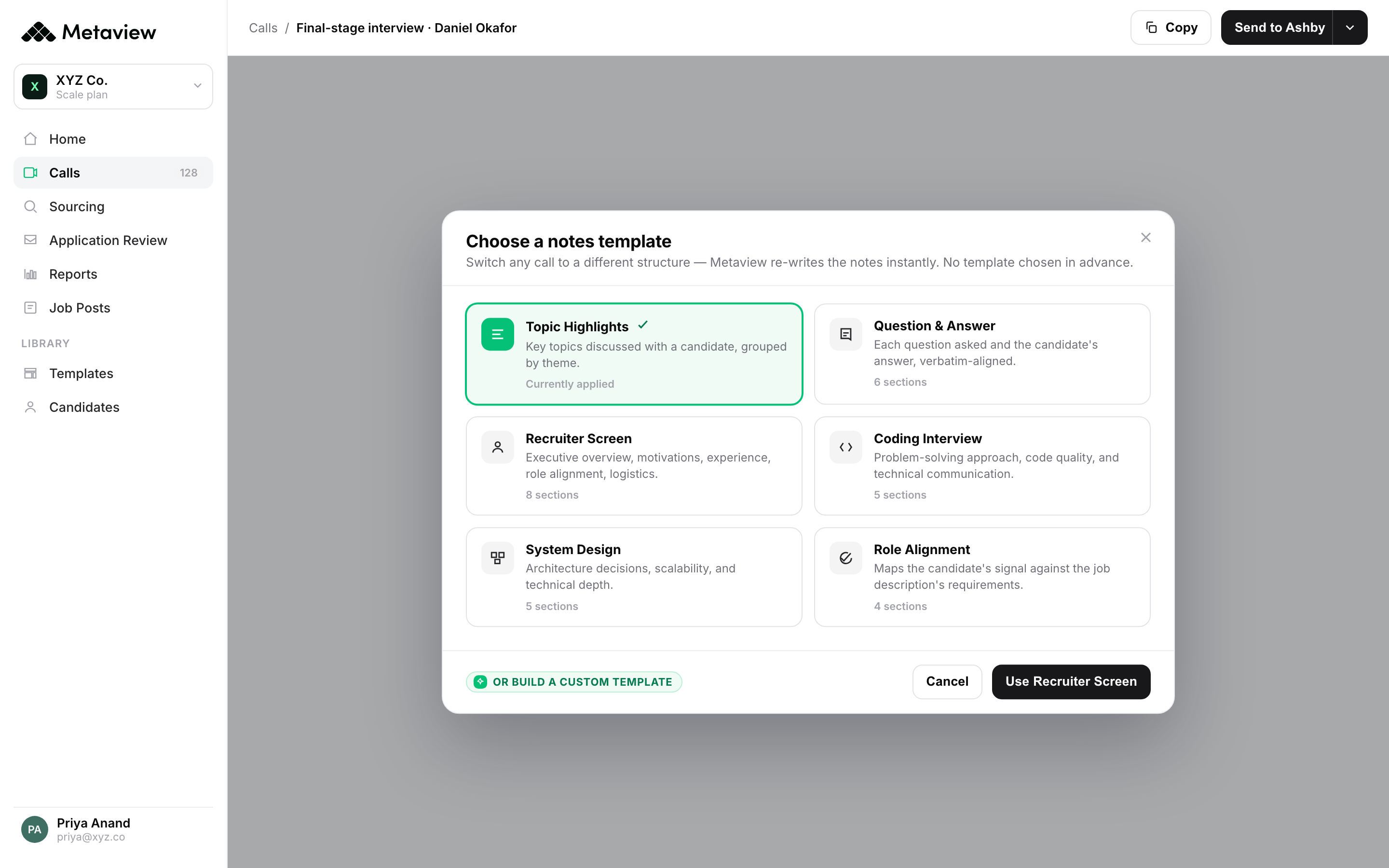
- Interview templates keep every interviewer on the same structure: pick one from the template library or build your own. Switch a call to a different template afterwards and the notes get rewritten to match.
- The scorecard arrives drafted by the Notetaker, each competency rated with the evidence and timestamps behind it, so scoring takes minutes.
- Everything syncs to your ATS, so the evidence sits where the panel makes the decision.
And once it's running, Reports show you whether the structure is holding: how often each competency was actually assessed across the pipeline, which is how you catch one that's on the scorecard but never gets explored.
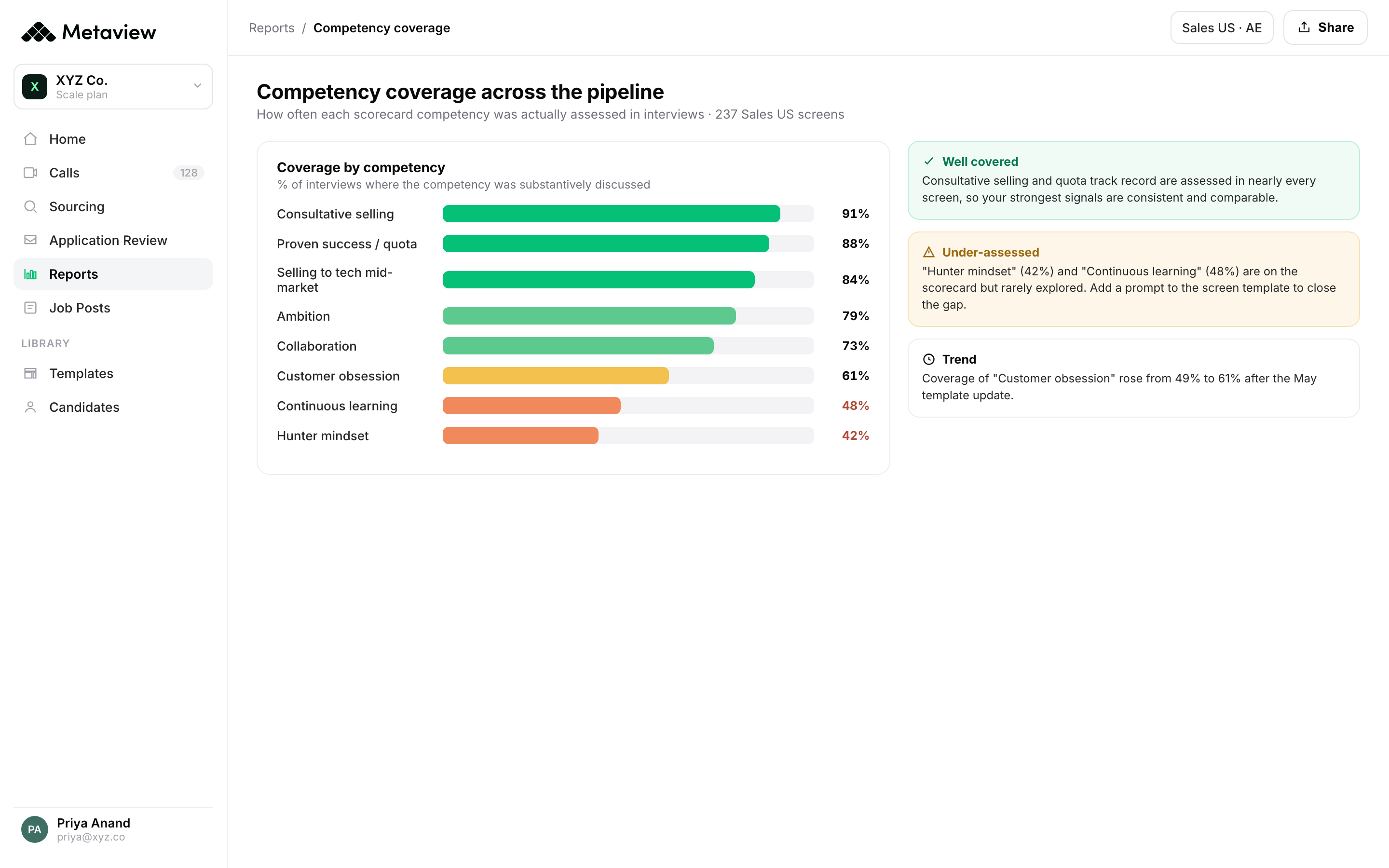
Done this way, the candidate gets a warm, human conversation and your team gets evidence it can compare. Both of those make the eventual offer easier to say yes to.
That covers the interviews. If the harder problem is getting enough of the right people into the process, we've also built fillmore, an autonomous recruiting agent that owns the outbound side. It's behind a waitlist right now, which you can join from that page.
Give it a role or a rough description of who you're after and it researches candidates, writes the personalized outreach, manages the follow-ups, and books the screening calls.
It lives in Slack, so you brief it and redirect it the way you'd message a teammate, and by the time you join, the conversation is already on the calendar.
Bring Metaview into your hiring stack.
Live notes, structured scorecards, and ATS sync - set up in under 10 minutes.
Frequently asked.
What is a structured interview?
An interview where every candidate is asked the same core, job-relevant questions and scored against a defined rubric, rather than a free-flowing chat that goes wherever the conversation takes it.
Do structured interviews improve offer acceptance?
There's no single number that proves the link, ours included. A clear, consistent process gives candidates a better experience and gets the whole panel aligned, and that should show up as faster, more confident offers. The size of the effect is something to measure on your own data.
Are structured interviews worse for candidate experience?
No, when they're done well. Structure is consistent questions and scoring. You keep the warmth and rapport while still asking everyone comparable questions.
How do you make interviews more structured?
Define the competencies at the intake call, write the questions that surface them, agree on a rubric, and score every candidate the same way during or right after the interview.
¹ Source: Metaview data. 5.5 million captured conversations, December 2020 to June 2026, analyzed in aggregate; a structured guide counts as present when a guide or template was loaded in the session. The 30.5% share covers the trailing 12 months of that dataset, around 3.4 million conversations. Scorecard completeness figures come from a sampled subset of created scorecards.
