
Recruiters and hiring managers will tell you they are aligned. The funnel tells a different story.
The disagreement rarely shows up as an open argument. It shows up as a hiring manager rejecting candidates the recruiter was sure about, round after round, because the two of them never agreed on what they were looking for.
Here is the data on how wide that gap really is, the competencies they clash over most, and how to close it before the search starts.
The alignment gap is bigger than it looks
Most teams rate the recruiter and hiring manager relationship as healthy. Push past the surface and the picture changes.
According to our 2026 AI & Hiring Alignment Report, surveying 505 recruiting leaders and hiring managers across North America and EMEA, the polite version and the honest version do not match.
Ninety percent call the relationship good or excellent, yet 58% wish they could work around their counterpart. That gap is where disagreement over the bar quietly lives.
The same survey found that 68% of searches start with high alignment at teams where AI is core to hiring, compared with 49% where it plays a less central role. Teams using AI in hiring were also 3.8 times more likely to rate their cross-functional relationship as excellent, based on 55% versus 14%.
The competencies they fight over
When you trace the friction to specifics, it clusters in a few places.
Potential versus proven experience is the big one. Recruiters, closer to a tight market, often argue for trajectory and adjacent skills. Hiring managers, on the hook for delivery, often want someone who has done the exact job before. Both are reasonable, and they collide on every borderline candidate.
The seniority bar is the second. What counts as “senior enough” is rarely written down, so it gets relitigated per candidate. Culture and communication are the third, easy to agree on as words, hard to agree on as a score.
This data shows that hiring managers and recruiters don't fully trust each other's judgment. This creates friction that tools alone cannot solve. The orgs that recognize this and help individuals collaborate more effectively will see dramatically better outcomes.

Why they see it differently
Different vantage points drive the disagreement, while stubbornness rarely does. Recruiters see the whole market and the funnel math; hiring managers see the team and the work that has to ship. Each is optimizing for something real.
Without a shared, written definition of the competencies, those two valid views never resolve into one bar. They just take turns being overruled, which is what erodes the trust the report measures.
How to close the gap
The fix is upstream of the candidates. Define the bar together, once, and evaluate against it.
- At the intake call, agree the competencies and what good looks like for each, in writing.
- Resolve the potential-versus-experience and seniority questions then, not per candidate.
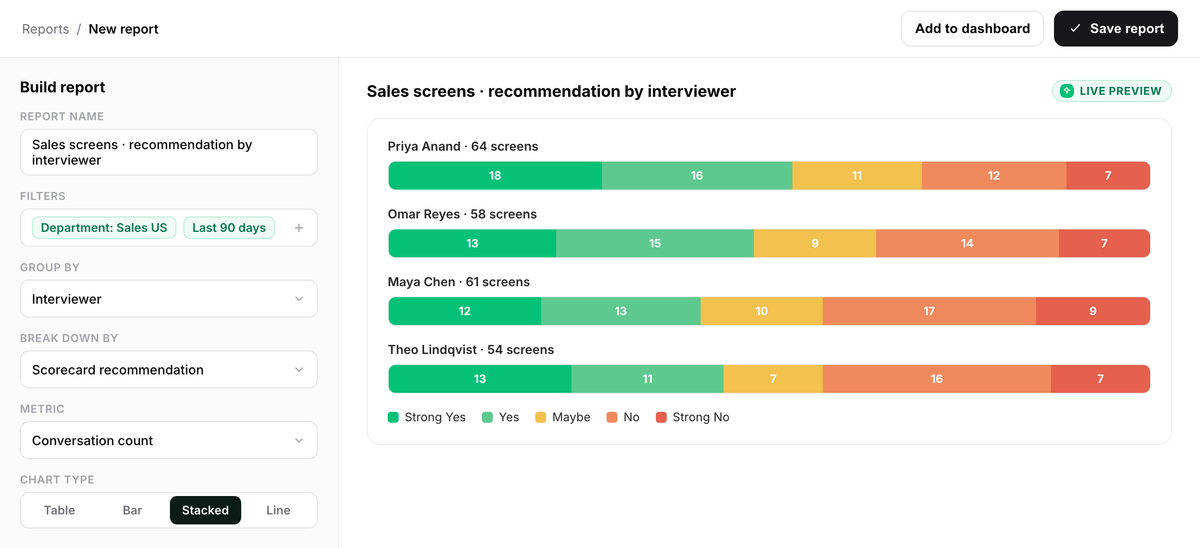
- Score everyone against that shared rubric, so both sides judge the same thing.
- Use shared evidence from captured interviews to settle disagreements by grounding the discussion in examples.
Setting the bar together at intake gives everyone a shared structure for making decisions. That makes avoidable disagreements less likely to cost you candidates.
Bring Metaview into your hiring stack.
Structured interview notes, draft scorecards, and ATS sync.
Frequently asked
What do recruiters and hiring managers disagree on most?
Usually the bar itself: what 'good' looks like, how much weight to give potential versus proven experience, and where the line sits on seniority and culture. The disagreement is less about the candidate and more about an undefined standard.
Why do recruiters and hiring managers disagree?
They see different slices. Recruiters see the market and the funnel; hiring managers see the team and the work. Without a shared definition of the competencies, those vantage points pull in different directions.
How big is the recruiter and hiring manager alignment gap?
According to Metaview's 2026 AI & Hiring Alignment Report, surveying 505 recruiting leaders and hiring managers across North America and EMEA, 58% wish they could work around their counterpart, even though 90% call the relationship good or excellent on the surface.
How do you fix recruiter and hiring manager disagreement?
Define the competencies and the bar together at the intake call, then evaluate candidates against that shared, written standard so both sides are scoring the same thing.
