

There are 804,803 different scorecard templates sitting in Metaview.
Each one is a moment when somebody looked at the templates their team already had, decided none of them fit the role in front of them, and built a new one.
I can’t tell you how many of those 804,803 are near duplicates, and the data doesn’t answer it. I can tell you that 763,270 were used once. For the typical template, the definition of the role was rebuilt for one search and then left behind.
All four figures describe one population: the 2,735,736 interviews that had a scorecard template attached to them. Inside that group, 72.1% of sessions ran on a template used two or more times. But reuse is concentrated: 763,270 one-off templates carried 763,270 sessions, or 27.9%, while the remaining 41,533 templates, just 5.2% of the 804,803 templates, carried 1,972,466 sessions, averaging 47.5 uses each. The 3.40 mean comes from dividing 2,735,736 sessions by 804,803 templates. Because it averages across a bimodal distribution, it describes almost no actual interview: most templates are used once and discarded, while most interviews run on the small minority that stick. These figures come from Metaview’s aggregated, anonymized product data and describe only interviews with a template attached. What share of all interviews carried a template is a separate question this data set does not answer.
Recruiting has spent a decade arguing about whether scorecards get filled in. That argument is settled and boring. The more useful question is what the scorecard is for in the first place, because the answer changes what you build and how long it lasts.
What the scorecard is actually for
Ask ten recruiters what a scorecard is and you get some version of "the thing the interviewer fills in afterwards". That description is accurate about the ritual and wrong about the object.
The scorecard is the only place where the agreement between you and your hiring manager gets written down in a form somebody else can act on. Everything else that agreement produces is perishable. The intake call is a memory. The job post is marketing. The Slack thread where you argued about whether five years of mid-market experience really matters is gone in a week. The scorecard is the version that survives, and it’s the version a fifth interviewer who joined the loop yesterday will read.
That is why the single-use pile matters. A durable definition should remain available for the next comparable search and get sharper as the team learns. Most templates are used for one search and left behind, while a much smaller group is reused heavily.
So the playbook below isn’t about writing better rows. Plenty has been written about writing the rows, including by us. It’s about where the definition lives, and what keeps it from being rebuilt from scratch for the next comparable search.
Write the definition down before the first application arrives
The usual sequence is that the definition firms up somewhere around the third onsite, when enough candidates have been seen for the hiring manager to finally articulate what they meant. Everyone accepts this as normal. It is normal, and it’s also the reason the first fifteen applicants got a different bar than the last fifteen.
There were six items hiring managers were supposed to assess for, but they all had their own questions. We’d never calibrated on what a good answer looked like.”
Six items existed. What a good answer to them looked like did not. That’s the gap the front of the funnel inherits first, because inbound applications arrive before anybody has interviewed anybody.
Application Review starts by drafting an Ideal Candidate Profile from the job description plus whatever context you give it, and a person reviews, edits and approves that profile before any evaluation runs against it. Metaview’s own copy on the speed of it is worth quoting exactly: "Your Ideal Candidate Profile is generated in about a minute. From there, every applicant is evaluated in roughly 1 second."
What happens next is the part that matters for this argument. Every application gets read against that profile, sorted into fit buckets rather than a league table, and each one carries the reasoning behind where it landed. You can disagree with a stated reason. Disagreeing with a rank is much harder work.
Two things follow from writing the definition first. The candidate list re-evaluates against the profile whenever the profile is updated, so a mid-search change of mind applies backwards instead of only forwards. And Application Review self-calibrates: as you progress and reject candidates, it learns from those decisions and suggests refinements to the profile, which a person then reviews and approves. The definition gets sharper as you use it, which is the opposite of the single-use pattern in most templates. That learning stays scoped to Application Review’s profile rather than becoming a company-wide model of taste.
Make the job post and the scorecard say the same thing
Here’s an uncomfortable dependency. The profile in the previous section is drafted from the job description. If the job description is eighteen months old and describes a role two reorgs ago, you have automated the propagation of a stale definition, very quickly, across every applicant.
Job Posts exists for this. It checks live and draft postings at the click of a button for freshness, compliance, engagement and brand, it learns from your interviews to give guidance specific to your roles, and it makes updates when something surfaces in a kick-off meeting or comes up repeatedly in interviews. It checks and improves posts you already have instead of generating them from nothing.
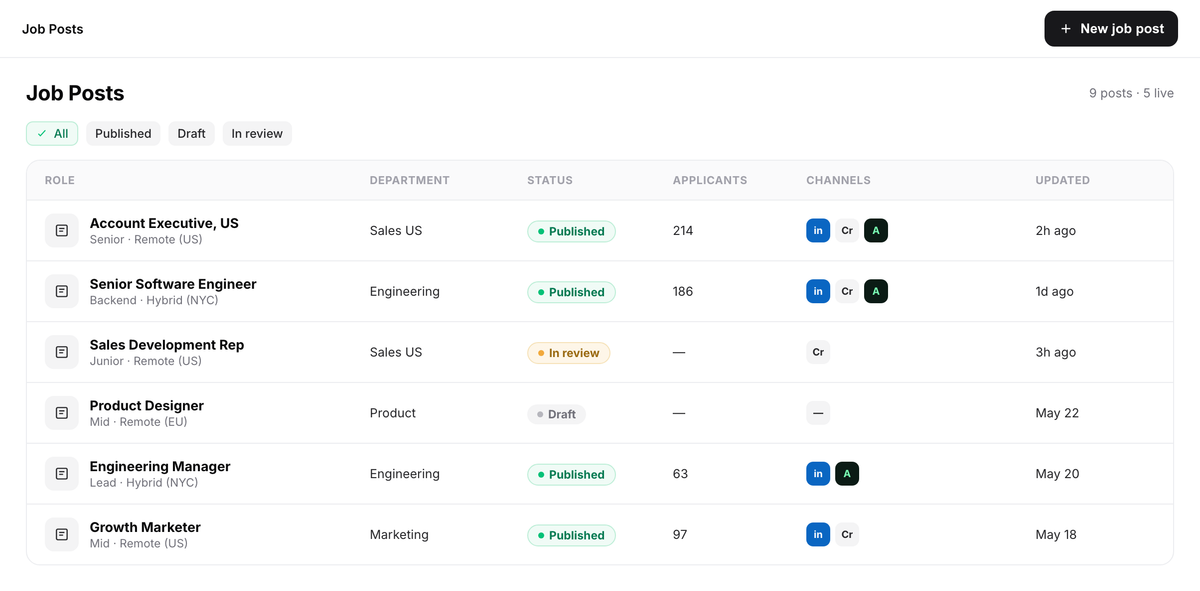
The point of putting Job Posts in a scorecard playbook is that the public post is the first version of the definition, and it’s the version candidates self-select against. If it disagrees with your scorecard, you’re screening people out at the top of the funnel using criteria the interview will never test, and screening people in against criteria the post never mentioned.
Carry the definition into the room
Now the interview. The Notetaker joins as a visible participant and, where consent has been given, captures every spoken word of the conversation. Consent is something your own process obtains, under your policy and your local law.
The Notetaker drafts each scorecard from the interview conversation using the role definition’s scorecard template. The interviewer reviews it, rates it and submits it, and the hiring recommendation is always theirs. Where the browser extension is in play, the objective sections of your ATS scorecard get filled in automatically and the subjective fields are deliberately left blank.
The writeback specifics matter more than most vendors admit, so here they are plainly.
| Stage | What usually happens | Metaview |
|---|---|---|
| Choosing the structure | A template is picked before the call, or forgotten entirely | Switch a call to a different notes structure afterwards and the notes are rewritten to match |
| Drafting the scorecard | Written from memory, often the next morning | Drafted from the conversation, then rated and submitted by the interviewer |
| Filling the ATS fields | Retyped into a second system | Browser extensions autofill the objective sections for Ashby and Greenhouse, leaving subjective fields blank |
| Getting it back into the ATS | Copy and paste, or it never arrives | Direct submission for Ashby and Lever; Greenhouse users paste |
Two ATSs for direct scorecard submission and two for extension autofill is a smaller number than the ATS integrations list overall, and those are genuinely different things. Breadth of integration is not breadth of writeback, and anyone quoting you the first number in answer to a question about the second is answering a different question.
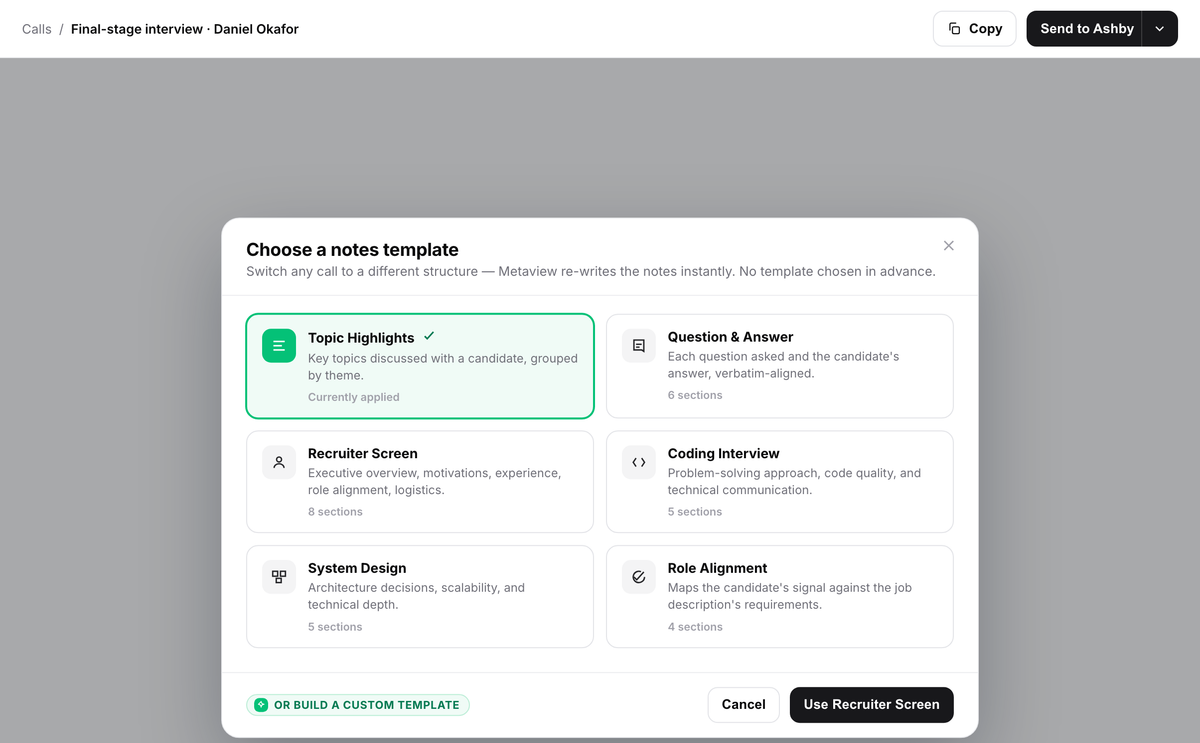
The fact that most templates are used once is the actionable part of the data. Deciding on a template set is a standards decision for a family of roles, and the firms that treat it that way say so out loud.
The next phase for us is deciding what templates we’re using as a firm across practices to make sure we’re consistently collecting the right data points.”
"As a firm across practices" is the whole move in five words. The unit of decision is the practice, and it sits above any individual recruiter or search. If you want a starting shape for that set, our scorecard template and intake questions are both reasonable places to steal from.
See what the interviews actually covered
The last move is the one most teams skip, because it requires admitting the definition might be wrong.
Reports queries your own interview data, in the product and through Metaview’s MCP server if you’d rather ask from wherever you already work. What you’re looking for is not a completion percentage. It’s the shape of the recommendations coming back, and whether that shape is the same across the teams that are supposedly hiring against one bar.
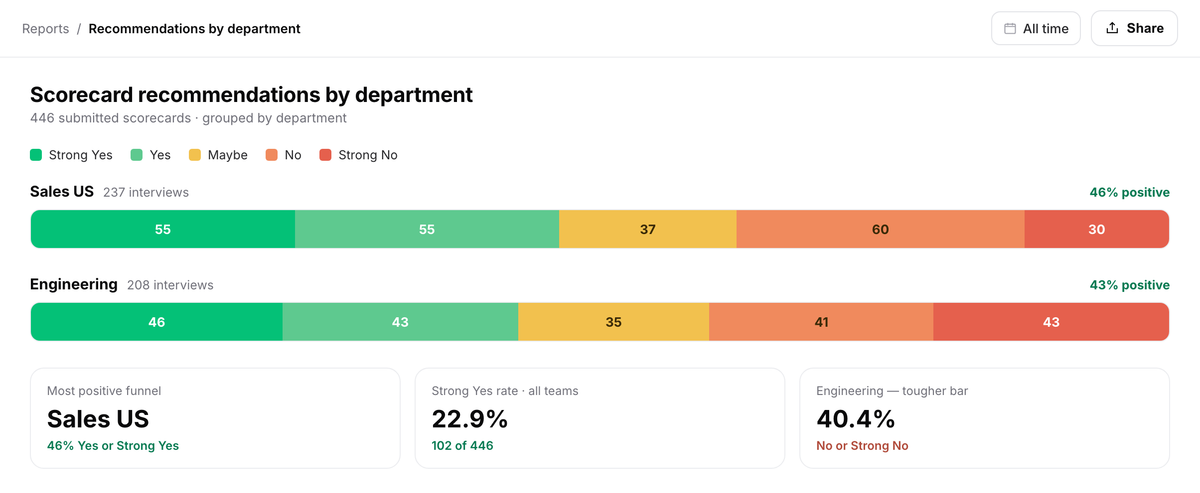
Read the difference between departments as a reason to check calibration, while allowing for the possibility that the teams face different candidate markets. You can only ask that question out loud once the scorecards share one definition instead of several private ones. If the submission side of this is where you’re stuck, we’ve written up what moves scorecard adoption and what the completion rates look like separately.
What this doesn't do
I’d rather say this plainly than let a playbook imply more than it can support.
Three more limits worth stating. Metaview never auto-rejects a candidate, and there’s no setting that turns that on. Every accept and reject is made by a person, including the ones the reasoning makes look obvious. And the notes themselves don’t evaluate, rank or recommend anybody; they capture and structure the conversation, and the judgment stays where it was.
The data can’t tell us whether template reuse improves hiring outcomes because it contains no post-hire outcome data. Rebuilding the definition for each search still removes the shared basis for comparing candidates across searches.
The definition is the asset
Most conversations about recruiting scorecards are conversations about compliance. Did people fill them in, how fast, how completely. Those are fine questions and they’re downstream of the one that matters.
The scorecard is where your team’s understanding of a role is written down. When teams treat it as a form, most versions are left behind after one search. Treated as an asset, it becomes the thing your job post is checked against, the thing every inbound application is read against, the thing the interview gets written up against, and the thing your reporting is actually reporting on. Same definition, four places, one version.
People make the hiring decisions here. Metaview’s Agentic Recruiting Platform gives the role definition one place to live that every stage can read, then keeps it current while the search is running. That’s a much smaller claim than the category’s name usually implies, and it’s the one I’d defend.
Frequently asked
What is a recruiting scorecard?
A recruiting scorecard is the written definition of what a role requires, structured so that every interviewer assesses the same criteria and records evidence against them. It is most useful understood as the durable record of what the recruiter and the hiring manager agreed the role needs, rather than as a form completed after each interview.
What should a recruiting scorecard include?
Include the criteria, a description of a good answer for each one, space to record evidence, and one overall recommendation owned by the interviewer. Our guide to writing an impactful interview scorecard shows how to write each part.
How do you keep a recruiting scorecard consistent across interviewers?
Decide the template set once for a family of roles instead of creating one per requisition. Keep the job post and scorecard on the same requirements, then review submitted recommendations by team to see where the bar has drifted. Reused templates are a small part of the library, yet they carry the majority of templated interviews. That concentration matters for consistency because the average number of uses per template doesn’t describe a typical one.
Does Metaview fill in the scorecard automatically?
Metaview drafts a scorecard from the interview conversation, and its browser extensions autofill the objective sections of ATS scorecards for Ashby and Greenhouse. Subjective fields are left blank and the hiring recommendation is always completed by the interviewer. Direct submission into the ATS works for Ashby and Lever; Greenhouse users paste the notes across.
Can a recruiting scorecard predict quality of hire?
No, and Metaview holds no data that could answer the question. Metaview’s product data covers what happens up to the hiring decision, with nothing on retention, performance or any post-hire outcome. A scorecard makes candidates comparable to each other on stated criteria, which is a different and more modest claim than predicting how someone will do in the job.
See the same role definition run from the job post to the debrief.
Applications read against it, interviews written up against it, and every accept or reject still yours.
