
Scoring candidates against defined competencies used to mean writing rubrics by hand and taking notes through every interview, which few teams had time for.
The idea was always sound. Instead of hiring on a hunch, you score each candidate on how well their answers match what the role actually needs.
AI now does the heavy part in the background, capturing the evidence against your competencies while you stay in the conversation, then drafting the scores for you to review. That one change is why almost any team can run it now.
How to hire better using competency-based interviewing.
Done well, the work happens in this order:
- Define the competencies: Find out what the role needs, well before you start interviewing.
- Ask questions: What gets candidates to show real evidence?
- Score every candidate: Put them against the same rubric, based on that evidence.
You'll find there's a common thread, where evidence is rewarded rather than confidence.
Plenty of people get hired because they interview well, and interviewing well doesn't always translate into doing the job well. The gap between the two is where bad hires come from.
What the alignment data shows.
Our 2026 AI & Hiring Alignment Report surveyed 505 recruiting leaders and hiring managers across North America and EMEA, and looked at how alignment between recruiters and hiring managers lines up with results:
What the pattern points to.
Teams that agree up front on what they're looking for tend to hit more of their goals. The survey shows the two move together, which stops short of proving that agreement causes the results. Still, the direction is consistent: agree on the competencies you're hiring for, then use them to evaluate everyone who comes through.
Step 1: Define the competencies for the role.
It's vital you get the pre-interview homework down. Once you know the role, write down the competencies someone needs to do it well, ideally in the intake call while the role is still fresh.
Metaview captures the intake call and pulls out the role’s must-haves, so what you’re hiring for is written down before the first interview.
Those must-haves become the competencies you interview against, so the intake call is where competency-based interviewing really begins.
The right competencies depend on the job. For an engineering role, you might look at:
- How they break down an unfamiliar problem
- The quality and clarity of the code they write
- How they design systems and weigh tradeoffs
- How they work with people outside engineering
A sales or finance role would look nothing alike. As a rule of thumb, four to six per role is the sweet spot: enough to cover what matters, few enough to hold in your head.
How you write each competency down matters just as much. It has to be a behavior you can watch for:
- Strong communicator
- Team player
- Detail-oriented
- Explains a technical tradeoff so a non-engineer can act on it
- Gives a peer direct feedback without damaging the relationship
- Catches the edge case everyone else missed in code review
The second list tells every interviewer exactly what to listen for. The first tells them nothing.
This is harder than it looks, and it’s most of the work.
Once your competencies are set, you can build them into the interview itself, so every round is structured around the ones it should assess.
In Metaview, you pick the interview type, and the round is structured around your competencies, so interviewers know exactly what they’re there to assess. Teams use it to keep every loop consistent without rewriting a guide each time.
It also pays to define three levels for each competency, so everyone knows what a weak, a solid, and an exceptional answer sounds like. Then spread them across the loop, so each interviewer owns two or three and nothing slips through.
Step 2: Ask questions that get real evidence.
With the competencies defined, each one points to its own questions.
For each, ask for a specific, real example. Then keep following up until you have evidence.
Two kinds of question do most of the work:
- Behavioral questions ask about the past: “walk me through a time you...”
- Situational questions ask about a hypothetical: “how would you approach...”
The real signal is in the follow-ups. What did you personally do? and what happened next? separate the people who did the work from the people who were standing nearby. If you’d rather not start from scratch, our interview questions library has sets for common competencies.
The hard part has always been capturing all of this while staying present. That’s the job AI quietly takes off your hands: Notetaker captures the full interview and writes structured notes against each competency as the candidate talks.
You stay in the conversation. The evidence is organized by the time the call ends.
It also helps to give each interviewer one competency to own, rather than the whole candidate. Five people each going deep on one thing beat five people trading vague impressions, every time.
Step 3: Score candidates against the same rubric.
Rate each competency against the interview rubric you wrote, tie every rating to specific evidence, and use the same scale across the whole loop.
Do it while the answers are fresh. A scorecard filled in two days later is a memory test, and memory drifts back toward the gut feel you were trying to replace.
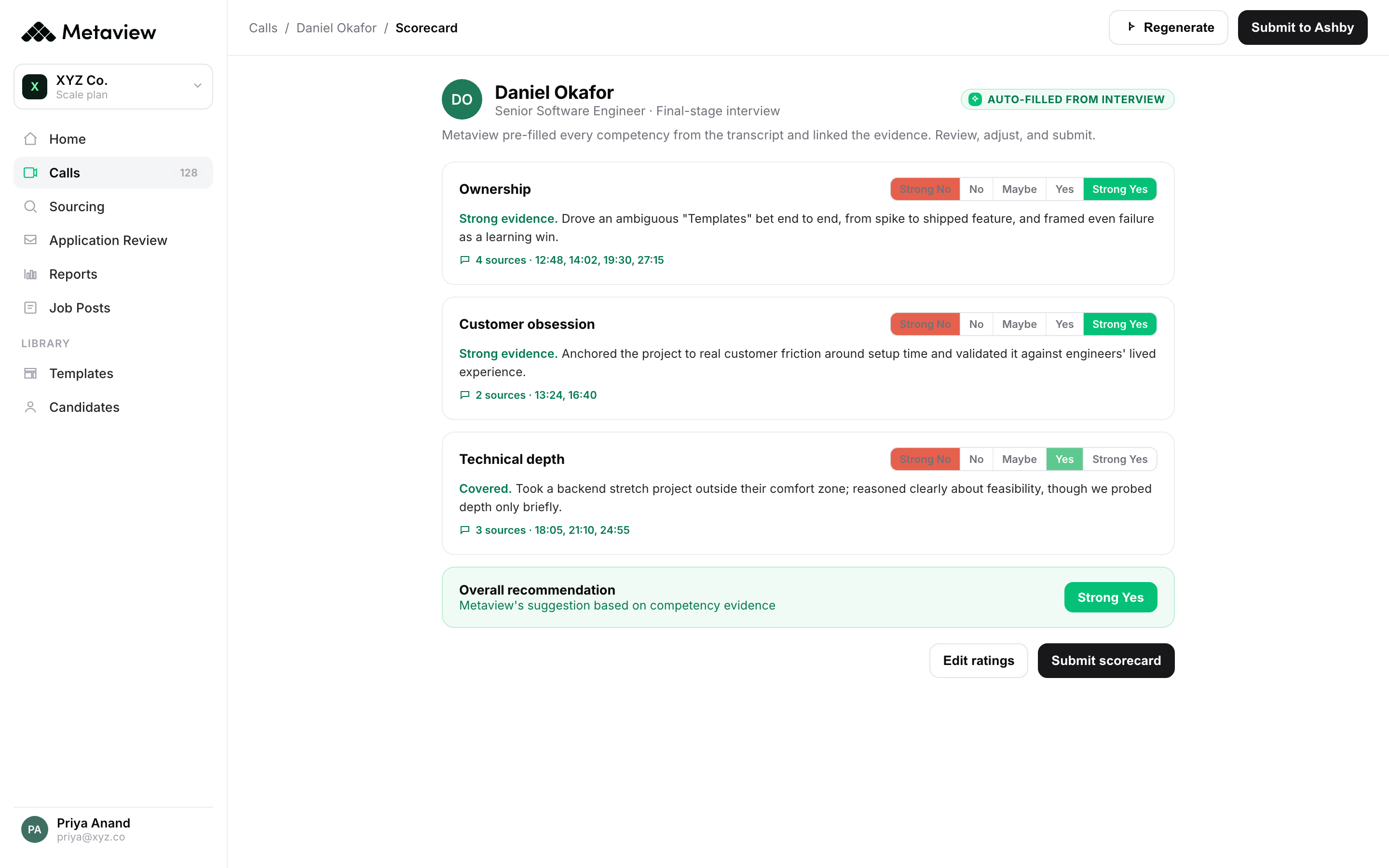
Because the evidence is already captured, most of the scoring is done for you. Metaview drafts the scorecard straight from the interview, each rating tied to what the candidate actually said, so you review and adjust instead of starting from a blank page.
Because everyone is scored the same way, the comparison makes the stronger candidate obvious:
- Problem-solving: Weak. Spoke in generalities, no real example.
- Communication: Mixed. Clear, but light on substance.
- Ownership: Weak. On the team, role unclear.
- Problem-solving: Strong. Walked through a real failure and the tradeoffs.
- Communication: Strong. Explained a hard decision to a non-expert.
- Ownership: Strong. Drove the project end to end.
Same competencies, same scale. On the evidence, Candidate B is the stronger hire, and you can show exactly why, which a hunch never could.
Common competency-based interviewing mistakes.
Most teams get the concept fast. The mistakes are all in the execution, and they’re easy to avoid once you’ve seen them.
Generating a generic rubric and stopping there.
It’s tempting to paste a job description into ChatGPT, take the tidy list it hands back, and move on.
But a generic rubric measures generic things. It won’t tell you what predicts success in your roles, which is the whole point.
Letting the rubric drift.
A few weeks in, people are scoring from a hazy memory of what a 3 used to mean. Regular calibration fixes that.
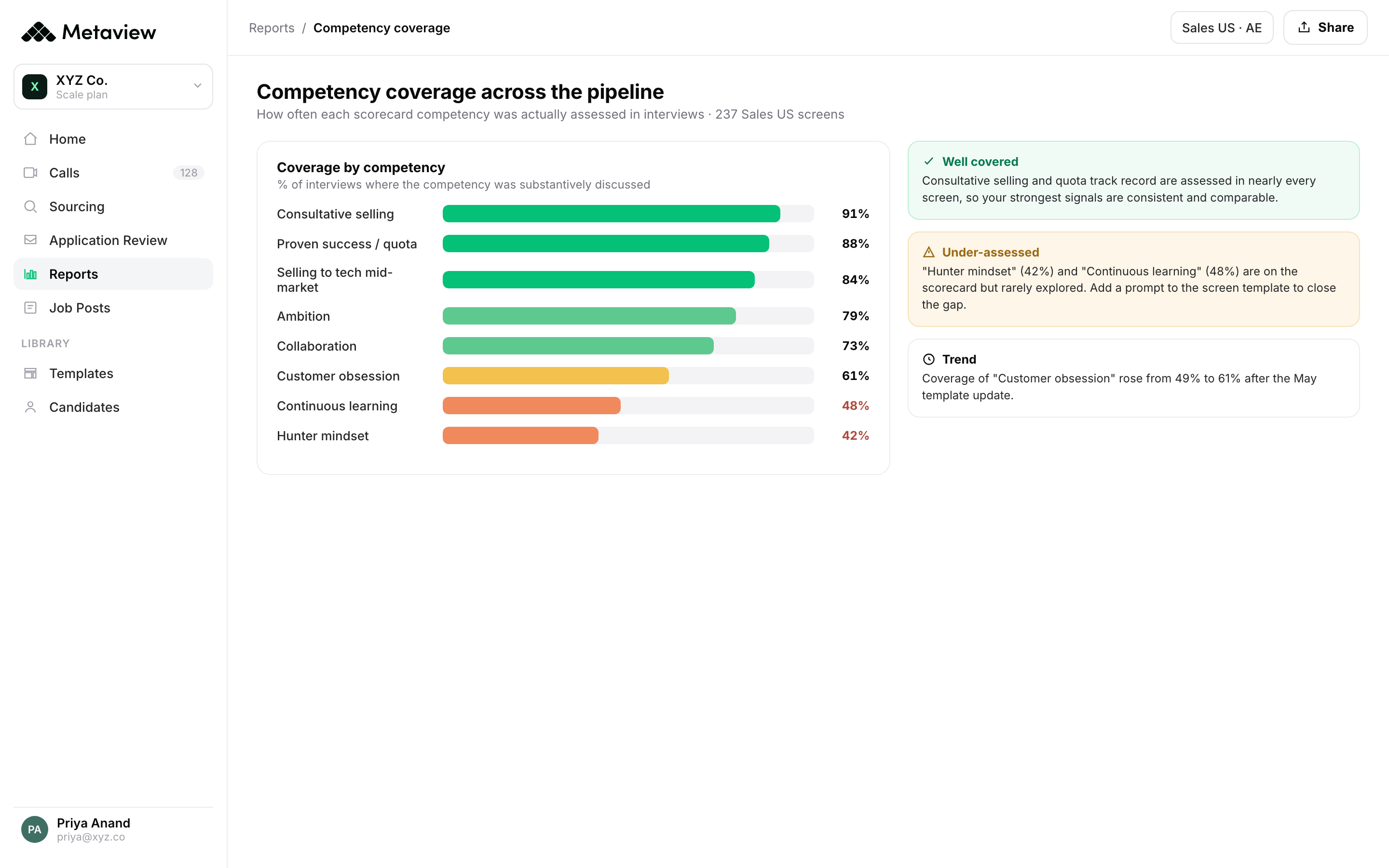
Metaview makes the drift easy to spot instead of leaving you to guess. Reports show how each competency is being scored across the team, so you catch it before it skews a hire.
Scoring the whole candidate at once.
One strong answer colors everything else, which is the exact interviewer bias the rubric exists to remove. Score each competency on its own evidence, and that pull mostly disappears.
Where competency-based hiring is heading.
Hiring is moving from something a handful of great interviewers do well to something any team can run consistently. AI is what makes that possible.
Brex rebuilt their values interview on Metaview, turning six different interpretations into one shared rubric, so every engineer is scored the same way across eight offices.

And the results hold up: 92% of Metaview users report better hiring decisions.
The best interviewers have always worked this way. Now the rest of the team can too: define four to six competencies, write out what weak, solid, and strong look like for each, and score every candidate against the evidence.
Bring Metaview into your hiring stack.
Draft every scorecard from the interview and score against one rubric.
Frequently asked.
What is competency-based interviewing?
It’s a structured interview method where you define the specific competencies a role needs, ask questions that produce evidence of each one, and score candidates against a written rubric. The goal is consistent, evidence-based decisions instead of gut-feel verdicts.
What is the difference between competency-based and behavioral interviewing?
Behavioral interviewing is a question technique: you ask for past examples, like “tell me about a time you...”. Competency-based interviewing is the wider framework that decides which competencies to assess and how to score them, and behavioral questions are one of the techniques it uses to gather evidence.
How many competencies should you assess in an interview?
Four to six per role is a good range, split across the interview loop so each interviewer owns two or three. More than six is hard to assess well, and fewer risks missing signal the role depends on.
How do you score a competency-based interview?
Use one rating scale across the whole loop, define what each level means per competency in a rubric, and tie every score to specific evidence from the conversation. Score during or right after the interview, while the answers are still fresh.
Does competency-based interviewing reduce bias?
It reduces some bias by holding every candidate to the same competencies against the same evidence standard, which makes inconsistent judgments easier to spot. It’s not automatic: rubrics drift and the halo effect creeps back, so teams need regular calibration to keep it honest.
