

A candidate signs the offer, then calls three days later. Their current employer has come back with a number, and now they're weighing it. The loop said hire. Nobody in the loop asked whether they would stay.
Most of what you needed was said out loud, back in the first conversations. Candidates ask about pay. They ask about the team they'd be leaving and where the job goes next. Those questions land while you're still selling them the role, and they tell you what your offer has to answer.
Metaview's 2026 AI and Hiring Alignment Report surveyed 505 recruiting leaders and hiring managers. All of them work in North America or EMEA. It found that 67% lose qualified candidates every month to competitors who move faster.
That figure is about speed. It doesn't measure counter-offers, and we won't stretch it into one. No question in the survey asks how many candidates stayed put for a raise.
We also can't tell you which interview cues predict a counter-offer. Offer outcomes never reach the interview record, so no transcript could establish the link.
The record does hold the subjects that came up. A topic classifier reads each transcript for the themes it tracks. Compensation is the one it finds most often, in 72.4% of the conversations with topic coverage. Career growth comes next, detected in 62.2% of that same set.
Why a closed candidate still walks.
A loop answers one question: is this a hire? Run enough rounds and you get a confident yes or no. Whether the candidate will take the offer is a different question. The loop doesn't ask it.
The current employer has every reason to move fast. Paying to keep someone they already know costs less than re-running the search. So a verbal yes can turn into a polite no inside a week.
The cues people point to afterwards sit in the interviews. A candidate who keeps crediting the team they'd leave is telling you something. So is one who frames pay as a number their current employer could match.
Candidates say this out loud, often in the first conversation. Then it gets filed under color instead of risk, and it resurfaces at the offer stage, after the number is already set.
The cues that show up in round one.
A counter-offer cue is a line worth following up on. The candidate says something that gives you a reason to ask about motivation. Treat it as a prompt to ask a better question. Nothing here measures it against real counter-offers.
The four below are the ones we'd hand a recruiter as prompts. They share one thing: the candidate volunteers them. No one has to go digging.
Read together, they tell you whether your role is pulling the candidate toward you, or a job they don't hate is pushing them out. That distinction earns a direct question. If someone wants a raise more than a move, find out before you price the offer.
| The cue | What it tells you | What to ask next |
|---|---|---|
| Loyalty to the current team | Curiosity is driving the move, and leaving is a hard call. | What would have to change for you to stay? |
| Comp framed as a bargaining chip | Pay reads as a lever they would like someone to move. | If your employer matched it tomorrow, where would that leave you? |
| Courted elsewhere | Their current employer may already know they are in motion. | Who else is in the mix, and how far along? |
| Hedged timeline | A slow process leaves the current employer room to move. | What is driving your timeline? |
A cue tells you where to spend the close. It never tells you who to cut. A great hire can carry every one on the list.
What comes up in the room.
Testing whether cues predict counters would need the whole conversation on the record, sitting next to how the close went. Self-reports won't cover it either. The candidate who took a counter doesn't explain why. The recruiter who lost the close doesn't reopen the transcript.
A topic classifier reads which subjects each conversation covered, and it ran across 331,874 of them. Compensation leads, at 72.4%. Career growth is the theme it surfaces next.
That is a record of what got discussed while the candidate still had a choice. Read which themes one candidate keeps returning to. You will know more before you shape their offer.
Why the debrief skips it.
A debrief is where the panel works out whether to hire the candidate. That's what the agenda is built for. Whether the person will accept is a separate question, and it rarely gets its own slot.
So the motivation cues sit in the transcript, accurate and unread. Name them on the agenda and the panel discusses them. Leave them off and nobody goes looking.
A counter-offer that lands after your verbal yes wastes the whole loop. The employer making it already knows the candidate, and they don't have to run a search to replace them.
Our debrief playbook puts prior interview records in the hiring manager's pre-read. It also tells the panel to probe the reads interviewers sense but can't name.
So a well-run debrief can reach these cues. The catch is scope. That pre-read covers the open questions on skill, and motivation sits outside it.
It also serves as a great candidate advocacy tool, as those who are being screened/interviewed are now represented by their own words, rather than the translation a Recruiter is typing in real-time whilst still trying to guide the conversation. A lot gets missed in the latter situation. With Metaview, NOTHING gets missed.”
Whatever the candidate told you about what they're weighing sits there in their own words. The team can review those exact comments before deciding how to position the offer. Guessing harder at the debrief won't surface them, and reading them back will.
Getting the cue onto the record.
You can't act on something no one wrote down. The first conversation gets archived, and by the time anyone builds the offer they're working from memory of a call three rounds back.
Metaview closes that gap at the source. The Notetaker captures every spoken word of each round. What the candidate said about pay stays anchored to their exact words. So does what they said about the team they'd leave.
From there, Metaview turns those answers into columns in Reports. Compensation Expectation is one you get out of the box, and it returns the number the candidate named. For loyalty or a competing offer, you write your own yes/no column and describe what it should look for.
After that it behaves like any other column. Filter the report down to candidates whose conversations covered comp or a competing offer. Group by role or stage, and a yes/no column gives you the percentage in each group.
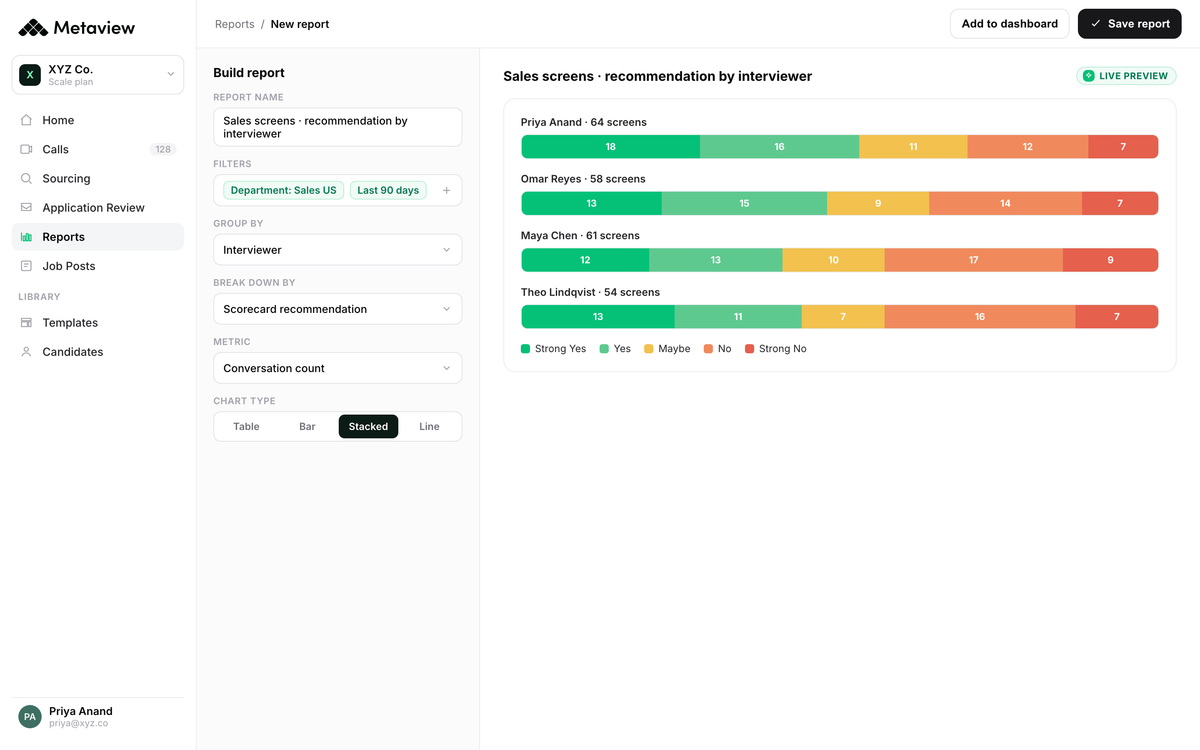
Metaview captures the conversation and puts the cues into fields you can read. Which candidates you chase, and what you offer them, stays with your team.
The recruiter reads the cue and the hiring manager weighs it. The leader who owns the close still makes the call, while there is still time to change the offer.
Reading the close before you build the offer.
Put the cues where someone can still act on them. That means three points in the process, each with a different job.
- At the screen: have the recruiter log comp framing and current-team loyalty in the first conversation. Whatever the candidate is weighing tends to surface there.
- Before the close: pull the early transcript. If comp and loyalty cues are stacking up, you want to see that while you can still change the shape of the offer.
- On price: if pay reads as a bargaining chip instead of a real constraint, ask what would make the number work. Better to price it in or walk away than to find out after the time is sunk.
Before you approve the offer, have the recruiter and hiring manager read back what the candidate said in the first conversation. You'll know what they were weighing while they still had a choice.
Then build the number around the thing they told you first.
Bring Metaview into your hiring stack.
Live notes, structured scorecards, and ATS sync - set up in under 10 minutes.
Frequently asked.
What is a counter-offer signal in an interview?
It's a line worth following up on. The candidate says something that gives you a reason to ask about motivation. Loyalty to the team they'd leave and pay framed as a bargaining chip are the common ones. Brief your interviewers to log the candidate's exact words instead of their own read, because exact words survive the handoff.
Can you predict a counter-offer from interview cues?
No. What you can fix is the questions. Pick the two motivation questions every screen has to cover, write them into the interview kit, then read the transcripts to check they got asked. Recruiters who skip them are usually short on time, so keep the list to two.
What are the most common counter-offer warning signs?
Four are on our list: loyalty to the current team, comp framed as a matchable number, interest from other companies, and a hedged timeline. None has a measured link to real counter-offers. Each is a reason to ask a follow-up while the candidate is still in front of you.
What can you track before the offer?
Two things. The topics that come up in your interviews, which Metaview detects from the conversation itself. And whether your team probes motivation on every screen, which is a process you own.
Does Metaview decide who gets hired?
No. Metaview turns the conversation into fields you can filter and chart. Every hiring decision stays with your team. If a cue only shows up late, check it against what the candidate said early on. A change of emphasis is worth a direct question before you price the offer.
