
Hiring teams are being asked to fill harder roles with smaller teams, and the search itself has become the bottleneck. Finding people, rather than assessing them, is where the pressure lands.
Agentic sourcing is our answer to that. A recruiter describes the role in plain language, an agent runs the search across the open web and the company's own systems, and it returns candidates with the reasoning behind each one.
LinkedIn Recruiter answers a different question. It sells a seat on the largest professional database there is, along with the filters to query it, and the searching stays with the person holding the seat.
So we went to our own sourcing data to work out what that difference is actually worth. Not the license fee, which is the part most teams argue about, but the time it takes to produce a shortlist and how many of those candidates a recruiter wants to call.
LinkedIn Recruiter vs agentic sourcing
Sourcing is the one part of hiring that never got easier. A recruiter reads the brief, guesses at the words the right people put on their profiles, builds a query around those guesses, and scrolls.
Done well it's a genuine craft. A strong sourcer knows that a platform engineer at one company is an SRE at the next, and writes the string accordingly.
What no string can do is read. Boolean matches the words present on a page, so people who describe the same experience differently never surface, and the team never learns they existed.
Both approaches are after the same people. They disagree about who does the reading, and about how far the search reaches.
| LinkedIn Recruiter | Agentic sourcing | |
|---|---|---|
| Turning a brief into a search | A recruiter translates it into a Boolean string | The role is described in plain language |
| What it matches on | Keywords present on the profile | The whole profile, read against the brief |
| Where it looks | Profiles on the platform | The open web, the ATS, and past conversations |
| Why a candidate showed up | They matched the filters | Reasoning attached to each candidate |
| What happens after a rejection | The recruiter rewrites the query | The next pass calibrates from that verdict |
| What the recruiter is buying | A seat, per recruiter, per year | The search run on their behalf |
The middle column is where the recruiter does the work. On the right it's done for them, and that distinction is the whole comparison. It's also why arguing about license price never settles anything.
Why we built sourcing that starts from the brief
The limitation was never that recruiters are bad at Boolean. The brief in a hiring manager's head is fuzzy, and translating it into a keyword string is where most of the meaning gets lost.
Sit in on an intake meeting and the useful version of the brief is all there. Someone describes the shape of the team and the last person who worked out, then names the two or three companies people like this tend to come from.
None of that survives a translation into AND and OR. It gets flattened into job titles and skill tags, because that is all a search box can hold.
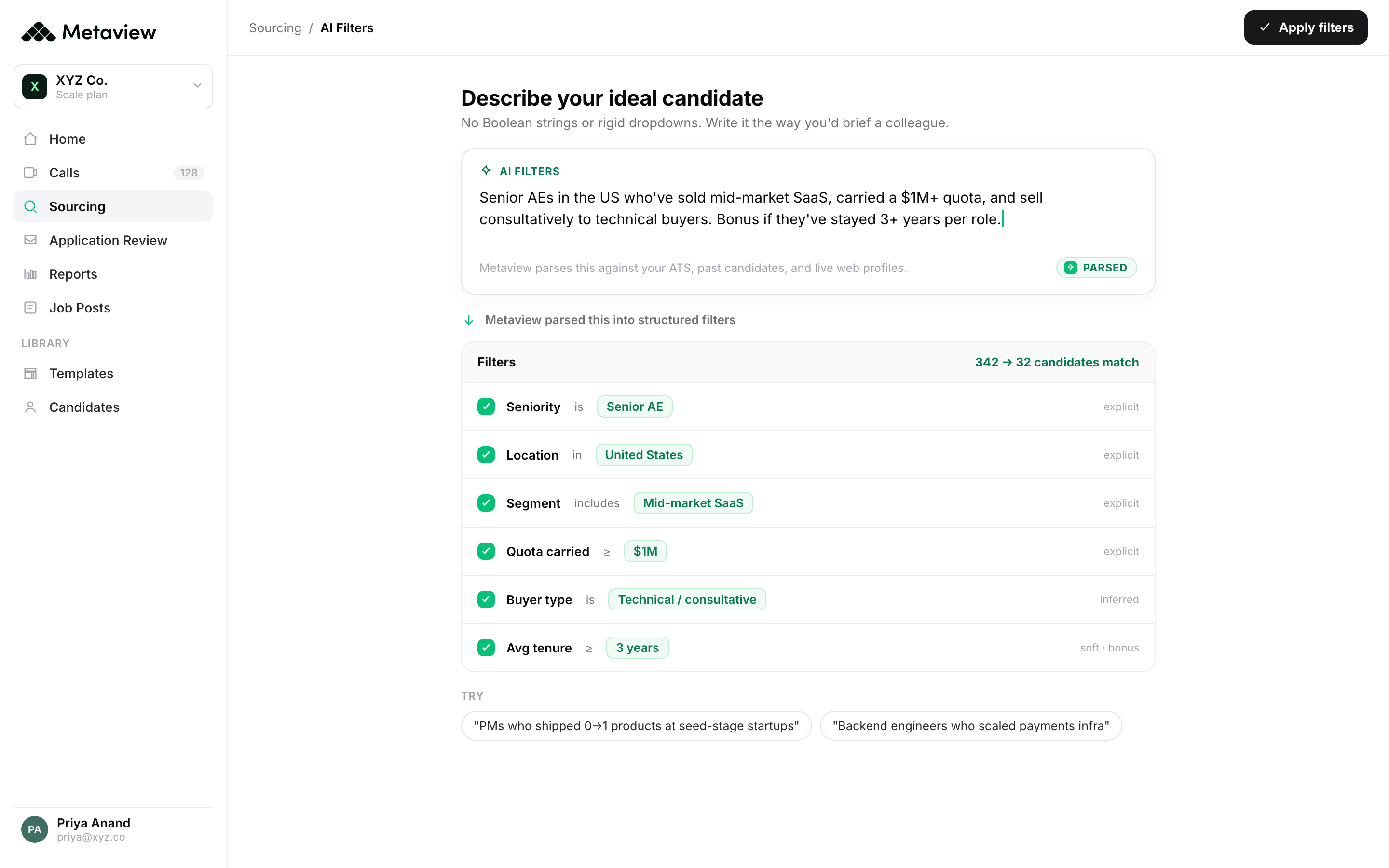
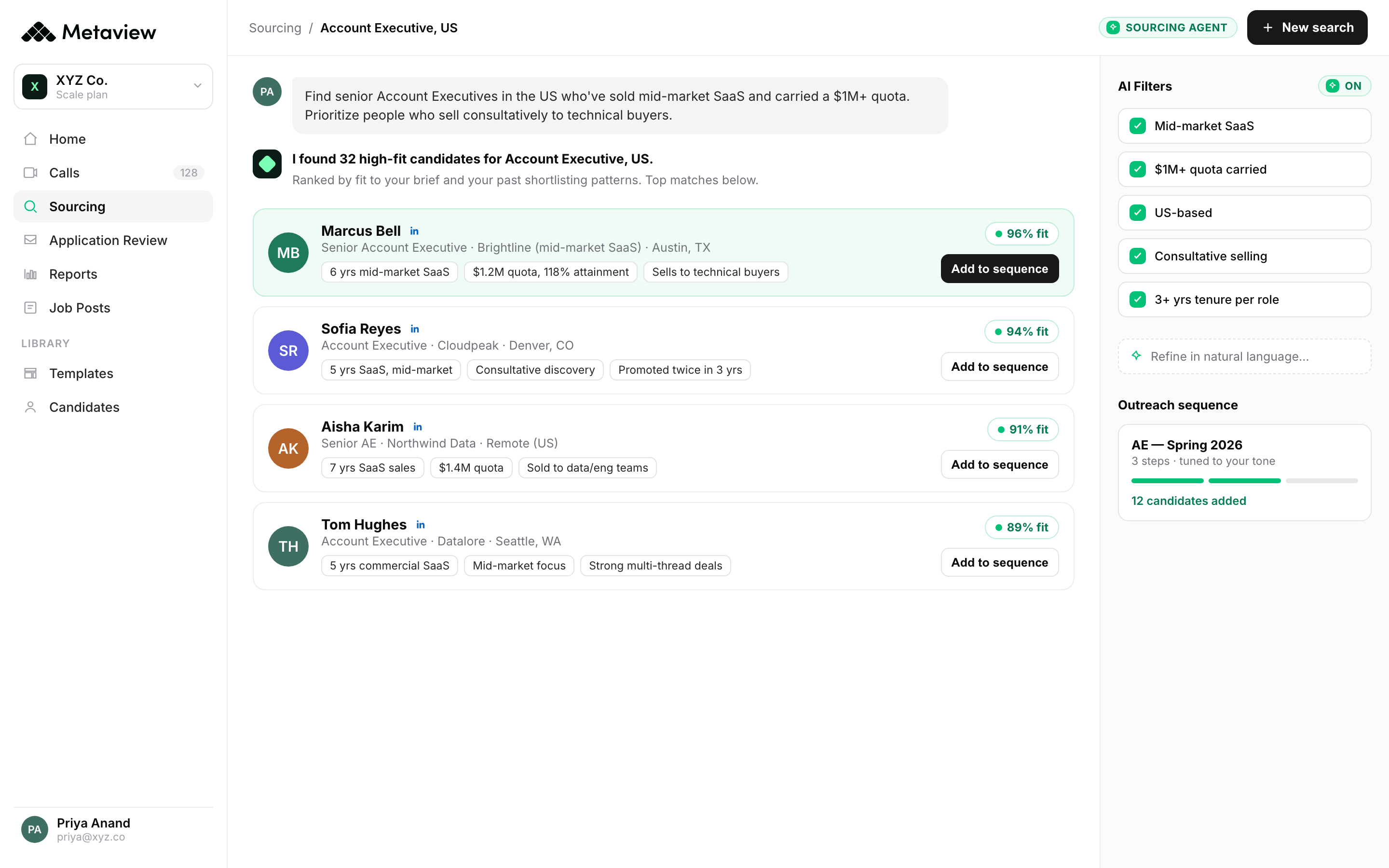
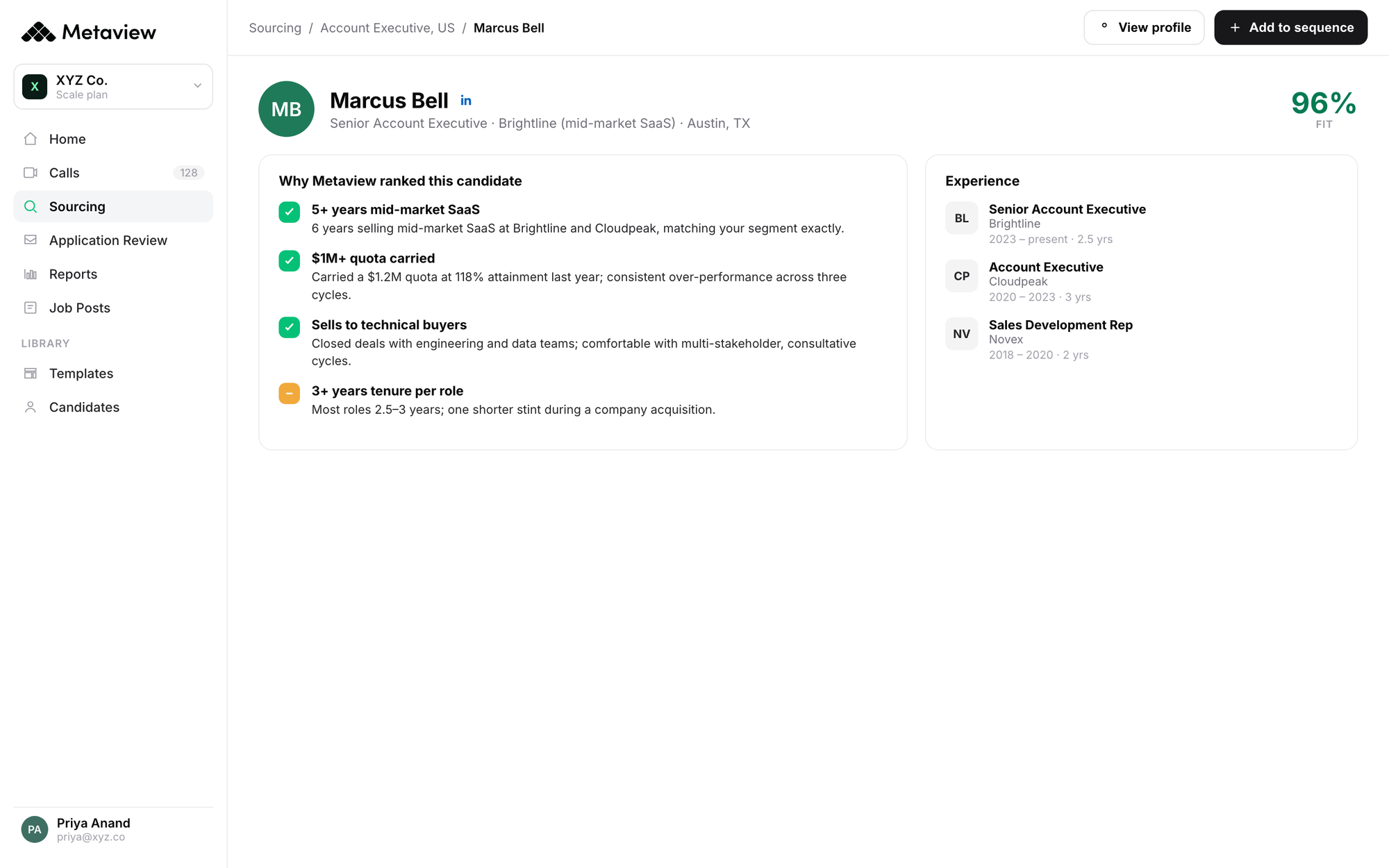
So we built the search to run on the brief instead. Our sourcing agent searches the open web, the candidates already synced from a company's ATS, and that company's own past Metaview conversations, then returns candidates with the reasoning for each one.
A recruiter marks a handful of people yes or no, the next pass reflects it, and the search sharpens over the life of a role instead of resetting with every new query.
Recruiters still decide who is worth a conversation. What the agent removes is the work that was never a judgment call, which is finding the people to consider in the first place.
It really helps with niche roles, I don't have to think about specific booleans, and it surfaces profiles I wouldn't have found on my own.”
It earns its keep fastest where the search itself is the hard part. Niche skills, small candidate pools, unfamiliar markets, and any role where the words on a profile describe the work poorly.
On a high-volume role with an obvious title and a deep pool, a well-written Boolean string still performs.
Where a LinkedIn Recruiter seat still earns its place
A seat buys reach into a very large profile pool, a messaging channel candidates actually check, and the profile data itself. None of that appears out of nowhere.
What has changed is how much of that a seat needs to be doing. The search has already moved. With fillmore, the outreach is moving too.
fillmore takes a role, a hiring brief, or a rough plain-language description of the person a team is after, then researches prospective candidates and constructs target lists from it.
It writes personalized outreach, manages the follow-up conversations, and books screening calls with candidates who are interested.
It runs in Slack rather than in another dashboard. Recruiters refine searches, adjust outreach, review pipelines, pause campaigns and redirect priorities through conversation, the way they would with a teammate.
Metaview frames that as delegation rather than automation. fillmore never assesses, scores or ranks anyone: booking the meeting is where it hands back, and recruiters review the pipeline and make every call about who to hire.
Follow that through and the question changes shape.
Once the searching runs on an agent and the outreach and follow-up run on fillmore, a seat is buying access to a pool of profiles rather than a workflow, and access to data doesn't need one license per recruiter.
The seats that earn their price are the ones held by people genuinely running manual searches and messaging at volume, and that number is worth counting before renewal.
This argues for paying for the database in proportion to the work it still does.
The real ROI of sourcing
ROI on a sourcing tool comes down to two numbers. How long until a shortlist exists that is worth reading, and how many people on it are worth a call.
These come from searches run on our own sourcing agent, so they describe what this product does rather than an industry benchmark.
There's no equivalent public number on the other side of the comparison, which is part of why the license fee ends up standing in for the argument.
The median gap between an intake call ending and a shortlist existing is 17.6 minutes. Most teams measure that gap in days, because it contains a brief being written up, a search being built, and a queue of other work in front of both.
A shortlist typically comes back with 48 candidates on it, enough to work with and small enough that somebody will read all of them.
Across 138,224 searches the agent has surfaced 9.1 million distinct candidates, so these numbers rest on a large sample rather than a pilot.
Volume on its own would only mean a longer list to reject, which is why the accept rate carries more weight. Across the 1.1 million candidates recruiters gave a clear yes or no to, 41.5% got a yes.
That's the closest read available on whether sourced candidates are any good, because it's a working recruiter looking at a real profile for a real role.
The results on Metaview are more refined versus the results on LinkedIn Recruiter.”
Speed is not a vanity metric here. In our 2026 AI & Hiring Alignment Report, 67% of the 505 recruiting leaders and hiring managers we surveyed told us they lose qualified candidates to competitors who move faster, every month.
The same survey turned up a second pattern. Among teams where AI is core to how they hire, 68% of searches start with the recruiter and hiring manager aligned on requirements. Where teams do not use AI, that figure is 49% of searches.
That is an association, and it does not prove the tools caused it. It's still the pattern we'd expect when the search runs on the brief itself rather than on somebody's interpretation of it.
When to make the switch
No team has to rip anything out to find out. Run one live role through both approaches, compare the two numbers above, and the answer lands on the company's own data. Some situations make it obvious before the test finishes.
| Where the team is | What it costs today | What changes |
|---|---|---|
| Roles sit in small candidate pools | Keyword search misses anyone who words the work differently | Context-aware sourcing reads the whole profile |
| More of the week goes to the search bar than to calls | Search time comes straight out of candidate time | The agent runs the search while recruiters run the calls |
| Every search returns people the team has already worked | The query becomes the ceiling on the market | New pools surface from the web, the ATS and past conversations |
| The contract carries more seats than manual searchers | Licenses are paid per head regardless of use | Seats scale with searchers instead of with the team |
A team small enough that a real search and a full interview load cannot happen in the same week gets the most back, because the search is what gets dropped.
So does a team whose intake calls already produce a real brief, because the brief is the input that decides everything downstream. A vague brief produces a vague shortlist, exactly as a vague Boolean string does.
Where several of those conditions hold, a team is paying for the same search work twice, once in license and once in hours. Where none of them do, keep doing what you are doing.
Bring Metaview into your hiring stack.
Sourcing, outreach, live interview notes, and structured scorecards in one place.
Frequently asked
What is agentic sourcing?
Sourcing where a recruiter describes the role in plain language and an agent runs the search, returning a shortlist with the reasoning for each candidate and refining it from feedback. The difference from a search tool is that the agent does the searching, then explains why each candidate is on the list.
How is agentic sourcing different from Boolean search?
Boolean returns only the profiles containing the exact terms you typed. Agentic sourcing reads the whole profile against the brief and learns from the candidates a recruiter approves or rejects, so it reaches people a keyword string never touches.
Is agentic sourcing a replacement for LinkedIn Recruiter?
Not yet a full replacement, though the gap is closing. LinkedIn is a database and a messaging channel, and agentic sourcing is the search layer above it. fillmore, our autonomous outbound agent, is on a waitlist, and when it ships it takes on outreach, follow-up and booking screening calls, which shrinks the workflow a seat covers and makes seat count the question to revisit at renewal.
Does agentic sourcing replace recruiters?
No. The agent surfaces candidates and explains why each one is there. Deciding who is worth a conversation, running the call and selling the role stay with the recruiter, and the agent improves precisely because a recruiter keeps telling it which candidates were right.
How much does LinkedIn Recruiter cost?
It is a per-seat annual license, and pricing is contract-based rather than public, so it varies widely with team size and negotiation. The more useful question at renewal is how many people on the team actually run manual searches, because that is the number the seat count should match.
How do you measure sourcing ROI?
Look past the license fee to the time between an intake call and a first usable shortlist, and to how many of the people it surfaces recruiters actually want to call. Run both approaches on the same live role and compare those two on your own data.
