
You can learn as much from the questions a candidate asks as from the ones they answer. They're also the easiest part of the interview to forget.
The strongest candidates treat the interview as a two-way evaluation. Their questions show how they think and whether they've done the work before.
The weak version is no questions, or "what does your company do." The strong version digs into the role, the team, and the bar, the way someone who means to own the job would.
Here are the questions that separate them, what each one tells you, and how to keep them in the record.
What a candidate's questions reveal
A candidate's answers tell you how they perform under your questions. Their questions tell you what they care about when no one is steering, which is harder to fake.
Strong candidates have options, so they're weighing you up while you weigh them up. In our experience, how far their questions go is a decent read on how hard they've thought about the role.
The questions strong candidates ask
Don't treat these as a checklist. Any candidate can find a list like this one and read it out. What matters is what each question reveals about how the person thinks, and what they do with your answer.
1. "What does success look like in the first 90 days?"
They think in outcomes. What it signals: they want to know how you'll measure them, so they can aim at it from the start. It's also the most rehearsed question on this list, so the asking tells you very little on its own.
A prepared candidate accepts your answer and moves on. Someone who has actually done the job asks what happens when the 90 days are up and the number was missed for reasons nobody controlled.
2. "Why is this role open?"
They're doing basic diligence, and they're checking whether they're walking into growth, or into a mess the last person left behind.
If it's a backfill, listen for whether they ask what the last person found hard. That's someone trying to inherit the problem with their eyes open, not someone collecting reassurance.
3. "How are decisions made here?"
They care about how the work gets done, and how disagreements get settled. Usually that comes from having been somewhere decisions were murky, and not wanting to repeat it.
Push once more. Ask them to describe the last decision they lost. How they talk about being overruled is worth more than anything they'll tell you about their strengths.
4. "What's the hardest part of this job that isn't in the description?"
They're testing how honest you'll be. What it signals: they want the real version of the job so they can decide with their eyes open, and they're checking whether you'll give it to them.
Give them the genuinely unglamorous answer and watch what happens. Enthusiasm that survives contact with the boring part of the job is the useful kind.
5. "What separates someone great in this role from someone good?"
They're asking for the bar in plain terms, because they mean to clear it and would rather know the standard than guess at it.
Then watch what they do with it. Once you've said what great looks like, do they tell you honestly where they'd fall short of it today? That's the answer worth writing down.
6. "What's changed for the team in the last year?"
They track the business as well as the job spec, which is what you want from anyone senior.
Give them the specifics rather than the press release. A candidate who can name what shifted, and who asks what it cost the team, is showing you how they'd read a change they had to live through.
7. "How is your team using AI in this work, and what would you expect from me?"
They're asking about the actual shape of the job, not the roadmap. What it signals: they want to know whether the work they'd be doing is the work they've prepared for, and they're willing to raise the awkward version of the question rather than wait to find out.
It is also a question most interviews never reach. AI fluency was detected as a topic in 14.98% of the 331,872 covered sessions the classifier labeled, so 85.02% show no sign of it, with the caveat that the taxonomy only catches what it has labels for and will miss some AI talk entirely. That is a standing share, not a trend. A candidate who raises it is starting a conversation most of your competitors are not having.
8. "What would make you hesitate about me?"
Asking this takes confidence and coachability at once. What it signals: they want the real objection while they can still answer it.
Give them a reservation you actually hold. Whether they argue with it, absorb it, or answer it is the closest you'll get to seeing how they take feedback before they work for you.
Weak questions, and whether you left room for good ones
No questions at all, at senior level, points at low preparation or low interest. So does a list that stays on perks and never touches the work.
Be fair before you score it. Some strong candidates hold back when they sense the slot is over, so leave real time and invite them out loud. What they do with that opening is worth watching.
There is usually more room than the calendar suggests. Across 174,558 captured interviews that carried a scheduled end time, 54.3% ran past it, and 44.1% ran over by five minutes or more.
Among the 94,823 that did run over, the median overrun was 11.9 minutes, a figure measured only on the interviews that overran rather than an average across all of them. Bear in mind that only interviews with a booked end time are counted here. A scheduled finish turns out to be a weak predictor of when a conversation actually stops.
That cuts both ways, so decide in advance rather than in the moment. Across the interviews captured on Metaview since 2020, more than a third finish in 30 minutes or less, and on those calls ten real minutes for questions is a third of the conversation. Work out which of your own questions you will drop to pay for it.
- "You covered everything, thanks" with nothing to add
- Googleable basics: "what does the company do?"
- Only perks: time off, remote policy, salary band, before they've asked anything about the work
- A good question asked once, then dropped the moment you answer it
- About the bar: what separates great from good in this role
- About the work: the hardest part that is not in the description
- About the team: how decisions get made and disagreements get resolved
- A second question that pushes on the answer you just gave
How to keep the questions on the record
The candidate's questions are some of the best evidence in the interview. They're also the first thing to go when you write things up later.
Start with how thin the written record usually is. Where a scorecard is drafted from the conversation it gets submitted 50.3% of the time, against 28.6% where it is written from scratch, measured on a capped sample of 120,000 created scorecards. Separately, and on a different measure: across the interviews captured on Metaview, around 5.2 million candidate interviews, only 31.2% have any scorecard attached at all.
Timing is its own question. In the sample of 811,298 scorecards where submission latency was measured, the median landed 2.32 hours after the interview ended, and a quarter took longer than 24.28 hours. For that slower quarter the write-up is a next-day job, and by then the questions someone asked you are competing with everything else in the conversation.
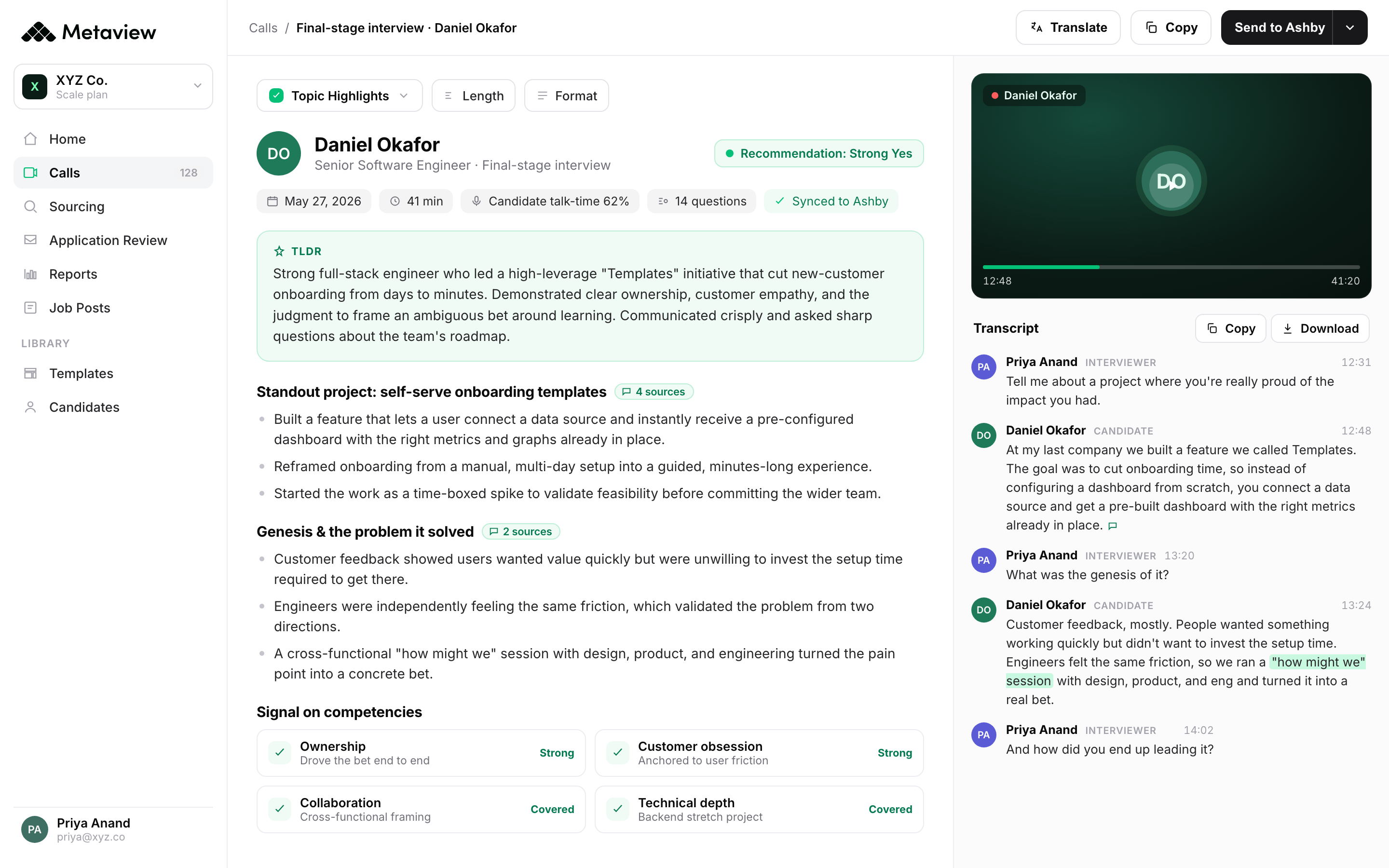
The Metaview Notetaker records and transcribes the interview, so the questions a candidate asks are in the same captured record as the rest of the conversation. You can score judgment or ownership against something specific instead of a vague "asked good questions."
Over the past year, we've saved over 1,000 hours for our interviewers and recruiting team. Beyond that, Metaview has allowed me as a talent leader to gain insights across meta themes like compensation or common candidate questions. It lets me be really proactive in my approach, versus reactive with problems that might come up.”
Make it part of the loop. A few habits turn this into something you can compare across candidates.
- Leave real time for questions and invite them, so your pacing doesn't cost a quiet candidate.
- Write down which questions they asked. The substance is what you're scoring.
- Tie it to a competency you already score, like judgment or ownership, set in the intake call.
- Don't reward volume. Note the one question that told you most about how they think, and what they did with your answer.
- Pair it with competency-based interviewing. Then the whole conversation, questions included, is there when you write the scorecard.
The best candidates are interviewing you the whole time. Listen to how they do it and keep it on the record, and a gut impression turns into evidence you can stand behind.
Figures in this piece come from Metaview's aggregated, anonymized data across around 5.5 million conversations captured between December 2020 and June 2026. Topic figures are drawn from the subset of sessions where the classifier returned labels, and they record the subjects a conversation covered.
Put the whole interview in writing.
Notes from the call, and a scorecard draft your interviewer reviews and submits.
Frequently asked
What questions should a strong candidate ask in an interview?
The ones your careers page can't answer. Strong questions go at the work itself, the bar for the role, or how the team makes decisions, and they come from someone already picturing themselves in the job.
Should a candidate's questions count towards your decision?
Yes, as evidence of judgment and ownership alongside the answers, scored against competencies you already use. Treat it as one input rather than a predictor. Nothing in our data links the questions a candidate asks to how they go on to perform in the job.
How much time should you leave for candidate questions?
Enough for a real exchange, so they can follow up on your first answer instead of accepting it. If the interview is running late, say so and offer to pick it up over email, then score what they ask there the same way.
Should you weigh a candidate's questions differently for junior roles?
Yes. A junior candidate has less context to draw on, so look for preparation over insider knowledge: what they read about the company, and who they'd be learning from.
What if a candidate asks something you can't answer?
Say you don't know, then find out and follow up. Candidates read the dodge, and the follow-up tells them more about how the team works than a smooth non-answer would.
