
When a hiring manager asks why the team turned a candidate down, the recruiter usually has the scorecards and a transcript no one has opened since the call. Transcripts tend to sit like that, filed after the interview and opened only when a question comes up that the scorecards can’t answer. By then someone is scrolling a whole interview’s worth of text for one sentence, and the answer to the hiring manager waits on the search.
Interview transcription for recruiters is the easy part now, and the transcript only pays off when someone reads it after the call. I’d give every transcript a job at a set point in the hiring process, and read it for that job before anyone needs it in a hurry.
Two of those jobs sit before and during the debrief, where the transcript settles what the candidate said. The other two come later, when someone wants to reopen a candidate or coach the interviewer who ran the call. In all four, the transcript supplies the words and a person makes the call. Without them, a debrief tends to go to whoever sounds most certain about what the candidate said.
Reread the lines around each scorecard quote before the debrief.
The first job belongs to the interviewer, after the scorecard is in and before the debrief starts. Reread the transcript around each answer your scorecard quotes or describes, to check that the context still says what the quote seems to say.
A line lifted out of an interview can mean more or less than it did in the room. An answer that looks thin on a scorecard may have followed a question that only asked for a yes or a no, and a confident line may have been walked back two minutes later.
- Open the scorecard you submitted beside the transcript.
- For each answer the scorecard leans on, read the question you asked just before it.
- Read on to your follow-up, if there was one, and the candidate’s reply to it.
- Where the context changes what an answer shows, say so at the start of the debrief, before anyone else gives a view.
This read finds no new evidence and changes no rating on its own. It checks the evidence you already chose, so you can correct yourself before the room does it for you.
Getting a transcript in the first place is a setup job of its own, and for interviews held on Zoom there’s a walkthrough of turning on Zoom transcription for every interviewer.
Settle what was said by reading the passage aloud.
The second job happens in the debrief itself, when two interviewers disagree about what the candidate said. The recruiter running the meeting ends the argument about memory by reading the passage, so the room argues about the rating with the candidate’s words in front of everyone.
- Read the question with the answer, and a few lines after it, so the room hears the follow-up as well as the first reply.
- Stop at the end of the exchange the disagreement is about.
- Once the words are agreed, let each interviewer argue their rating again from them.
Agreeing on the words leaves the rating open. An interviewer who heard a pause as nerves and another who heard it as a gap in knowledge can both be reading the same line honestly. I’d let each of them make the case, and the hiring manager settles it. Either way, note the passage in the debrief record.
A separate debrief walkthrough covers how to run the rest of that meeting.
Reopen a passed-on candidate from the record.
The third job comes up weeks later, when someone on the team says the company shouldn’t have passed on a candidate. It might be the recruiter, or a hiring manager looking at a thin shortlist. Go back to the passages behind the no before you go back to the people who said it.
- List the reasons the scorecards gave for the no, in the scorecards’ own words.
- Find where each reason shows up in the transcript.
- Give those passages and the competency they were rated against to someone who wasn’t in the interview, and ask what the passages show.
- Take what that reader found back to the hiring team, and let the team decide whether to reopen.
Of the four steps, I’d defend the cold reader hardest. The people who said no will read each passage the way they heard it the first time, and a reader who never met the candidate can only go on the words. That reader gives the hiring team a second reading of the same evidence, and the team still makes the call.
A transcript also leaves things out. It holds the words, so a shared screen or the tone of an answer won’t be in it. Where the no rested on something like that, say so when you take the passages back, so the transcript doesn’t stand in for what it can’t show.
Months later, those passages are useful again if the candidate comes back into scope for another role. A separate guide to candidate rediscovery covers resurfacing past candidates from applicant tracking systems and from earlier interviews.
Coach interviewers from their own questions.
The fourth job turns the transcript around. The other three read the candidate’s answers, and coaching reads the interviewer’s half, because that half is the one the interviewer controls.
I’d have the interviewer read their own lines before you do. I think a note lands better when the interviewer has found the problem first, and the conversation can start from what they noticed. Then read the transcript together for these patterns:
| In the interviewer’s lines | What it costs the debrief | What to try next time |
|---|---|---|
| A leading question, such as “So you’d say you work well under pressure?” | The candidate agrees, and the scorecard records an answer the interviewer supplied | Ask about the last deadline the candidate missed, and what they did next |
| A vague answer with no follow-up | The rating rests on the part of the story the candidate chose to tell | One follow-up on what the candidate personally did, before moving on |
| A competency on the scorecard that no question reached | The rating for it is a guess, or the field stays blank | Match each competency to a question before the interview starts |
| Long stretches where the interviewer does the talking | Less of the hour is the candidate’s evidence | Keep the pitch about the company for the last part of the call |
Start with one interview per interviewer, ideally one where their rating sat apart from the other panelists’ ratings, because that’s the transcript they’ll want to understand anyway.
Where Metaview fits in interview transcription for recruiters.
Each of the four jobs begins with a passage someone has to find. On Metaview, an agentic recruiting platform, the passages come from the Notetaker.
During the call, the Notetaker joins as a participant the candidate can see, then records and transcribes both sides of the interview. Once the call ends, it turns the recording into structured notes. No recording happens unless consent is given, and candidates hear about the recording through touchpoints your team configures.
Metaview integrates with applicant tracking systems such as Ashby and Greenhouse and works alongside them, so the transcript sits in Metaview, next to the candidate’s record in the applicant tracking system rather than inside it. A cold reader opens the passages there.
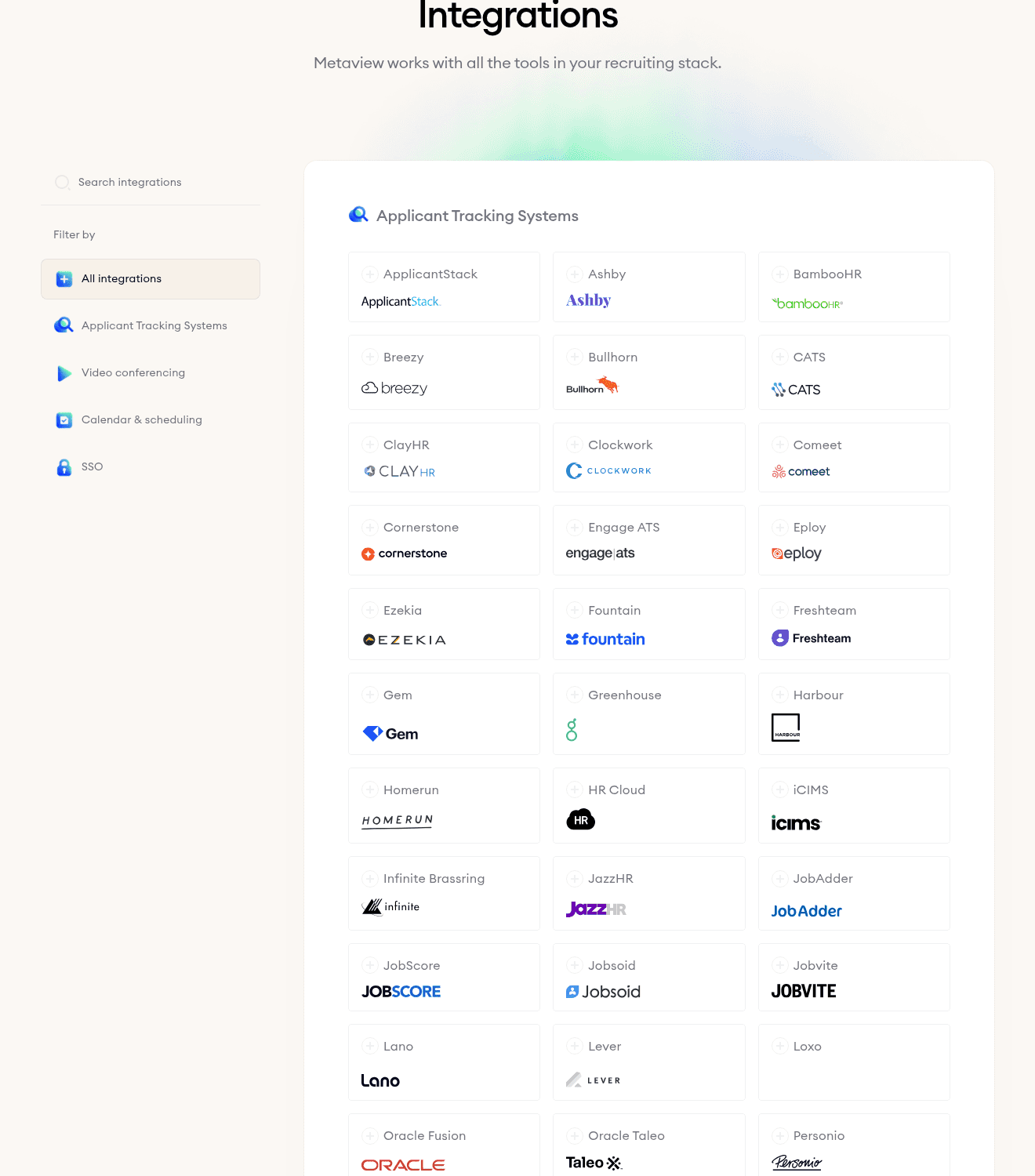
- 1The page’s filters, starting with “All integrations.”
- 2The “Ashby” entry in the applicant tracking systems list.
- 3The “Greenhouse” entry, further down the same list.
Metaview’s Notetaker captures every spoken word, and for the first job that means each note section links back to the moment in the transcript it was drawn from. Open the note behind a scorecard quote and follow it to the passage, and the question before it is right there.
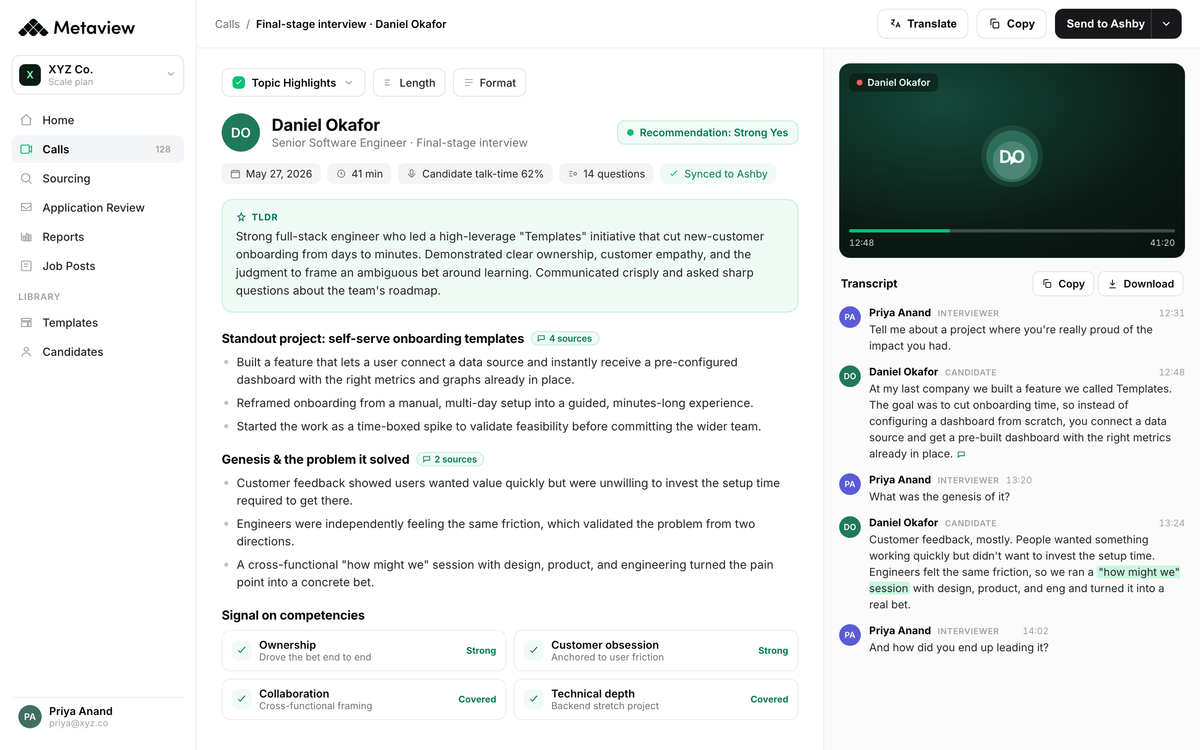
- 1A note heading marked “4 sources,” for the parts of the conversation the note draws on.
- 2The transcript beside the notes, each line under the speaker’s name and a time, such as the candidate’s answer at “12:48.”
- 3The words “how might we” highlighted in the candidate’s answer, the same phrase the notes use under “Genesis & the problem it solved.”
The notes are editable, so when a passage says less than its note does, the interviewer can correct the note before anyone relies on it.
For coaching, switch the interview’s notes to the question-and-answer layout. It sets each question the interviewer asked beside the candidate’s answer, so the interviewer’s half of the call reads on its own.
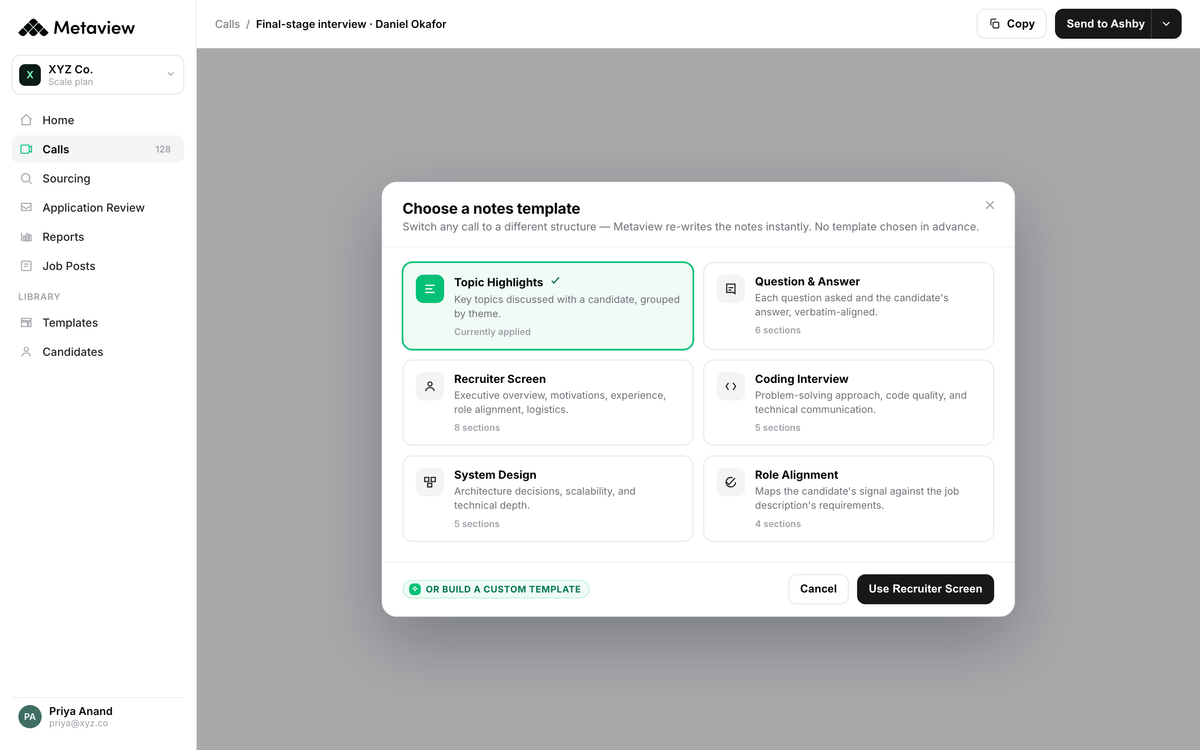
- 1“Topic Highlights,” the template currently applied to this interview’s notes.
- 2“Question & Answer,” which lists each question asked with the candidate’s answer.
- 3The option to build a custom template instead.
A job can also start from a question rather than a note, such as what a candidate said about leaving their last role. Ask the Metaview Assistant, which replies in plain language from your team’s captured interviews and recalls the specific details.
Coaching from transcripts also means no one has to sit in on interviews one at a time. A 2022 post on interviewer quality, written by Shahriar Tajbakhsh, set out why that feedback is hard to give across a whole team:
becoming a great interviewer is a skill that’s learned over time and requires regular, personalized feedback, which can be tough to scale.”

A transcript of each interview gives that feedback something specific to point at, and the Notetaker produces one for every interview it joins.
Check whether your transcripts get read after the call.
After a month of real hiring, four questions show whether the jobs are happening at all.
- Ask two interviewers, the day before a debrief, whether they reread the lines around their scorecard’s quotes. If neither did, give that reread its own slot before the meeting.
- Count the disagreements in your last few debriefs that ended on a passage read aloud. If there were none, have the recruiter bring the transcript open to the next one.
- Look at the last candidate someone asked to reopen. If no one outside the interview read the passages, add the cold reader before the team meets on it again.
- Ask each interviewer when they last read their own questions back. If it hasn’t happened this quarter, start with the interview where their rating sat furthest from the panel.
A passage read aloud in a debrief is the plainest sign that a team uses its transcripts after the call, because someone settled the candidate’s answer from the transcript instead of from memory. A month of debriefs without one means the transcripts are filed and the decisions still run on recall.
Coach interviewers from their own transcripts.
See the Metaview Notetaker lay out an interview question by question, so coaching starts from what the interviewer asked.
Frequently asked.
Must candidates be told their interview is being transcribed?
Tell them, and tell them how to decline before the call starts. A candidate who declines still gets the interview, and the interviewer writes notes by hand instead. Nothing about the choice goes on the scorecard. The exact notice for each location is your privacy lead’s to write.
How long should you keep interview transcripts?
Keep them for the period your data retention policy sets, and apply it to every candidate alike. Deletion follows that schedule, or a candidate’s request where local law gives them that right. A transcript kept past the period is a liability, however handy it might be later.
Can a candidate ask to see their interview transcript?
Depending on where they live, a candidate may have a legal right to request the personal data a company holds about them, and an interview transcript can fall within that. Agree with your privacy lead how you’d answer before the first request arrives, including who reads the file before it goes out.
What if the transcript and the interviewer’s notes disagree?
Play the recording at that moment first, because a transcript can mishear a name or a technical term. If the recording matches the transcript, correct the notes and say in the debrief which version you’re using. If the transcript misheard, fix the line before anyone quotes it.
Can you use an old interview transcript when a candidate applies again?
You can, within your retention period. Read the passages behind the earlier decision before the new screen, and treat them as what the candidate said at the time. Skills and circumstances change between applications, so the old transcript tells the new interviewer what to ask about, and the people running the new interview make the call.
