

A high-volume job spec can ask for more than the hiring process ever assesses. On one req, a recruiter checks a criterion in a screening conversation, and a hiring manager checks it again. Another requirement stays on the scorecard even though there isn’t a stage gathering evidence for it.
Both problems aren’t visible until the mapping is written down. For each criterion, we record the instrument, the delivery format, what the evidence can tell us, and what it cannot. That gives a Head of TA something concrete to fix before inbound application overload turns duplicate checks and empty rows into daily work.
Start with the criteria.
Open the spec for a repeat high-volume role. Copy every requirement, preference, competency, and knockout condition as written. Don’t hide or remove the vague phrases. During the intake meeting, the recruiter and hiring manager can define the behavior behind each phrase before anyone assesses it.
Give every criterion one primary instrument:
- Application materials, including the resume and application questions
- A short structured conversation
- A standalone work sample
- A human interview
- A practical or physical test
Now add delivery format as a separate column. Instrument and format aren’t the same thing: they answer different questions. The instrument tells us where the evidence comes from, while the format records how the candidate provides it.
When it’s delivered inside a conversation, a scenario remains part of that conversation; a standalone work sample requires a separate artifact or task outside it. The distinction matters because open text isn’t limited to one instrument. Asking a candidate to write a short answer during a conversation differs from asking them to research an account and submit a plan afterward.
Use your experience with each instrument to assess the evidence it yields. As you do, fill two columns for every criterion: what you actually learn and what the evidence cannot tell you.
The second column keeps a narrow observation from turning into a broad claim. A candidate’s response to one price objection gives you evidence about that defined situation. It can’t establish how the same approach will hold across a live book of business.
We can record burden as recruiter time and candidate effort. Use the lowest-burden instrument that can gather comparable, job-relevant evidence at the confidence the decision needs. A declaration can stay in the application materials when it’s enough to have a stated answer. Use a structured conversation for a shared question plan and written rubric. Move a criterion to a human interview when the evidence can’t be gathered without engaging another person in real time.
After each conversation at the screening stage, recruiters and hiring managers review the evidence assigned to that instrument.
Map a representative high-volume SDR role.
An SDR spec isn’t a single-format assessment because it combines eligibility checks, spoken communication, written work, and applied selling tasks. The map separates the instrument from the delivery format and records the limit of every answer.
| Criterion | Instrument | Delivery format | What you actually learn | What it cannot tell you |
|---|---|---|---|---|
| Authorized to work in the role’s location | Application materials | Declaration | The candidate’s declaration against a clear eligibility question | Whether the documentation is valid or the circumstances will change |
| Available for the required schedule and location | Application materials | Declaration | The candidate’s stated availability for the published conditions | Whether attendance or availability will change later |
| Prior outbound sales exposure | Application materials | Declaration | The candidate’s claimed experience and scope | Whether the candidate can sell well or has verified results |
| Motivation for this SDR role | Short structured conversation | Voice | Whether the candidate gives specific reasons tied to the work | Whether that motivation will persist after repeated rejection |
| Explain an unfamiliar product clearly | Short structured conversation | Voice or video | How the candidate organizes an explanation after receiving the same prompt | How the candidate will handle every live prospect conversation |
| Handle a common price objection | Short structured conversation | Scenario | The candidate’s approach and language in one defined sales situation | Whether the same approach will hold across a live book of business |
| Write a concise prospecting email | Short structured conversation | Open text | The candidate’s written judgment, message structure, and editing choices | How the candidate communicates aloud or follows up later |
| Respond to a rejected outreach attempt and choose the next action | Short structured conversation | Multiple-choice scenario with conversational follow-up | How the candidate handles a defined setback and chooses the next step | How the candidate responds to repeated rejection over time |
| Apply feedback to a second role-play | Human interview | Live role-play | How the candidate uses feedback in the next live attempt | How the candidate responds outside the defined role-play |
| Complete a basic CRM activity, if day-one CRM proficiency is required | Practical test | Live task | Whether the candidate can complete a defined task in a CRM sandbox | The candidate’s speed or accuracy under a normal workload |
| Explain a recent sales challenge clearly | Short structured conversation | Voice | How the candidate organizes a spoken account after receiving the same prompt | How the candidate handles a different communication task later |
| "Resilient self-starter" | No instrument, as written | None until the behavior is defined | Nothing comparable until the team defines an observable behavior | How the candidate behaves in any defined situation |
| Research a target account and submit a short outreach plan outside the call | Standalone work sample | Open text | How the candidate selects relevant account details and turns them into a written plan | How the candidate explains those choices in a live conversation or repeats the work under a normal workload |
In the first pass, the map checked the sales-challenge account twice: once in the short structured conversation and again in the hiring-manager interview. The deduplication rule assigns that account to the short structured conversation. The human interview keeps its separate "Apply feedback to a second role-play" criterion.
By contrast, the resilient self-starter row has no defined behavior to assess. The phrase can’t be assessed by any instrument as written until the team defines one. The final row shows why the second axis matters. Open text is the delivery format, while the separate artifact makes the instrument a standalone work sample.
Give each criterion one owner.
A recruiter checks spoken clarity in a recruiter phone screen. Later, the hiring manager asks for another general account of a sales challenge and learns the same thing. That’s how duplicate assessment enters one question at a time.
Use the map to name the distinct behavior each stage owns. The short structured conversation can own the candidate’s explanation of the sales challenge, while the human interview owns the live role-play where the candidate applies feedback from another person.
A later stage may need a second look at a related skill. Write that difference into the row before adding the question. For example, spoken organization and applying feedback are separate behaviors even when both involve talking. The instrument, format, expected evidence, and limit should make that distinction visible.
When two stages still gather the same evidence, the process doesn’t need both checks, so choose one owner and remove the other check. If the evidence the hiring manager needs isn’t the same, update the interview rubric with the behavior that belongs there. An instruction to check communication again leaves each interviewer to invent a new meaning.
Find the criteria no stage assesses.
A requirement without an instrument can still appear on a scorecard and influence the debrief. The resilient self-starter row gives the team no planned question, task, or shared evidence to score. Recruiters can’t compare answers when the behavior remains undefined.
Define the behavior or remove the requirement. If the team means respond to a rejected outreach attempt and choose the next action, write that into the spec. Then assign it to a scenario in the short structured conversation. If the team can’t name the behavior, remove the phrase from the spec and the interview scorecard.
Run the empty-row check whenever the skills-based hiring criteria change. A new criterion isn’t ready until the team can name the evidence, its owner, and its limit. Until then, it’s an expectation without an assessment.
Choose automation at the instrument level.
Once every criterion has an instrument, the automation decision isn’t about the entire stage. An ATS stage can contain declarations from application materials, a short structured conversation, and a separate work sample. For each instrument, decide what to automate based on the evidence it gathers and who must judge it.
Don’t move declarations out of application materials when a stated answer is enough. Use a standalone work sample for a separate artifact, a human interview for engagement with another person, and a practical test for a live task. The written map keeps those choices visible when the process changes.
A question plan, an appropriate response format, and a written rubric define the boundary of the short structured conversation. Criteria requiring a separate work product, live human interaction, or a specialized physical procedure aren’t part of the short structured conversation and remain with the instrument built to gather that evidence.
Use Screening for the short structured conversation.
Screening sits between Application Review and a human interview. It’s Metaview’s voice-led AI screening agent. It holds a conversation with every candidate the team chooses to assess, then gives recruiters a scored, evidenced write-up for their review.
Screening is designed for repeat roles taking 100 to 300+ applications, with standardized job descriptions. Screening can run the short structured conversation in the map while application materials, human interviews, standalone work samples, and practical tests keep their assigned criteria.
Setup takes minutes. Point Metaview at the role, and Screening generates a structured assessment plan with questions and per-question scoring rubrics. From the start, the agent ingests the job criteria, the company’s Ideal Candidate Profile, workspace knowledge about how the company hires, and the individual candidate’s CV. It uses that context to customize the questions for each candidate. Before anything goes out, recruiters can test an individual question or preview the full call from end to end.
There’s a scoring rubric written in prose for each question, with named bands that describe the evidence expected at each level. For example, a dependability rubric might define the "great" band as "a sustained, specific track record (timeframes, what others relied on them for) including a time it cost them something to deliver." Recruiters can customize the rubric, while the map records why the question belongs in this instrument and where its evidence stops.
The conversation can draw on these formats:
- Voice
- Video
- Scenarios
- Open text
- Multiple choice
A scenario can use multiple-choice options, followed by a conversational probe into the choice the candidate made. Screening combines those formats in a real-time, fluid conversation, so it doesn’t limit every response to a one-way recording with canned questions. Teams get more range than basic one-way video products without the complexity and inflexibility of a bespoke build. Scenarios don’t leave the short structured conversation, while a separate artifact still routes to a standalone work sample.
| Criterion | Delivery format | What the agent gathers | What the recruiter reviews |
|---|---|---|---|
| Motivation for this SDR role | Voice | The candidate’s reasons for wanting the role | The response against the question’s motivation rubric |
| Explain an unfamiliar product clearly | Voice or video | The candidate’s explanation after a shared prompt | The organization and clarity of the explanation against the rubric |
| Handle a common price objection | Scenario | The candidate’s response to the defined objection | The approach and language against the question’s rubric |
| Write a concise prospecting email | Open text | The candidate’s written response | The message structure, judgment, and editing choices against the rubric |
| Respond to a rejected outreach attempt and choose the next action | Multiple-choice scenario with conversational follow-up | The candidate’s chosen next action and explanation after a defined setback | How the candidate handles the setback and supports the next action against the rubric |
| Explain a recent sales challenge clearly | Voice | The candidate’s account of a recent sales challenge | How the candidate organizes the spoken account against the rubric |
The conversation adapts to the role and the candidate’s answers, with 76% of the agent’s questions following up on something the candidate said. Each question includes its own conditional follow-up instruction telling the agent what to probe. This example comes from a role where the team routed the work-authorization check to the conversation, while the SDR map above keeps it in application materials: "If they hold a time-limited permit, ask what it is and when it expires, factually and neutrally; if they are unsure, ask what their current status allows." Candidates can ask questions back and get answers, which means the conversation isn’t limited to the agent’s questions and information moves in both directions.
A candidate doesn’t need a login or account to open the link on desktop or mobile whenever it suits them. The team sets the call length when it builds the screen, and the invitation tells the candidate how long it will take. There’s no scheduling or phone tag, and Screening supports 18 languages. Teams can include an opt-out link in the invitation. The map should account for candidate effort as well as recruiter time.
After a call is completed, the recruiter receives a topline rating of Great, Good, Okay, or Poor Fit. Each result comes with a documented reason grounded in the call. Where consent has been given, the Screening call recording captures every spoken word and is available for your review. The team can check a written-up answer against what the candidate actually said. Recruiters also receive the audio recording and transcript mapped question by question, plus background safety and candidate fraud checks.
During the call, the agent flags responses that are likely AI-assisted or fraudulent. If a team requires video to stay on, it also watches for signs of reading from a second screen or script, and for chatbot use. For each completed call, the recruiter considers the flag as part of the evidence and decides whether the candidate moves forward.
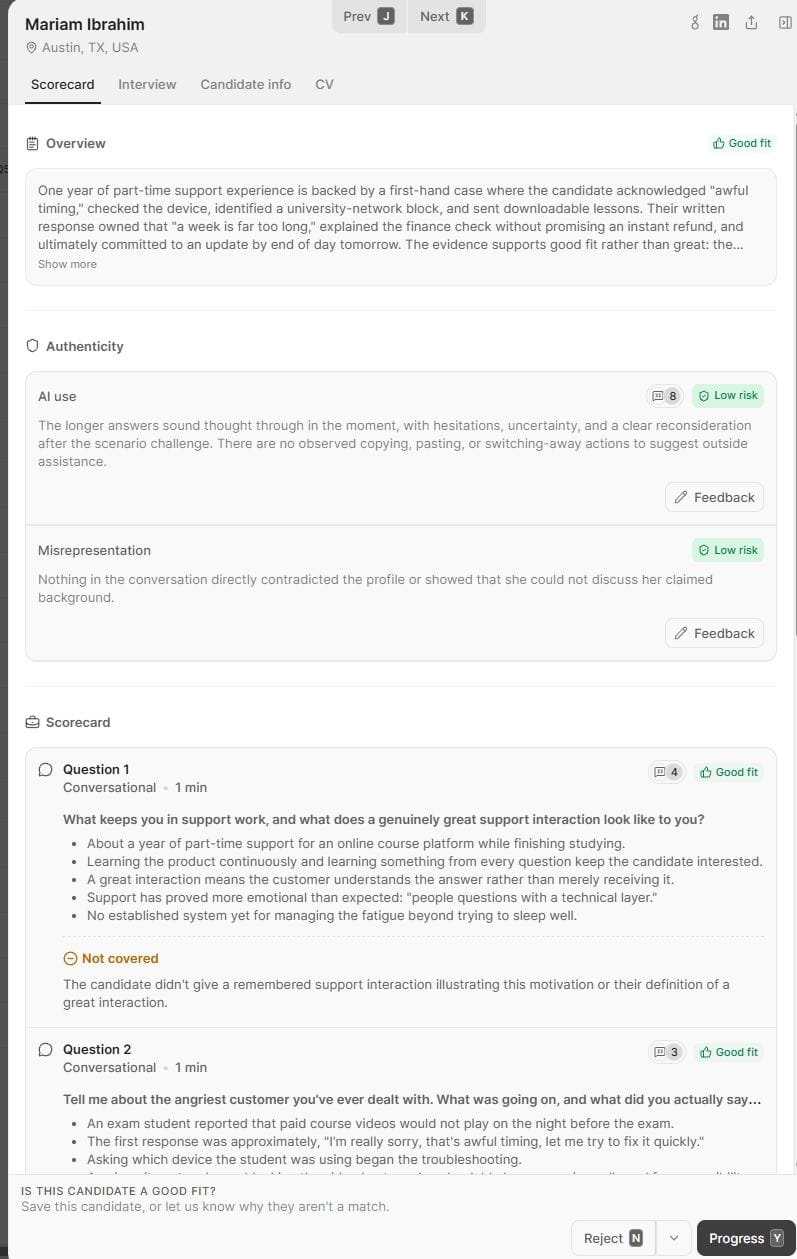
For completed calls, recruiters can bulk advance or reject candidates using the agent’s output, but the decision can’t take effect until a recruiter physically presses the button. For each completed call, the ATS sync then carries exactly these items: the summary of the call, the candidate’s information, and the recruiter’s progress or reject decision.
Screening complies with existing regulations, including the EU AI Act and New York City Local Law 144, but Local Law 144 puts the bias audit and the candidate notice on the employer. The human decision rule stays in place through the whole review.
Stress test what belongs elsewhere.
Now run criteria that don’t fit Screening through the same map. Each row needs evidence from a different instrument, and the final column states the boundary of that evidence.
| Criterion | Instrument | What you actually learn | What it cannot tell you |
|---|---|---|---|
| Lead an executive-level discussion about an ambiguous business decision | Human interview | How the candidate explains a recommendation and responds to another person in real time | How the candidate handles a different decision, audience, or executive context |
| Complete the role’s specialized physical procedure | Practical or physical test | Whether the candidate completes the defined steps in the test environment | How the candidate handles a different physical procedure |
| Describe working-style preferences | A separate personality test, with its own governance | How the assessment records the preference defined for the role | How the candidate collaborates in a role-specific task |
An executive discussion requires real-time interaction with another person. A specialized physical procedure needs a highly bespoke assessment with the relevant simulation. Working-style preferences belong to a separately governed personality assessment, so the map can add an instrument beyond the core five when governance requires it.
Screening’s fit excludes executive search and C-suite recruiting. It doesn’t cover highly bespoke assessment loops such as engineering roles with physical gear simulations or personality profile assessments. When a disputed criterion lands on one of these rows, keep the evidence with that instrument.
Keep the map alive.
A map created at intake records the team’s current standard. Recruiter decisions can reveal that the written rubric is missing a requirement the team repeatedly applies.
The agent monitors how recruiters approve and reject candidates after they review completed calls and looks for patterns in the reasoning they enter in the feedback log. If a recruiter rejects several candidates after reviewing completed calls with a note such as "remote only, we need in office," the agent treats the repeated reason as a pattern. It’ll then prompt the recruiter with a suggested rubric refinement, such as adding a hard requirement that the candidate must be available to work in the required market.
A human accepts or dismisses the suggestion, and the agent doesn’t rewrite the rubric on its own. Accepting a refinement changes the map. Record the accepted requirement in the criterion row, including the evidence and limit it changes, in the same document the hiring team uses for the role.
As recruiters use the assessment, the map changes through that explicit sequence. The starting rubric guides the conversation. Recruiter reasoning can surface a repeated requirement, and an accepted refinement updates the written standard. Everyone using the map can see the accepted wording, while the recruiter remains in control of the change.
Keep the current map beside the spec and scorecard. At the interview debrief, use the evidence assigned to each instrument. Remove a repeated question that has no separate job, and challenge any score with no planned evidence behind it.
For the next req, the map tells every recruiter and hiring manager what to assess and where to gather the evidence.
Map Screening to your hiring process.
See how Screening handles the criteria your map assigns to a short structured conversation.
Frequently asked
What can a team configure for each screen?
For each screen, teams configure the plan, questions, rubrics, call length, invitation, and outreach settings.
Can an existing screening call be used to create the questions?
Yes. Questions can be built from a job post or an existing screening call.
Who should maintain the map after intake?
Assign a named TA owner to each live req. They’re the person who updates the map when the spec, scorecard, assigned instrument, or accepted rubric wording changes and makes sure recruiters and hiring managers work from the current version.
How do we audit whether stages are following the map?
Compare a sample of completed scorecards and interview records with the map. Check whether each stage gathered its assigned evidence and stayed within the stated limit. If a stage collected something outside its row, remove the duplicate or document the distinct behavior it owns.
What if one criterion seems to need both a conversation and a separate artifact?
Split it into the observable behaviors each instrument will assess. Put the spoken explanation in the short structured conversation and the submitted work in a standalone work sample, with a separate evidence statement and limit for each. If the team can’t name two different behaviors, choose one primary instrument and remove the duplicate.
