
A typical requisition gets hundreds of applications in the first 48 hours. Most candidate screening software ranks them once and walks away.
That is fine if a resume tells you everything. It rarely does. The signal you actually score on shows up later, in the screener and the rubric, after the candidate has answered the questions that matter.
The screening platforms worth picking are the ones that learn from those later decisions. They watch which candidates you advance, watch which ones you cut, and tighten the criteria for the next batch automatically.
This guide compares the 11 candidate screening platforms recruiters use most, where each one fits, and where each one falls short.
The 11 platforms at a glance.
Quick read on what each platform is built for and where it fits in the screening flow. Details and honest trade-offs in the per-tool sections below.
| Platform | Category | Best for |
|---|---|---|
| Metaview | AI Application Review with closed feedback loop | Teams that want screening quality to sharpen with every hiring decision |
| Greenhouse | ATS-native AI screening | Teams already on Greenhouse who want structure inside one platform |
| Puck | AI phone screening | Inbound-heavy teams running repeatable early-stage screens |
| Ashby | All-in-one recruiting platform with screening | High-growth tech teams that want analytics-led workflows |
| Eightfold AI | Deep-learning skills inference | Enterprise teams hiring across many job families |
| HireEZ | Sourcing-led screening with profile enrichment | Outbound-heavy teams qualifying sourced candidates fast |
| Paradox | Conversational AI screening | High-volume hiring where speed and mobile UX matter most |
| Xobin | Assessment-led candidate screening | Teams screening with skills, coding, and behavioral assessments |
| KitaHQ | AI resume and video screening | High-volume teams and staffing, recruitment, or RPO businesses with several active pipelines |
| TestGorilla | Skills- and assessment-led screening | screening Teams that want candidates to demonstrate skills before the first human interview |
| Checkr | Background and identity screening | Teams that need scalable identity, background, and compliance checks |
Where most candidate screening software falls short.
Most platforms treat the application as the candidate. They rank the resume on day one and never look again.
They keyword-match instead of understanding the role. A senior backend engineer who calls their experience "building infra" gets buried under everyone who used the exact phrase from the JD.
They are ATS bolt-ons. The screening layer is a tab inside the tracking system, not a system that learns. The criteria you set on Monday is the same criteria on Friday, even after you have rejected 50 candidates for the same reason.
They miss the screening call. The recruiter learns the candidate is wrong on motivation in minute 3, and that learning never makes it back into the ranking for the next 200 applications.
And they treat fraud as someone else's problem. AI-generated resumes and identity deception go up every quarter; most interview screening tools still leave detection to the recruiter's gut.
The best candidate screening software in 2026
The best tools in 2026 use AI to evaluate candidates in context, conduct intelligent screening conversations, and give recruiters better evidence for who should move forward.
1. Metaview.
Category: AI Application Review with closed feedback loop
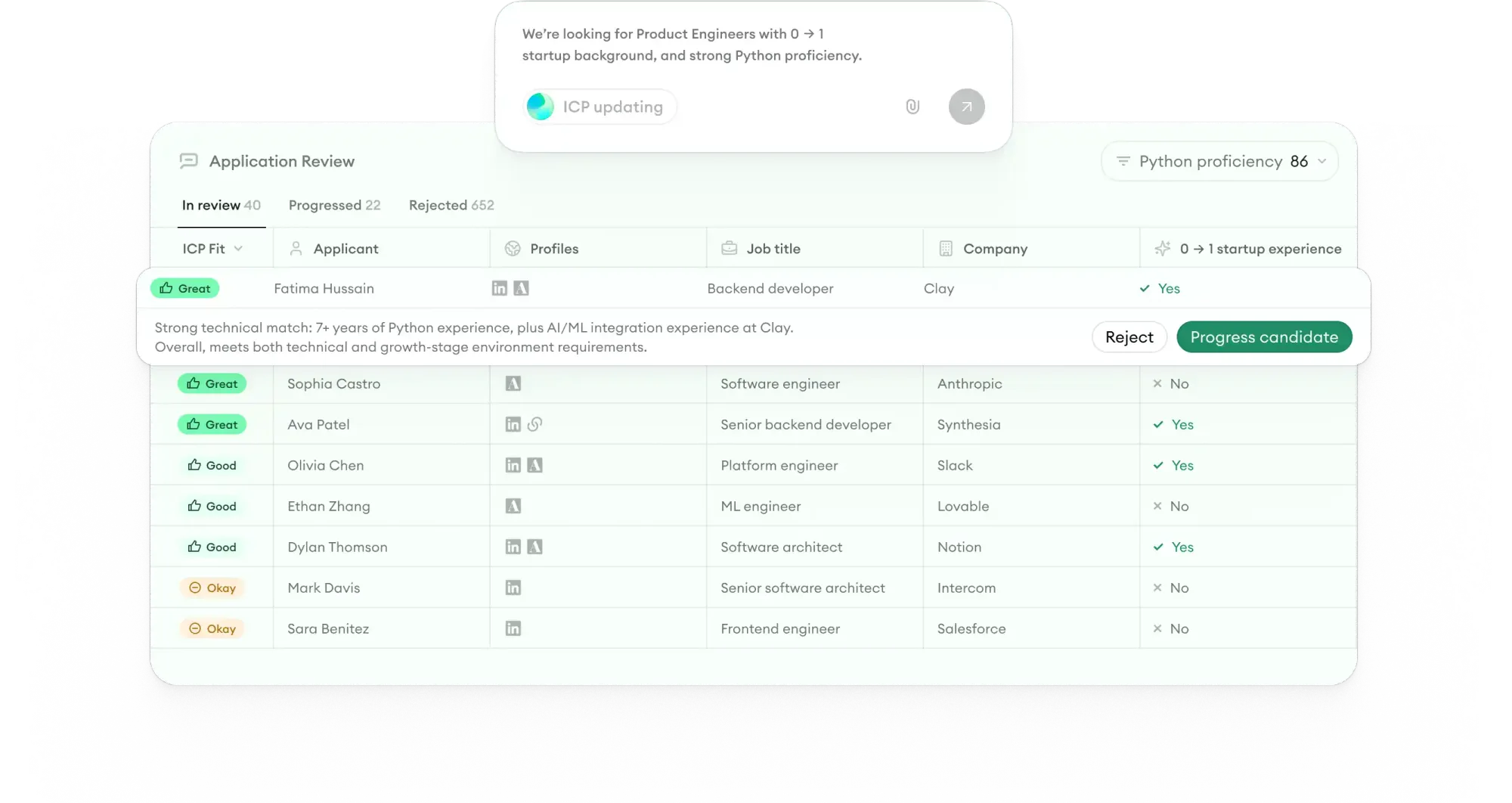
Metaview is the AI recruiting platform built around the interview as data. Application Review evaluates every inbound applicant against an Ideal Candidate Profile generated from the job post and refined by every accept and reject you make.
The closed feedback loop is the differentiator. Every decision sharpens the ICP, the pipeline re-ranks automatically, and the next 200 applications get scored against criteria your team has already validated.
What it covers:
- Real-time evaluation of every applicant against your ICP, 24/7
- Self-calibration: the ICP refines from your accept/reject decisions
- Plain-language reasoning behind every evaluation, with full edit control
- Built-in fraud detection on by default
- Native ATS sync with Ashby, Greenhouse, Lever, Workable, Teamtailor, and more
- Custom AI columns for criteria like deal size, location fit, or domain experience
Where it falls short: if your only need is parsing resumes into searchable fields inside an existing ATS, Metaview is more product than you need.
Best for: teams running high-volume inbound where the screening criteria should sharpen with every cycle, not stay frozen.
Jobber tested Metaview against another screening tool before going all-in. Dan Andres, Talent Attraction Partner at Jobber, described the difference.
We tested Metaview against another tool and the difference was clear. It goes way beyond keyword matching. The ICP fit explanation, the red flags, and the reasoning behind each evaluation are real differentiators.”
2. Greenhouse.
Category: ATS-native AI screening
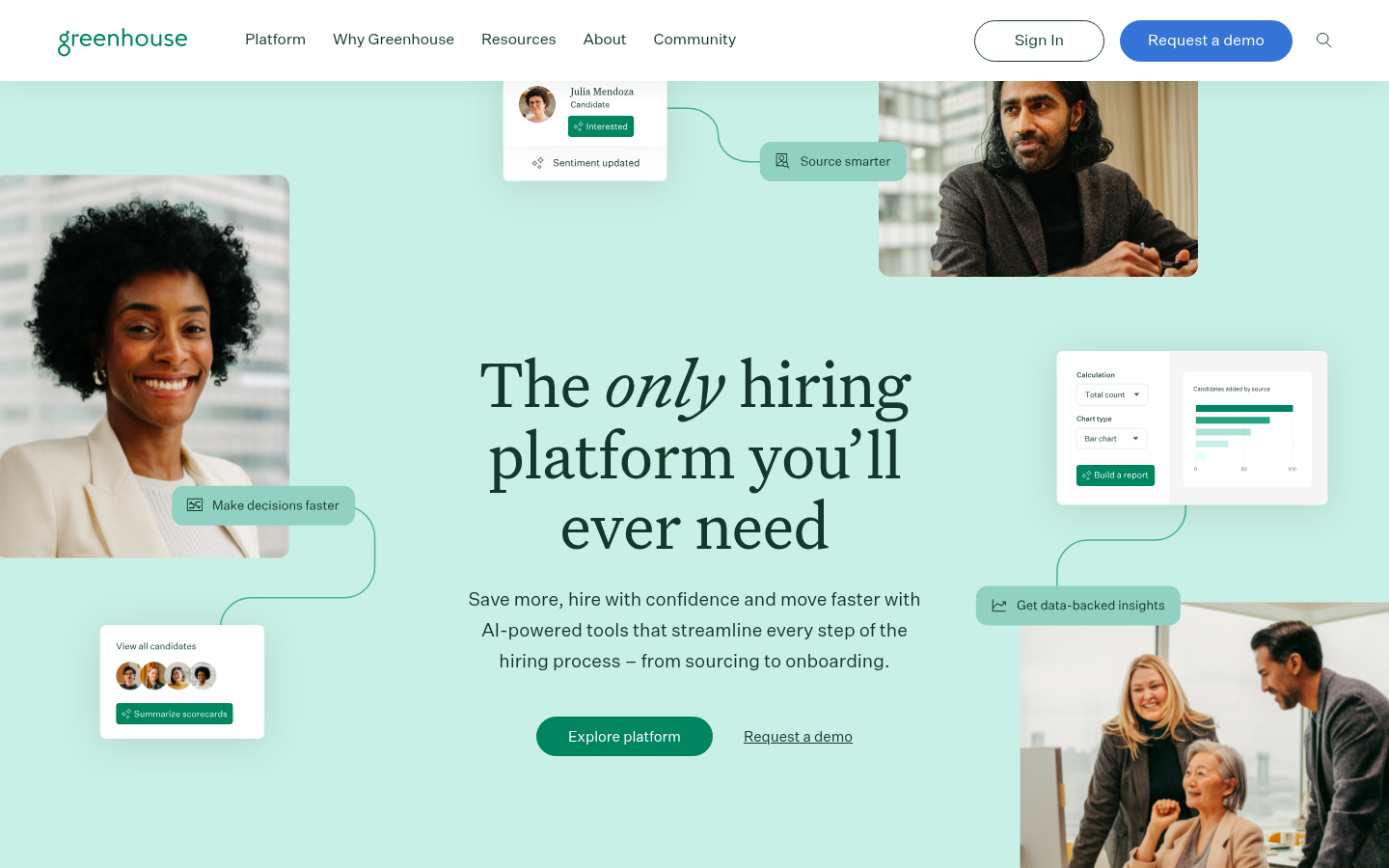
Greenhouse is the structured-hiring ATS most growth-stage teams default to. Its screening tooling layers AI scoring onto the resume review step inside the tracker.
For teams already on Greenhouse, the value is in not adding another login. You get a workable ranking layer on top of the workflow your team already runs.
What it covers:
- AI-assisted resume screening tied to job-level criteria
- Structured scorecards and interview kits
- Candidate comparison views inside the candidate record
- Workflow automations for stage moves and notifications
- Bias-reduction prompts inside the evaluation flow
Where it falls short: the screening layer ranks once. It does not re-rank the pipeline after your team rejects 30 candidates for the same reason, and it does not learn from interview signal.
Best for: teams already standardized on Greenhouse who want structured screening inside one tool and are not ready to add a dedicated AI layer.
3. Puck.
Category: AI phone screening
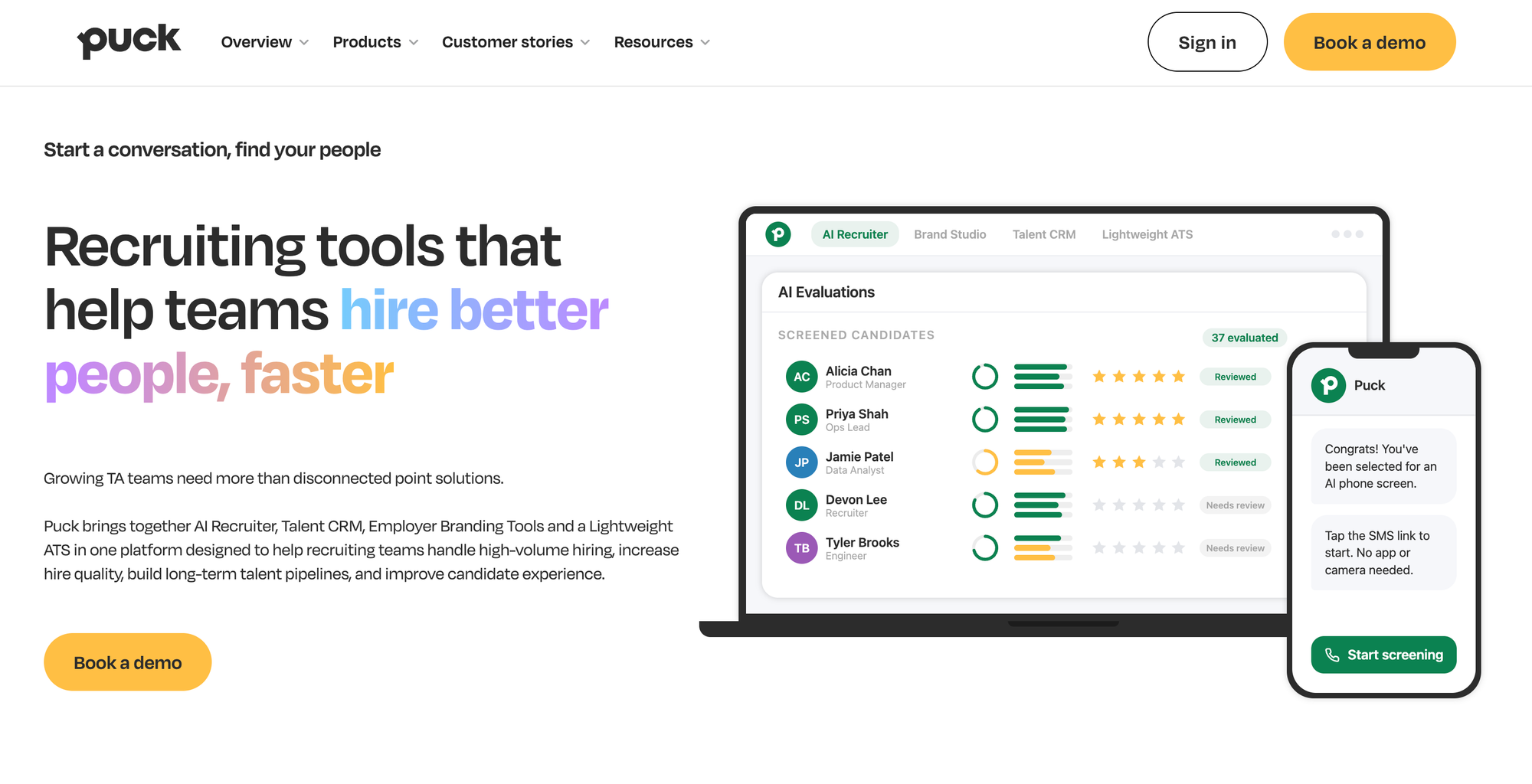
Puck runs early high-volume candidate screening as a two-way conversational audio interview through its AI Recruiter. Candidates start from an SMS or email link, need no camera or app, and can finish the roughly 10-minute screen when it suits them.
For setup, Puck's AI suggests questions and evaluation categories based on the job description, but the recruiter can modify or add their own. Puck's AI scores the completed interview and returns the recording, transcript, and score to the dashboard, after which the recruiter decides who moves forward.
What it covers:
- Custom questions for repeatable phone-screen workflows
- Audio screening that candidates launch from an SMS or email link, 24/7, with multilingual support
- Calls graded by Puck's AI, with each evaluation reviewed by a recruiter
- Automated follow-up and candidate matching
- AI resume review, a Talent CRM, and a lightweight ATS
- Greenhouse, Ashby, Lever, and other native ATS integrations
Where it falls short: Puck is designed around high-volume and inbound-heavy hiring, so its strongest fit is a repeatable early-stage screen. A highly bespoke or low-volume search may still call for a more hands-on process.
Best for: inbound-heavy teams that want candidates screened quickly without requiring a scheduled live call.
4. Ashby.
Category: All-in-one recruiting platform with screening
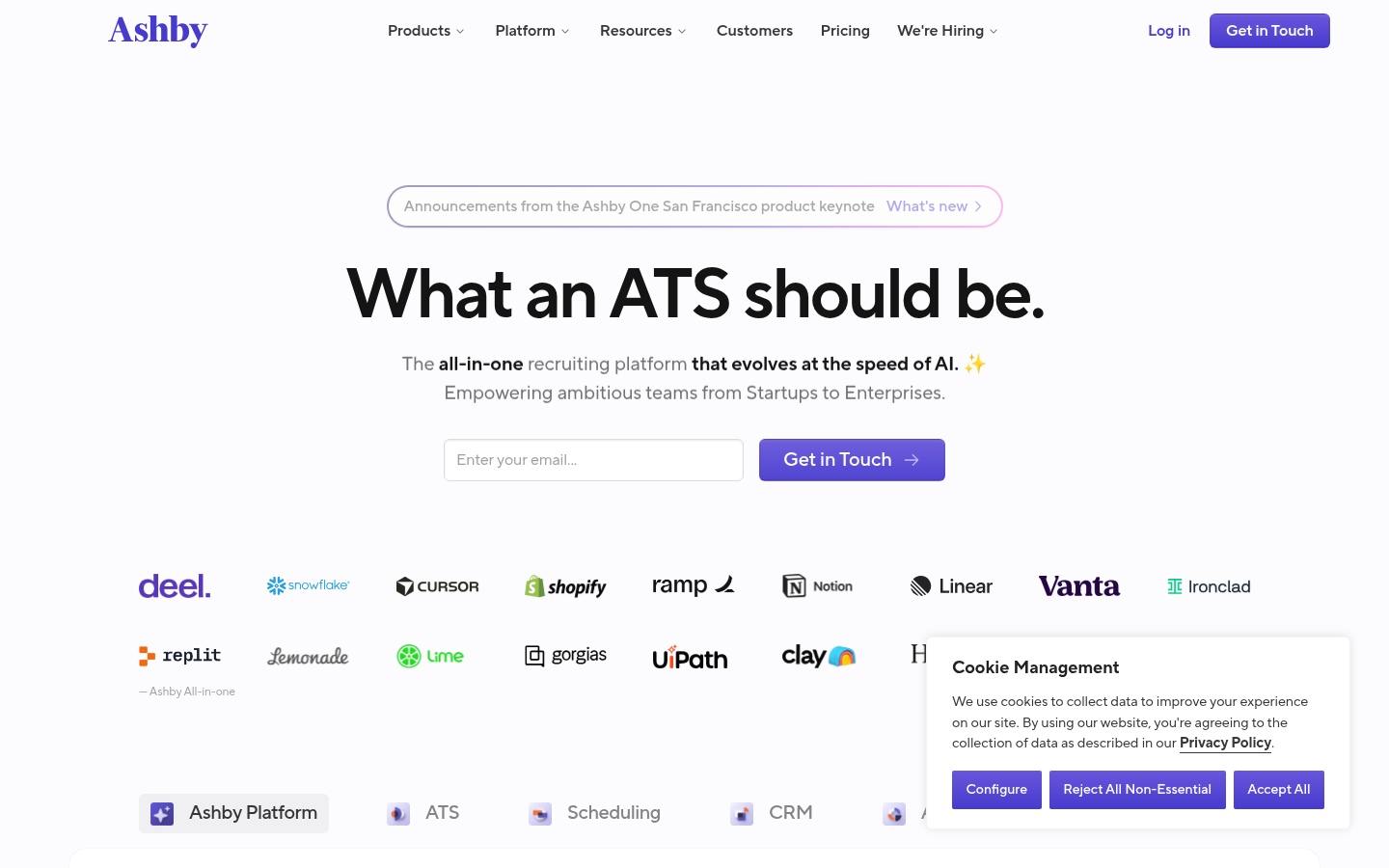
Ashby is the all-in-one recruiting platform most high-growth tech teams pick when they outgrow a basic ATS. The screening features combine resume parsing, automated ranking, and customizable scorecards in one workflow.
The analytics layer is what makes Ashby stand out. You can see screening conversion by source, by role, by interviewer, which most ATSs cannot do without a separate reporting tool.
What it covers:
- Automated candidate scoring and prioritization
- Highly configurable scorecards for structured evaluation
- Built-in interview note organization
- Deep analytics on screening conversion rates
- Unified ATS, scheduling, and CRM in one tool
Where it falls short: screening AI is one feature among many, not the focus. The ranking is solid but does not self-calibrate from your decisions, and there is no built-in interview-intelligence layer.
Best for: high-growth tech teams that want analytics-led workflows and are happy with screening as a feature inside the ATS.
5. Eightfold AI.
Category: Deep-learning skills inference
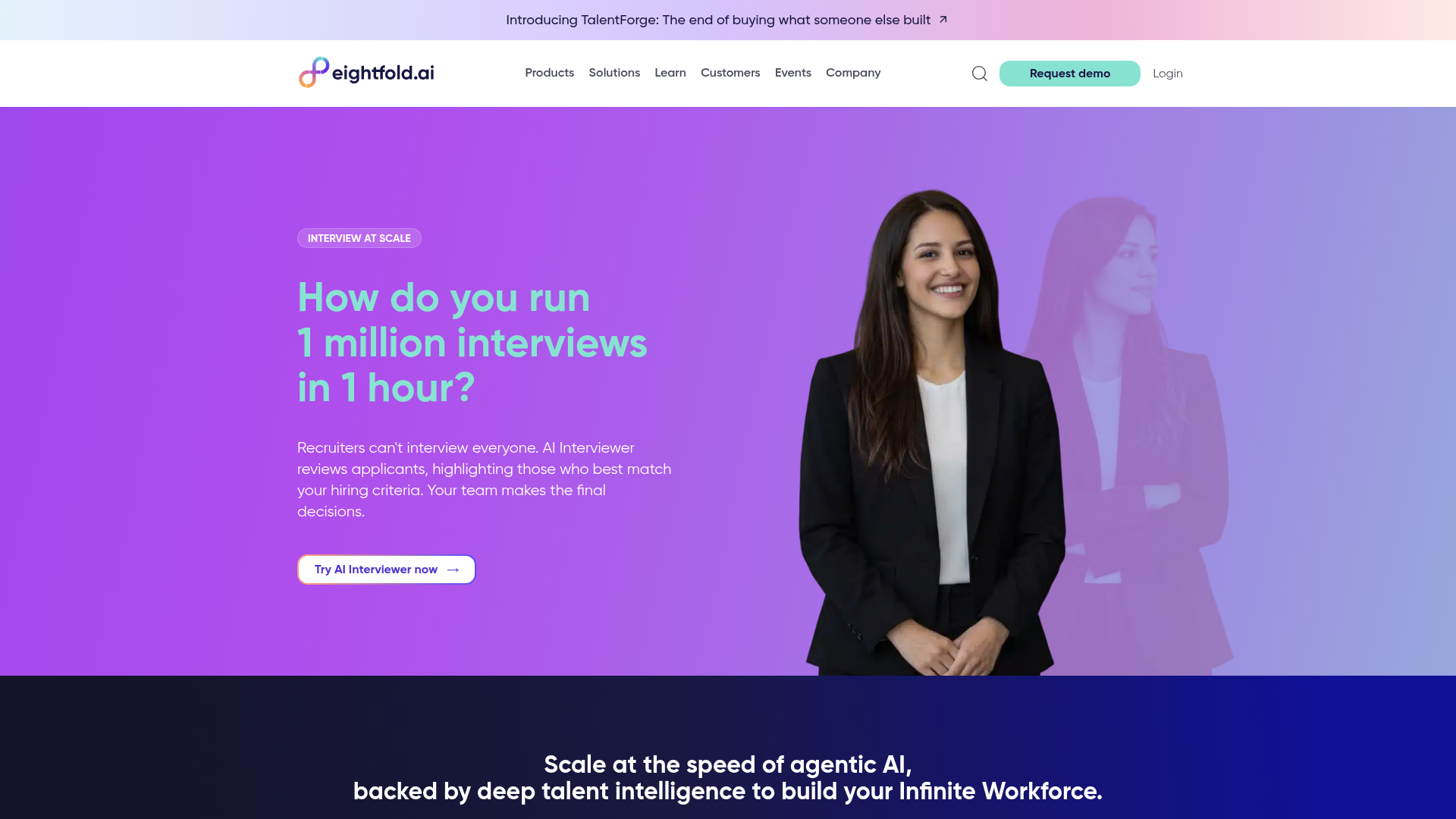
Eightfold AI uses deep-learning models to infer skills candidates have not explicitly listed. It maps declared skills, adjacent skills, and career paths to predict role fit and long-term potential.
For enterprise teams hiring across many job families, the skills graph surfaces candidates traditional screening misses entirely. Internal mobility and silver-medal rediscovery are the strongest use cases.
What it covers:
- Skills inference and capability modeling
- AI-matched candidate rankings per role
- Diversity and bias-mitigation controls
- Unified view across internal, external, and past applicants
- Automated rediscovery of silver-medal candidates
- Enterprise security and compliance posture
Where it falls short: the implementation footprint is heavy. For sub-enterprise teams the skills graph is more model than you need, and the AI is opaque compared to platforms that show reasoning per candidate.
Best for: enterprise organizations hiring across multiple job families with strong internal mobility programs.
6. HireEZ.
Category: Sourcing-led screening with profile enrichment
HireEZ started as an outbound sourcing tool and grew into a screening layer that qualifies the candidates it surfaces. It enriches profiles with public data and ranks fit before a recruiter opens the file.
For outbound-heavy teams, the value is the connected workflow: discover, enrich, qualify, and push to the ATS without leaving HireEZ.
What it covers:
- AI-based candidate matching with quality scores
- Comprehensive profile enrichment from public data
- Automated qualification filters on outbound pipelines
- CRM-style organization of sourced talent
- Integrations with major ATS platforms
Where it falls short: the screening is calibrated to sourced candidates, not inbound applications. Teams with mostly inbound volume will hit the limits fast.
Best for: outbound-heavy teams who want sourcing and qualification inside one workflow.
7. Paradox.
Category: Conversational AI screening
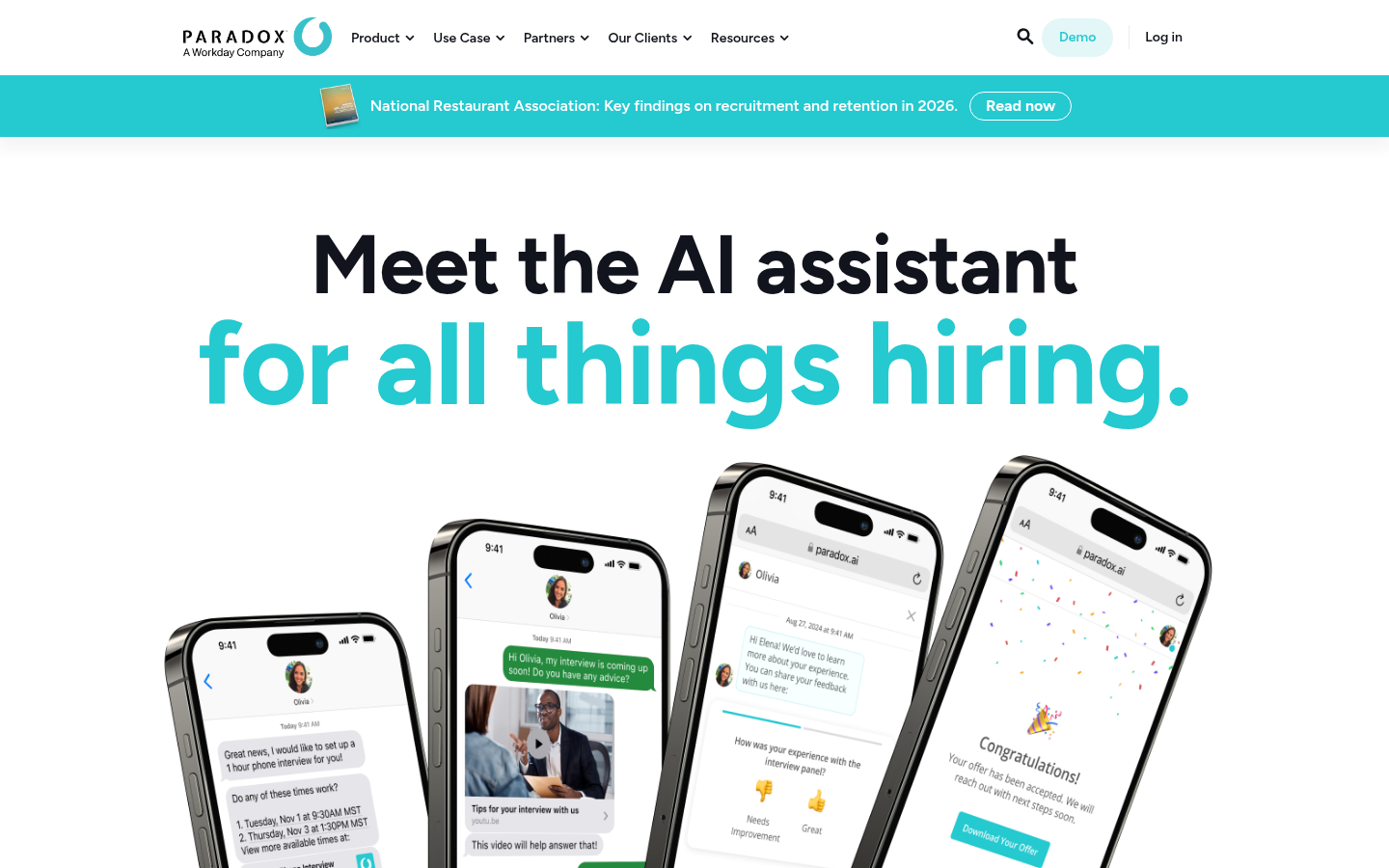
Paradox runs early-stage screening as a chat conversation. Candidates answer structured questions via SMS, mobile, or web chat, and the assistant Olivia evaluates basic qualifications in real time.
For high-volume hiring where the bottleneck is response speed, Paradox shines. Candidates get answered in seconds; recruiters get cleaner pipelines without manually triaging applications.
What it covers:
- Automated chat-based screening conversations
- Instant qualification against predefined rules
- Mobile-first candidate experience
- Automated scheduling for qualified candidates
- ATS integrations for real-time stage updates
Where it falls short: the screening is rule-based, not interview-aware. For knowledge-work or senior roles where nuance matters, the chat conversation cannot replace a recruiter screen.
Best for: high-volume retail, hospitality, and frontline hiring where speed and mobile UX matter most.
8. Xobin.
Category: Assessment-led candidate screening
Xobin screens applications through resume review, assessments built from job descriptions, and open-ended response scoring. AI Evaluate returns a scored shortlist after grading open-ended answers and flagging anomalies.
The connected workflow also covers coding rounds, automated video interviews, agentic technical interviews, and applicant tracking through Tracks. Trigger-based workflows handle reminders and candidate communications.
What it covers:
- Resume screening
- Assessments built from a job description
- Scored shortlists from AI Evaluate
- Automated video and agentic technical interviews
- Offer-stage nudges and candidate communications
Where it falls short: Screening sits within a broader Xobin flow that includes assessments, Tracks, proctoring, and both live and automated interviews.
Best for: Teams screening candidates through assessment, coding, and video interviews.
9. KitaHQ.
Category: AI resume and video screening
KitaHQ pairs AI Resume Screening with AI Video Interview. Teams review CVs, qualifying answers, and required documents before moving candidates into multilingual video interviews.
AI Interview Assessment covers skills, communication, and role fit, while AI Candidate Report turns interviews into reports. HireOS manages active pipelines and candidate communication, with hiring manager review kept in the same place.
What it covers:
- AI resume screening
- Multilingual AI video interviews
- Skills, communication, and role-fit assessments
- Candidate reports from interviews
- Active pipeline and candidate communication management
Where it falls short: KitaHQ does not replace an HRIS, job boards, sourcing databases, outbound sourcing, background checks, or highly personalized executive search.
Best for: High-volume teams and staffing, recruitment, or RPO businesses managing several active pipelines.
10. TestGorilla.
Category: Skills- and assessment-led candidate screening
TestGorilla screens candidates based on what they can actually demonstrate, rather than relying primarily on resume credentials. Teams can combine qualifying questions with skills tests, role-specific assessments, structured AI interviews, and asynchronous video questions to build a more evidence-based first screening stage.
Its breadth is the main attraction. TestGorilla offers 350+ skills tests, while its AI interviews can ask follow-up questions based on candidate responses and score the conversation against predefined criteria.
What it covers:
- 350+ skills and role-specific assessments
- Qualifying questions for minimum job requirements
- Structured AI interviews with follow-up questions
- Asynchronous video questions
- Explainable candidate scoring with human override
- Integrations with Greenhouse, Workable, Lever, Teamtailor, and other ATSs
Where it falls short: TestGorilla is strongest when you already know which skills or competencies you want candidates to demonstrate. Teams looking primarily to learn from recruiter decisions and continuously refine how the entire inbound applicant pool is prioritized will want a more dedicated application-review layer.
Best for: teams that want to screen candidates based on demonstrated skills and structured assessments before committing recruiter time.
11. Checkr.
Category: Background and identity screening.
Checkr operates later in the candidate screening process than most tools on this list. Rather than deciding who deserves a first interview, it helps employers verify the identity and background of candidates they're seriously considering hiring.
The platform combines employment background checks with identity verification and compliance workflows. Checkr Assess can also apply role-specific adjudication criteria to surface relevant records consistently, helping recruiting teams spend less time manually reviewing background reports.
What it covers:
- Employment background checks
- Identity verification before background screening
- Criminal record and motor vehicle record screening
- Employment verification
- Role-specific screening recommendations
- Automated adjudication and record filtering
- Mobile-first candidate portal with real-time status updates
Where it falls short: Checkr isn't designed to evaluate candidate fit from resumes, skills, or interview conversations. It complements earlier-stage candidate screening software rather than replacing it.
Best for: teams that need scalable background, identity, and compliance screening once candidates reach the later stages of the hiring process.
How to choose candidate screening software.
The right platform depends on the funnel shape, the existing stack, and how much you trust AI to make recommendations you can override. To score your shortlist side by side, use our 30-question rubric for evaluating an AI screening tool.
Comparing tools at adjacent layers of the recruiting stack? See our guides on the best applicant tracking software and CRM vs ATS for recruiting.
Bring Metaview into your hiring stack.
Live notes, structured scorecards, and ATS sync - set up in under 10 minutes.
Frequently asked.
What is the best candidate screening software?
It depends on what you need from screening. For ATS-native scorecards inside an existing workflow: Greenhouse or Ashby. For deep-learning skills inference at enterprise scale: Eightfold. For sourcing-led qualification: HireEZ. For high-volume conversational screening: Paradox. For on-demand AI phone screens: Puck. For an AI screening layer that learns from every hiring decision and re-ranks the pipeline: Metaview.
Can AI screening replace the recruiter screen?
No, and the good platforms do not try to. AI handles the volume work: ranking applications, surfacing fit signals, flagging fraud, and removing the manual cleanup. The recruiter screen stays human because that is where motivation, salary, and culture signals come out.
Does candidate screening software reduce bias?
When the rubric is consistent and applied to every candidate, yes. The trap is using AI as a black box. The platforms worth picking show their reasoning, let you edit the criteria, and never auto-reject.
Do these platforms detect fake or AI-generated applications?
Fraud detection coverage varies. Metaview ships fraud detection on by default in Application Review with a plain-language risk explanation per application. Most ATS-native screening modules treat fraud as a separate add-on or do not cover it at all.
How much does candidate screening software cost?
Most enterprise platforms quote on request based on seat count, ATS integration, and feature depth. Metaview offers a free starting point with a work email; paid plans add full Application Review, ATS sync, and reporting.
