
The teams that hire well in 2026 source differently than they did in 2024.
The volume model is dead. The teams winning today run small, deliberate, channel-specific strategies that put recruiter time on the few candidates worth a real conversation, not the thousand worth a templated outreach.
Here are 11 candidate sourcing strategies that work right now: what each one is, where it fits in the funnel, and how to operationalize it without burning out the team.
All 11 strategies at a glance.
| # | Strategy | Best for | Effort |
|---|---|---|---|
| 1 | AI sourcing against past hires | Repeatable role families | Low after setup |
| 2 | Nurtured talent communities | Long-cycle senior hiring | Medium, compounds |
| 3 | Referral programs with teeth | Quality of hire and retention | Medium, ongoing |
| 4 | Alumni and rehire pipelines | Fast time-to-productive | Low if data exists |
| 5 | Niche community sourcing | Specialized technical or creative | Medium |
| 6 | Hyper-personalized cold outreach | Senior or hard-to-reach | High per message, high yield |
| 7 | Video-first recruiter intros | Standing out from templated outreach | Low per message |
| 8 | ATS rediscovery | Reusing existing candidate data | Low |
| 9 | Employer brand as passive sourcing | Long-term reduction in outbound load | High, compounds over years |
| 10 | Diversity-first channel design | Reaching candidates LinkedIn misses | Medium |
| 11 | Nearshore and global talent markets | Expanding remote-friendly candidate pools | Medium |
1. AI sourcing against your past hires.
The strongest sourcing signal isn't keyword match. It's the pattern of who's actually worked out at your company over the last 18 months.
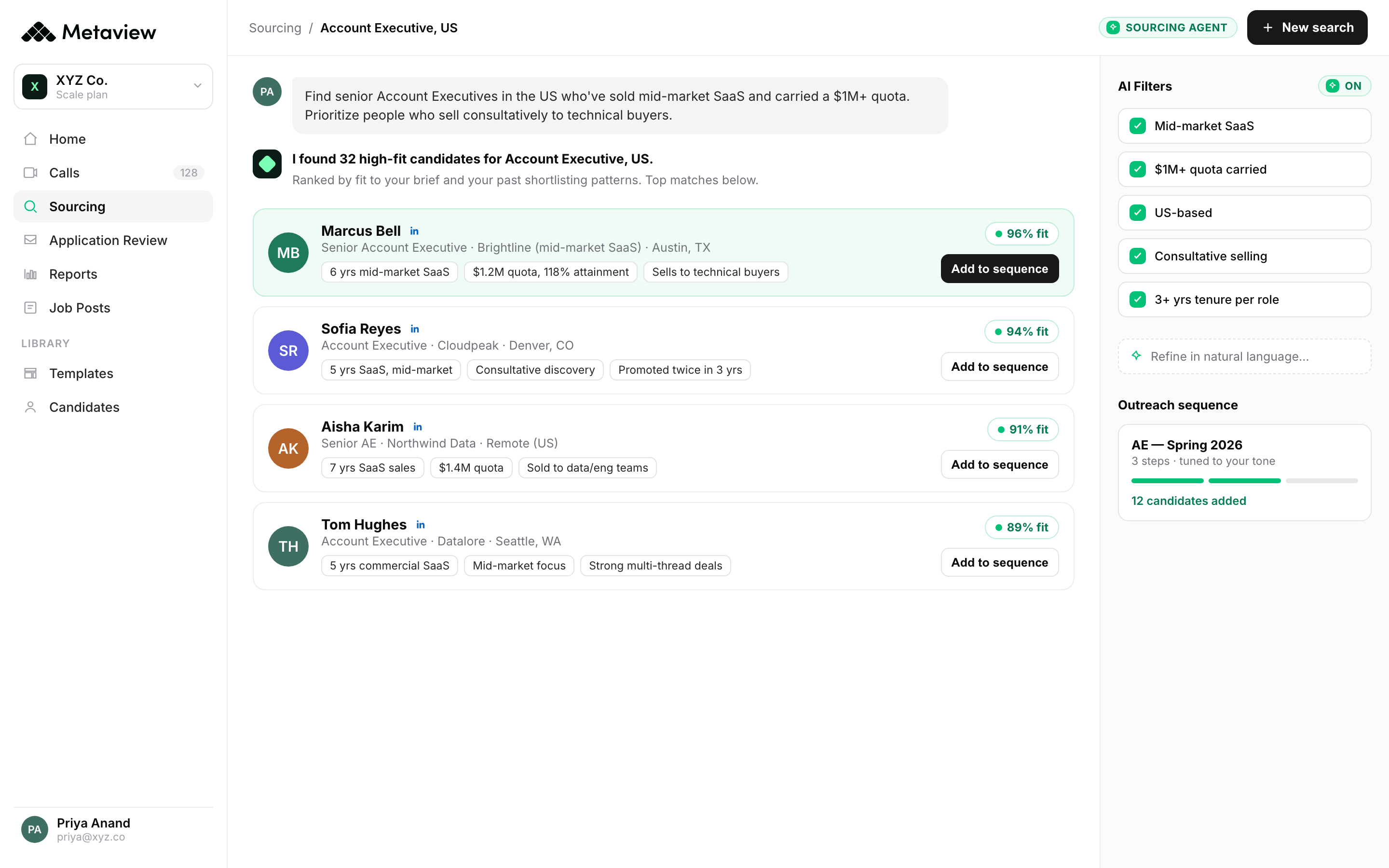
Modern AI sourcing weights candidates against your past hire data, not a generic skills taxonomy. The output is a shortlist tuned to your actual environment, not a textbook profile.
What to do: feed your last 50 successful hires into the sourcing agent. Let the model surface candidates who match the actual pattern, not the JD's wishlist.
2. Nurtured talent communities.
The candidate you contact for a role next year is cheaper, faster, and more likely to convert than the candidate you cold-message today.
A talent community is the set of past applicants, referrals, alumni, and warm passive candidates kept engaged through low-cost touchpoints. The infrastructure is a segmented CRM. The work is monthly: useful content, role-specific event invites, the occasional check-in.
What to do: identify the 500 candidates you wish you could re-contact. Build a quarterly newsletter that gives them something other than "we're hiring." Measure response when the next req opens.
3. Referral programs with teeth.
Referred hires stay longer and ramp faster than any other source. Most companies know this and still under-invest in referrals because the program is run as a passive ask.
The high-yield version: per-role briefings to top employees, a structured ask ("two people in your network who could do X"), a clear cash incentive, and visible recognition for the referrer.
What to do: calibrate the bonus to be material. $1,000 per hire is a token. $5,000-$10,000 changes behavior.
4. Alumni and rehire pipelines.
The fastest time-to-productive hire is someone who's already done the job at your company.
Alumni networks aren't passive. The teams that win at them have a single owner running quarterly check-ins, a Slack channel, and a clear "we'd rehire you" message attached to most exits.
What to do: tag every regretted-attrition exit. Reach out within 12 months. The conversion rate on returning alumni is higher than any cold sourcing channel.
5. Niche community sourcing.
The candidates who matter most in technical or creative roles aren't on LinkedIn at the right level of engagement. They're on GitHub, Hugging Face, Dribbble, Behance, niche Slack groups, and Discord servers built around their craft.
Niche community sourcing means engaging in those spaces as a credible peer, not a recruiter cold-calling. The conversion is slow and the relationship-led model is unforgiving of templated outreach.
What to do: pick one community per role family. Assign one recruiter to be visible in it for six months before measuring yield.
We've accelerated our searches by cutting administrative time. We're freeing our search practitioners to advise clients, and to be out in the market developing critical relationships.”

6. Hyper-personalized cold outreach.
Cold outreach still works for hard-to-reach senior candidates. What stopped working is the templated version.
The 2026 version uses AI to read each candidate's public signal (a recent talk, a published thread, a project they shipped) and bake one specific reference into the first 12 words. Same message, candidate-specific opener. Reply rates rise from 4-8% to 15-20%.
7. Video-first recruiter intros.
A 45-second Loom intro in a cold outreach email pulls 2-3x the reply rate of a templated email at the same effort cost.
The candidate sees a human, not a wall of text. The recruiter signals real time invested. The format is hard to fake at scale, which is exactly what makes it work in 2026.
What to do: record one Loom per senior candidate. 45 seconds max. Name the candidate's recent project in the first 10 seconds.
8. ATS rediscovery.
The candidates you've already rejected once are not all permanent rejects. Some were close-no-decision. Others were the wrong shape for the role they applied to but the right shape for a role you're opening now.
ATS rediscovery surfaces those past applicants who match new reqs. The data is free; the engagement is warmer because you've talked before.
What to do: rerun every new req against your past 24 months of applications before sourcing externally. Most teams find 5-10 strong matches per role without spending a dollar on net-new outreach.
9. Employer brand as passive sourcing.
The slowest-compounding strategy and the highest-leverage one over years. A strong employer brand turns inbound applications into a sourcing channel of their own.
The work is editorial: case studies, engineering blog posts, conference talks, podcast appearances. Each one builds the inbound funnel that outsources part of your sourcing problem to your future candidates.
What to do: publish one substantive piece of content per month tied to a specific role family. Measure inbound applications attributable to it 12 months later.
10. Diversity-first channel design.
The pipelines that surface underrepresented candidates aren't the same ones LinkedIn defaults to. Sourcing for diversity means deliberate channel selection, not bolted-on filters at the end.
Examples: HBCU career fairs, professional associations for underrepresented groups, returnship pipelines, niche conferences, and university partnerships beyond the obvious tier-one schools.
What to do: audit your current channel mix for the demographic outputs. Add one underused channel per quarter and measure flow at the source-of-hire stage.
11. Nearshore and global talent markets.
For remote-friendly roles, choose geography as deliberately as you choose a sourcing channel. National and nearshore markets can widen the candidate pool while preserving the working-hour overlap your team needs.
Latin America is the clearest nearshore example for US companies. Regional job boards and professional communities give you a direct route into local networks. A specialist recruiter or RPO provider can help you hire remote talent from Latin America when you don't have local market knowledge in-house.
What to do: add a nearshore channel to your next remote-friendly req and compare candidate quality and scheduling friction with your usual sources.
How to pick your mix.
The right answer for most teams is three channels deeply, not ten lightly.
Start with AI sourcing against past hires for your highest-volume role family. Add nurtured talent communities for your senior roles. Pick one specialist channel (referrals, alumni, niche community) for the hardest-to-fill openings.
Review the mix quarterly using quality-of-hire-by-channel data. Cut the channel that produced the worst hires last quarter. Add one new one. Iterate.
The teams that overspend on sourcing tools are running six channels none of them attends to fully. The teams that win are running three channels with the discipline to make each one work.
Where Metaview fits into your sourcing.
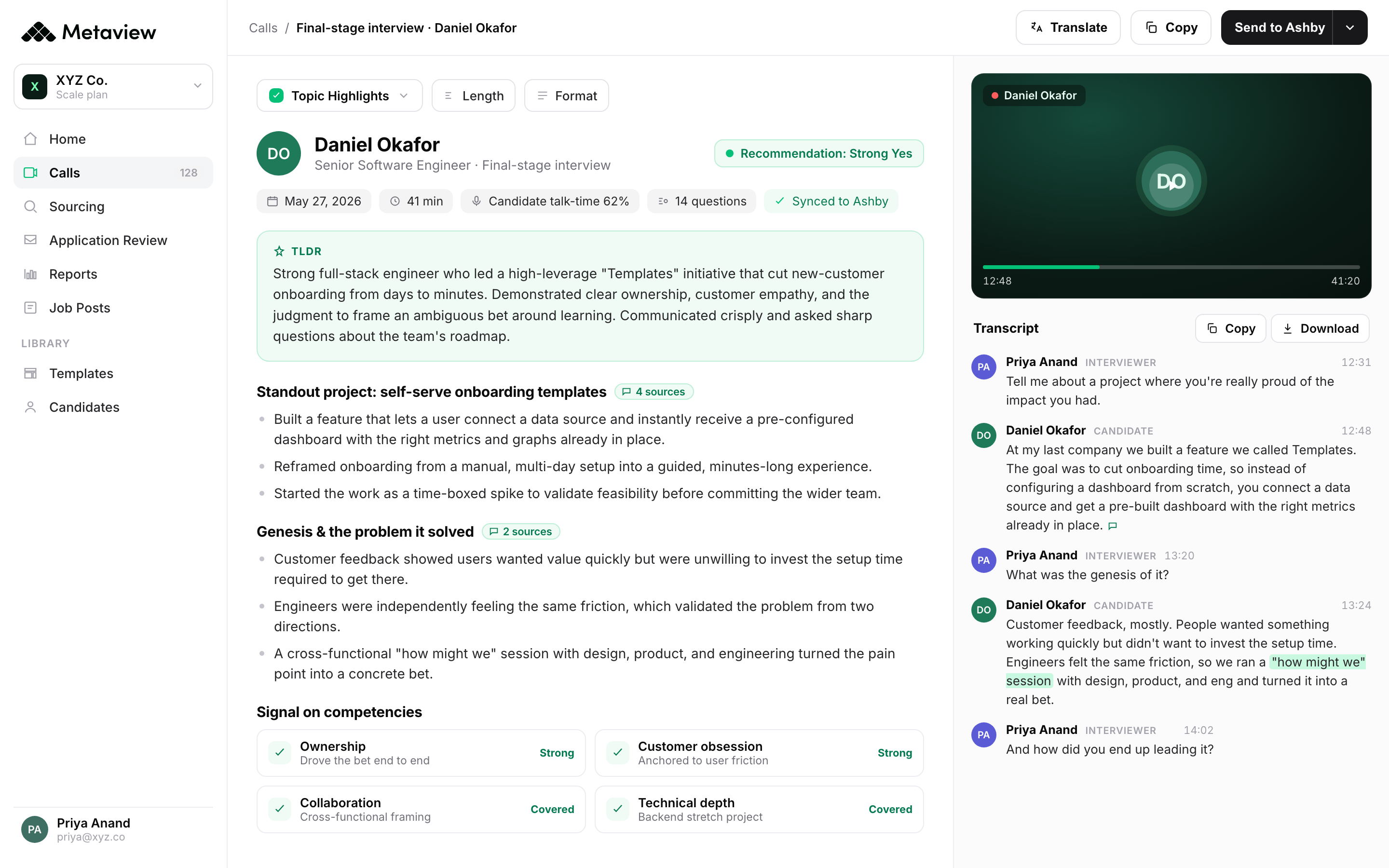
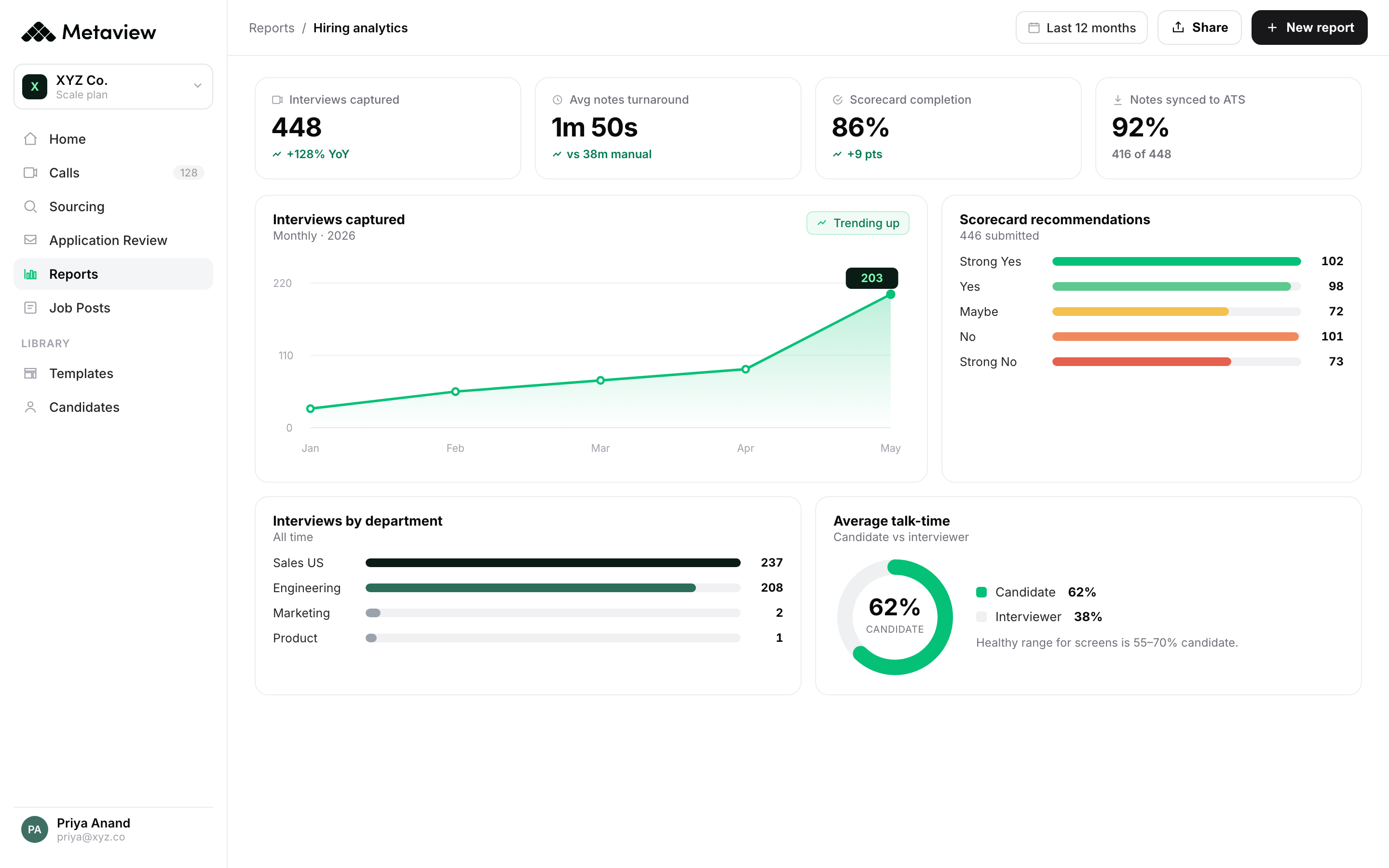
Metaview is built to make sourcing the right shape of candidate easier. Sourcing ranks candidates against your live brief and past successful hires, Notetaker captures every conversation, and Reports flow the data back to your ATS to inform the next sourcing cycle.
Bring Metaview into your hiring stack.
Live notes, structured scorecards, and ATS sync, set up in under 10 minutes.
Frequently asked.
What's the most effective sourcing strategy in 2026?
AI sourcing against your past hires combined with nurtured talent communities. The first surfaces relevant candidates fast; the second cuts the cost of the next hire by 40-60% because you're contacting candidates who already know you.
How many sourcing channels should I use?
Three at most. Two channels run deeply usually outperform six run lightly. Quality-of-hire-by-channel analysis tells you which two to commit to.
What's a good cold-outreach reply rate?
15-20% for personalized outreach on senior roles. Templated cold outreach lives around 4-8%. The single highest-leverage change is rewriting the first 12 words of every message to include one candidate-specific detail.
How do I scale referral sourcing?
Make the ask specific and material. Per-role briefings to top employees, a structured prompt ("name two people in your network who could do X"), and a bonus large enough to change behavior. $5,000-$10,000 per hire works; $1,000 doesn't.
What about diversity sourcing?
Diversity outcomes follow from channel selection at the source, not from filters at the end. Add at least one channel per quarter that reaches candidates the default sourcing tools miss. Measure flow at source-of-hire, not at applicant.
How long until a new strategy shows results?
AI sourcing and ATS rediscovery show results in weeks. Nurtured communities and employer brand show results in quarters. Plan the mix accordingly.
