

A role opened in 2022 drew a median of 5 applications. A role opened in 2026 draws 45. That's the comparison everyone reaches for, and on its own it's close to useless, because the mean for those same 2026 roles is 180.6.¹
Put a median of 45 under a mean of 180.6 and you're looking at a stacked pile. The weight lands on a minority of roles. Most reqs draw a number one person can genuinely read. A few draw a number nobody can, and the few are what people picture when they say screening is broken. Any argument that opens with the average role is describing a role that mostly doesn't exist.
That distinction decides what an application review agent is actually for, and it's the part that usually gets skipped. So here's what the volume data shows, where it runs out, what an agent changes at each end of that distribution, and the one question none of it can answer.
We build the software that does this work, so read the product sections with that in mind. I've tried to be exact about which claims rest on measurement and which rest on one recruiter's account.
The pile is not evenly spread
The volume figures here come from aggregated public applicant tracking data covering 128 million applications across 784,000 jobs at 1,612 companies.¹ That's third-party market data, and it tells you nothing about any one vendor's scale.
The median climbs steadily when you count by the year the job opened: 5 through 2022, 14 in 2024, 26 in 2025, and 45 so far in 2026.¹ Treat that as a rough proxy. A role opened in 2022 has had four years to collect applications and a role opened in 2026 has had months, the dataset doesn't record how long each role stayed open to applicants, and the cohorts aren't directly comparable in either direction.
The spread is the part that gets left out. Pool every job in the dataset across all the years it covers and a quarter of roles draw 2 or fewer, the middle sits at 11, three quarters sit at 69 or below, and the top tenth pull 249 or more.¹ That pooled view reaches back to jobs opened in 2004, which is why its middle runs so far below the 2026 cohort. The stacking shows up in every cut of the data.
It holds inside every function too. Engineering roles run a median of 14 against a mean of 170.5, Finance a median of 8 against a mean of 75.5.¹ Every function has a heavy tail. None of them is buried across the board.
Why the middle moved is a separate question, and none of this answers it. One-click and AI-assisted applying is the obvious suspect, and the curve bends in roughly the right years, but nothing measured here establishes the cause.
What actually breaks first
Start with the median role, since that's where most reqs sit. Forty-five applications is genuinely readable. If hours were the whole problem, most teams would be fine and this piece wouldn't need writing.
What recruiters actually describe is the fortieth application getting a different quality of attention than the fourth. Reading speeds up as the queue lengthens. The bar moves between Monday and Thursday. Whoever applied late gets read by a tireder reviewer. That's what recruiters report, and this data doesn't measure it. I'd sooner say that plainly than dress it up.
Johnny Drexhage, a senior recruiter at Workleap, put it this way in a case study we published.
It quickly becomes difficult to manage. Especially if you want to give every candidate a fair and thoughtful review.

The usual escape hatch is a keyword filter, and it trades one problem for another. It rewards whoever wrote the resume with the expected words, which, now that every resume tool ships with AI assistance, is close to everyone. It quietly drops the person who did the work and described it differently. Drexhage called his old approach "quick keyword-based judgments, which can sometimes miss strong candidates", and his hedge is the honest one. Nobody has ever measured the candidates a filter drops, because by definition nobody reads them.
Now take the top tenth, where the arithmetic genuinely runs out. A queue in the hundreds sits against a recruiter who also has interviews to run and offers to close, and no amount of care fixes a queue that refills faster than it drains. Two different problems, and they've been getting one answer.
What the agent does with the pile
The first move happens before any reading: you write down what the role needs. Metaview's Application Review drafts an Ideal Candidate Profile from the job description and whatever context you add, and you edit and approve that profile before anything is assessed against it. The criteria are yours, in writing, and every later call points back at them.
Then it reads every application against those criteria and sorts each one into a fit bucket, Great, Good, Okay or Poor, with the reasoning behind the call visible. There's no published score. That matters more than it sounds, because a written reason is something you can argue with, while a number just sits there asking to be trusted.
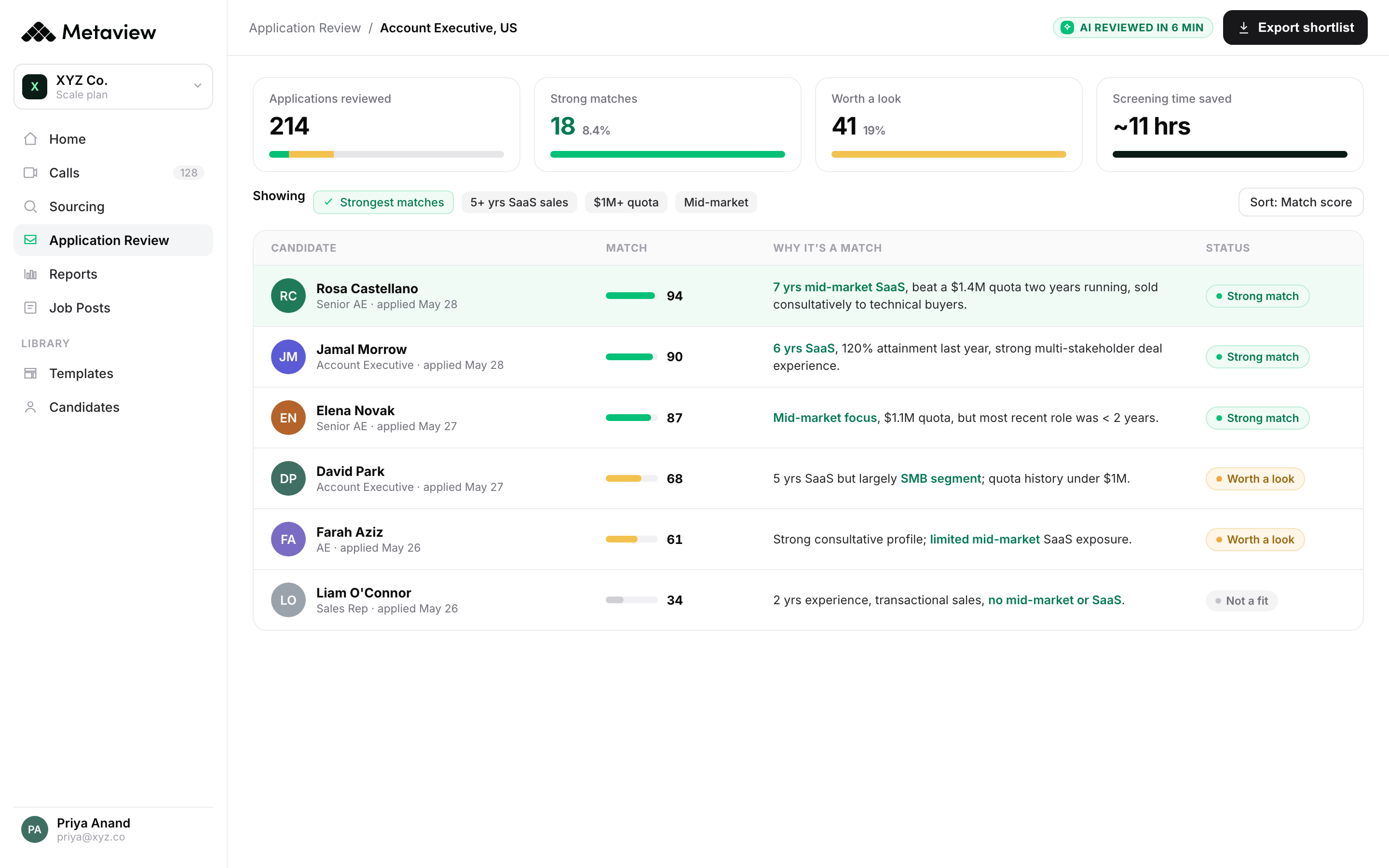
Every application is also assessed for signs of identity deception and application automation before it goes further. The fraud-detection model flagged 28.59% of the applications put through that check as medium or high risk.² A flag records the model's suspicion, and confirming it is still a human job. Nothing here measures how many wasted screens it prevented.
Here's where I'd push back on our own marketing. The sort hands you a reordered queue, and the middle of it is bigger than you want. The top bucket takes 12.8% of the applications the agent has evaluated and the bottom takes 26.7%, which leaves more than half in the middle two.² Most inbound is genuinely ambiguous, and a tool that pretended otherwise would be lying to you. What you get is a better order to work in and a written reason on every application, so a fast no is a no you can inspect.
Drexhage's read on that part was: "Metaview actually explains why a candidate is a good or a bad fit. That level of reasoning is something us recruiters really need." He also reported that it "reduced my screening time by up to 50%". That's one recruiter describing his own week, on a page we publish, and it's worth exactly that much.
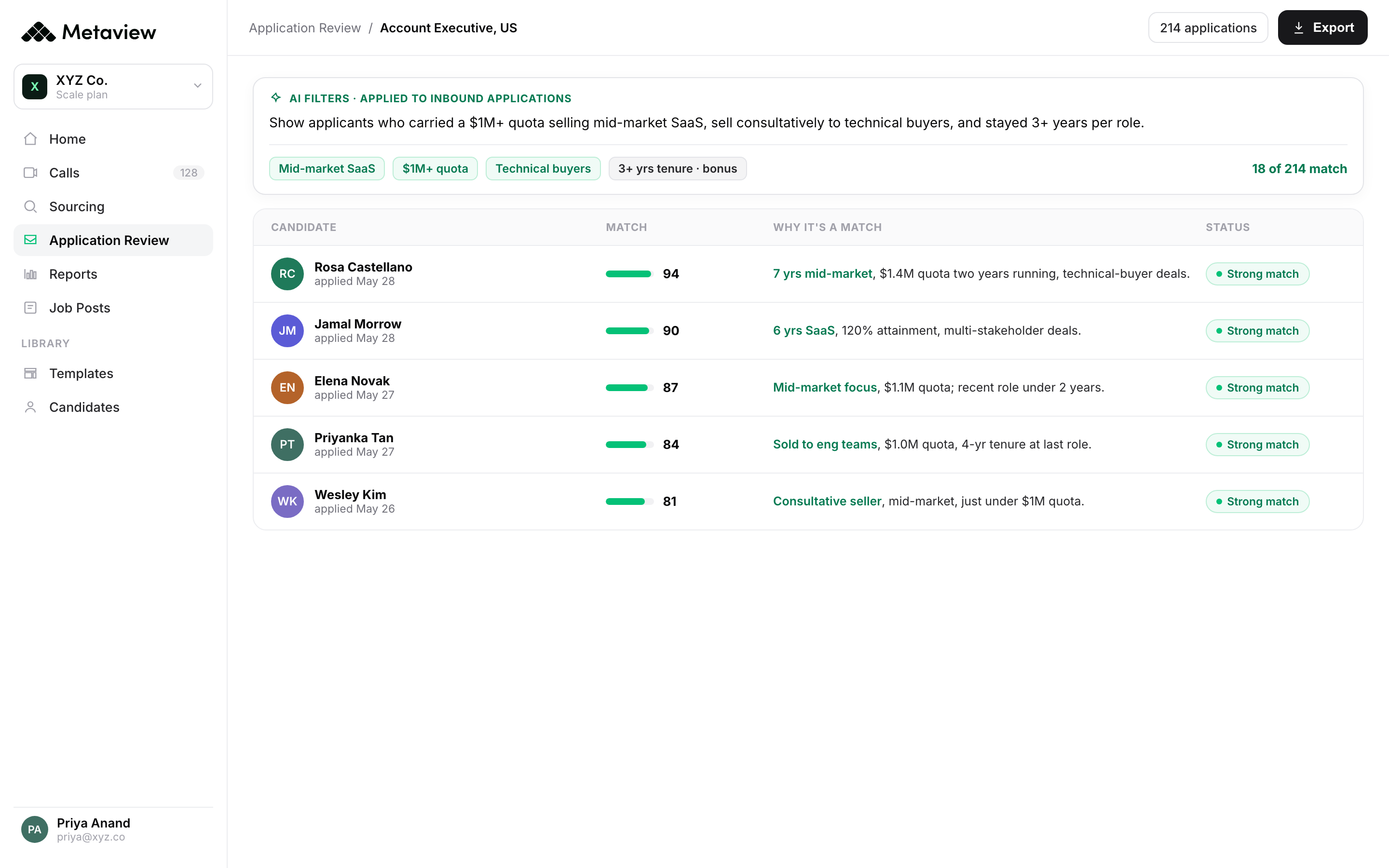
The line between reviewing and deciding is built into the product itself. The agent reviews and sorts. The recruiter decides. Metaview never auto-rejects, there's no configuration that turns that on, and every progress and reject call is made by a person who can see the reasoning.
What this data cannot tell you
Once everything has been read against the same criteria, the rating and the recruiter's decision sit on one record, so you can compare them. Great-fit candidates advanced past screening 17.2% of the time, counting only the applications a recruiter reached a decision on, against 12.1% of good-fit, 7.8% of okay-fit and 5.6% of poor-fit.² The ordering holds all the way down.
What that shows is agreement between the model and the recruiter. Whether either of them read the candidate correctly sits outside what this data can reach. The recruiter can see the rating before deciding, so the two readings lean on each other, and anchoring on the label may explain part of that gradient. This data gives me no way to separate the two, and I'd be wary of any vendor who told you theirs does.
Two more limits, stated plainly. Advancing past screening is rare in every bucket including the top one, because a team's calendar sets how many interviews it can run, whatever the number of people who qualify. And nothing in this data follows anyone after they're hired, so none of it speaks to how these decisions turned out.
What survives all that is a smaller claim and a more defensible one. Every application was read against criteria a human approved, in the same way, with a reason recorded next to the decision. That's an auditable process, and an auditable process is the most that product data of this shape can ever demonstrate. Whether the ordering itself was right is a separate question, and this cannot answer it.
The plumbing keeps all of that in one place. Metaview pulls candidates in from your ATS.³ The accept and reject decisions you make in Metaview push back to the ATS on Ashby, Greenhouse, Lever and SmartRecruiters.³ The reason a candidate was moved or declined stays attached to the candidate.
So, if you're running roles in the heaviest tenth, an agent is the difference between reading everything and reading whatever you get to. On median roles it changes something quieter and probably more durable: the fortieth application meets the same written standard as the fourth, and you can go back and see what that standard was. Neither of those tells you who to hire. That call is still yours.
Application Review, on your inbound.
Your criteria, every application read against them, and every decision still yours.
Frequently asked
How many applications does a role get in 2026?
It depends on the role. Roles opened in 2026 have drawn a median of 45 applications so far and a mean of 180.6, against a median of 5 for roles opened in 2022, in aggregated public ATS data covering 128 million applications across 784,000 jobs. Pooled across all jobs and all the years that dataset covers, the top tenth of roles draw 249 or more.
Does every role have an application overload problem?
No, and treating it as universal is how teams buy the wrong fix. The distance between the median and the mean says the load is stacked into a minority of roles: most reqs draw a number one person can read, while the top tenth, pooled across all jobs and all years, draw 249 or more. The case for moving the first read off a human is arithmetic at the top of that distribution and about consistency everywhere else.
What is an AI application review agent?
It's software that reads every application against written criteria for the role, sorts candidates into fit buckets, and shows the reasoning behind each call instead of matching keywords. Metaview's Application Review drafts an Ideal Candidate Profile from the job description, and a human edits and approves that profile first. Every application is also assessed for signs of identity deception and application automation.
Does the AI make the hiring decision?
No. The agent reads, sorts and explains its reasoning, and the recruiter decides. Metaview never auto-rejects, and there's no configuration that turns that on.
How is AI screening different from a keyword filter?
A keyword filter matches the words on a resume, so it rewards phrasing and drops strong candidates who described the same work differently. An agent reads the application in context against the role's criteria and records why each candidate landed where it did. Neither approach has ever been measured against the candidates it rejected, because by definition nobody reads those, so treat any claim about recovered candidates carefully.
¹ Volume figures come from aggregated public applicant tracking system data covering 128,292,471 applications across 784,361 jobs at 1,612 companies, analyzed in 2026. This is third-party ATS data and it says nothing about any vendor's own scale. Medians and means by year are counted by the year the job opened, so treat them as a proxy for annual volume, and 2026 is a partial year. The percentile figures are pooled across all jobs and all the years the dataset covers.
² Fit-bucket, fraud-risk and advance-rate figures come from Metaview product data, each on its own base. The fit-bucket split covers applications the agent has evaluated, the fraud-risk share covers the 905,562 applications run through fraud detection, and advance rates cover only the applications a recruiter reached a decision on. Flags reflect the fraud-detection model's judgment, which a human still has to confirm.
³ Supported Application Review integrations and decision writeback per Metaview's Application Review documentation, 2026.
