
Ask a talent leader whether their team runs structured interviews and the answer often arrives as a link.
The link goes to a guide: competencies down one side, questions under each. Someone spent a useful week building it. It's good work.
It also doesn't answer the question. You asked whether the team runs structured interviews. The answer describes what they planned to run. Those are different claims, and the gap between them is where the value leaks out.
Structured interviewing works because interviewers cover comparable ground and score against shared criteria. That's what makes two candidates comparable in the first place.
So if half the panel improvises, the comparison never gets produced. You still get scores. They just don't mean what the process promised.
What a guide proves.
A structured interview guide establishes intended structure. It doesn't establish that structured interviewing happened.
The design half gets real attention. Teams workshop the competencies. They anchor the rating scale with worked examples. That produces a design, and a design is a hypothesis about what will happen in a room you're not in.
A guide is easy to inspect. You can read it before the interview happens.
Drift is harder. It only shows up across conversations, scorecards and debriefs. A team that never reads those records can't tell whether a deviation was one interviewer's habit or a flaw in the guide itself.
Some organizations do audit interviews or read scorecards against the guide. In the talent teams we work with, though, the pattern is narrow and consistent: evidence stops at the design.
Why a guide is not evidence of a guided interview.
Interviewers don't tear the guide up. The drift is small enough to miss.
One interviewer knows the domain and improvises a better question. Another doesn't, so they ask something adjacent and move on. A third runs out of time and drops the last competency.
Four interviewers just assessed four different things and put four scores on the same scale. Every one of those choices was defensible at the time. That's what makes the pattern so hard to catch.
LC Dyas, Senior Talent Partner at EvenUp, described what that looks like inside one hiring team.
There were six items hiring managers were supposed to assess for, but they all had their own questions. We’d never calibrated on what a good answer looked like.”
There are two failures in that quote. The first is easy to see: six shared criteria, six private question sets.
The second is quieter and does more damage. The panel had never agreed what a good answer sounded like, so the same scale meant six things.
That's why "did they ask the right questions" is such an incomplete test. You can hit every question on the guide and still score against a private standard.
Teams that close this gap make the guidance travel with the interview instead of living in a document. Damian Shelley, a Talent Acquisition Partner at SoSafe, gave the reason: hiring managers are often newer to hiring.
Structure their questions for them and everyone follows the same line of questioning, so answers can be compared. The guide was a document. Documents are easy to leave closed.
What adherence means in practice.
To manage adherence, you have to define it as more than compliance with a question list. It runs across at least six dimensions. A team can pass on some and fail on others.
| Evidence to inspect | What that evidence establishes | |
|---|---|---|
| Was the assigned competency assessed | Transcript and notes for the loop | Whether it came up, and for how long. A person still judges whether it was assessed well |
| Were the required questions asked | Transcript matched against the guide | Whether the required questions or genuine equivalents came up. Answer quality is a separate read |
| Were answers probed to evidence | The exchange that followed each answer | Whether a follow-up happened. Judging whether it was the right one takes a person |
| Was the evaluation completed against the criteria | The scorecard, next to the call | Completion and content together, which beats a completion rate on its own |
| Were ratings independent and on time | Submission timestamps, relative to the debrief | Whether the rating landed before the group conversation or after it |
| Were leading or off-limits questions avoided | The searchable record across the loop | Whether the phrasing occurred. Intent and context stay a human call |
Much of that right-hand column stops short, and that's deliberate. A record of what got discussed isn't a judgment that the competency was assessed well. Asking the right question on paper proves little on its own.
Any framework that skips this distinction is selling a compliance score.
Software can show what happened in the room. Recruiters and hiring managers still have to judge whether the evidence met the standard. Any vendor telling you otherwise, us included, should be asked to show their working.
Perfect adherence is the wrong goal.
The strongest objection to all this is that rigid adherence makes interviews worse. An interviewer reading identical wording in identical order can't follow the interesting thing a candidate just said. And that's often where the evidence lives.
Push compliance hard enough and you get interviewers who fill in the form and learn nothing. You also get candidates who feel processed. That's a real cost.
Adherence and uniformity are different targets. A well-run structured interview holds the competencies and the scoring criteria constant, then lets the path through them vary.
Look for interviews that covered the same ground to comparable depth, where the variation came from what the candidate said.
An interviewer can ask every prescribed question and still run a poor interview. They might lead the candidate toward the answer. They might take a confident story as evidence, or score against a standard they never wrote down.
A compliance check can't see any of that. A transcript can.
The loop that turns observation into change.
Recording interviews changes nothing by itself. Looking at something isn't the same as managing it. The loop has five steps, and skipping any of them turns it back into a dashboard no one opens.
Define the expected behavior at a stated unit. Per interviewer, or per stage. A line like "we're more consistent" won't do the job. A real target sounds like this: every candidate for this role gets the same four competencies covered by the panel between them.
Observe what happened against that definition. This used to mean a second person sitting in the room, so teams sampled a few interviews instead of reviewing all of them.
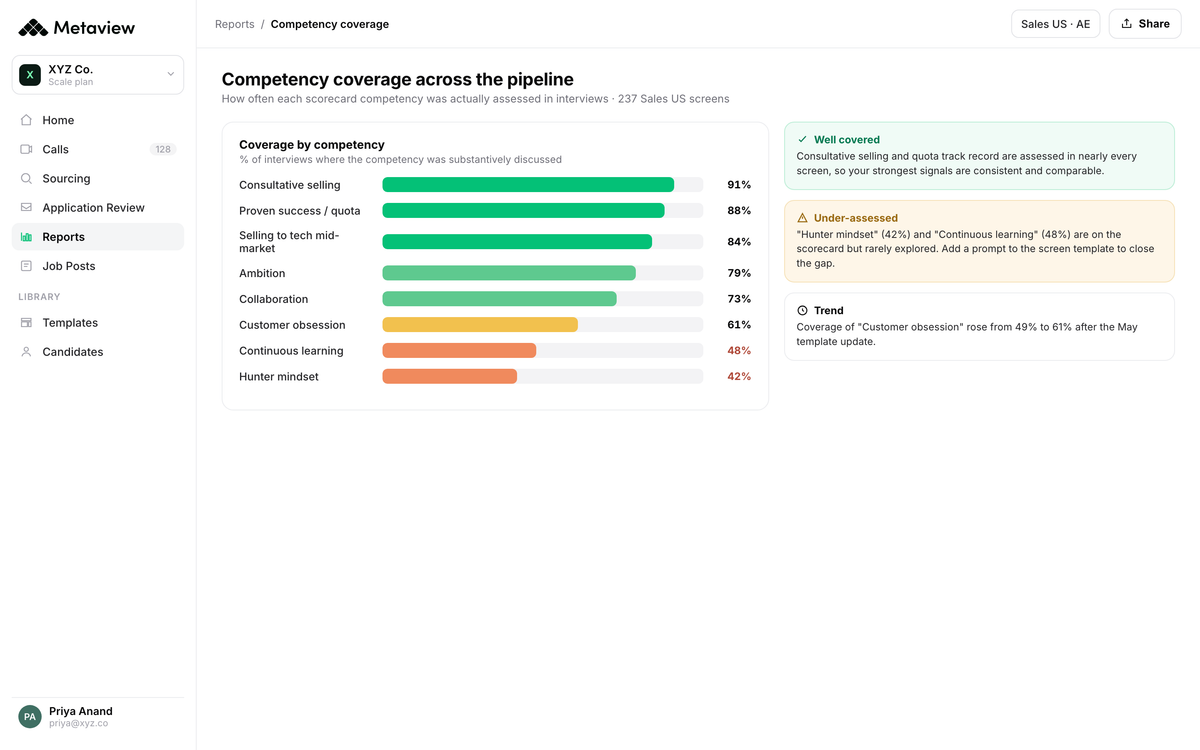
- 1The competencies the panel covers in nearly every screen.
- 2The ones sitting on the scorecard that interviews keep skipping.
Classify the deviation. Most deviations don't matter at all. Swapping a question for a better one sits a long way from never reaching the competency at all. Treat those two the same way and you lose the room.
Coach or redesign. This is where the loop forks. One interviewer drifting is a coaching problem. The whole panel drifting at the same point means the guide is wrong. Most of the talent teams we work with get this backwards and spend months coaching individuals through a design flaw.
Verify it held. Re-observe the same unit a quarter later. Skip this step and all you have is an opinion about whether the change worked.
Alan Price, Global Head of Talent Acquisition at Deel, describes the middle of that loop as something his team already runs.
Interviewer-level insights pinpoint who’s consistently compliant, who’s asking the right questions, and who needs coaching.”
The unit there is the interviewer. That's the right unit for coaching and the wrong one for redesign, so you need both views. Metaview Reports is where we put them, next to the scorecard data that shows whether the evaluation half of the process ran at all.
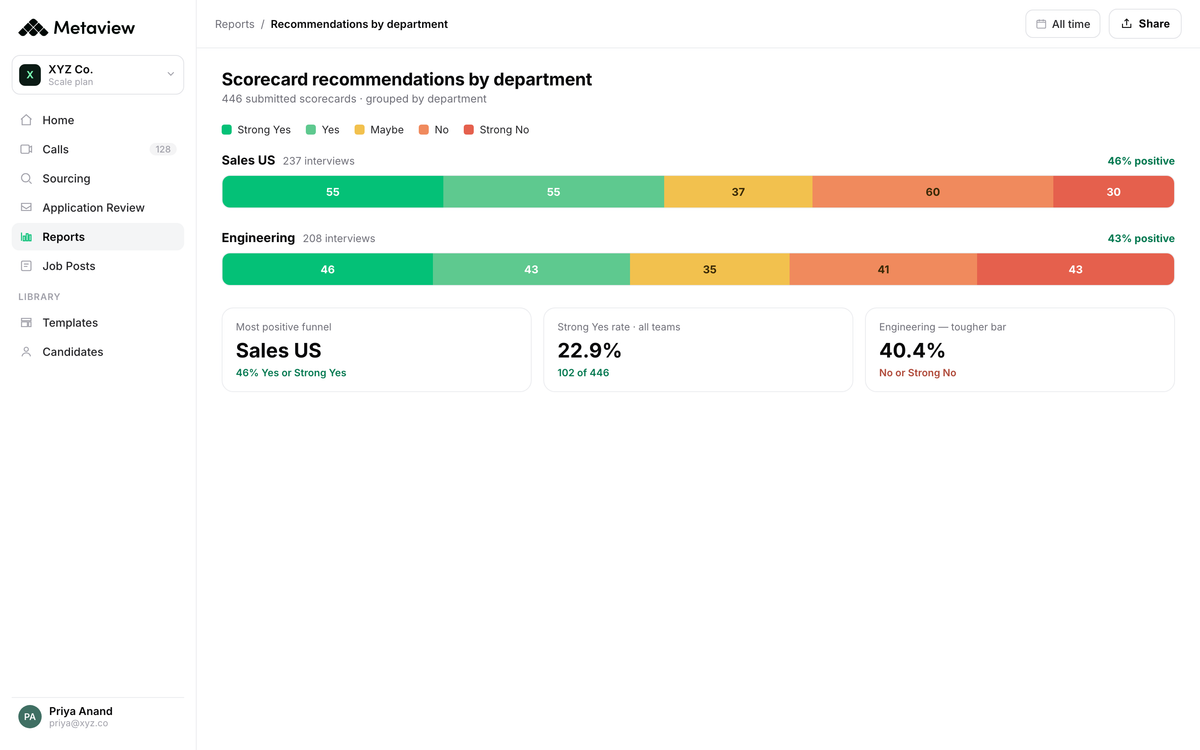
- 1One team's recommendation mix, Strong Yes through Strong No.
- 2Another team holding the same scale to a tougher standard.
This does start to sound like surveillance. Interview records carry candidate data, so decide who can open them and how long you keep them before the first review, and tell candidates what you're doing.
Putting an automated compliance label into a performance review is a separate decision, and a worse one.
What makes this land is what it gives interviewers back. Danielle Harders, Director of Global Business Recruiting at Brex, found that structured rubrics left her interviewers more confident in their decisions. The standard stopped being private.
What to do this quarter.
One role and one honest look is enough to start.
Pick the role you hire most, and one dimension from the table. Define the unit before you review anything. For example: the share of completed loops where the panel covered every assigned competency and got at least one job-relevant example for each.
Then review a fixed sample from last quarter against that rule.
Classify each miss as an interviewer habit or a design flaw. Act on whichever dominates. A quarter later, review the same number of loops under the same rule.
Treat that comparison as an operational signal. It won't prove your change caused the movement, and if it's going to drive performance decisions, you need a bigger sample and an independent reader.
Design quality and execution reliability fail in different ways. A guide the panel never runs can't deliver what it promised. A guide followed to the letter still fails if the design underneath it is weak.
Both halves need inspecting. Only the design half gets it today, and that's the half that was never in question.
Bring Metaview into your hiring stack.
Live notes, structured scorecards, and ATS sync - set up in under 10 minutes.
Frequently asked.
How do you measure interview adherence without making interviewers defensive?
Ranking people with the data on day one is what makes them defensive. Teams that avoid the problem share the aggregate view before the individual one, and fix the guide first when the whole panel drifts at the same point. Brex found interviewers felt more confident in their decisions once the rubric was explicit, because the standard stopped being private.
How many interviews do you need to review before adherence data means anything?
Start smaller than you think. A handful of interviews will show you one person's habit, which is enough to coach on. Before you redesign a guide, work through a full hiring cycle for one role so you're not reacting to one unusual candidate. Neither of those is a sample you'd defend in a performance decision, so use a bigger one and an independent reader for that.
Does interview adherence apply to unstructured or conversational interviews?
In part. If there's no intended structure, there's nothing to adhere to, and the first job is deciding what the interview should assess. Watching the interviews still helps, because it shows you what your team assesses by default when no one has told them what to cover.
