
Ask a talent team whether they'd put a strong candidate in the last interview of a packed day, and many of them will hesitate. The 4:45 slot has a reputation.
The worry is that the read comes back flatter than the candidate deserved. The instinct is reasonable and unproven. Nothing in an interview record ties the hour of a call to what happened to the candidate afterwards.
We haven't found a platform that measures how tired an interviewer was, either. Anyone quoting you a fatigue penalty in score points is estimating.
This post gives you controls instead of a number. The practices that protect a score from the slot are the ones that make scoring defensible anyway. You can put them in without settling the question first.
What time-of-day bias means in interview scoring.
Time-of-day bias is the idea that part of a score reflects when the conversation happened instead of how the candidate did. People expect the same answer to land better at nine in the morning than at the end of a run of back-to-backs.
The conditions people name are the hour on the clock and where the call sits in an interviewer's day. Interviewer state sits underneath both, and it's the hardest to pin down.
Interview platforms record when a call happened. None of the ones we've looked at test that against whether the candidate advanced, and none capture interviewer mood. The link between the hour and the outcome sits untested.
There's no hiring-specific evidence for a time-of-day effect, so this post won't hand you one. You can't wait for a number that isn't being produced, and the interviews are running this week either way.
Cap the interview load before you read the scores.
Start with the calendar, because it's the cheapest thing to change. An interviewer running six conversations in a day is probably doing a different job by the sixth, and the scores won't tell you either way.
The cap itself should come from what your interviewers already carry alongside their day jobs, not from a figure in a blog post. Write the number down and hold it through a busy week. Past that ceiling you're relying on stamina.
A final round deserves an interviewer who hasn't already worked through a full slate. That makes the ceiling matter most where the stakes are highest. It's a scheduling decision, not a coaching one.
Anchor every score to a shared rubric.
A tired interviewer and a fresh one may drift in different directions when the question is open. The scores won't tell you which is which. A shared rubric gives both of them the same evidence standard. That's most of the protection available without measuring anything.
Write the competencies down before the loop opens, then agree what strong evidence sounds like for each one. Interviewers score against that description instead of a general impression of the call.
The scorecard should ask for the evidence, not the rating alone. An interviewer who has to point at something the candidate said stays tied to the transcript. That tie holds at nine in the morning and at five.
Having these structured rubrics has helped interviewers feel a lot more confident in their decision making.”
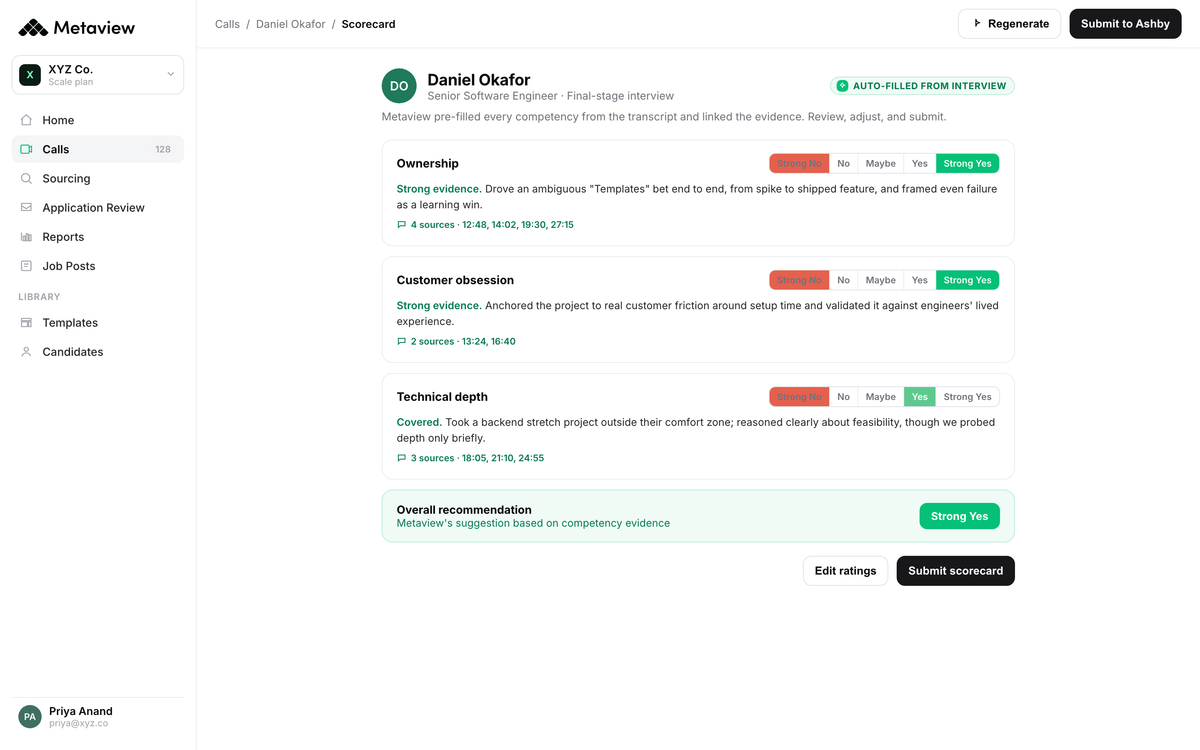
- 1Every competency carries the same rating scale. An interviewer scores against a fixed set instead of a general feeling about the call.
- 2Each rating shows the moments in the conversation it came from, which is what makes a score reviewable later.
Put the conditions on the record next to the verdict.
When the only thing surviving a call is a rating, there's no way to ask three weeks later whether the slot mattered. You can't check a pattern that never made it onto a record.
So keep the conditions of the call on the same record as its outcome. Put the duration and the interviewer beside the verdict, in one row somebody can sort.
Metaview's Notetaker captures the conversation. Each call carries the date it happened and how long it ran, and the scorecard verdict sits on the same row. A reviewer sees the outcome and the shape of the call together.
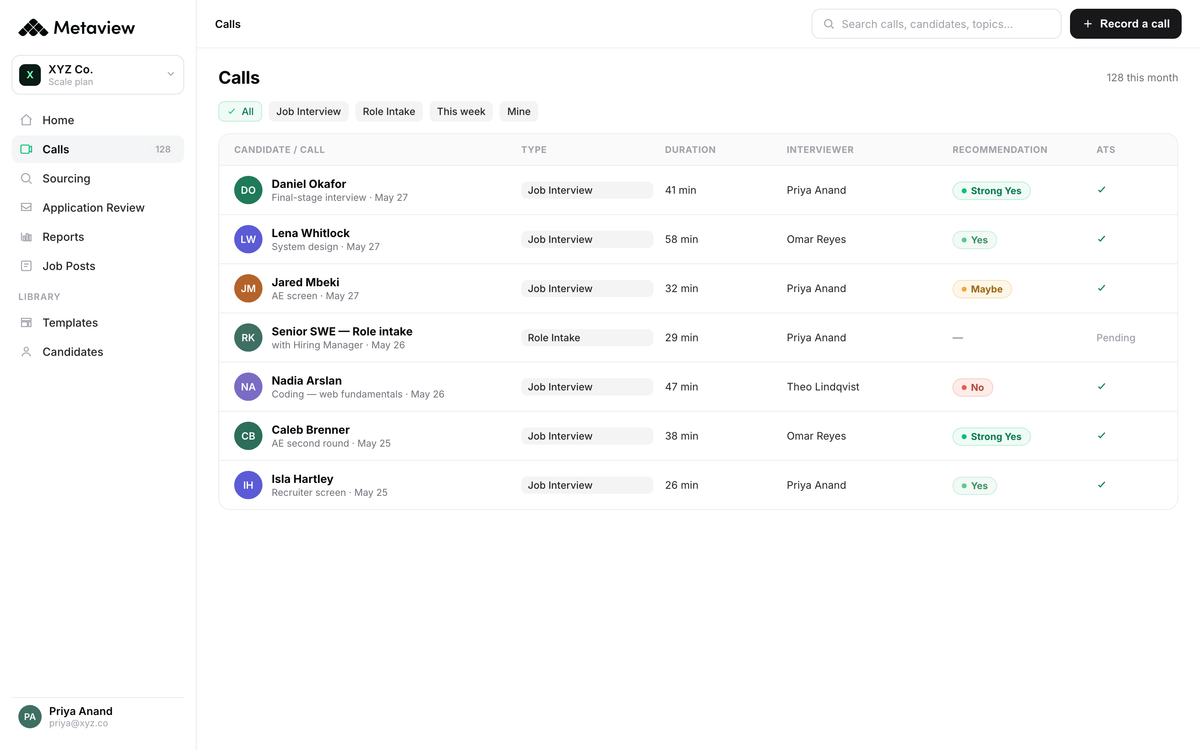
- 1Every call stores its duration, so a conversation that ended early shows up without anyone having to remember it.
- 2The interviewer sits on the same row, which is what lets you group calls by person when you go looking.
- 3The recommendation sits beside both, so a verdict never travels without the context it came from.
Run the check on your own pipeline.
Once the conditions are on the record, you can answer the question inside a single role. Pull a few weeks of interviews and compare how each interviewer's first calls of the day landed against their last ones.
Small samples move around on their own, and one interviewer having a rough Thursday tells you very little. Treat any gap you find as a prompt to look, not a finding.
While you're in there, check whether the scheduler is loading one day heavier than the rest. Then check whether short interviews cluster around particular interviewers.
Someone who takes most of the conversation leaves the candidate less room to show anything, whatever time it is. Talk-time is the pattern you can see without guessing at anyone's mood.
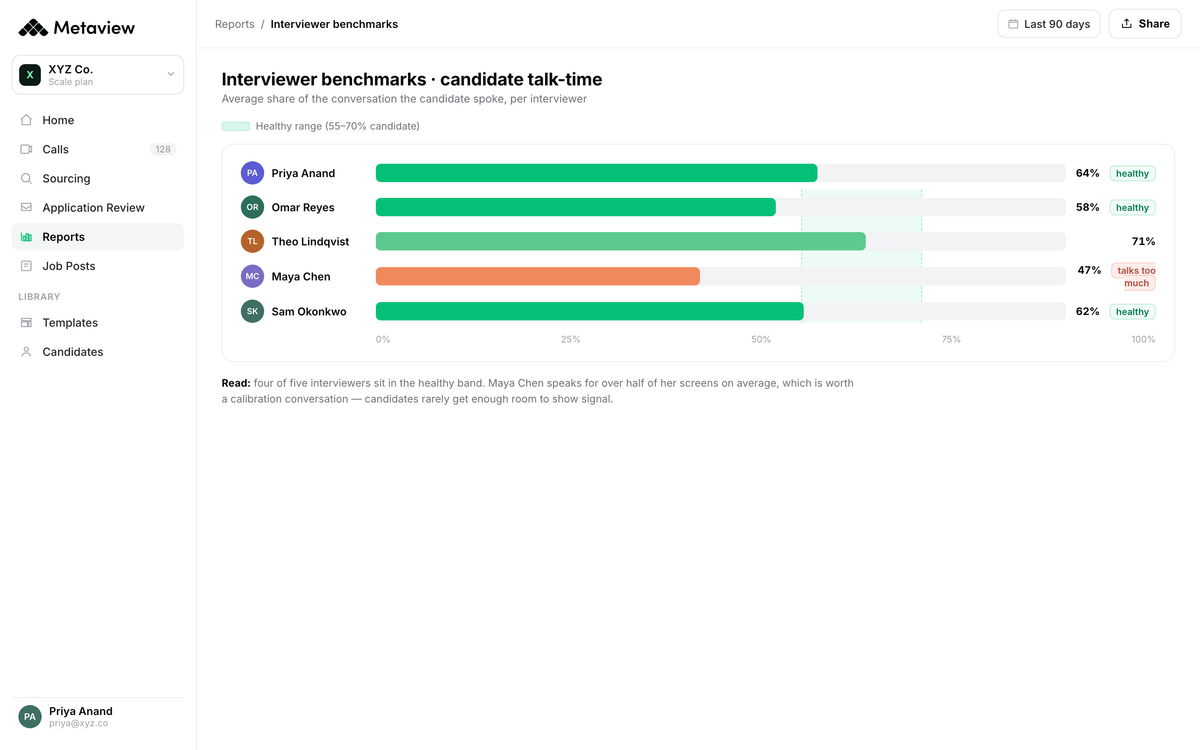
- 1Each interviewer's average sits against a healthy band. An outlier shows up without anyone inventing a target.
- 2A flagged interviewer is a coaching conversation. It's never a verdict on the candidates they've already scored.
Our look at who talks more in an interview covers what a healthy split tends to be. The point here is narrower: this is a condition you can observe, which puts it ahead of mood.
What to do when a score looks slot-driven.
Sometimes a strong candidate picks up a soft no late in a heavy day, and the written feedback is too thin to explain it. The move there is a second read.
Overturning a verdict because of when it happened swaps one unmeasured judgment for another. Nothing about the hour tells you the interviewer got it wrong.
The recording and the notes are both there, so go back to the conversation instead. A second person can read the evidence and say whether the rating matches what the candidate gave.
That's a better test than the clock, because it asks about the candidate instead of the conditions. It also gives the interviewer something specific to work on, which is what makes interviewer training stick.
None of this needs you to know how much the slot moves a score. Each control makes the read easier to defend on its own terms.
The cap and the rubric are free, and neither needs a tool, so start there. Then get the conditions onto the record. By the time somebody raises the question in a debrief, it stops being a matter of opinion.
Bring Metaview into your hiring stack.
Live notes, structured scorecards, and ATS sync - set up in under 10 minutes.
Frequently asked.
What is time-of-day bias in interview scoring?
The idea that part of an interview score comes from when the conversation happened. It covers two separate things: the hour on the clock, and how many interviews that person had already run. Only the second one is something your calendar can fix.
Does time of day change interview scores?
Your interview data can't answer that, because nothing links the hour of a call to what happened to the candidate afterwards. If someone quotes you a penalty in score points, ask which hiring dataset produced it before you plan around the number.
Can you adjust a score after the fact if you suspect fatigue?
No. Changing the number replaces one unmeasured judgment with another. Send the call to a reader who wasn't in the loop, and have them work from the recording instead of the written summary.
What if only one interviewer can cover late slots?
Then the late slot becomes a constraint you plan around. Keep your highest-stakes rounds off that person's late calendar, and put a second scorer on anything important that has to run there.
Does Metaview decide who gets hired?
No. Metaview captures the conversation and keeps the scorecard verdict beside it, so a team can review both together. The interviewer still scores the candidate, and the hiring manager still makes the call.
