
Most hiring teams can name a hire they wouldn't make again. The loop looked clean at the time. The panel agreed and the offer went out without much argument.
The instinct afterwards is to go back and look for the moment somebody missed. Often it's a story that sounded rehearsed, or an answer that never got specific.
Interview data alone can't tell you which of those moments predicts a bad year. That would need post-hire performance and retention records, and no interview platform sees them.
Any vendor selling a warning-sign model built on transcripts is selling a correlation they can't check.
You can check whether the moment survived the call at all. Plenty of scorecards never get filled in, and plenty more carry a line or two where the reasoning should be. The record keeps far less than most teams assume.
The hire everyone signed off on.
A loop answers one question: is this person a hire? Run enough rounds and you get a verdict you can defend. What it doesn't ask is whether you'll regret the hire a year from now.
A regret hire clears the bar in the room, then underperforms once the work gets real. Or leaves before earning back what it cost to hire them.
Either way, the team wouldn't run it back.
Metaview's 2026 AI and Hiring Alignment Report looked at how that working relationship lines up with hitting goals.
The survey measures association here, and nothing about cause. Even so, the recruiter and hiring manager relationship tracks with whether a team hits its goals.
When people go back and look, what they point to is sitting in the interviews. Often it's a story they've told too many times, or a second follow-up the candidate slid past. It all happens in the open.
It gets said out loud, often early. Then it goes down as color and never as risk. None of that predicts a bad year. It does tell you the moment was available and went unrecorded.
Naming the four moments.
A warning sign here is an interview moment you can point at. Experienced interviewers treat it as worth digging into. It prompts another question, and nothing below offers evidence that it forecasts anything.
A strong hire can show one of these signs and still turn out excellent. So a single moment is never grounds to screen someone out.
You catch the moment in the room, then probe it once more to see whether it's a fluke or a pattern.
Read it the right way and the rehearsed story isn't disqualifying on its own. Plenty of nervous candidates over-prepare.
Ask what they specifically did and what it produced. A rehearsed example goes vague at that point.
The no-conflict answer is the easiest one to mistake for a strength, which is why it slips through. Ask the follow-up that a smooth answer can't keep up with, and you'll see what's underneath it.
A rehearsed story can survive one question. By the third, the gap between describing the work and doing it shows.
Whatever a panel notices in the room, the transcript is where it stays. Reopening it is the part a panel controls.
What survives the call.
Prediction would require matching interview records and scores to later performance data. That data doesn't reach an interview platform, so this piece stops short of it.
The question interview data can answer is narrower, and for a hiring team it's more useful. How much of any interview reaches the written record that the rest of the panel reads?
Across 13,382 scorecards, the median written feedback runs to 365 words. That sounds healthy until you look at the bottom of the distribution, where 26.6% carry five words or fewer of narrative.
Across 13,373 created scorecards, 27.5% carry a single filled field or nothing at all. Only 32.1% have every field filled.
Where prose does exist, just over half contains language that points at a specific example. That share comes from a keyword proxy, so read it as a rough signal.
An incomplete scorecard leaves the rest of the panel without the evidence behind an interviewer's judgment. The record should hold what the panel knows. Most of it's empty.
Why the panel slides past it.
The scorecard captures a verdict, and it captures one well. But it doesn't have a field for the moment that should have prompted a harder follow-up. That moment disappears the second the call ends.
The panel had the candidate's answer but never reviewed it together. So the recruiter and the hiring manager each work from their own impression of the same conversation.
That gap isn't new, and no single hire creates it. One of the Alignment Report's contributors names it.
This data shows that hiring managers and recruiters don't fully trust each other's judgment. This creates friction that tools alone cannot solve. The orgs that recognize this and help individuals collaborate more effectively will see dramatically better outcomes.”
Capture the exchange the same way for everyone and the panel has one shared record to read at debrief. Reading back what the candidate said is what surfaces the moments worth a second question.
Keeping the moment on the record.
This stays invisible for a plain reason. The moment lives in the conversation, and the conversation is the part that disappears when the call ends.
That's the gap Metaview closes. The Notetaker captures every spoken word of each round. All four moments stay anchored to what the candidate said, word for word.
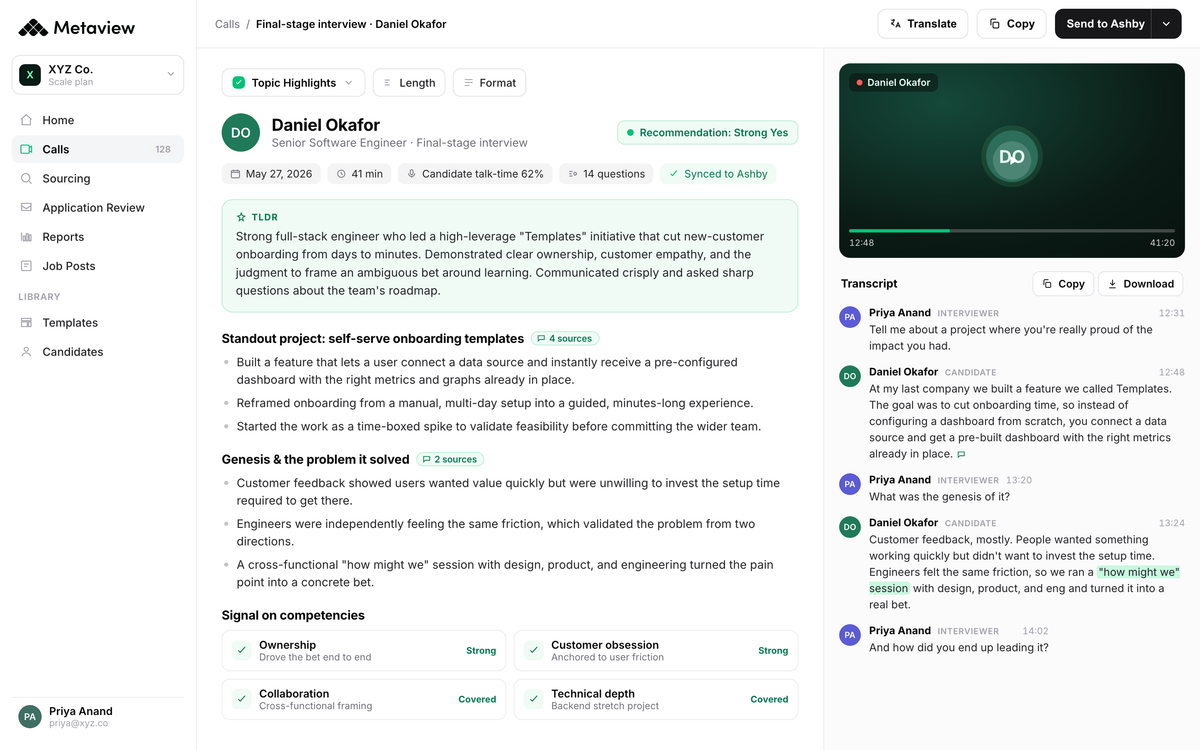
From there you can make the signs structured. Write an AI column for the moment you care about and it becomes its own field you can sort and filter on. A deflected follow-up stops being a private hunch and turns into something the whole panel can see.
Then it lives in Reports. Scorecard completion sits on the dashboard as a headline number. That's a number a team can move.
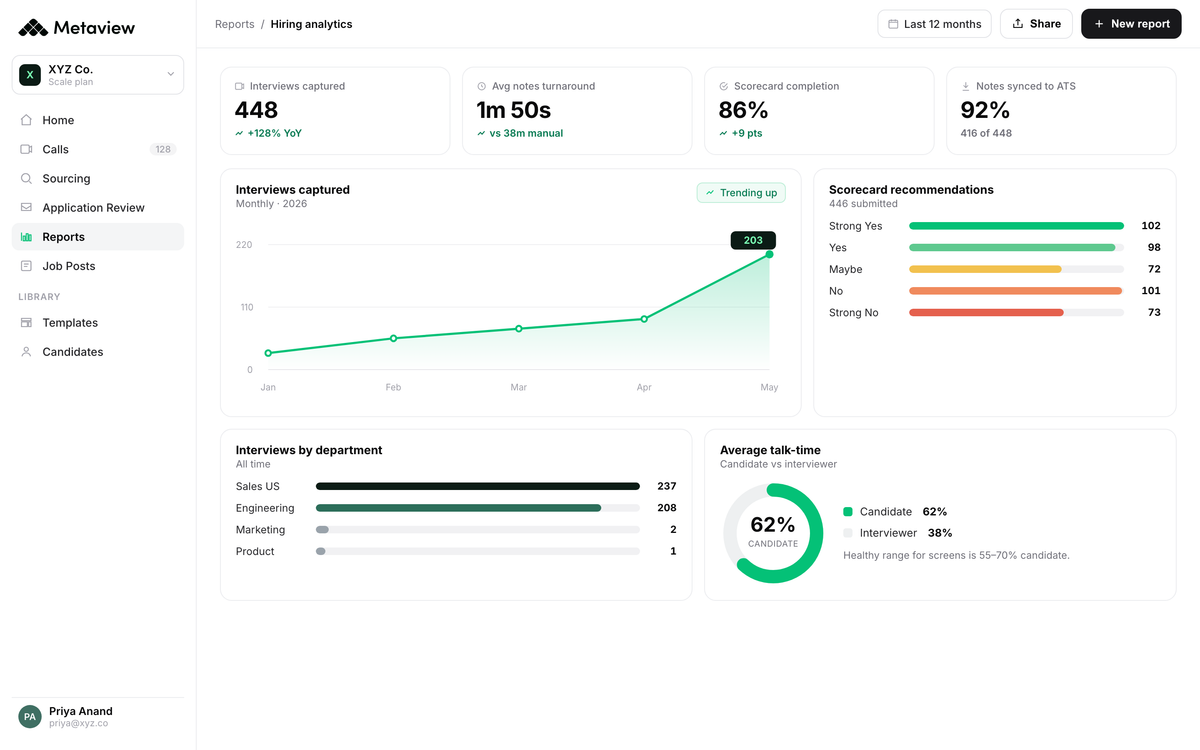
Metaview captures the conversation and keeps it readable. It doesn't screen anyone out or re-grade a candidate. The interviewer still scores the candidate, and the hiring decision stays with the people who own it.
Using the signs without misusing them.
When a candidate gives you the rehearsed story or the smooth answer, the useful move is to push once more. A quiet mark against them tells you nothing.
The gap between a described achievement and an owned one opens up on the second answer.
There's also a retrospective habit worth keeping. When a hire does go wrong, go back and read the interview.
Read it to ask whether anything in the record would have prompted a different question at the time. Proving the sign was there is a game you can always win after the fact.
Do that a few times and a panel starts noticing the same moments live. That's the only mechanism here that shifts anything.
Say one interviewer keeps reading a borrowed-credit "we" as a strong yes. That's a calibration conversation about which moments deserve digging into.
Treat each one as a reason to ask, and nothing more. A sign tells you the evidence in front of the panel is thin. That's a fact about the interview, and it says nothing about the person.
Write down what the candidate said in their own words, and keep the score separate. Then agree as a panel on which moments earn a second question, so the same answer gets the same follow-up whoever is in the room.
Bring Metaview into your hiring stack.
Live notes, structured scorecards, and ATS sync - set up in under 10 minutes.
Frequently asked.
What is a regret hire?
A regret hire clears the interview loop and then fails the year. They either carry a low performance rating or they leave, and the team wouldn't make the same hire again. The label lives in HR and performance systems. Interview data doesn't hold it. Treat any claim that an interview platform can predict one with care.
Can interview warning signs really predict a regret hire?
Not on any evidence we can show you. Proving it would need interview records matched to how each hire performed six and twelve months later. That outcome data doesn't reach an interview platform. The four signs here are interviewing craft, useful as prompts for a second question. Be skeptical of any vendor selling a validated warning-sign model built on transcripts alone.
What are the most common interview warning signs?
Four come up again and again in interviewing practice. The rehearsed-story tell: one polished example answers every prompt, then thins out under a follow-up. The no-conflict answer: nothing ever got hard. The deflected follow-up: specifics evaporate when you ask what they did themselves. The borrowed-credit "we": every win is plural and the candidate can't locate their own piece. Each one earns another question, never a rejection.
How much interview feedback gets written down?
Less than most teams assume. Better than a quarter of created scorecards come back with a single filled field or nothing at all. The practical fix is to record what the candidate said in their own words, and keep that separate from the score you gave.
Does Metaview decide who gets hired?
No. Metaview captures the conversation and keeps every answer on the record, so the panel can revisit it. It doesn't run the interview or flag anyone for rejection. Scoring stays with the interviewer. The hire stays with the people who own that call.
