
Slapdash hiring is the cheapest thing to fix and the most expensive thing to leave alone. Tighter macro does not make hiring faster. It makes the hire that misses cost double. The headcount you cannot redeploy, the runway you cannot extend, the team you cannot grow around the wrong middle layer. None of that gets fixed downstream. It gets fixed at the panel.
The teams that come out of a tight cycle well are the ones that used the slow stretch to fix the rubric, the panel, and the calibration. The teams that come out of it badly are the ones who hired the same way as in 2021 because the playbook felt familiar. Familiar is not the goal. The goal is a system that holds quality at a bar the business actually needs.
That system is not complicated. It is just rare. And in 2026, with AI doing the volume-end sort cleanly, the bar to run it has never been lower.
The claim, stated plainly
Slapdash hiring is the symptom. The absence of a system is the disease. Most teams treat the symptom by hiring faster, hiring more carefully for a quarter, then sliding back. The disease comes back because the underlying machine is unchanged: a panel that has not seen the rubric, a debrief that lives in someone's head, a calibration that never happens because nobody scheduled the meeting.
The right read is the opposite of the one most teams have. The downturn is not when you slow down hiring. It is when you fix the engine while the volume is low and the cost of fixing is cheap. The teams that do this run a system that compounds. The teams that do not run the same loop they ran in 2021, hire the same way, miss the same hire, and write the same retro.
Every hire is a priority hire when the runway is short. Run the panel like the company depends on it because it does.
What slapdash actually looks like
The pattern is consistent across teams. Four signals show up, sometimes all four in the same loop.
The first: the rubric does not exist before the role does. The recruiter and the hiring manager agree on a shape and a salary, and the rubric gets written, if it gets written at all, after the first three candidates have already interviewed. The first three candidates are now the unintended baseline. Every later candidate gets compared against them rather than against the bar the business actually needs.
The second: the panel does not see the rubric before the interview. They get a calendar invite, a resume, and a vibe. They ask the questions they always ask. The answers go in their head. The scorecard, if there is one, gets filled in two days later from memory.
The third: the debrief is unstructured. Everyone speaks. The senior person speaks longest. The recruiter writes a paragraph. The decision is made. The dissent that should have been a calibration moment becomes a footnote in someone's notebook.
The fourth: there is no replay. When a hire misses at six months, the only artifact is the offer letter and the original resume. The interview itself, where the signal was, is gone. The team learns nothing because there is nothing to learn from.
None of these are accidents. They are what a hiring loop produces when it has no system. The fix is not heroic. It is procedural.
Three quality moves you can ship this quarter
Rubric before the role
The rubric is written before the role is posted, and it is tied to outcomes you actually measure on the job. Generic competency lists do not count. The rubric is the question. The interview captures the answer. If the question is wrong, every answer is noise.
Write the rubric with the hiring manager. Tie each row to a behavior you can observe in a 30-minute conversation. Drop the rows that say "leadership" or "communication" without telling you what to listen for. Replace them with what specifically you want to hear when this person describes their last project.
Structured panel debrief in writing
Every panelist scores every row of the rubric in writing within 24 hours, with the candidate's actual words pulled from the interview as the proof. The debrief discusses the rows where scores disagreed, in order of how much they disagreed. The debrief does not begin with "what did everyone think?" It begins with row three, where the scores were three and seven and nobody noticed.
The recruiter owns the score-out, not the conclusion. The hiring manager owns the conclusion. The split keeps the recruiter honest on the rubric and the hiring manager honest on the decision.
Interview replay for calibration
When scores disagree on a row, you replay the interview moment that produced the disagreement before the debrief continues. Most disagreements collapse the moment everyone is looking at the same evidence. The ones that do not collapse become the calibration session that updates the rubric for next time.
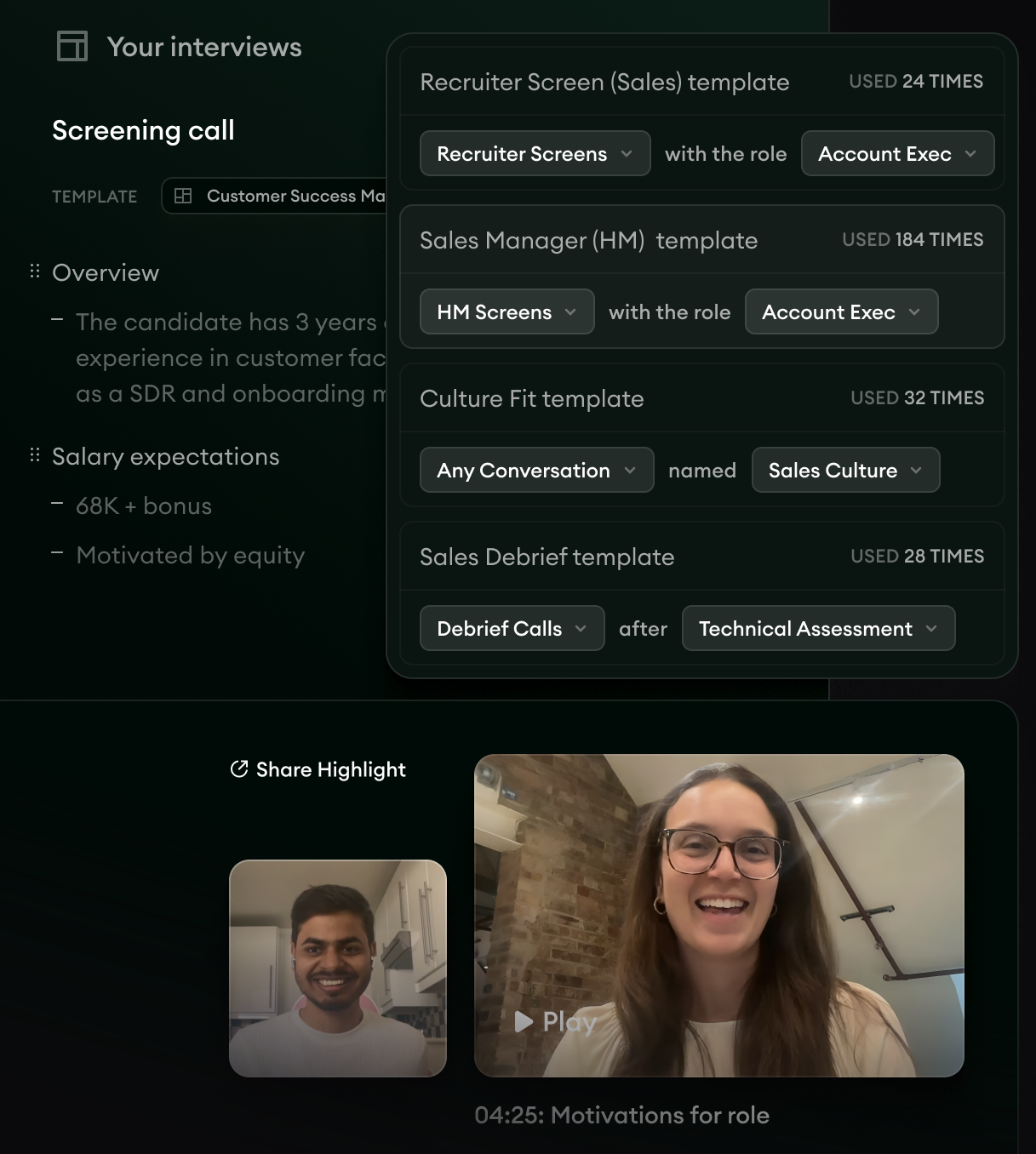
This is the single highest-use move in the loop, and it is the one most teams cannot do because they do not have the interview to replay. That is the part Metaview fixes for free.
The proof, and where Metaview fits
The structured-and-recorded interview is not a Metaview invention. It has been the right answer for a decade. What changed is the cost. Recording, transcribing, scoring against the rubric, and surfacing the moment that mattered used to take a half-day per interview. With Metaview's Notetaker it takes the time you already spend interviewing, and the scorecard writes itself, with the candidate's actual words as the proof.
According to Metaview's 2026 AI & Hiring Alignment Report, surveying 505 recruiting leaders and hiring managers across North America and EMEA, the gap between the teams running the system and the teams running the slapdash version shows up at the goal line:
The 79% versus 36% is the line worth screenshotting. The teams that calibrate, replay, and run the loop together exceed their goals twice as often as the teams that do not. That is the quality compounding through the system. It is also the gap that most quarterly reports describe as "talent strategy" without ever defining what changed operationally.
The operating change for talent leaders
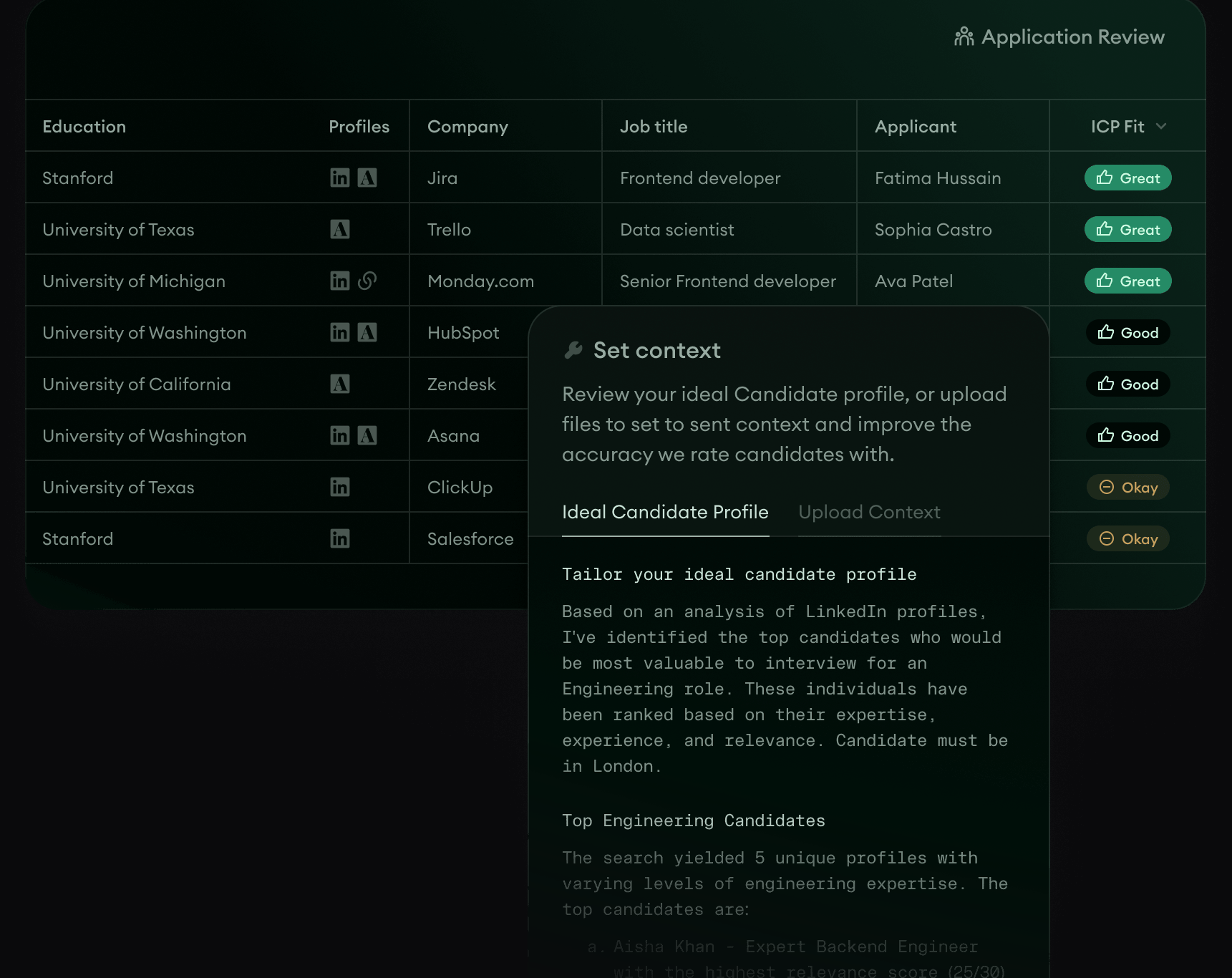
Pick one role. Write the rubric with the hiring manager before the role posts. Run the panel against the rubric. Record every interview with Notetaker. Score in writing within 24 hours. At the volume end, let Application Review stack-rank with the reasoning trail visible, so the human time goes to the conversations where the bar is set, not the ones where the resume is being skimmed.
Do that for one cycle and you will not go back. The team sees what a properly run loop produces. The hiring manager sees the calibration in writing. The recruiter sees the data the next rubric should be built against. The bar moves up, and it stays there because the system is now what holds it.
Frequently asked
Isn't slapdash hiring just speed?
Speed is fine. Slapdash is not. Speed plus a rubric, a recorded interview, and a written debrief is a system that compounds. Speed without those is the system that produces the mis-hire you regret in six months.
We are in a hiring freeze. Why does any of this matter right now?
Because the few hires you make in a freeze matter more, not less. The bar tightens. The cost of the wrong hire goes up because there is nowhere to redeploy the headcount. The teams that come out of the freeze well are the ones that used the slow stretch to fix the rubric, the panel, and the calibration.
My panels are not slapdash. We use structured interviews. What more is there?
Structured is the start. Recorded, scored against the rubric in writing, surfaced in the debrief, and replayed when there is disagreement is the system. Most teams stop at structured and never close the loop on what the structure actually captured.
Does AI not make slapdash worse, not better?
Sloppy AI does. AI at the volume end with a reasoning trail, plus a human at the panel with a rubric, makes the system tighter than human-only ever was. The 2026 Alignment Report is clear: teams that put AI at the core hit goals 85% of the time.
Where do I start?
Pick one role. Write the rubric before the role opens. Record the panel. Score in writing within 24 hours. Replay the interview before the debrief if scores disagree. Do that for one cycle and the bar is set.
Bring Metaview into your hiring stack.
Live notes, structured scorecards, and ATS sync - set up in under 10 minutes.
