

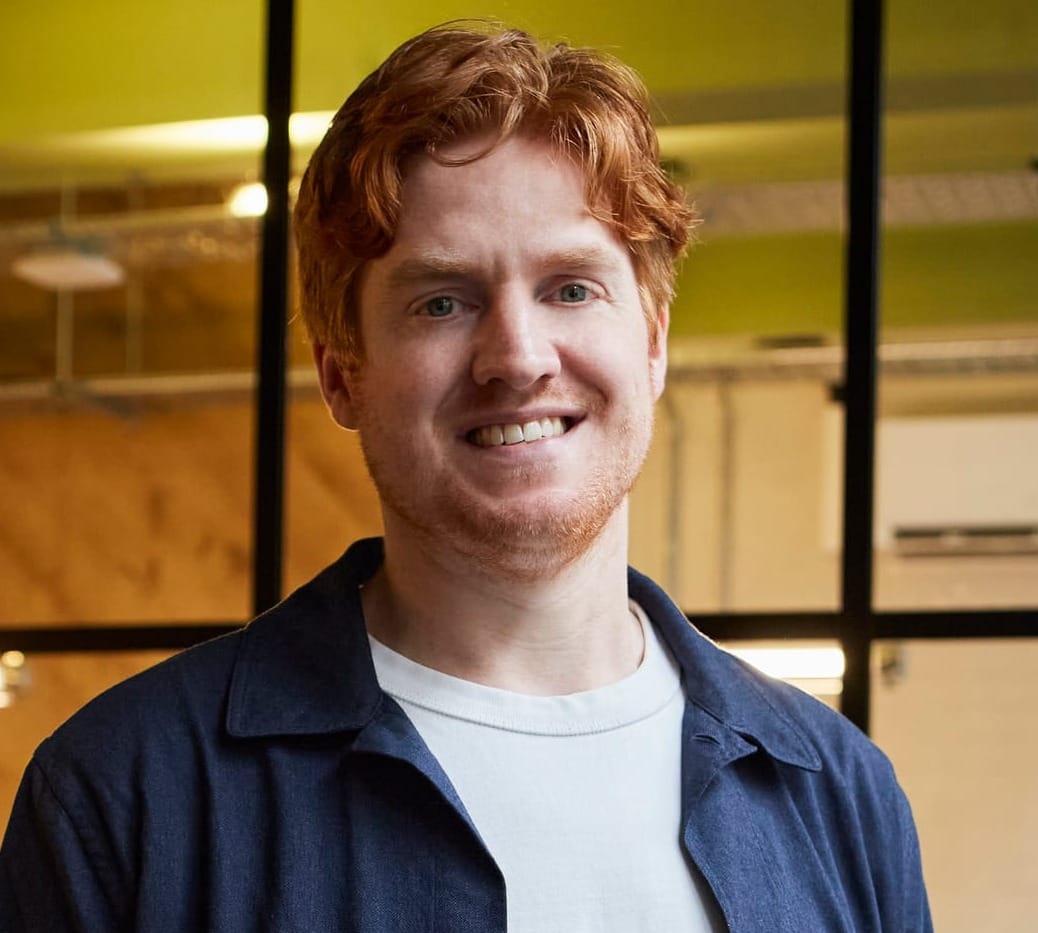
Back in 2022, Metaview ran William Tincup's voice through its Interview Intelligence engine and called him a better interviewer than he claims to be. Four years later, the bar he set still holds. The difference is that AI now sits in the room and watches every move.
Tincup has spent the last decade as one of the loudest, most prolific voices in HR tech. Through Recruiting Daily and his Use Case podcast, he has logged thousands of interviews with founders, recruiters, and AI vendors. That body of work makes him a rare benchmark: a working interviewer who is also a working commentator on how AI is reshaping interviewing itself.
This refresh revisits the original audit through a 2026 lens. The interviewing fundamentals Tincup demonstrated (heavy listening, open-ended prompts, low filler) are now the exact behaviors that AI tools like Metaview's Notetaker measure, surface, and coach in real time. The question is no longer whether he is a good interviewer. It is what his style teaches recruiters and hiring managers in an AI-augmented hiring stack.
The original Tincup audit and why it still matters
In June 2022, Tincup hosted Siadhal Magos, Metaview's CEO, on his Use Case podcast. The conversation covered why customers use Metaview and what a great interview process looks like. At one point Tincup called himself "a horrible interviewer," citing his habit of asking questions like "What's your favorite Beatles album" or "How are you misunderstood?"
Metaview ran the episode through its Interview Intelligence engine and disagreed. The data showed Tincup did the things great interviewers actually do: he listened more than he spoke, asked clear and concise questions averaging 30 words each, and used 118 filler words across the conversation (below the average interviewer benchmark). His open-ended prompts produced an average candidate monologue of 0.78 minutes, with the longest stretching to nearly three minutes.
Four years later, the audit reads less like a fun party trick and more like a forecast. The exact metrics Metaview measured by hand in 2022 are the default capture surface in 2026. Talk-time, question depth, and filler rate are now ambient signals, generated automatically by AI capture tools sitting on every recruiter screen.
The interviewers who looked good in the recording four years ago are the ones AI is now coaching everyone else toward.”
Three traits that aged into AI signals
Tincup's 2022 audit surfaced three behaviors. Each one has since become a measurable input that AI tools use to evaluate interviewer effectiveness across an entire hiring org, not just one recording.
The first is listen-to-talk ratio. Tincup let the candidate (Siadhal) speak. He resisted the interviewer reflex to fill silence with another question or a long preamble. AI capture tools now compute this ratio per interviewer per call and roll it up into team-level dashboards. A recruiter whose ratio drifts toward 70% interviewer talk-time is no longer interviewing; they are presenting.
The second is question economy. Tincup averaged 30 words per question. Compact questions force the candidate to interpret intent and respond with substance instead of parsing what the interviewer wants to hear. This is the same pattern that separates good interviewers from bad ones across thousands of calls Metaview has analyzed since.
The third is filler discipline. 118 filler words over a 30-minute conversation is restrained. Filler density is a leading indicator of interviewer fatigue, low preparation, or an unclear scorecard. AI tools flag spikes in real time and coach interviewers between rounds.
- Talk-time felt intuitive, measured only after the fact
- Question quality known only to the interviewer in the moment
- Filler counts required a manual transcript review
- Coaching feedback arrived weeks later, if at all
- Talk-time ratio surfaced live, per interviewer, every call
- Question depth scored against a rubric tied to the scorecard
- Filler patterns auto-flagged with timestamps for replay
- Coaching cues delivered between rounds, not in next quarter's review
What AI capture adds to the Tincup style
The 2022 audit was a one-off party trick: pull one episode, run it through the engine, write up the numbers. The 2026 version is the default state. Every interview a recruiter runs against Metaview's Notetaker generates the same metrics Tincup got measured against, plus dozens more.
What changes when this becomes ambient is not the individual interview. Tincup ran a good interview in 2022 without any of this telemetry. What changes is the floor. The median interviewer at any company now has access to the same diagnostic surface Metaview built by hand four years ago. Coaching shifts from "this is what great interviewers do, you should try it" to "your last call drifted 15 points below the team median on listen ratio, here are the three timestamps."
Where Tincup's esoteric questions fit in 2026
The questions Tincup mocked himself for ("What's your favorite Beatles album," "How are you misunderstood?") are the part of his style that AI is least equipped to score. A rubric can measure whether a question was open-ended, concise, or relevant to the scorecard. It cannot measure whether asking about the Beatles surfaced the candidate's actual self-perception.
This is the durable edge of a human interviewer in an AI stack. Esoteric questions surface the things the rubric did not know to ask about. The signal arrives sideways. AI can analyze the response after the fact and tag it for the scorecard, but the question itself comes from a working interviewer making a judgment call in real time.
Tincup's framing in the original audit ("I'm a horrible interviewer because I ask weird questions") had the diagnosis backwards. The weird questions are the part that makes him hard to replicate. The fundamentals (listen, ask cleanly, don't fill space) are now table stakes that AI helps everyone hit.
I'm a horrible interviewer.”
How AI augments interviewers without replacing them
Tincup has spent the last two years on every AI-in-hiring panel that will have him, and his read on what AI does well in interviewing tracks closely with what the data showed about his own style: AI handles the measurable, the human handles the unstructured. The same split shows up in how teams are using LLM-assisted workflows for recruiting: the model drafts and measures, the recruiter judges and decides.
The four Metaview product surfaces that mirror this split are not theoretical. They are the operating layer that closes the gap between a recruiter running 30 interviews a week and a recruiter running 30 well-instrumented interviews a week.
Surfaces candidates that match the rubric the recruiter actually used in the last hired role, not the JD on paper.
Ranks applicants against a defined Ideal Candidate Profile so the interviewer's first conversation starts from a real shortlist.
Captures the call live, scores listen ratio and question quality, and writes the scorecard automatically.
Rolls interviewer-level metrics up to team dashboards so coaching gets routed where the gap is, not where someone remembers it.
The pattern in the Tincup audit was that one interviewer's calibration could be measured. The pattern in 2026 is that every interviewer's calibration is measured by default, and the gap to the Tincup-style baseline is visible the day someone misses it.
These numbers come from Metaview's 2026 AI and Hiring Alignment Report, surveying 505 recruiting leaders and hiring managers across North America and EMEA. The takeaway is simple. The Tincup-style interviewer who used to be a happy accident in a hiring team is now a coachable target across the entire org.
The operating shift for 2026
The original 2022 audit ended with three insights about William's chops. The 2026 version ends with three directives for any TA leader thinking about interview quality in an AI era.
One: instrument the fundamentals before scoring the esoteric. Listen ratio, question economy, and filler discipline are the floor. Get every interviewer to the Tincup baseline before debating whether asking about Beatles albums is good practice.
Two: route coaching where the AI flags the gap. The interviewer with a 70% talk-time problem does not need a quarterly review. They need a 10-minute conversation after their next call. AI surfaces the gap; the human manager closes it.
Three: protect the room for human judgment. The questions AI cannot rubric (the sideways ones, the ones that catch self-perception) are the part of interviewing worth preserving. Tincup's "horrible" questions were the most interviewer-defensible signal in the 2022 audit. They still are in 2026.
Bring Metaview into your hiring stack.
Live notes, structured scorecards, and ATS sync - set up in under 10 minutes.
Frequently asked questions
Was William Tincup actually a good interviewer in the 2022 Metaview audit?
Yes. The Interview Intelligence engine showed Tincup listened more than he spoke, averaged 30 words per question, and used fewer filler words than the average interviewer. His open-ended prompts produced candidate monologues averaging 0.78 minutes. The data contradicted his own self-assessment as "a horrible interviewer."
What does AI measure about interviewer skill in 2026?
AI capture tools like Metaview's Notetaker measure listen-to-talk ratio, question word count and openness, filler word density, candidate monologue length, and adherence to the scorecard. These metrics roll up into team-level dashboards that surface coaching opportunities between rounds, not in next quarter's review.
Do esoteric interview questions still work when AI is in the room?
Yes, and they are the part of interviewing AI is least equipped to evaluate. A rubric can score whether a question is open-ended, but it cannot judge whether asking about the Beatles surfaced a candidate's actual self-perception. Esoteric questions remain the durable edge of a human interviewer.
Does AI replace the human interviewer?
No. AI handles the measurable (talk ratio, question economy, filler counts, scorecard adherence) so the human can focus on the unstructured signal: judgment calls, sideways questions, and reading the room. The split mirrors what the 2022 Tincup audit foreshadowed.
How does a team get every interviewer to a Tincup-style baseline?
Instrument every interview by default with an AI capture layer, surface listen ratio and question quality at the interviewer level, route coaching to the lowest-quartile interviewer first, and protect time for the unstructured questions AI cannot score. Most teams that run this loop see the bottom quartile close on the median within a quarter.
