
Naming the five stages of a recruitment funnel is easy, and so is reading the conversion rate between each one off the dashboard. Explaining why a conversion moved last month is harder, and that gap, between tracking a funnel and explaining it, is why the same leaks come back quarter after quarter under different names. Troubleshooting each conversion handoff by handoff is one approach. This guide goes a layer down, to the record of what was asked and answered in the interviews at each stage, because that record is what tells you which conversion to worry about and who to talk to about it.
What the recruitment funnel actually measures (and what it hides).
Define the recruitment funnel in functional terms and the picture is the same on every team. It is a structured pathway candidates move through, from application or outreach to hire, with a measurable conversion rate at each handoff. Sourcing into screening, screening into interviewing, interviewing into offer, offer into hire. Every applicant tracking system draws it the same way. Every TA leader has the chart somewhere on a dashboard.
The chart on the recruiting dashboard measures movement: a candidate left stage 2, a candidate entered stage 3, and the ratio of those two numbers is your conversion rate at the screen step. It records nothing about the substance of that movement: which questions were asked, whether they were the right ones for the role, whether the panel heard the same answers, and whether the rejection came from the rubric or from the interviewer’s memory of how the call felt. So when conversion at stage 3 drops six points month over month, the question a TA leader needs answered is which two interviewers, on which competency, produced the new pattern. The funnel chart cannot answer that. The interview record underneath it can.
Metaview’s 2026 AI & Hiring Alignment Report, a survey of 505 recruiting leaders and hiring managers at companies with 200 or more employees in North America and EMEA, puts numbers on the top of the funnel. 85% of companies exceeding their hiring goals use AI in hiring. Where AI is core to hiring, 68% of searches start with high alignment on requirements between recruiter and hiring manager; where teams don’t use AI, 49% do. The survey shows association rather than cause: it can’t tell you that AI produced the alignment or the goal attainment. It does show how often a search starts with the requirements agreed in advance, and that is the first number to check when top-of-funnel volume looks fine and quality looks thin.
If there’s an underlying theme to the work that I’m doing here at ZoomInfo, it’s how do you strengthen the quality of the data that you bring to the table when you’re looking to hire.”
The 5 stages and the 5 places they leak.
Funnels leak the same way across most teams. The labels change, the numbers vary, but the patterns are remarkably consistent. Here is the stage-by-stage map of what we see most often, paired with the data signal that makes each leak visible before it shows up as a missed quarter.
Stage 1: Sourcing.
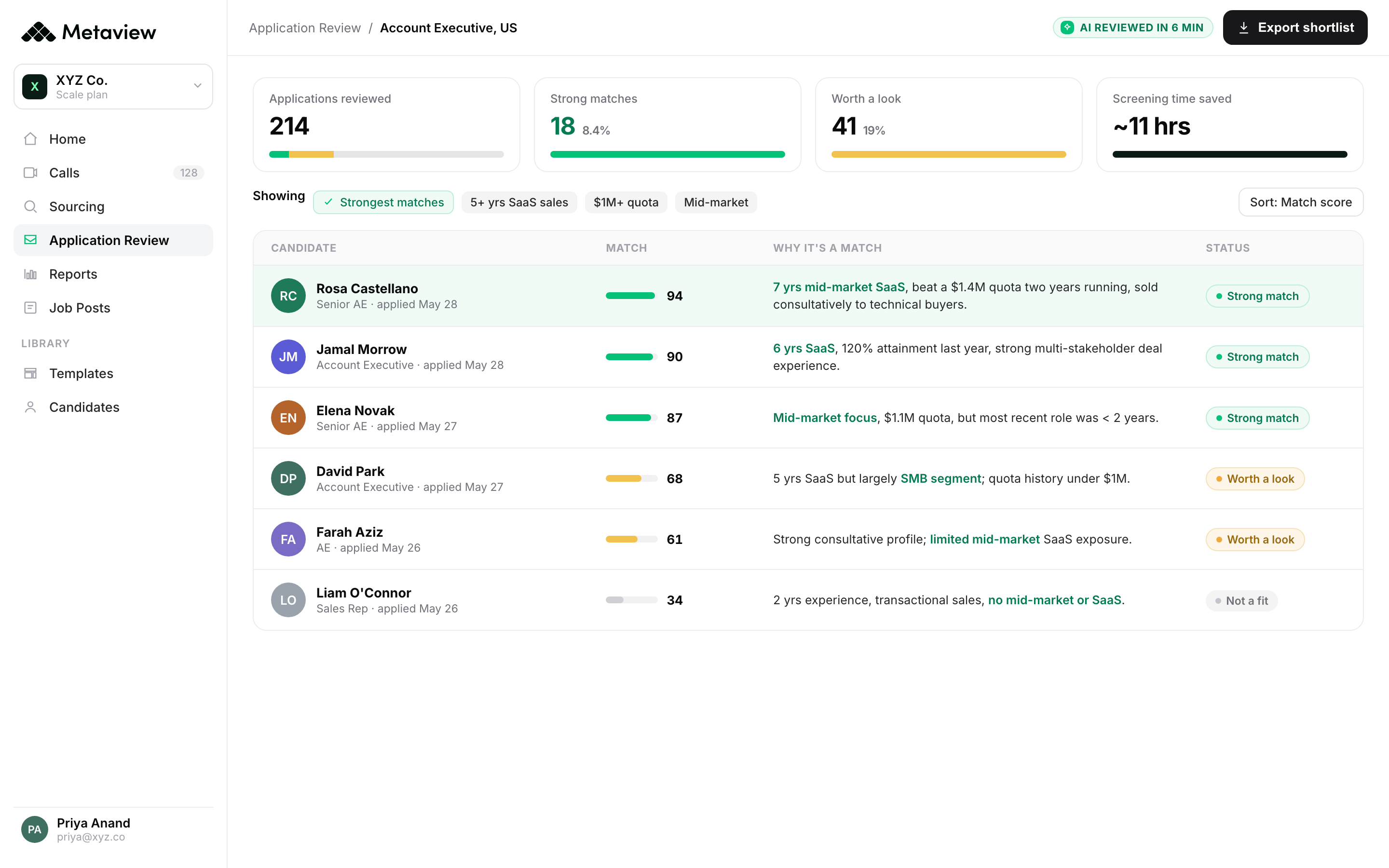
The leak: top-of-funnel volume is fine, but the share of qualified candidates is below expectations. The cause is rarely sourcing tactics. It is misalignment between what the job ad says, what the recruiter is screening for, and what the hiring manager will actually accept on a debrief. The data signal that exposes it: structured comparison of intake-call requirements against screen-stage rejection reasons. If rejections cluster around criteria that were not in the intake notes, the funnel is leaking at the spec, not the source.
Stage 2: Screening.
The leak: screen-to-interview conversion looks healthy until you check it by recruiter. One recruiter is converting at 12%, another at 38%. The chart averages to 24%, and the team-level funnel report does not catch the variance. The data signal that exposes it: screen-call notes structured against the same rubric across the team. Without rubric capture, you cannot tell whether the high-converting recruiter is finding hidden gems or shipping marginal candidates forward.
Stage 3: Interviewing.
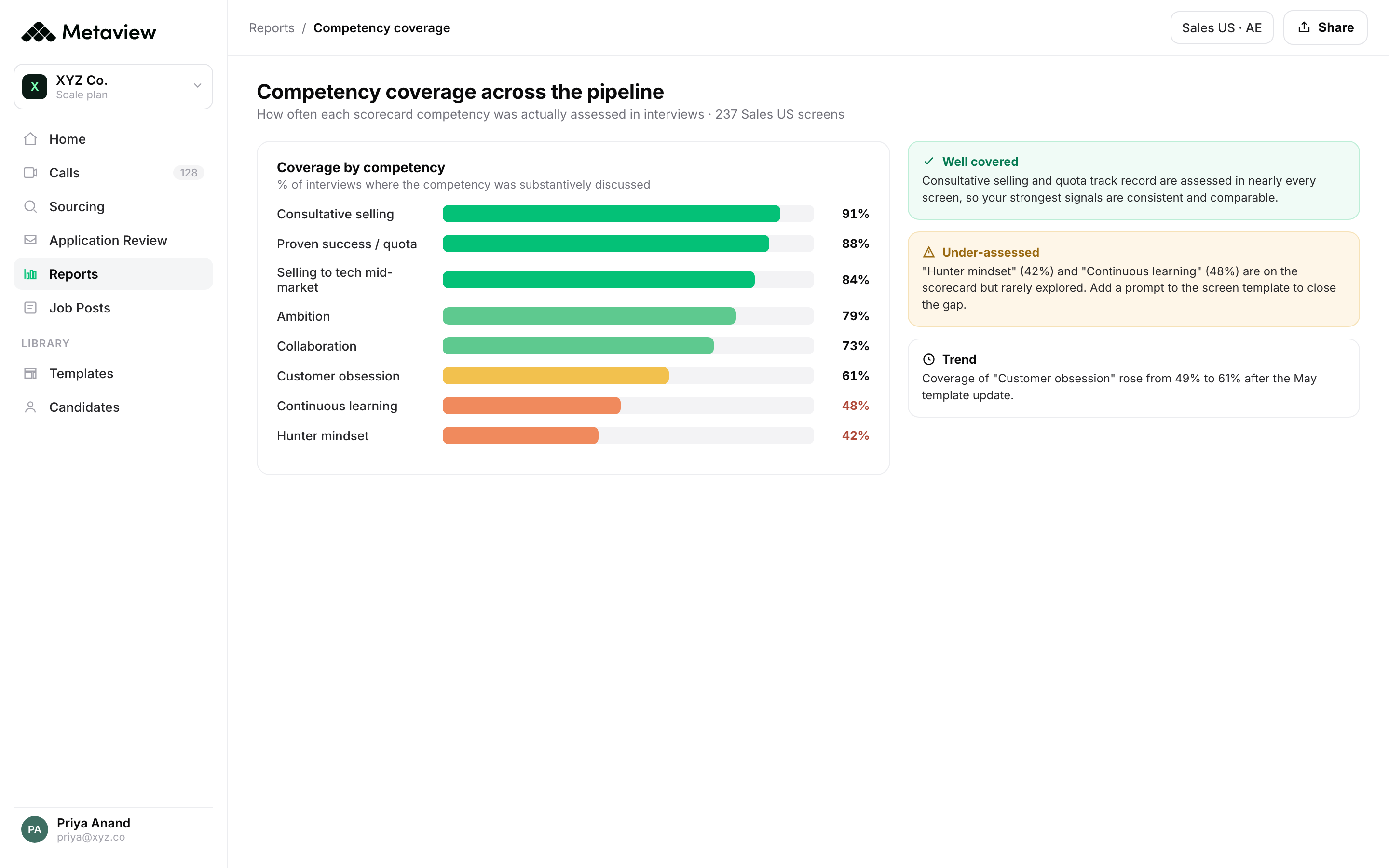
The leak: interview-to-offer conversion swings stage over stage and quarter over quarter, and nobody can explain it. The most common pattern is that panels are running different versions of the same interview. One interviewer asks for live code, another asks for past experience, the third asks for behavioral examples. They are all assessing ‘the engineering bar,’ but they are not pulling the same signal. The data signal that exposes it: interviewer-level reports against the question rubric. When one interviewer is asking three of the seven competencies and another is asking five, the conversion drift becomes a coverage problem, not a quality problem.
Stage 4: Offer.
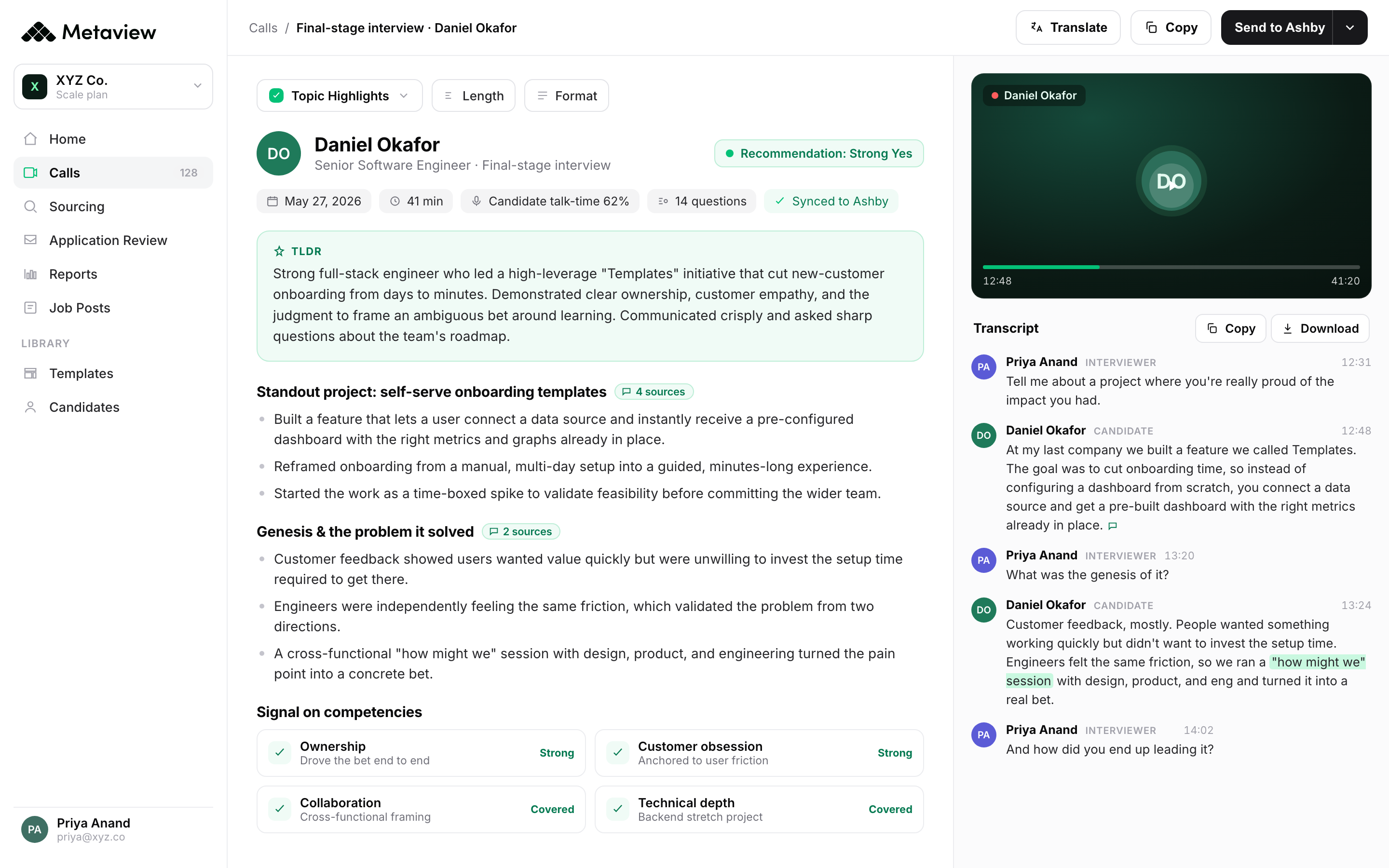
The leak: offers go out, candidates take longer than expected to respond, and acceptance rates drop without an obvious cause. The pattern is almost always debrief drift. The hiring manager forms the offer recommendation from memory of the panel, not from the recorded signal of who said what. By the time the offer letter goes out, the framing has subtly shifted, and the candidate hears a pitch that does not match the conversation they had. The data signal: post-interview multi-source summaries that the hiring manager can pull from at offer time, instead of recall.
Stage 5: Hire-to-Quality.
The leak everyone admits has no good data: do the people we hired actually do the job we hired them for. The connection between funnel performance and hire quality is usually broken, because the panel signal that produced the offer is unrecoverable six months later. The data signal: the same structured interview record, queryable when a hiring manager flags a performance pattern. The team that can ask ‘show me the panel notes for everyone we hired into Sales Engineer in 2025 who did not survive ramp’ has closed the loop. Most teams cannot.
How to map your funnel without losing two weeks to ATS exports.
Most funnel-mapping exercises drown in ATS export work. The data lives in three different objects (candidates, applications, interview events), the joins are inconsistent, and the conversion math has to be redone every time someone renames a stage. By the time the spreadsheet is clean enough to read, the question the TA leader was trying to answer has aged out.
Here is the version of the mapping exercise that does not lose two weeks. Define the five stages first, the way your team actually uses them, not the way the ATS labels them. Pull conversion rates at each handoff for the last 90 days. For each stage, identify the single most important signal capture point: intake notes for stage 1, structured screen notes for stage 2, panel transcripts for stage 3, panel debrief notes for stage 4, the same panel record retrieved at 90 days for stage 5. That is the audit map.
The shortcut is to skip the spreadsheet engineering and start at the capture point instead. If every interview is captured at the stage it happens, the report is built from the interview data rather than reconstructed from exports each quarter. Automating the export and instrumenting the stage itself are different jobs, and only the second one tells you why a number moved.
Manual, Generic AI, and Metaview at each stage.
The five-stage breakdown reads as three different workflows depending on whether you run it manually, with a stack of generic AI tools, or with Metaview as the structured record under each stage. Here is the comparison.
| Stage | Manual | Generic AI | Metaview |
|---|---|---|---|
| Sourcing | Recruiter eyeballs inbound against a static job spec; intake misalignment shows up later. | A separate AI resume screener ranks against the job description; no link to intake or rubric. | Application Review ranks inbound against the ideal-candidate profile, which updates from every recruiter and hiring manager decision. |
| Screening | Free-text screen notes; recruiter-to-recruiter conversion swings 12-38% without anyone noticing. | A separate AI notetaker writes a transcript; nothing connects it to the rubric or the next interviewer. | Structured screen notes against the role rubric; recruiter-level conversion is visible by competency. |
| Interviewing | Panels run different versions of the same interview; competency coverage is uneven and invisible. | Each interviewer’s notetaker produces a one-off transcript; panel-level signal does not aggregate. | Panel-level reports against the question rubric show coverage, drift, and consistency by interviewer. |
| Offer | Hiring manager pitches the role from memory of the panel; framing drifts from the panel conversation. | A summarizer condenses one transcript; multi-source debrief still relies on recall. | Multi-source summaries pull cross-panel signal in one place, so the offer matches the conversation the candidate had. |
| Hire-to-Quality | Panel signal that produced the offer is unrecoverable six months later; root-cause analysis is anecdotal. | Transcripts may exist but aren’t queryable by role, competency, or interviewer. | The same structured interview record is queryable at 90 days; hiring leaders can audit decisions by role and outcome. |
The pattern under the table is the boring one. Manual is fine when volume is low and the team has senior interviewers everywhere. Generic AI helps at specific moments, but it does not connect them. The Metaview argument is the same signal at every stage, every interviewer, queryable later. The compounding is in the connection, not in any one cell.
Closing the feedback loop: stage data should drive stage decisions.
A funnel report that does not change behavior is a screenshot. The point of the data layer is to close the loop between ‘conversion at stage 3 dropped’ and ‘we ran a coaching conversation with the two interviewers who account for it on Tuesday.’ The feedback loop is what makes the funnel a learning system instead of a periodic disappointment.
Siadhal Magos, our co-founder, made this point cleanly in a recent short video: conversations are becoming the differentiator in recruiting, and the recruiters who can read what is happening inside a conversation in time to act on it will out-recruit the ones who cannot. The funnel sits downstream of those conversations. If you can read them, you can read the funnel.
The loop has three pieces. First, the data captured at stage has to answer the question a TA leader will ask later. A conversion percentage on its own does not; interviewer-level coverage against a rubric does. Second, the data has to arrive before the quarterly review. A weekly cadence gives an interviewer time to change something before the next panel; a quarterly one arrives after the damage is done. Third, the action has to sit at the interviewer level. Funnels do not change behavior; coaching conversations with named interviewers do.
Hiring managers want to see data, not feelings. When you can say ‘75% of candidates in this market expect remote work’ and back it up with real conversation data, it changes the conversation.”
Catawiki’s TA team described this shift cleanly when they wrote about how Metaview Reports changed the way they advise hiring managers. The reframe is small, but it is the whole game: from feelings about the panel to evidence from the conversation. That is what closing the loop sounds like in practice.
Once the loop is closed, a conversion drop at stage 3 stops being a mystery. It becomes a specific question with a specific owner. That is the difference between a funnel that gets reported on and a funnel that gets fixed.
A 30-60-90 instrumentation plan.
A TA leader does not need a six-month project to wire the record under the funnel. The 30-60-90 plan below gets a team from quarterly ATS exports to weekly interviewer-level reporting, and it is the version to hand to a hiring ops partner on a Monday morning.
- Days 1 to 30: turn on interview capture for every screen and panel interview. Attach the scorecard template for each role so the notes map to the right competencies. By day 30 every interview is producing structured notes, and the back-loaded transcription project goes away.
- Days 31 to 60: switch on Application Review for inbound on the two highest-volume roles, with the ideal candidate profile reviewed and approved by the recruiter and hiring manager before it runs. Where the ATS supports it (Ashby and Greenhouse, through the browser extension), let the objective scorecard fields autofill from the interview notes. Then pull the first interviewer and competency report off the new data and set it beside the ATS conversion numbers for the same 60 days. Where a conversion moved, the report shows which interviews sat behind it.
- Days 61 to 90: run the first two coaching conversations with interviewer-level reports as the agenda, in place of recall. By day 90 the loop is closed: stage data drives stage decisions weekly, and the funnel report is used to fix things as well as to read them.
That sequence is the cheapest insurance you can buy against the five leaks above. Each phase produces a specific artifact, each artifact is the input the next phase needs, and at the end the funnel is something you can read in real time rather than autopsy in a quarterly review.
 Metaview Technologies
- Funnel report runs on ATS stage transitions; conversion percentages move but no one can explain why.
- Screen-call notes are free text in three different formats; recruiter-level variance is invisible inside the team average.
- Panel debriefs run on memory; competency coverage drifts by interviewer with no feedback loop.
- Hire-to-quality questions land in the recruiter’s lap six months late, with no recoverable signal from the panel.
- Funnel report runs on the same structured interview signal the panel actually produced, so the why is one click below the what.
- Screen notes are tagged against the role rubric; recruiter-level conversion is visible by competency, not just by stage.
- Panel reports show coverage and drift by interviewer; weekly coaching conversations run off the data, not recall.
- Hire-to-quality is a one-query lookup: pull the panel signal for everyone hired into the role last year and look for the pattern.
Bring Metaview into your hiring stack.
Live notes, structured scorecards, and ATS sync - set up in under 10 minutes.
Frequently asked.
What is the recruitment funnel?
The recruitment funnel is the sequence of stages candidates move through from first application or outreach to hire, usually five: sourcing, screening, interviewing, offer, and hire, with a conversion rate measured at each handoff. It is the standard way to see where candidates drop off. The drop-off only becomes fixable when the data under each stage is rich enough to explain it: conversion percentages on their own tell you something moved, and they do not tell you why.
What is a good conversion rate at each stage of the recruitment funnel?
Published benchmarks vary widely by source, role, seniority, market, and how each team defines its stages, so treat any single figure as rough context. The comparison that holds up is your own trailing 90-day rate for the same role, broken out by recruiter at the screen stage and by interviewer at the panel stage. A team average can look stable while one recruiter converts at three times the rate of another, and that spread is the number to act on.
How is the recruitment funnel different from the candidate experience?
The funnel measures the recruiter-facing process: stages, conversion rates, time-in-stage, sourcing channels. The candidate experience is the same process seen from the candidate’s side: how they heard about the role, how they felt at each touchpoint, what made them say yes or no. Both should be mapped and optimized. The funnel is the easier one to instrument quantitatively; the candidate experience is the part most teams under-measure.
What metrics should I track at each stage of the funnel?
At sourcing, track source-of-hire and applicant-to-screen yield, broken out by intake-spec category. At screening, track screen-to-interview conversion by recruiter, with rubric coverage as the secondary signal. At interviewing, track competency coverage by interviewer and interview-to-offer rate by panel composition. At offer, track time-to-offer and offer-acceptance rate by hiring manager. At hire-to-quality, compare the panel evidence that produced the offer with what the hiring manager reports at the first performance check-in. The averages do not tell you much; the slice-by-recruiter and slice-by-interviewer views are where the leaks show up.
How does AI help with recruitment funnel optimization?
The useful place for AI is the interview itself, because that is the stage the funnel report knows least about. Metaview’s Notetaker joins the interview, records and transcribes it, and produces structured notes against the role’s scorecard; Reports then show coverage by interviewer and by competency across the team. That gives a conversion change at any stage a record to check against: which interviews, which interviewers, which competencies. The conversion math itself still comes from the ATS, and every progress or reject decision is still made by a person.
