
Something has changed in the candidate review meeting, and it has nothing to do with rubrics, scorecards, or a new template. Every interview the team ran on the candidate is already in the room. The full recording. The structured AI notes by competency. The scorecard auto-filled against the rubric agreed at intake. The cross-panel report showing what every interviewer probed on, where they agreed, where they did not. The candidate review meeting does not start cold anymore.
That single shift, the move from review by memory to review by captured evidence, changes who talks first, what gets cited, how long the meeting takes, and who walks out aligned. It also changes who can confidently make the decision when one of the interviewers cannot attend. The decision lives in the evidence layer now, not in the room.
The four product surfaces that make this work, live capture, structured AI notes, cross-panel reports, and natural-language AI filters over the evidence, all ship together in Metaview today. This is what changes operationally for the TA leader running calibration, for the hiring manager who walks in cold, for the recruiter writing the offer the same afternoon, and for the candidate who deserves a decision that traces back to what they actually said.
Review by memory is the part of the funnel everyone tolerates.
Most candidate review meetings start the same way. The recruiter opens with a recap of the rubric. Each interviewer takes a turn describing what they remember. Someone with strong feelings about the candidate sets the tone early. Whoever interviewed most recently is more vivid. Whoever interviewed first is more abstract. The competencies that anchored intake quietly drop out, replaced by impressions like I liked her energy and he seemed confident. Forty minutes later the team has talked itself into the loudest person's view.
This is not a calibration problem. This is a capture problem. The team is trying to reconstruct, from working memory, a multi-hour conversation that happened across several days. Even high-performing teams run into the same wall: the richness of the candidate's actual answers is gone by the time the review opens. What replaces it is whatever each interviewer wrote down, and what they wrote down was filtered through their own attention and bias during the call.
The cost shows up downstream. According to Metaview's 2026 AI & Hiring Alignment Report, surveying 505 recruiting leaders and hiring managers across North America and EMEA, 67% of teams lose qualified candidates to competitors who move faster every month. The compounding effect is even sharper: teams without excellent partnerships are 60% more likely to lose those candidates. Slower review cycles do not just delay offers. They change who is still available to accept one.
We may need to know whether a recruiter or hiring panel went deeper on a certain topic. Being able to go back to Metaview, pull those exact notes, and see exactly what was said has been really helpful.”

What's now true in the candidate review meeting.
Four things are different the moment captured evidence becomes the default. Each of them changes the rhythm of the meeting itself, not just the prep work before it.
Every interview is searchable verbatim evidence.
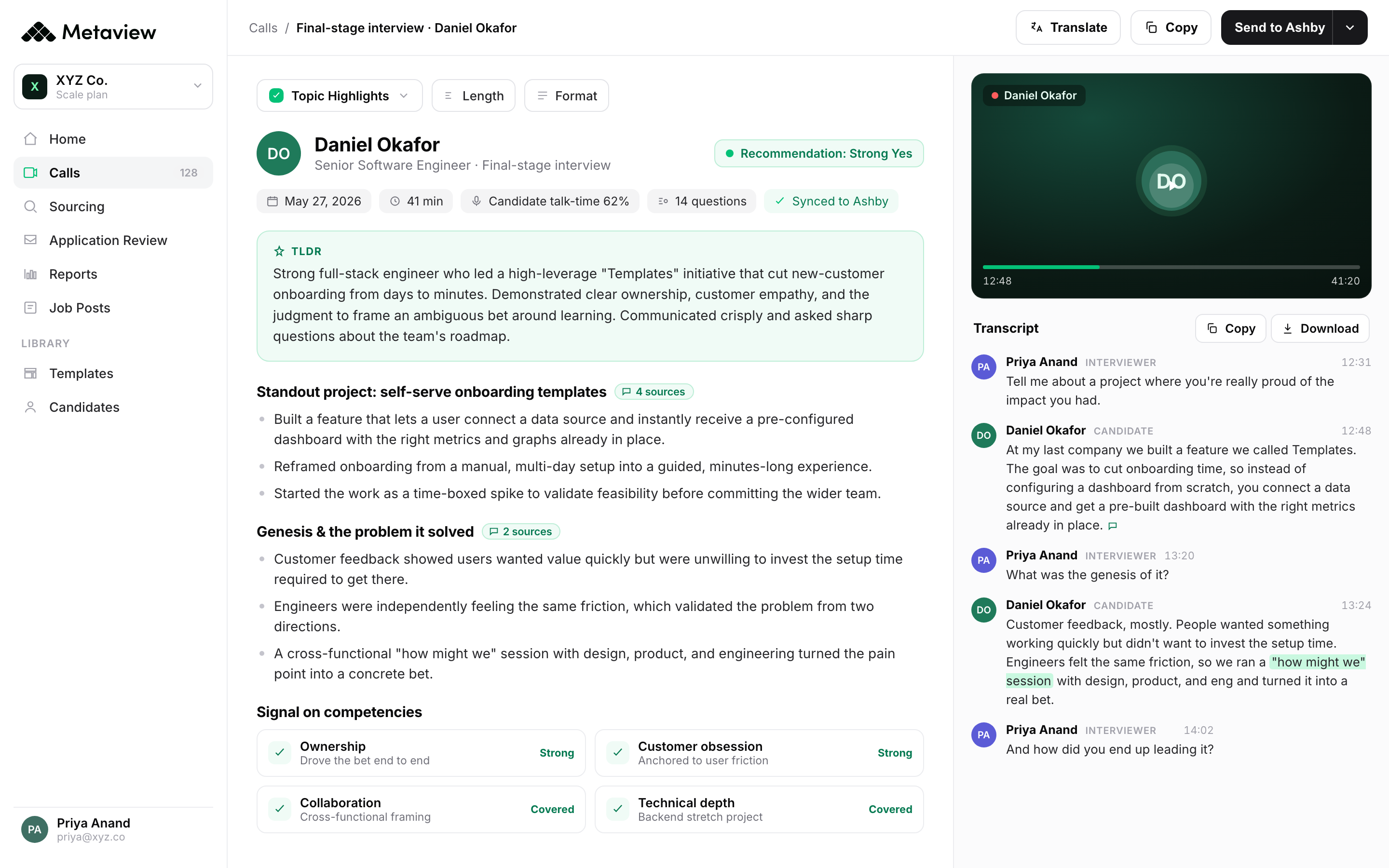
When an interviewer says she was great on system design, the next question is no longer can you say more. It is let me pull the moment. The transcript is indexed, the AI notes are linked to the source minute, and the team can stop arguing about what was said and start arguing about what it meant. That is a much better argument to be having.
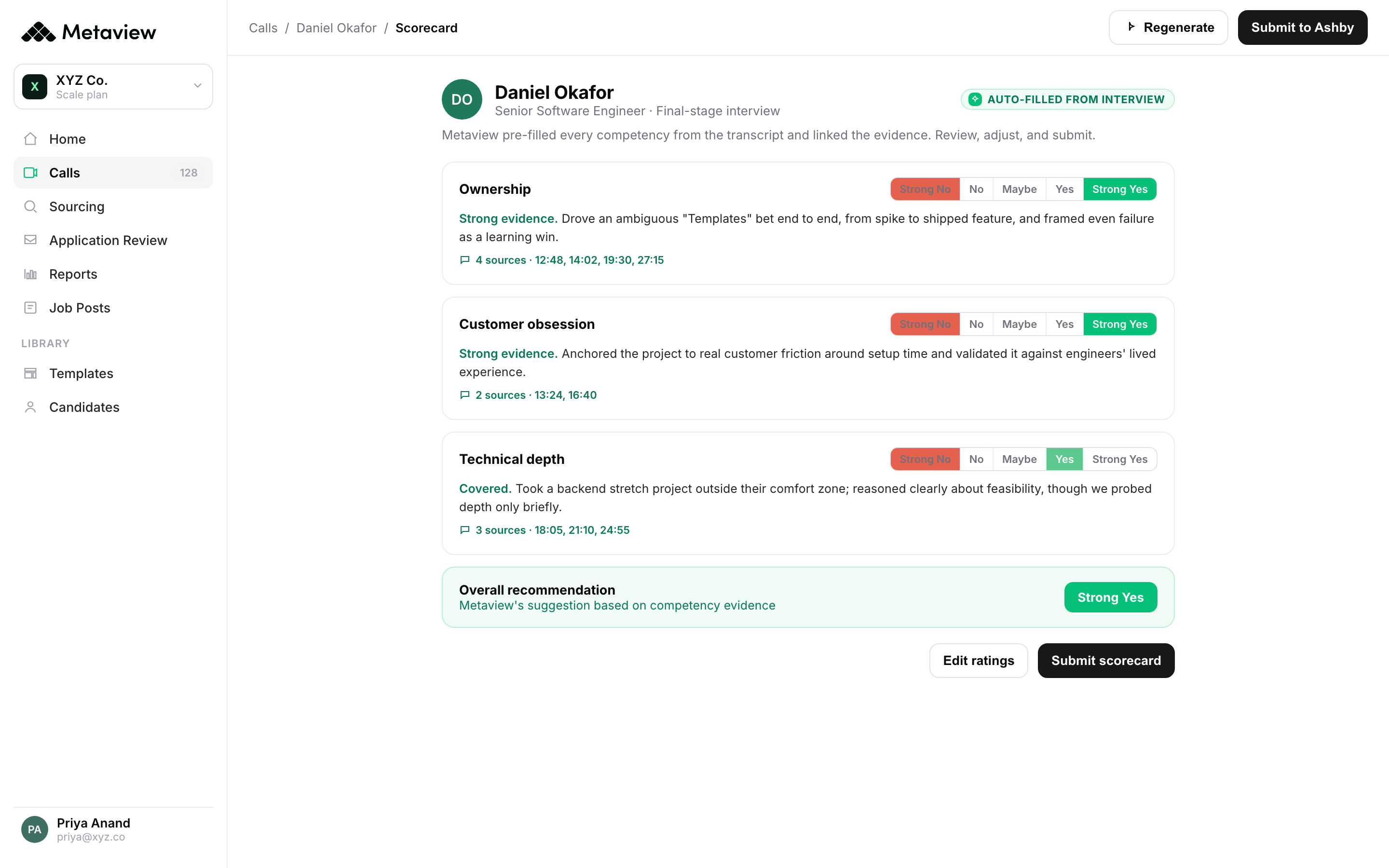
The scorecard auto-fills against the rubric you set at intake.
The competencies the team agreed on at intake show up in the scorecard with evidence already attached. The hiring manager is not staring at an empty form trying to remember the candidate's answer to question four. The structured AI notes have already mapped the answer to the rubric, with the transcript citation. The hiring manager edits and confirms. They do not reconstruct.
Multi-source summaries pre-attach to each candidate before the meeting.
The candidate's screening call, technical interview, hiring manager interview, and panel rounds are summarized into one cross-stage view before the review opens. Strengths show up as a list, with citations. Open questions show up as a list, with citations. Areas where the panel disagreed surface as a list, with citations. The review meeting starts with the answer to what do we know, not the question.
The decision lives in the ATS, not in the meeting notes.
Scorecards push back to Greenhouse, Ashby, Lever, Workable, and the rest on submission. The hiring decision and the evidence it was based on live in the same record the offer team uses to write the comp package, the recruiter uses to debrief the candidate, and the talent leader uses to audit the quality of the call six months later. The review meeting stops being a parallel system.
How this lives in your ATS, calendar, and team.
The reason captured evidence holds up under a review meeting and not just in a demo is that it lives in the systems the team already uses. Metaview connects to the calendar, auto-detects the interview type, applies the right template, and writes the structured notes back into the ATS the moment the call ends. No new tool to open. No copy paste. No I'll send my notes after.
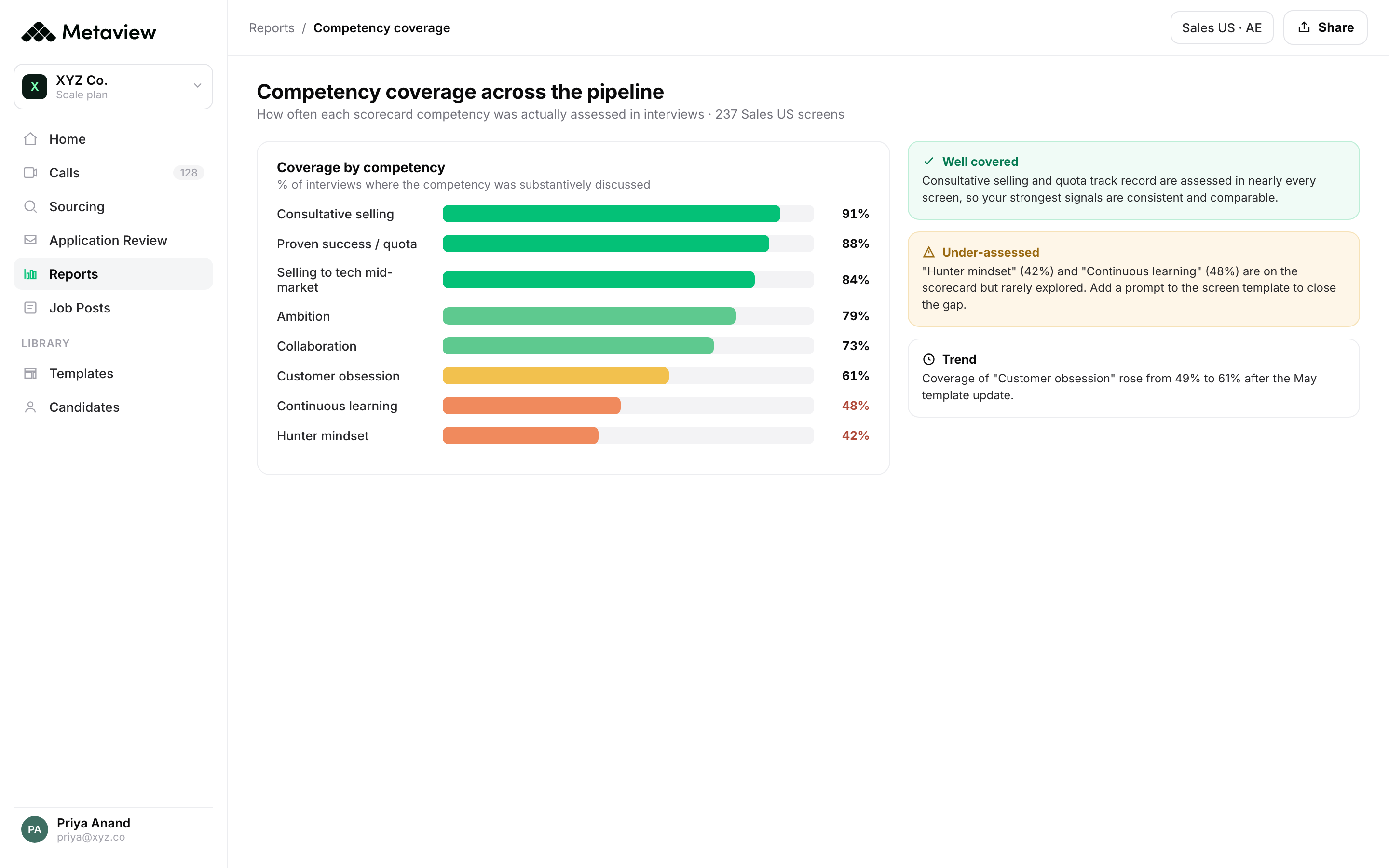
For the recruiter, that means the scorecard submission step is already drafted by the time they open the candidate. For the hiring manager, the prep email arrives with the cross-panel summary inline, not a link to review the recording. For the talent leader, the Reports view rolls up the same evidence by role, by team, by interviewer, with AI columns for things like rubric adherence and competency coverage. The capture layer became the operating layer.
Configuration-wise, the same Metaview workspace can run different templates for technical screens, hiring manager interviews, debriefs, and offer prep, with different default scorecard mappings per template. When a hiring manager interview runs at 2pm, the post-meeting AI notes already know which competencies to organize against. The review meeting at 4pm opens to those competencies in order.
Without captured evidence vs with Metaview.
The cleanest way to see what changes is to put both columns side by side.
- Each interviewer recalls what they thought the candidate said, days after the interview.
- The loudest opinion sets the early tone of the meeting. Quieter interviewers anchor against it.
- Disagreement gets resolved by re-arguing the impression, not by pulling the moment.
- When an interviewer cannot attend the review, their stage is summarized by someone who was not there.
- Offer-team prep happens after the meeting, from scratch, from the recruiter's memory of the conversation.
- The full transcript and the structured AI notes per competency are pre-attached to the candidate.
- The cross-panel report opens the meeting. Agreement and disagreement are visible before anyone speaks.
- Disagreement gets resolved by pulling the transcript line and the rubric anchor in the same click.
- An absent interviewer's stage is represented verbatim by their own structured notes and recording.
- Offer-team prep is one AI Filters query away: strongest signals across all stages, sorted by competency.
How a 45-minute review meeting changes.
If you have ever run a 45-minute candidate review and walked out without a decision, the diagnosis is almost always the same. The first 20 minutes got spent re-establishing what each interviewer remembered, the next 15 got spent debating impressions, and the last 10 ran out before the team could anchor on the rubric. The clock did not break the meeting. The absence of shared evidence did.
With Metaview in the stack, the first 10 minutes are the cross-panel report on screen. Strengths, gaps, and the two or three places the panel split, all read out from the structured AI notes. The next 20 minutes are the decision conversation, with the transcript moments pulled live where useful. The last 15 minutes are the offer package: comp range calibrated to the candidate's actual answers about scope, references queued from the notes on past managers, and the recruiter walking out with a draft email and a clear next step.
The 10x Recruiting Podcast episode below digs into a related angle from the interviewer side. The best interviewers are not just asking better questions, they are surfacing the kind of signal that downstream reviewers can act on. Captured evidence is what makes that signal portable across the panel.
The big aim was to upskill interviewers and make sure we were asking the most relevant questions. With the ultimate goal of hiring the right people and improving the quality of hires we're making.”

What's available today.
All four surfaces ship together. None of this requires a new contract, a beta opt-in, or a custom rollout. If Metaview is on the calendar, the candidate review meeting changes the next time the team runs one.
- Live capture across every interview type. Recruiter screens, technical interviews, hiring manager interviews, debriefs, executive panels. Meeting type auto-detected from the calendar invite.
- Structured AI notes mapped to your rubric. Templates configurable per interview stage and per role. The rubric you set at intake is what the notes organize against.
- Cross-panel Reports with AI columns. Roll up the same evidence by role, team, or interviewer. AI columns for rubric adherence, competency coverage, and any custom field your team needs.
- AI Filters over captured evidence. Natural-language queries across transcripts, notes, and scorecards. The review meeting and the offer prep both start with a search bar.
- ATS write-back on submission. Greenhouse, Ashby, Lever, Workable, and more. The scorecard, the notes, and the rating live in the same record the offer team uses.
Teams where AI is core to hiring see a 40% increase in initial alignment at search kickoff and are 3.8x more likely to rate their cross-functional working relationship as excellent, according to the same 2026 report. The candidate review meeting is the downstream beneficiary of every one of those upstream gains. When the rubric is shared, the capture is structured, and the review opens to evidence rather than memory, the meeting itself stops being where the process loses time.
 Metaview Technologies
See how live capture, structured AI notes, cross-panel reports, and AI Filters change the rhythm of a 45-minute review.
Frequently asked.
Does this require my interviewers to change how they conduct interviews?
No. Metaview joins the call as a participant and captures everything in the background. Interviewers run the conversation the way they always have. The structured notes, scorecard mapping, and cross-panel report happen automatically afterwards.
What if a hiring manager could not attend one of the interview stages?
Their stage is still fully captured. The transcript, the structured AI notes, and the rubric-mapped scorecard are all available in the candidate record. A hiring manager who could not attend can review the evidence in minutes rather than rescheduling the panel or relying on a secondhand summary.
Can the team filter the captured evidence by competency across candidates?
Yes. AI Filters runs natural-language queries across transcripts, structured notes, and scorecards. The review meeting can open with a side-by-side view of how three finalists handled the same competency, with verbatim moments cited.
How does this affect time spent in the review meeting itself?
The first 20 minutes of most review meetings used to be spent re-establishing what each interviewer remembered. With captured evidence pre-attached, that reconstruction work is already done. Teams report the conversation moves from impression-debate to decision-and-offer-prep within the same calendar block.
Does the scorecard sync back to our ATS?
Yes. Metaview pushes the scorecard, structured notes, and rating back to Greenhouse, Ashby, Lever, Workable, and other supported ATSes on submission. The hiring decision and the evidence behind it live in the same record the offer team uses next.
