
A candidate replies to your interview invite with one line: “Would it be possible to see the questions beforehand?” You have about a minute to decide. Say yes and you wonder whether you have just handed one person an advantage the rest of the slate did not get. Say no and you are not sure what you protected.
Most requests for neurodivergent interview accommodations arrive like that one, and most of the hesitation comes from treating them as a favor. An accommodation removes a test you never meant to set.
A conventional interview measures the competency you care about. Alongside it, the format also measures working memory and processing speed, and it rewards looking comfortable while thinking out loud. For most roles, none of that is the job.
Then there are the candidates who never ask. In a 2023 Birkbeck survey of 990 neurodivergent employees, only 11.3% said they faced no barriers to disclosing, so most of the candidates who would benefit from an adjustment will not request one.
Accommodations remove tests you never meant to set.
Start with what an interview is for. You are trying to find out whether someone can do a job. Almost everything else the format measures is incidental, and you would drop it if you noticed you were measuring it.
The clearest evidence for this comes from a 2021 study in the journal Autism by Katie Maras and colleagues. Fifty adults, 25 autistic and 25 non-autistic, sat two mock job interviews about six months apart.
The first interview used typical, unmodified questions. The researchers then used what they learned to adapt the questions and ran the interviews again, with employment experts rating every interviewee.
On the unmodified questions, the experts rated the autistic interviewees less favorably than the non-autistic ones. On the adapted questions, ratings improved for both groups, and improved more for the autistic interviewees, so the gap between them narrowed. The authors’ own conclusion is that adaptations to interview questions are critical to level the playing field for autistic candidates.
Fifty people is a small study, and mock interviews are not real hiring decisions. There is also an order effect in play: everyone sat the conventional interview first and the adapted one second, so practice and familiarity may explain part of the rise in scores. Treat the result as a strong indication that still needs confirming.
What candidates say about the process points the same way. A 2023 survey of 225 autistic adults and 64 adults who were neurodivergent but not autistic, also published in Autism, found all groups frustrated by how much of recruitment turns on social skills. They asked for more practical ways to show what they can do.
In government figures for the United Kingdom covering 2024 to 2025, the employment rate for disabled people whose main health condition is autism was 31.4%. The overall employment rate for non-disabled people, measured in the second quarter of 2025, was 82.5%.
Those two figures come from different reporting frames, so they make a rough comparison at best, and the publication itself cautions that estimates for individual conditions rest on small samples. Read the gap as an order of magnitude.
One note on scope. The interview-specific research is mostly about autistic candidates, because that is where the work has been done, and this post says “autistic” wherever a study did.
The same Birkbeck survey shows how wide the group is. Attention deficit hyperactivity disorder (ADHD) was the largest group at 611, ahead of autism at 499, with dyslexia at 224 and dyspraxia at 151. Prevalence runs the same way: ADHD sits at around 5% worldwide and developmental coordination disorder, still widely called dyspraxia, at up to 6%, against autism at under 1.6%.
So the accommodations below are written for the whole group, whatever the diagnosis. For how much the format alone is doing, it is worth reading on structured versus unstructured interviews.
Six neurodivergent interview accommodations that keep the bar intact.
One test to apply before any of these. Name the competency the stage exists to measure, then ask whether the adjustment removes a barrier or removes the competency. For a role where reasoning aloud with incomplete information is the work, thinking time before a live discussion changes what you are measuring. For most roles it does not. Treat the six below as defaults that still answer to that test.
Send the questions, or their shape, in advance.
This is the one candidates ask for most often, and it is the one interviewers hesitate over most. The worry is that preparation is itself a signal. It rarely is. If you wanted to know whether someone can produce a coherent answer about a project they led, you already know they can prepare, because they prepared for the interview.
You do not have to send the exact wording. Sending the shape is usually enough: the four competencies you will cover, the fact that two questions will ask for a specific past example, and roughly how long each will take.
Give a time estimate you can keep.
An interview that runs long is a different interview from the one the candidate prepared for. Someone who arranged childcare or budgeted their energy for 45 minutes is now doing something else. It is reasonable to expect that lands harder on some candidates than others.
Across 174,558 interviews in Metaview’s own data, 54.3% ran over their scheduled time, and 44.1% ran over by five minutes or more. More interviews run over than finish on time.
Ask one question at a time, and put it in writing.
Compound questions are common and expensive. “Tell me about a project you led, what went wrong, and what you would do differently” is three questions that must be held in memory while answering the first one. Anyone can lose the thread, and a question carrying three parts makes that likelier for everyone in the room. The problem sits in the question itself.
Interviewers also talk in longer stretches than they think. In a sample of 1,274 interviews from Metaview’s data, the median longest uninterrupted stretch of interviewer speech was 114.1 seconds. That is nearly two minutes of continuous talking before the candidate is expected to respond to whatever was in it.
That sample is small next to the millions of conversations in the wider set, so read it as a picture of these interviews. It may not hold for interviewing everywhere.
Ask one thing, wait for the answer, and then ask the next. On a video call, paste each question into the chat as you ask it.
Offer a choice of format.
In the 2023 survey, participants across all three groups asked employers for a choice of recruitment methods and for more information about the process up front. Autistic and otherwise neurodivergent participants also raised the environment itself, meaning the room, as something that shapes how the conversation goes.
A choice does not have to be elaborate. Camera on or off. A written exercise instead of a live problem, or the same exercise with thinking time before the discussion. A quieter room, or one interviewer instead of three.
Say out loud what you are assessing.
Candidates are usually guessing at what counts. Telling them removes the guess without telling them the answer. “This next question is about how you handle ambiguity, so I am listening for how you made the call, whatever the outcome” costs you nothing and lets someone spend their attention on the substance.
It also imposes some discipline on you, and interviews vary more than most teams realize. Across 2,688 interviews in Metaview’s data, the share of the conversation taken by the interviewer ran from 27.9% at the tenth percentile to 65.1% at the ninetieth. The same named interview is a different experience depending on who runs it. As above, this is a thin sample against the full set, so treat it as a signal about these interviews.
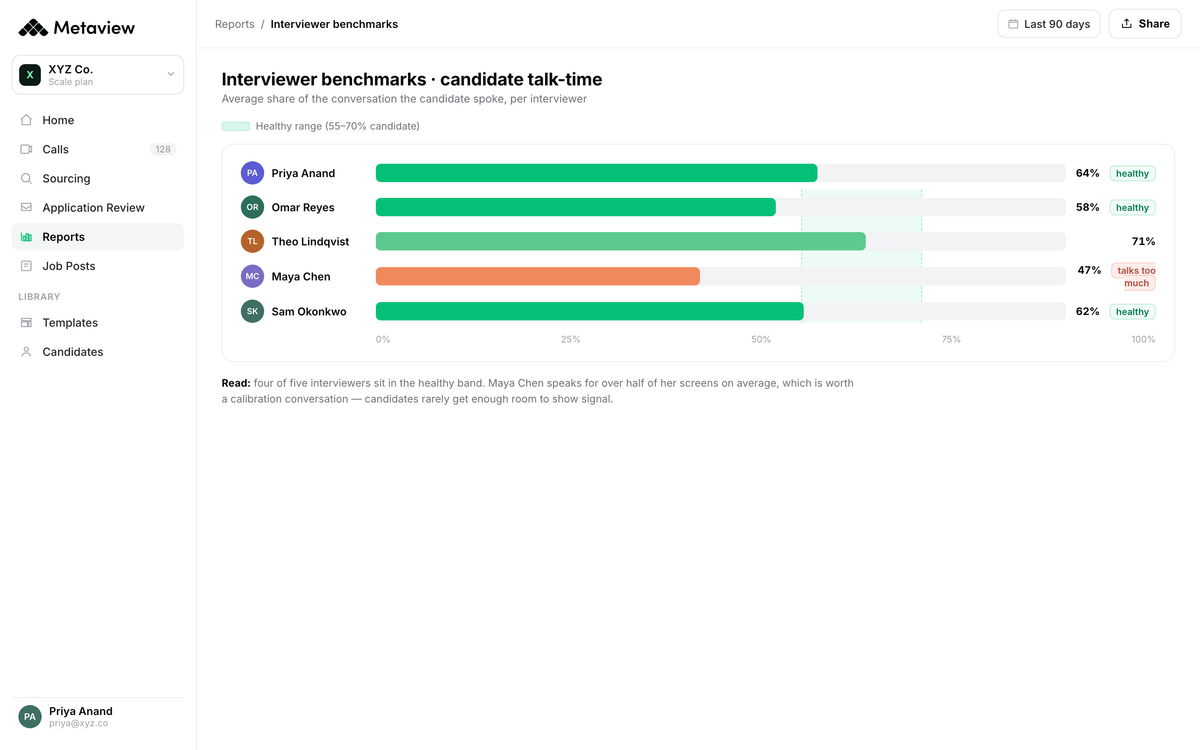
- 1The talk-time band set for the candidate’s share of the conversation.
- 2One interviewer sitting below the band, a prompt for a calibration conversation with that interviewer.
Score what the candidate did.
This is the accommodation that does the most work, and the one most likely to be skipped, because it happens after the candidate has gone. It is covered in the next section.
| What it costs you | What it does not change | |
|---|---|---|
| Questions sent in advance | You lose the surprise. Check first that surprise was not what you meant to test. | The depth of the example still has to be real. |
| A time estimate you keep | You have to schedule honestly and cut your own follow-ups. | Every candidate answers the same questions. |
| One question at a time | Nothing, beyond breaking a habit. | You still ask everything you planned to ask. |
| A choice of format | Some scheduling work, and a second exercise format to maintain. | Difficulty holds, as long as both formats test the same competency. |
| Naming the competency | You have to know what you are assessing before you walk in. | Candidates still have to demonstrate it. |
| Scoring on evidence | Writeups take longer if you are working from memory. | The threshold for a yes is exactly where it was. |
What interview writeups reward.
Take every submitted scorecard that recommended a yes and every submitted scorecard that recommended a no, then count how often each word appears per 1,000 words of written feedback. A handful of describing words turn up far more often on the yes side. Four of the clearest:
“Keen” leads at 2.16x, followed by “communicator” at 2.09x, “adaptable” at 1.96x and “thoughtful” at 1.83x. Further down the same list come “personable” at 1.80x, “pragmatic” at 1.74x, “calm” at 1.66x, “eager” at 1.60x and “proficient” at 1.57x.
Those words fall into two kinds. “Pragmatic” and “proficient” describe capability, and a writeup that reaches for them is doing its job. “Keen”, “calm” and “personable” describe how the candidate came across in the room.
This list is easy to over-read. It shows what interviewers wrote once they had decided, and it cannot show what drove the decision. A positive writeup will contain positive adjectives, and “communicator” and “adaptable” may be competencies your rubric names outright.
The manner words are the part to pay attention to. No interviewer plans to score whether a candidate seemed keen, yet “keen” sits at the top of these four. A candidate whose tone or eye contact reads as flat can lose ground in exactly those words, after the call has ended and no format change can help. The fix is cheap: write down what the candidate did, and score that.
If you want a structure that pushes writeups toward evidence, Metaview’s interview scorecard template is built around competencies.
Keeping the record without keeping notes.
Scoring on evidence assumes the evidence still exists when you sit down to write, and often it does not. In a sample of 13,382 scorecards, the median piece of written feedback ran to 365 words, but 26.6% were five words or fewer.
The gap is wider further along. Of 296,555 candidates who were advanced to the next stage, 41.9% had no submitted scorecard at all. That figure counts missing scorecards on candidates who moved forward, which is a different measure from how completely scorecards get filled in.
This is where the note-taking problem bites. An interviewer typing while the candidate talks is only half listening, and what they write down is a compressed impression of what was said. Metaview joins the call as a visible participant and captures every spoken word, so the writeup can quote the candidate directly.
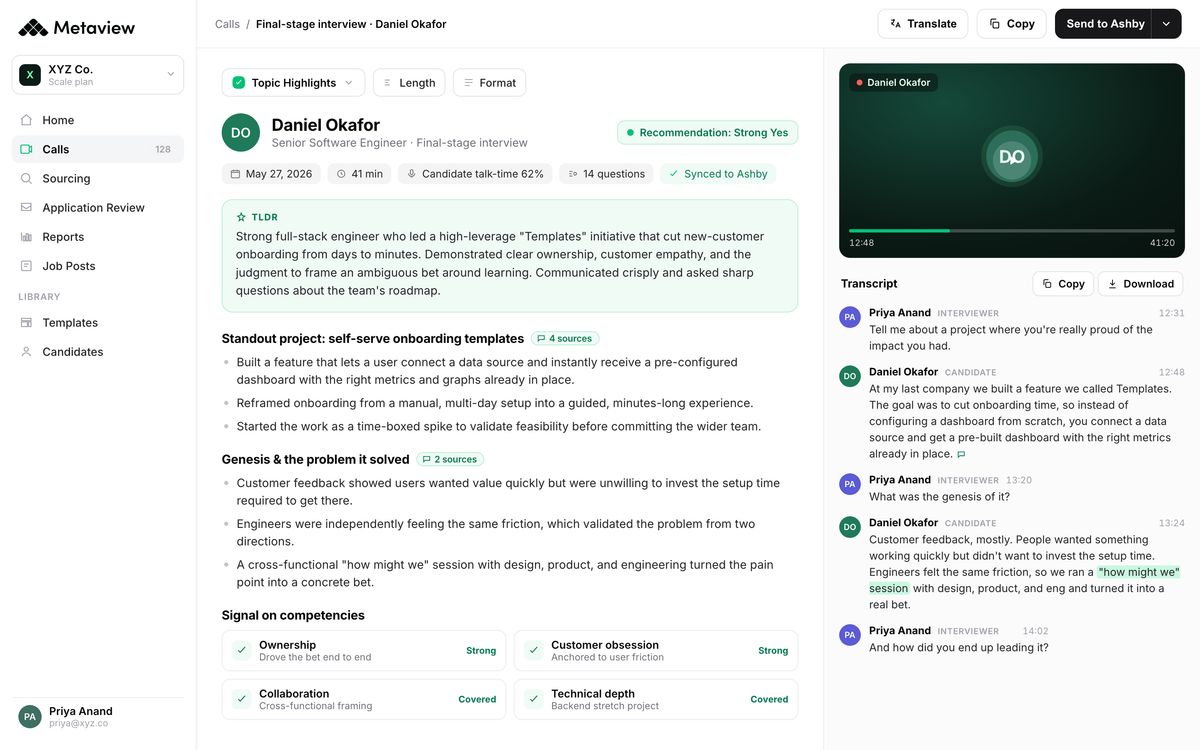
- 1Talk-time for the call, visible without anyone having to estimate it afterwards.
- 2The transcript, with speaker labels and timestamps, so an answer can be quoted word for word.
The short video below, from Metaview’s own channel, shows what an interview looks like when interviewers don’t have to take their own notes.
Candidates notice the difference too. Miguel Delgado Alonso, People & Talent Senior Director at Perk, puts it plainly: “It’s harder for the candidate to feel engaged when they see people looking at different screens during a conversation.”
A bad interviewer transacts. A good interviewer interacts.”

Riviera Partners, an executive search firm, describes the same effect on its client and candidate calls in its case study with Metaview, where Partner Justin Cottrell says the tool lets you “stay present and engaged in conversations without needing to worry about detailed note-taking.”
The scorecard then starts from that record, with each competency tied back to the moments in the conversation it came from.
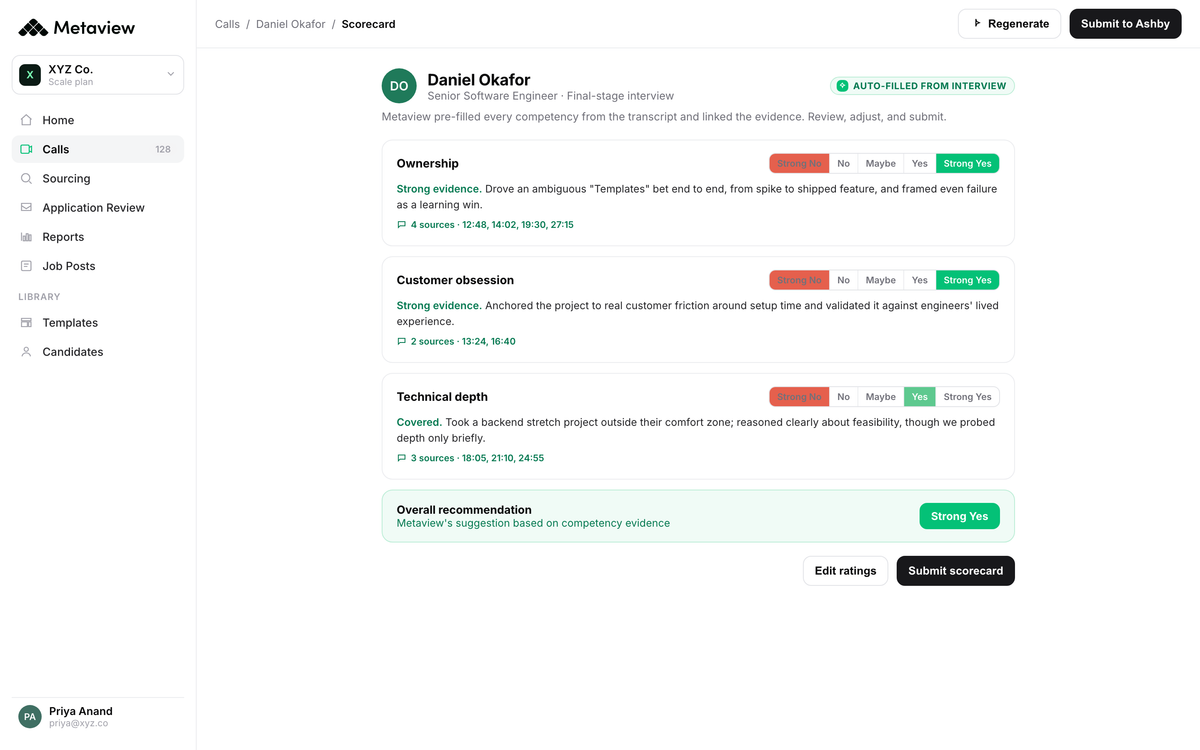
- 1Each competency carries its evidence, timestamped back to the point in the conversation it came from.
- 2The overall rating is a suggestion. The interviewer edits it and submits it.
For what happens to scorecard quality when the writeup starts from a transcript, see Metaview’s analysis of interview scorecards across millions of conversations.
Two objections you will hear.
Doesn’t this lower the bar?
The Maras study is the closest thing to an answer. Both groups answered the adapted questions and the experts’ ratings went up for both, while the gap between them narrowed. The narrowing is the part that carries weight, because the autistic interviewees gained more. Be precise about the limit, though: since everyone sat the conventional interview first, the across-the-board rise could be practice as easily as adaptation.
Then be precise about the word bar. The threshold you set for a yes stays where it is. Who clears it can change, because that is what a narrower gap means. If that sounds like the same thing, ask which of those two interviews measured the job more accurately. An instrument that reads more accurately is supposed to change who passes.
Don’t you need to know who is neurodivergent?
No. Every accommodation above can be offered to your whole slate as a default, which means you never have to ask an intrusive question and no candidate has to name a diagnosis to a stranger to be interviewed on fair terms.
Go back to the Birkbeck finding from the start of this post. A process that works properly only once someone has disclosed is designed for a small minority of the people it is meant to serve.
What defaults cannot do is replace an individual process. Someone may need a break, captions, assistive technology, extra processing time, or something your team has not thought of. Publish a confidential route for asking, point it at whoever owns accommodations at your company instead of the interviewer, and ask what would help. The diagnosis itself stays out of the conversation.
Some candidates will still choose to disclose, and it is worth having a route for them. A 2024 study found that raters who were told an interviewee was autistic rated that person more favorably than raters who were not told.
Adding general information about autism on top of the disclosure did not improve ratings further. That result describes how raters in one study responded, and no single interview is guaranteed to go the same way. Use it as a reason to make disclosure easy, and leave the decision with the candidate.
Everything above describes what a well-run interview already looks like: a candidate who knows what is coming, an interviewer who asks one thing at a time and listens to the answer, and a writeup that records what happened. Run it that way and you get a cleaner read on everyone who reaches the offer stage, with the bar for a yes exactly where you set it. If you want the fuller version of the format underneath it, start with structured interviews.
Give every candidate an interview scored on evidence.
Interview notes and scorecards built from the conversation, synced to your applicant tracking system.
Frequently asked.
How do you offer accommodations without asking anyone to disclose?
Build them into the process for every candidate. Put the competencies and the rough shape of the interview in the invite, make camera use and the exercise format optional, and give everyone the same confidential route for asking for anything else. A candidate can then use what they need without explaining why.
Who should own accommodation requests, the recruiter or human resources?
Whoever owns accommodations at your company, kept separate from the interviewer who will score the candidate. The recruiter’s job is to make the route visible in every invite and to pass requests along promptly, so the adjustment is in place before the interview starts.
Should an accommodation request be recorded on the scorecard?
No. The scorecard records how the candidate performed against the competencies, and an adjustment to the format is not evidence about the candidate. Handle the request through whatever route your company uses for accommodations, and keep it out of the assessment record.
What if a hiring manager refuses to share questions in advance?
Ask which specific signal they believe the surprise is producing, and whether the scorecard has a line for it. Usually there is not one, which makes the case on its own. If they still say no, the fallback that costs them nothing is sending the competency areas without the wording of the questions.
What should you do if a candidate discloses a diagnosis during the interview?
Thank them and ask what would help for the rest of the conversation. If it is something you can do there and then, do it. If it is not, say so and offer to pause or rearrange, so you are not improvising while you are still scoring them. Do not ask about the diagnosis itself and keep it out of the scorecard. Pass anything that looks like a formal accommodation request to whoever owns that at your company.
