
Taking notes is a constant hurdle to running good interviews. Tools like BrightHire solve that problem by automatically recording recruiting conversations, generating transcripts and notes, and helping hiring teams capture the evidence they need to make decisions.
BrightHire does this well. The choice comes down to whether you want a tool that records and summarizes interviews, or a platform that puts what you learn to work across the rest of hiring.
There's now a wide range of BrightHire alternatives to choose from. Some offer a similar mix of interview recording and AI notetaking, while others are simple meeting assistants that can be adapted for recruiting. And increasingly, AI hiring platforms use interview intelligence as part of a broader recruiting system.
This guide compares nine of the best BrightHire alternatives, from dedicated interview intelligence platforms to broader recruiting tools.
BrightHire alternatives compared.
Most modern AI meeting tools can transcribe conversations. The more useful comparison is how well each platform understands recruiting, and what it can do with interview information after the call ends.
| Tool | Recruiting specific | Recording + transcripts | AI notes | Scorecards + rubrics | ATS integration | Recruiting automation |
|---|---|---|---|---|---|---|
| Metaview | Yes | Yes | Yes | Yes | Yes | Yes |
| Employ AI Interview Companion | Yes | Yes | Yes | Yes | Yes | Limited |
| Screenloop | Yes | Yes | Yes | Yes | Yes | Yes |
| Honeit | Yes | Yes | Yes | Partial | Yes | Limited |
| Hirevue | Yes | Yes | Yes | Yes | Yes | Yes |
| Fireflies.ai | No | Yes | Yes | No | Limited | No |
| Otter.ai | No | Yes | Yes | No | Limited | No |
| tl;dv | No | Yes | Yes | No | Limited | No |
| ZoomMate | No | Yes | Yes | No | No | No |
For teams that only want to stop taking manual notes, the general-purpose options can be perfectly adequate. The distinction becomes more important when you want interview data to become part of the recruiting process itself.
What is BrightHire?
BrightHire is an interview intelligence platform built specifically for recruiting teams. It records and transcribes hiring conversations, produces AI-generated notes and summaries, and helps interviewers capture structured evidence without dividing their attention between the candidate and a notepad.
The platform also supports structured interview plans, scorecards, interviewer coaching, and recruiting analytics. This makes it considerably more specialized than a general-purpose meeting assistant. BrightHire has also expanded into AI-led candidate screening with BrightHire Screen.
Zoom acquired BrightHire in late 2025. That's an advantage for organizations running most of their interviews on Zoom, although BrightHire continues to support other meeting platforms rather than becoming a Zoom-only product.
Why recruiting teams choose BrightHire.
- AI interview notes: Automatically captures and summarizes recruiting conversations.
- Recordings and transcripts: Creates a searchable record of what candidates and interviewers actually said.
- Structured interviewing: Helps teams use consistent interview plans, questions, and evaluation criteria.
- Scorecard workflows: Makes it easier to turn interview evidence into structured candidate feedback.
- Interviewer coaching: Gives teams visibility into how interviews are being conducted and opportunities to improve.
- Recruiting analytics: Surfaces insights across interviews rather than treating every conversation in isolation.
Where teams may want an alternative.
BrightHire's specialization is also one reason teams may consider alternatives. If you primarily need interview intelligence, it's a natural fit. But recruiting leaders want AI to help with much more than what happens during an interview.
A BrightHire alternative may provide:
- More automation across the funnel: Sourcing, outreach, screening, and application review alongside interview intelligence.
- Connected recruiting context: A platform that uses what it learns from hiring managers, recruiters, and candidates to inform future searches and evaluations.
- Broad recruiting integrations: Consistent workflows across your ATS, video platforms, and other hiring tools.
- One platform for all recruiting intelligence: Interview notes, scorecards, hiring manager alignment, and reporting without adding separate AI tools at every stage.
Some provide a cheaper or simpler way to capture interviews; others take the information inside those interviews and put it to work across the rest of recruiting.
What to look for in a BrightHire alternative.
The best BrightHire alternative depends on what you want from interview intelligence: a cleaner record of each conversation, or interview data that feeds the rest of the recruiting workflow.
Here are the capabilities worth comparing.
Recruiting-specific interview notes.
An interview isn't an ordinary meeting. Your notetaker should understand candidate experience, motivations, competencies, compensation expectations, and other recruiting signals rather than producing a generic meeting summary.
Automatic transcripts and recordings.
Accurate transcripts give your team a reliable record of what was actually said. Look for strong speaker identification, searchable transcripts, accessible recordings, and support for the meeting platforms your team already uses.
Structured scorecards and role rubrics.
The most useful interview tools connect what candidates say to the competencies and criteria you're evaluating. Automatic scorecard completion removes another piece of interview admin and gives hiring teams more consistent evidence to review. In Metaview's own data, 28.6% of manually drafted scorecards were submitted, against 50.3% when Metaview generated the first draft. Teams that turn on AI drafting may already run tighter processes, so treat the gap as an association rather than proof.
ATS integrations.
Interview intelligence shouldn't live in another silo. Look for integrations with your ATS that automatically put notes, transcripts, and scorecards where recruiters and hiring managers already work.
Interviewer consistency and coaching.
Recording interviews creates an opportunity to improve them. Features such as interview plans, role-specific templates, interviewer feedback, and coaching help teams ask better questions and evaluate candidates more consistently.
Hiring analytics and reporting.
Individual interview notes are useful. Aggregated interview data can be even more valuable. Look for platforms that help recruiting leaders identify patterns across roles, interviewers, candidates, and hiring processes.
Intelligence beyond the interview.
A standalone notetaker captures information. A broader recruiting intelligence platform can use what your team learns to improve candidate screening, sourcing, application review, hiring manager alignment, and future hiring decisions.
9 best BrightHire alternatives for recruiting teams.
We've focused primarily on tools that can record, transcribe, summarize, or otherwise improve recruiting conversations, while also including a few options that take interview intelligence further.
1. Metaview: complete AI hiring platform.
Core focus: AI recruiting platform with interview intelligence across the hiring process.
Metaview is the strongest BrightHire alternative for teams that want excellent interview intelligence as part of the full recruiting flow. Like BrightHire, Metaview automatically captures recruiting conversations, produces detailed transcripts and AI notes, and helps interviewers complete structured scorecards against the criteria for each role.
The bigger difference is what happens beyond the interview. Metaview is a complete AI recruiting platform with agents for sourcing, screening, automated outreach, and application review, plus interview intelligence, hiring manager alignment, and reporting. It works alongside the ATS rather than inside it: scorecards can be submitted directly into Ashby and Lever, and a browser extension autofills the objective fields of Greenhouse and Ashby scorecards.
Context captured from intake calls, interviews, and debriefs becomes part of a shared understanding of the role and what a great candidate looks like. The sourcing agent, for example, can search your past Metaview conversations alongside the web and your connected ATS.
Key capabilities
- Recruiting-specific AI notes: Automatically creates detailed, structured notes from interviews and other hiring conversations.
- Interview transcripts: Captures the full conversation so teams can return to the original evidence when needed.
- Automatic scorecards: Uses interview evidence to help complete scorecards consistently against role-specific rubrics.
- AI sourcing and outreach: Finds high-fit candidates and helps automate personalized outbound engagement.
- AI screening: Runs two-way screening conversations with the candidates you choose to assess and returns an assessed fit for your team to act on.
- Application review: Reviews inbound applicants against your criteria and prioritizes the candidates worth attention.
- Hiring manager alignment: Keeps recruiters and hiring managers working from shared context throughout the search.
- Recruiting reporting: Turns conversations and hiring activity into insights you can use across the funnel.
Limitations:
- Broader than necessary if you only want a basic meeting recorder or transcription tool.
- Recruiting-specific rather than designed as a general AI notetaker for every type of company meeting.
Best for: Recruiting teams that want best-in-class interview notes and intelligence as part of a broader AI platform for sourcing, screening, evaluation, alignment, and reporting.
Pricing: Free tier available; paid plans priced per agent. Current rates are on the Metaview pricing page.
2. Employ AI Interview Companion: dedicated interview intelligence.
Core focus: AI interview notes, structured interviewing, and interviewer support.
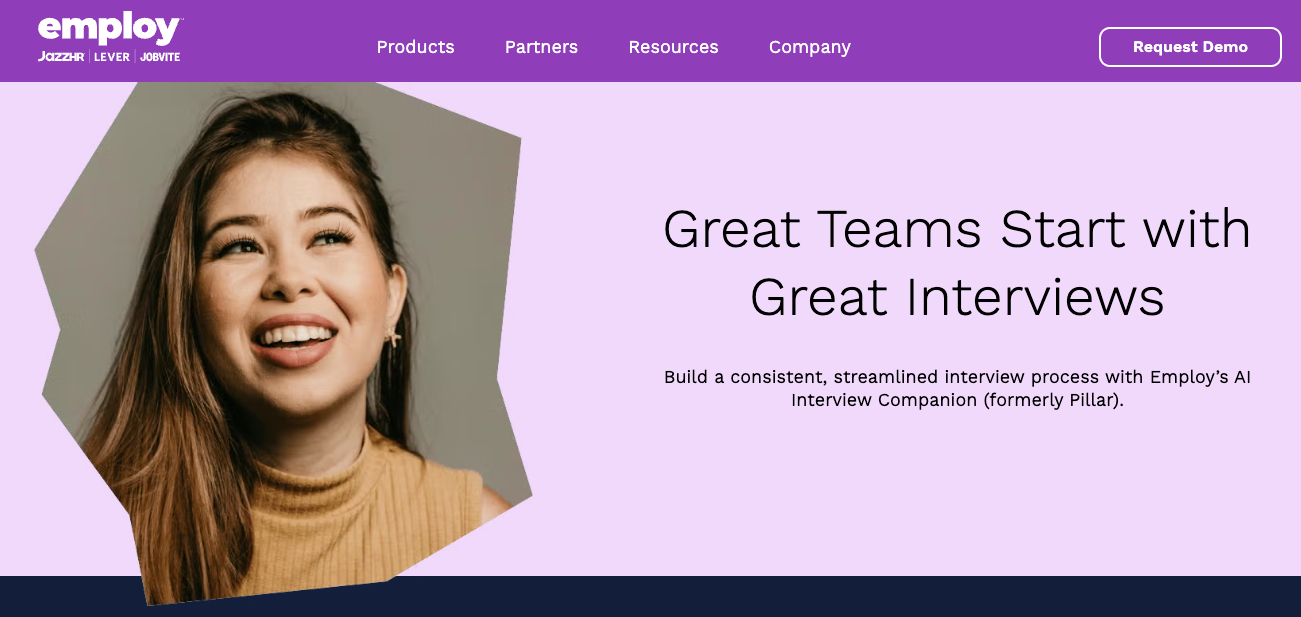
Previously known as Pillar, Employ AI Interview Companion, is one of the more direct BrightHire alternatives for teams primarily interested in improving interviews. It uses AI to generate notes and summaries, helping interviewers stay focused on candidates rather than documentation.
Like BrightHire, it emphasizes structured interviewing and more consistent candidate evaluation. And its connection to the wider Employ recruiting software ecosystem will be particularly interesting for existing customers.
Compared with Metaview, however, its focus is much more squarely on the interview itself rather than using interview context across sourcing, application review, and the wider recruiting process.
Key capabilities
- AI interview notes: Captures key information from candidate conversations automatically.
- Interview transcripts: Creates a record of interviews that teams can revisit after the call.
- Structured interviewing: Helps teams standardize interviews around consistent questions and criteria.
- Interviewer support: Gives interviewers additional context and guidance during the evaluation process.
- Candidate insights: Makes information from interviews easier for hiring teams to review and share.
Limitations
- Primarily focused on interviews rather than end-to-end recruiting automation.
- Most compelling for teams already using or considering the wider Employ ecosystem.
Best for: Teams looking for a dedicated recruiting interview intelligence tool, and existing Employ users.
Pricing: Part of a wider software suite. Request a demo for details.
3. Screenloop: structured interviewing and quality of hire.
Core focus: Interview intelligence, structured hiring, and quality measurement.
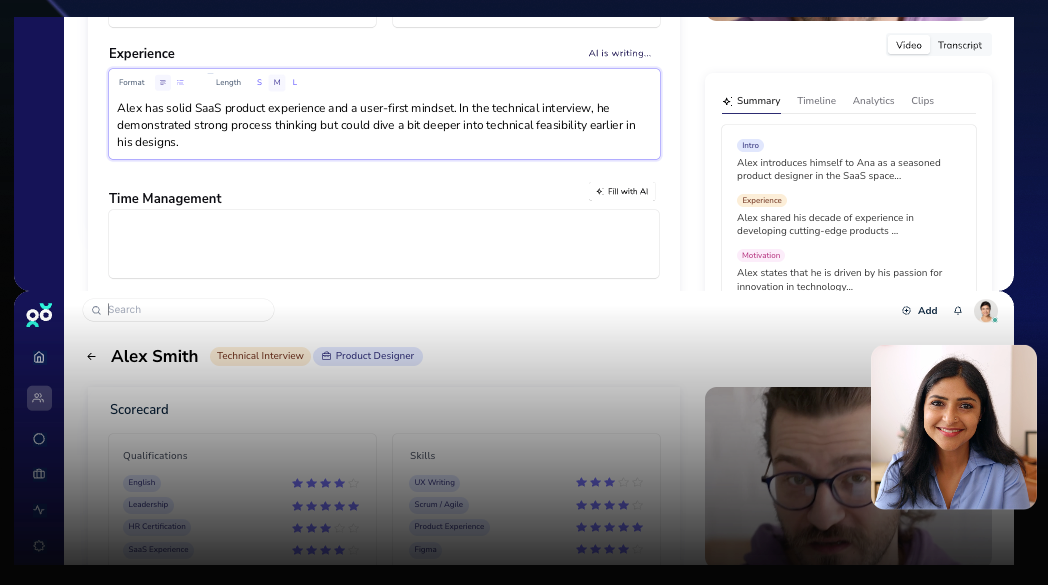
Screenloop combines AI interview intelligence with tools that make hiring processes more structured and measurable. It records and transcribes interviews, generates AI notes, and helps teams use consistent scorecards and evaluation criteria across candidates.
Compared with BrightHire, Screenloop emphasizes structured interviewing connected to quality of hire. This helps you understand whether your processes ultimately produce successful hires.
It also offers broader talent acquisition automation beyond the interview itself, including tools for screening and recruiting operations. It’s a useful option for teams looking to standardize hiring at scale.
Key capabilities
- AI interview notes and transcripts: Records conversations and automatically captures the important details.
- Structured scorecards: Standardizes candidate evaluation around predefined competencies and criteria.
- Interview intelligence: Gives teams greater visibility into how interviews are conducted.
- Quality-of-hire analytics: Connects recruiting processes with post-hire outcomes and performance.
- Recruiting automation: Extends into adjacent workflows such as candidate screening and TA operations.
Limitations
- Broad feature set may be more than smaller teams need from an interview notetaker.
- Less focused on sourcing and generating outbound candidate pipeline.
Best for: Recruiting organizations that want to structure interviews and measure how processes affect quality of hire.
Pricing: Book a demo for details.
4. Honeit: recruiter-led interviews and candidate submissions.
Core focus: Recruiting-specific interview intelligence and candidate presentation.
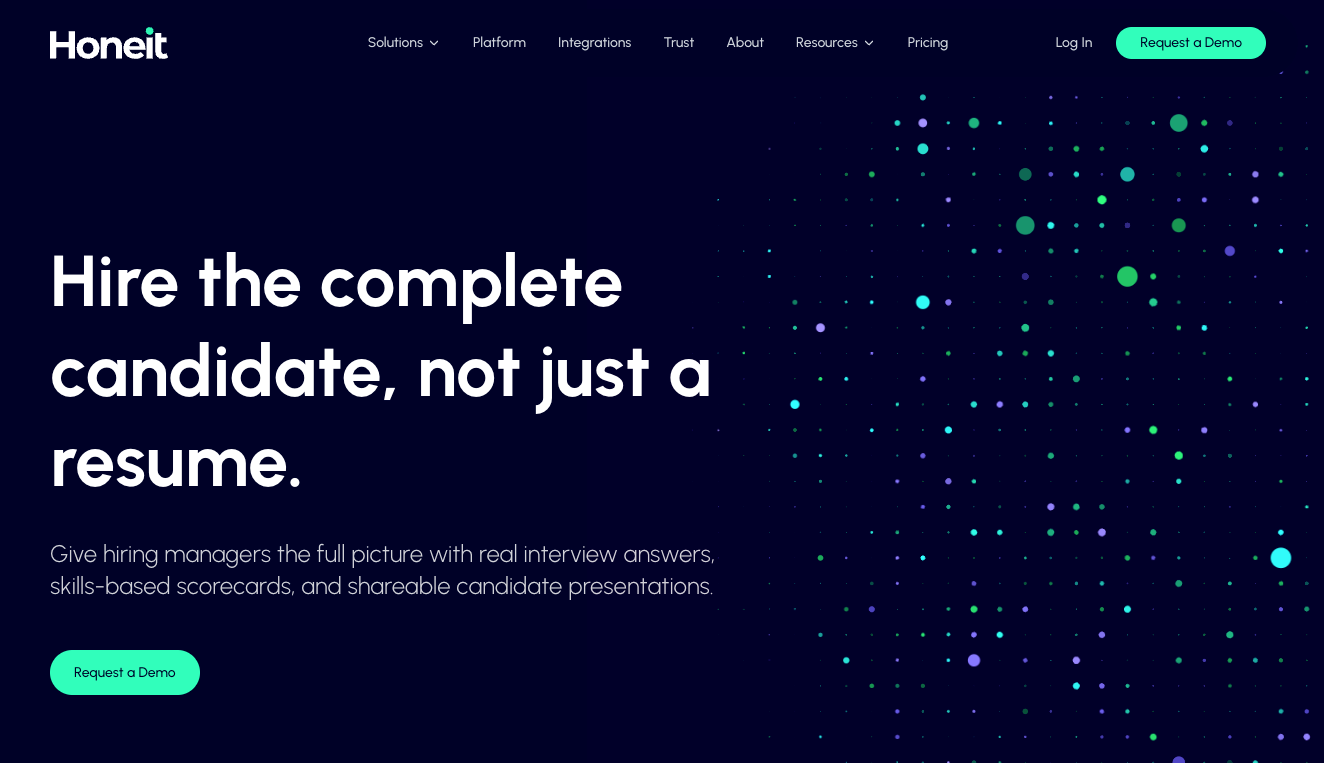
Honeit is another recruiting-specific alternative to BrightHire, with a particular focus on turning conversations into intelligence. It records and transcribes interviews, creates AI-powered notes, and helps you capture evidence without typing throughout the call.
Honeit also emphasizes sharing interview highlights and candidate submissions. That helps staffing firms and recruiters who need to present candidates to clients or hiring managers.
This gives it a different center of gravity from Brighthire. There’s less emphasis on enterprise interviewer coaching, and more on helping recruiters capture, package, and communicate candidate information.
Key capabilities
- Interview recording and transcription: Automatically captures recruiter and candidate conversations.
- AI interview notes: Produces structured summaries without manual notetaking.
- Candidate highlights: Makes it easier to surface and share important moments from interviews.
- Candidate submissions: Helps recruiters package candidate information for hiring managers and clients.
- Recruiting-specific workflows: Designed around talent acquisition rather than general business meetings.
Limitations
- Limited functionality for sourcing and top-of-funnel recruiting.
- More narrowly focused on interview capture and candidate presentation than full recruiting intelligence.
Best for: Recruiters and staffing teams that want to turn candidate conversations into structured, easily shareable submissions.
Pricing: Free trial available. Professional plan from $110/user. Custom plans also available.
5. Hirevue: enterprise video interviewing and assessments.
Core focus: Video interviewing, assessments, and high-volume hiring.
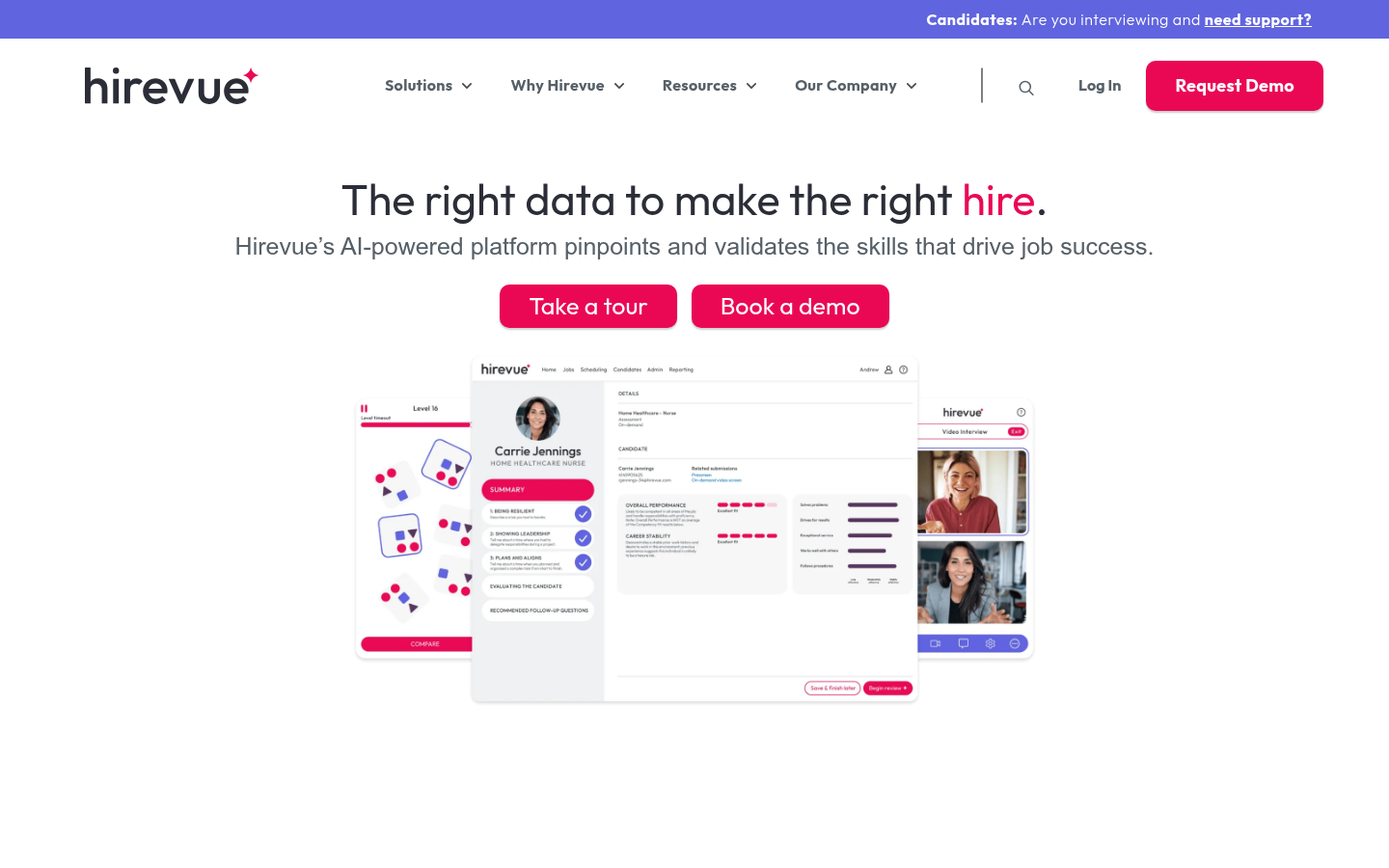
Hirevue is an enterprise hiring platform, rather than a direct replacement for BrightHire's interview intelligence functionality. Its strengths are in structured video interviewing, skills assessments, candidate screening, and other tools to help large organizations evaluate candidates at scale.
Hirevue offers on-demand video interviews and automated early-stage evaluation. That’s relevant for high-volume hiring programs where recruiters simply can't conduct a live conversation with every applicant.
The tradeoff is that teams primarily looking for an AI notetaker and intelligence layer for their existing interviews may find Hirevue more extensive than they need.
Key capabilities
- Live and on-demand video interviewing: Supports both traditional interviews and asynchronous candidate responses.
- Candidate assessments: Evaluates skills and competencies alongside interview performance.
- Structured interviewing: Helps organizations standardize how candidates are evaluated.
- High-volume screening: Automates parts of early-stage evaluation for large applicant pools.
- Enterprise hiring workflows: Supports complex recruiting programs across large organizations.
Limitations
- More complex than a dedicated AI interview notetaker.
- Geared primarily toward enterprise and high-volume hiring use cases.
Best for: Large organizations that want video interviewing and candidate assessments alongside broader tools for standardizing hiring at scale.
Pricing: Pricing starts around $25K-$40K per year.
6. Fireflies.ai: general-purpose BrightHire alternative.
Core focus: AI meeting recording, transcription, and summaries.
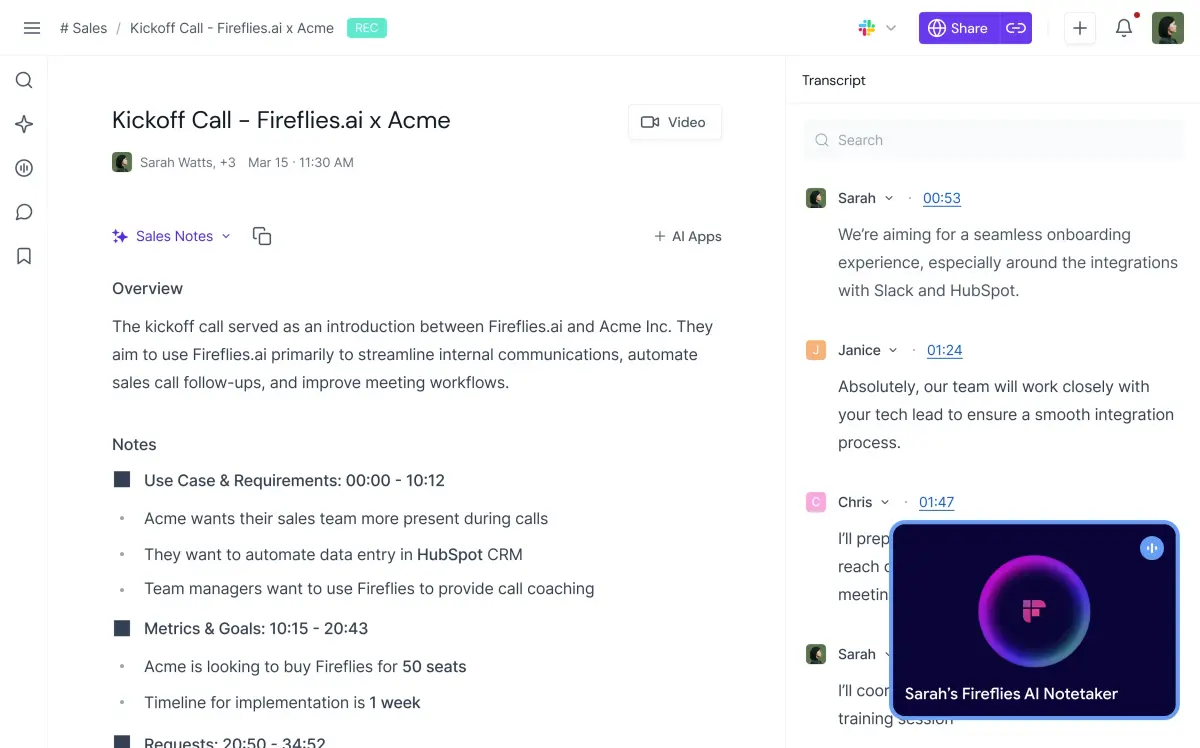
Fireflies.ai isn't specifically for recruiters, but it can cover the fundamental notetaking problem that leads many teams to consider BrightHire. It joins meetings, records conversations, generates transcripts and summaries, and makes past discussions searchable.
Because Fireflies is also built for sales, customer success, and other functions, it can be useful if your organization wants one AI meeting assistant for multiple teams. The tradeoff is signal: unlike BrightHire or Metaview, Fireflies isn't primarily designed around candidate scorecards, hiring rubrics, or recruiter workflows
It's therefore more of a substitute for the recording and summarization layer of BrightHire than for its full interview intelligence functionality.
Key capabilities
- Meeting recording and transcription: Automatically creates a searchable record of conversations.
- AI summaries: Pulls key points and action items from meetings.
- Conversation search: Lets teams find information across previous calls and transcripts.
- Meeting platform integrations: Works across commonly used video conferencing tools.
- General-purpose workflows: Can be used across recruiting as well as other business functions.
Limitations
- Doesn't offer the same depth of recruiting-specific context as dedicated interview intelligence tools.
- Not suited to role-specific scorecards, rubrics, and structured candidate evaluation.
Best for: Teams that want a general-purpose AI meeting assistant they can use for recruiting interviews as well as other company meetings.
Pricing: Free plans available; Pro plans from $10/user per month.
7. Otter.ai: straightforward interview transcription.
Core focus: Transcription, AI notes, and searchable meeting records.
Otter.ai is another general-purpose AI meeting assistant. It’s a simple BrightHire alternative when your main priority is getting away from manual interview notetaking. It records and transcribes conversations, generates automated summaries, and gives users a searchable record they can revisit after an interview.
Otter can also work beyond recruiting, useful for if you want the same notetaking tool for internal meetings, customer calls, and candidate conversations. But that versatility comes with the same tradeoff as other generic assistants: it understands the interview as a meeting, rather than as one stage in a structured hiring process.
Recruiters looking for role-specific notes, ATS scorecard workflows, or intelligence that carries into other stages of hiring will generally need a recruiting-specific platform instead.
Key capabilities
- Automatic transcription: Creates written records of interviews and meetings.
- AI meeting summaries: Condenses conversations into key points and takeaways.
- Searchable transcripts: Makes it easy to return to specific parts of previous conversations.
- Meeting capture: Supports common online meeting workflows.
- Cross-functional use: Works for recruiting as well as meetings elsewhere in the organization.
Limitations
- Not designed for recruiting-specific evaluation or hiring workflows. Lacks sourcing, screening, and applicant intelligence.
Best for: Small teams that primarily want reliable transcripts and AI summaries without adopting a dedicated recruiting intelligence platform.
Pricing: Free plan available; Pro plan from $8.33/user per month; Business plan from $19.99/user per month.
8. tl;dv: low-cost BrightHire alternative.
Core focus: Meeting recording, transcription, and AI summaries.
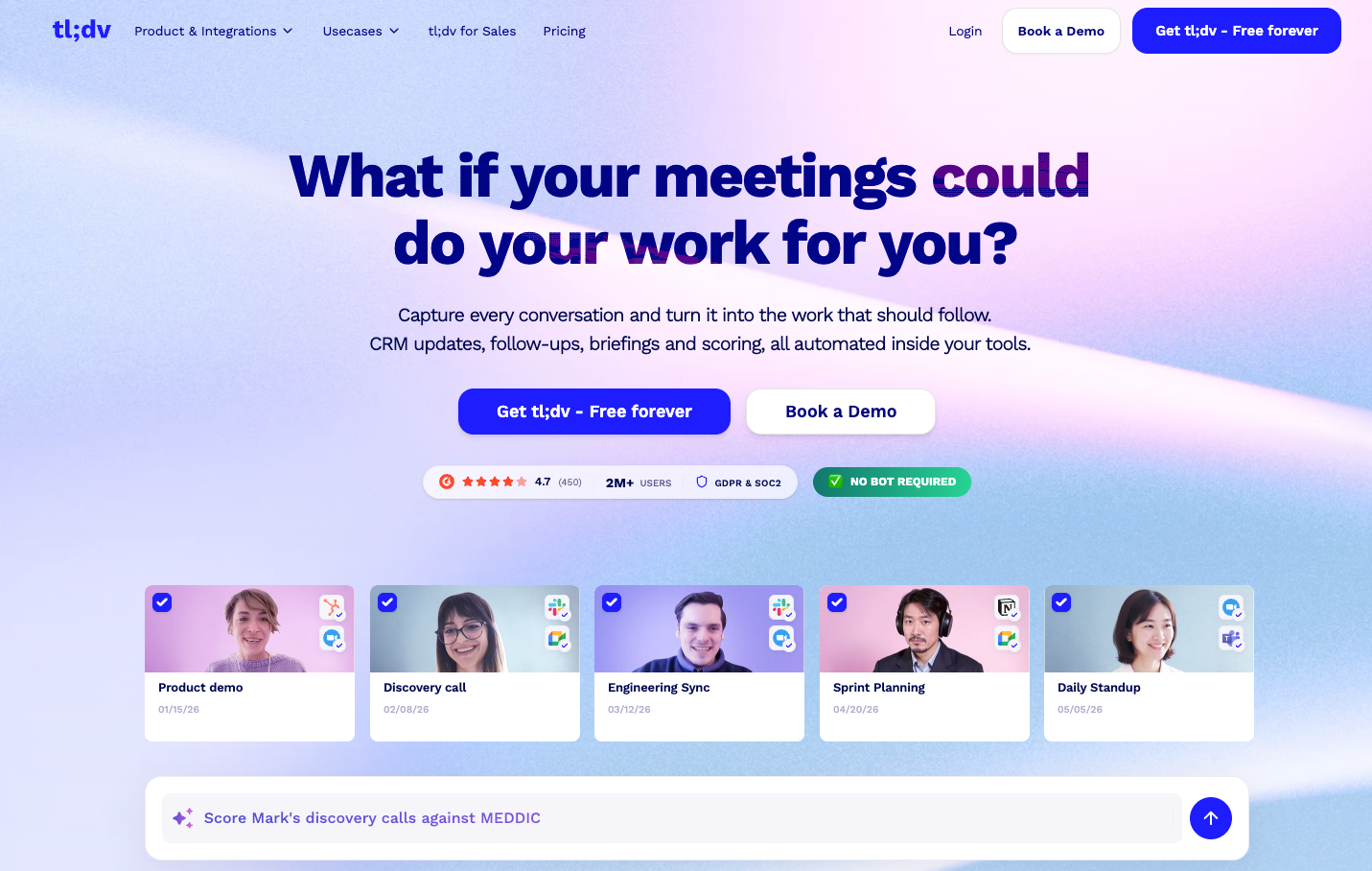
tl;dv is a general-purpose AI meeting assistant that offers many of the basic capabilities teams initially look for in BrightHire: recording conversations, generating transcripts, and creating AI-powered notes. It works across popular video meeting platforms and makes it easy to search, revisit, and share information from previous calls.
Its accessible pricing and free plan make it particularly appealing to individuals and smaller teams that want to automate interview notes without investing in dedicated interview intelligence software. But compared with BrightHire, tl;dv isn't built around recruiting-specific concepts like candidate evaluation, interview rubrics, and ATS scorecards.
It's a good way to capture an interview, but recruiting teams will need other tools to turn that information into a consistent hiring process.
Key capabilities
- Meeting recording: Automatically captures online interviews and other meetings.
- Transcription: Produces searchable transcripts of conversations.
- AI notes and summaries: Extracts important points without requiring manual notes.
- Search and sharing: Makes previous conversations easier to find and distribute.
- Free entry point: Offers an accessible option for teams with relatively simple requirements.
Limitations
- Not purpose-built for recruiting or talent evaluation.
- Lacks the structured scorecards and wider hiring workflows of recruiting-specific platforms.
Best for: Individuals and smaller teams that want an affordable way to record, transcribe, and summarize interviews.
Pricing: Free plan available; Pro plan from €18/user per month; Business plan from €29/user per month.
9. Zoom AI Companion and ZoomMate: basic interview notes inside Zoom.
Core focus: Native AI assistance for Zoom meetings.
Zoom's AI Companion is worth considering if your interviews already happen in Zoom. Its built-in meeting summaries and transcription come with eligible paid Zoom Workplace plans, so teams can get basic interview notes without adding a separate tool. ZoomMate is Zoom's newer agentic product built on Custom AI Companion, and it works across the whole workday rather than only inside meetings.
And it’s more interesting now that BrightHire is owned by Zoom. Both integrate with the Zoom environment, but BrightHire adds the recruiting-specific workflows and intelligence that a general meeting assistant doesn't provide.
ZoomMate is therefore less of a direct BrightHire competitor and more of an alternative for teams questioning whether they need dedicated interview software at all. If you need role-specific notes, structured scorecards, ATS workflows, or intelligence across the recruiting process, a purpose-built platform like Metaview or BrightHire is the stronger fit.
Key capabilities
- Native Zoom experience: AI assistance is built directly into the meeting environment.
- Meeting summaries: Generates an overview of important discussion points.
- Conversation insights: Helps users revisit and understand what happened during meetings.
- Cross-functional use: Works for interviews as well as other Zoom meetings across the organization.
Limitations:
- General-purpose rather than designed specifically for recruiting.
- Doesn't provide the depth of structured candidate evaluation and recruiting workflows offered by dedicated platforms.
Best for: Zoom-first teams with relatively simple interview notetaking requirements.
Pricing: Basic Zoom plans are free; Pro plans from $14.16/user per month (includes unlimited AI notes); Business from $18.33/user per month.
Metaview vs BrightHire: what's the difference?
Metaview and BrightHire overlap most clearly on interview intelligence. Both help recruiting teams capture interviews, generate AI notes and transcripts, and turn conversations into structured data.
The biggest difference is the scope of the two platforms. BrightHire is primarily built around making interviews and screening more effective, while Metaview uses interview intelligence as one part of a much broader AI recruiting platform.
Consider BrightHire if...
You need better interview notes, integrated with Zoom. Its recruiting-specific notes, structured interview tools, scorecards, and interviewer coaching provide much more hiring context than a general-purpose AI meeting assistant, including Zoom’s own AI companion ZoomMate.
Choose Metaview if...
You want to improve the rest of your recruiting process too. Metaview's AI Notetaker automatically creates transcripts and structured notes, while integrations with your ATS help keep scorecards and candidate records up to date.
But interviews are only one part of Metaview. Its AI recruiting agents source candidates, automate outreach, run screening calls, and review inbound applications, and a human makes every progress or reject decision. Metaview also captures context from hiring manager conversations and debriefs and provides reporting across the recruiting process.
That creates a feedback loop that a standalone interview tool can't offer. What your team says about the role, what it learns from candidates, and what hiring managers respond to can become shared context for the rest of the process.
In short: BrightHire helps you get more from interviews. Metaview puts interview intelligence to work across hiring, from sourcing and outreach to closing and reports.
From better interview notes to better hiring.
Interviewers shouldn't have to choose between paying attention to candidates and taking detailed notes. That’s what Brighthire’s all about.
But today, the more interesting question is what happens to all the information you capture once the interview ends.
A standalone AI notetaker can give you a great transcript and summary. A complete AI recruiting platform can take things further, using context from interviews, intake calls, debriefs, applications, and hiring decisions to keep the entire process aligned.
With Metaview, you get automatic interview transcripts, tailored notes, and scorecards, but those capabilities sit alongside AI sourcing, outreach, screening, application review, hiring manager alignment, and reporting. Recruiters don't just save time taking notes; the whole hiring process gets more context to work with.
Try Metaview for free and see what happens when your interview intelligence becomes part of a connected recruiting process.
Bring Metaview into your hiring stack.
Live notes, structured scorecards, and ATS sync - set up in under 10 minutes.
FAQs about BrightHire alternatives.
What are the best BrightHire alternatives?
The best BrightHire alternatives include Metaview, Employ AI Interview Companion, Screenloop, Honeit, HireVue, Fireflies.ai, Otter.ai, tl;dv, and Zoom AI Companion. The right choice depends on whether you want dedicated recruiting intelligence, broader hiring automation, or simply an AI tool to record and summarize interviews.
Metaview is the most comprehensive alternative on this list for teams that want to go beyond interview intelligence. Alongside automatic interview transcripts, notes, and scorecards, it provides AI sourcing, outreach, screening, application review, hiring manager alignment, and recruiting analytics.
Did Zoom acquire BrightHire?
Yes. Zoom announced its acquisition of BrightHire in November 2025, and the transaction closed in December 2025.
The acquisition brings BrightHire closer to the Zoom ecosystem and enables deeper integration between interview intelligence and the Zoom platform. BrightHire has continued to support other meeting platforms, however, so it isn't exclusively a Zoom interview tool.
Does BrightHire only work with Zoom?
No. BrightHire is owned by Zoom, but it continues to offer cross-platform support.
For companies that conduct most interviews on Zoom, the relationship between the two products can be a significant advantage. Teams that interview across a mix of Zoom, Google Meet, Microsoft Teams, and other platforms should compare how well each BrightHire alternative fits their existing meeting and recruiting stack.
Are there free alternatives to BrightHire?
Yes, depending on what you need. General-purpose meeting assistants such as tl;dv offer free plans that can cover basic recording, transcription, and AI summarization, although they don't provide the same recruiting-specific workflows as dedicated interview intelligence platforms.
Metaview is a better fit if you want recruiting-specific AI rather than simply a free meeting recorder. You can try Metaview for free to capture interviews automatically and see how its notes and intelligence connect with the rest of your recruiting workflow.
