

When an interviewer writes "coachable" on a scorecard, the next person to read it gets the conclusion and none of the exchange behind it. A Head of Talent can’t tell from the word which behavior the interviewer watched, or whether the candidate was ever given feedback to respond to.
Metaview’s aggregate analysis of interview records contains no coachability measure, and nothing in it defines the word. The scorecards it does cover mostly end in a firm verdict, and a firm verdict makes the record look settled enough that nobody asks what the trait label was based on.
Coachability enters the decision without a definition
Several behaviors can sit behind the same word. One interviewer may care about whether a candidate takes redirection. Another may look for an answer that changes after feedback. An interviewer could also be reacting to whether the candidate seemed personable or eager. Those judgments aren’t the same, and nothing in the record ties them to one definition.
A label can therefore make scorecards look more consistent than the underlying judgments are. Two interviewers can both write "coachable" after paying attention to completely different behavior. The shared word doesn’t supply a shared test or show what happened in the room.
TA teams need an observable example when a trait affects the decision. A scorecard entry containing only the label doesn’t give the next reviewer a candidate response to inspect. The record can support a hiring discussion once it includes the feedback moment and what happened next.
About the data
Metaview has captured around 5.2 million candidate interviews (5,207,185 at the time of the data pull). When the scorecard is AI-generated, submission jumps to 50.3%, roughly a 60% lift over the natural state, where only 31.2% of interviews get a scorecard at all.
Those two rates use different denominators. The 31.2% is a share of all candidate interviews, and the 50.3% is the share of AI-generated scorecards that get submitted, so the lift is an approximate comparison.
The recommendation figure in the next section uses a third population: roughly 1.1 million submitted scorecards. Interviews that never produced a submitted scorecard sit outside it.
The analysis has no field for coachability, and no query in it tests for the trait. It also holds no post-hire outcomes, so it can’t say whether candidates described as coachable perform any better once they are in the job.
Decisive verdicts still leave the trait unmeasured
Most interviewers who submit a scorecard land on a positive verdict: 62.2% of submitted scorecards end in yes or strong yes. A verdict that firm reads as though the interviewer knew exactly what they were looking for.
The convenient reading is that this confidence reflects perception. If interviewers commit to a positive verdict this readily, the argument goes, they must be seeing something real in the candidate.
The recommendation field records where the interviewer landed and holds nothing about how they got there, so a strong yes built on a tested feedback exchange looks identical to one built on a good first impression.
The same gap shows up at the level of a single trait. A scorecard that calls a candidate adaptable, with no feedback moment or changed answer written beside it, hands the next reader a conclusion to accept or reject and no exchange to check it against.
Test the behavior deliberately
Start by defining the behavior that matters for the role. A useful definition can cover whether the candidate takes redirection and incorporates feedback given in the room. The response to that redirection is the first observable response. Probing follow-up questions can examine what happens next. An updated answer after a challenge gives the interviewer another observable response to document.
Then create a moment that makes the behavior observable. One question in the set you already ask can carry a feedback step. During an exercise, the interviewer can offer a correction or redirection and give the candidate room to respond.
The scorecard should capture what happened. Record the feedback and the candidate’s response. Add whether the answer changed after the challenge. The interviewer can rate that documented behavior and include the example that supports the rating.
Keeping the bare word "coachable" off the scorecard focuses the entry on an exchange another reviewer can inspect. The interviewer retains responsibility for the rating and the hiring decision.
Compare that with an entry that records the trait word "coachable" with no supporting exchange. That entry doesn’t give the hiring team an example to review. Identifying the feedback and the candidate’s response gives the team a specific event to discuss when interviewers disagree about the rating.
Make the interview record checkable
What follows keeps the exchange behind a rating available for a second reader to check, which is the part a scorecard adjective throws away.
The Notetaker preserves the exchange
Metaview’s Notetaker joins the interview as a visible participant and, if consent is given, records the conversation, transcribes it, and produces structured notes. A recruiter or hiring manager can go back to the exchange where feedback was given and check what the candidate actually did next. Recruiters and hiring managers still make the rating and the decision.
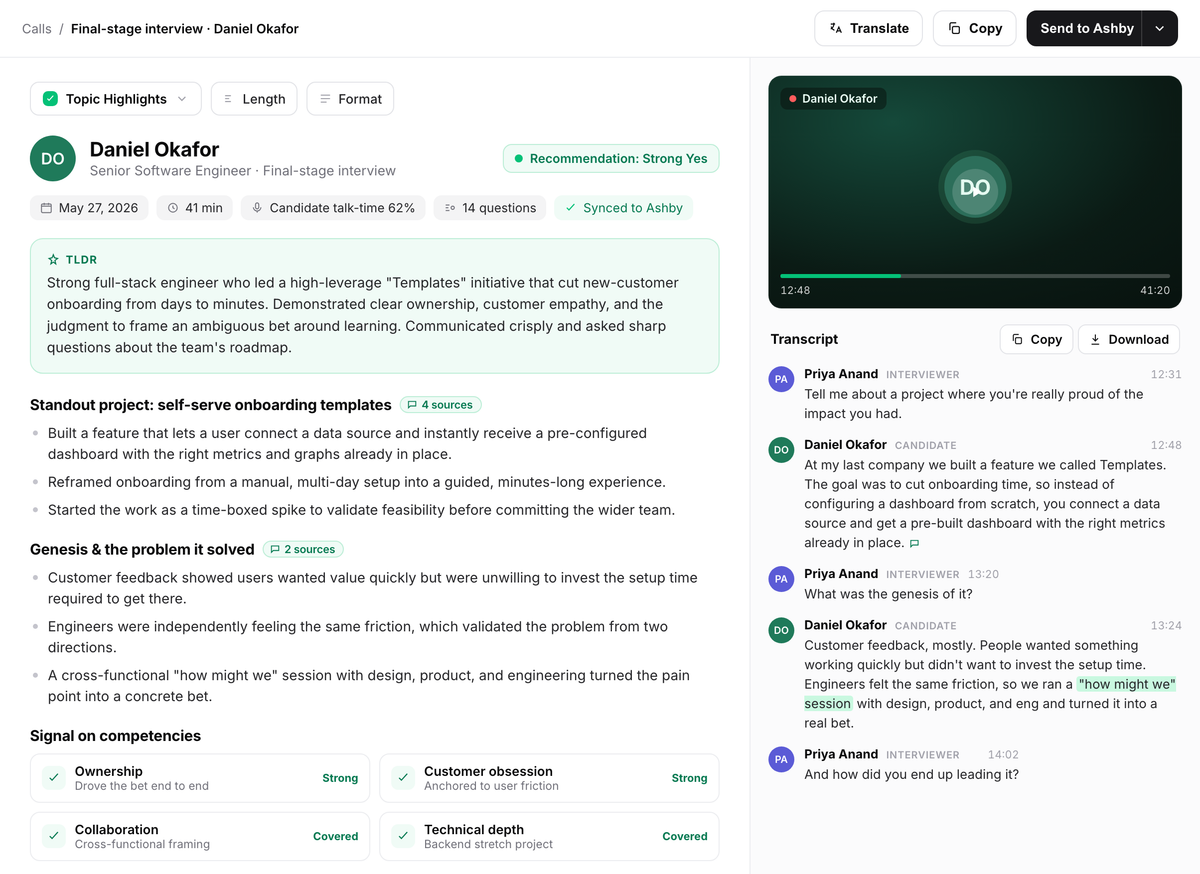
- 1Some section headings show source counts that a reader can use to trace the section back to the interview.
- 2The transcript keeps the question and the answer that followed it, with timestamps.
- 3Each competency tile shows an adjective rating with an evidence line underneath.
The notes keep the source attached
Notes built from an interview, a resume, and a job description keep each section tagged with the source it came from. A second reader can trace a claim back to the conversation or document that supports it instead of taking the summary on trust.
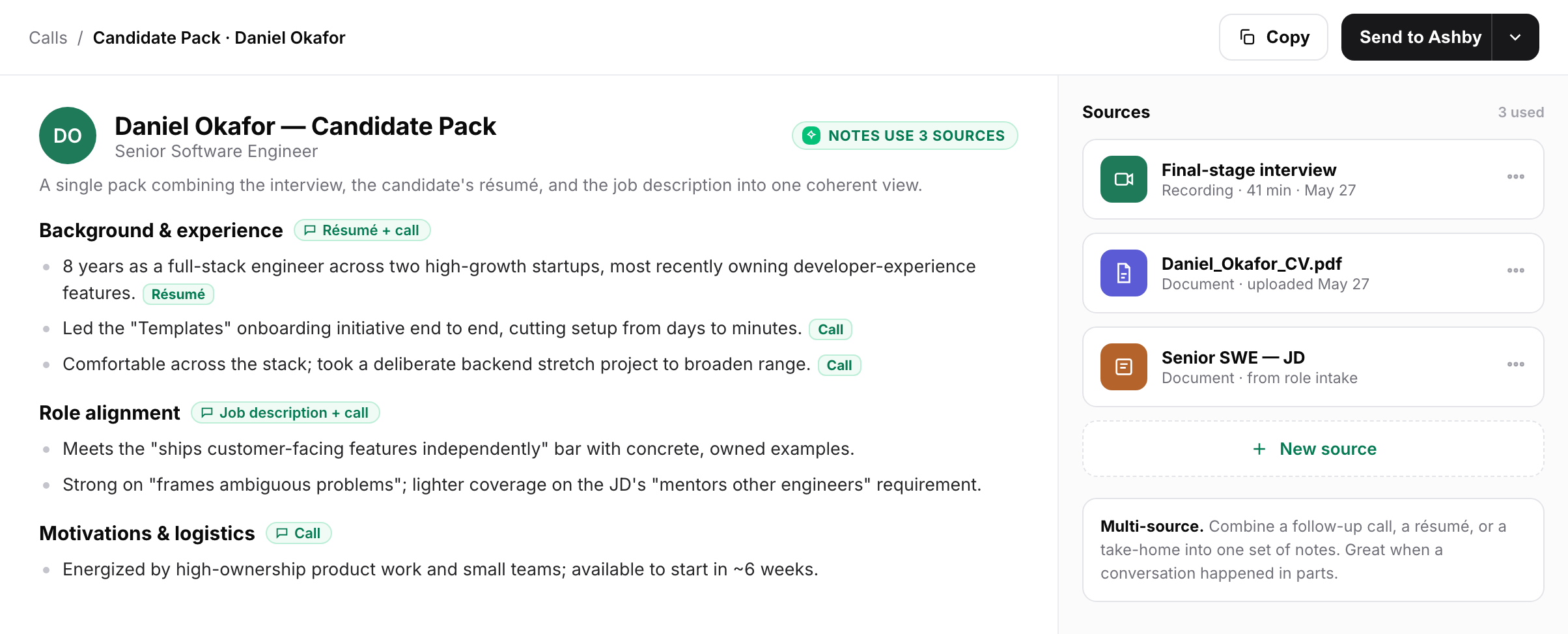
- 1Each section of notes is tagged with the source it came from.
- 2Claims stay attached to the material that supports them.
- 3The sources panel lists every document and recording the notes drew on.
Reports let you audit a sample
Metaview Reports lets a team query its own interview data in the product or through the Metaview MCP. A TA operations team can use those queries to examine how often trait words appear with no example attached.
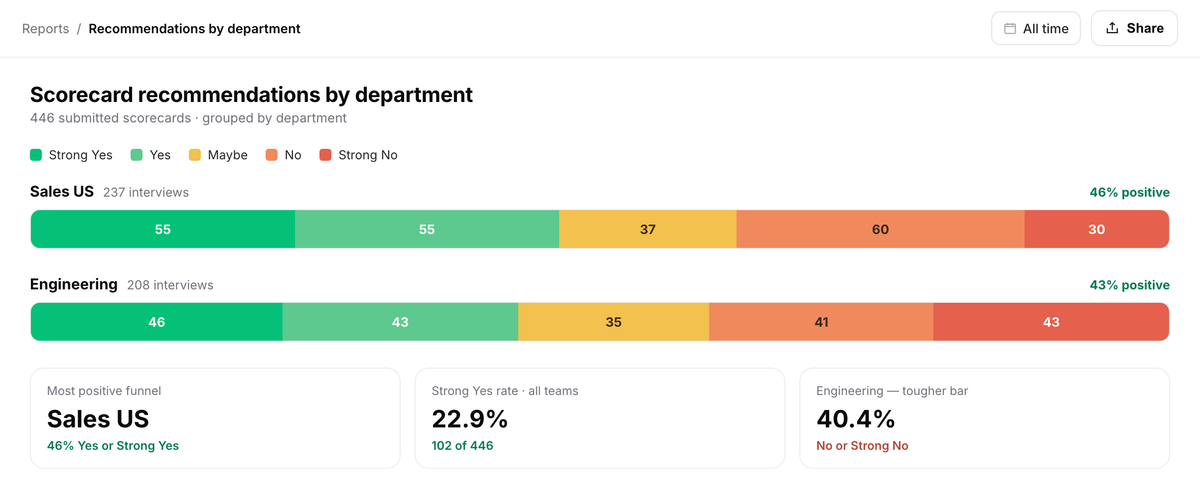
- 1The report names how many submitted scorecards it is built from.
- 2Recommendations are grouped so one team can be compared with another.
- 3The Strong Yes rate tile shows its count underneath.
Metaview Assistant answers natural-language questions about the team’s own interviews and recalls exact details from them, so a reviewer can ask where in an interview the candidate was given feedback. The reviewer can then check the transcript for that exchange and compare the documented behavior with the scorecard entry.
These capabilities make the process easier to inspect. They don’t measure coachability or predict any post-hire outcome. The team defines the behavior and the interviewer creates the moment. The hiring group decides how to use the evidence.
Document the behavior you choose to assess
Coachability stays vague when the scorecard carries an adjective without the exchange behind it. A team can define the behavior and add a deliberate feedback step this week, then write down what the candidate did with that feedback inside the interviews it already runs.
Review the moment your team defined.
Captured conversations, structured notes, and reporting across your loops, with the rating and the decision left to your interviewers.
Frequently asked questions
Can Metaview measure coachability?
Metaview doesn’t ship a coachability measure. What a team can check is whether its ratings are comparable: every interviewer who rates the behavior on a loop should run the same feedback step and cite the exchange, or the ratings describe different things.
Does a confident recommendation mean the interviewer assessed coachability?
Not by itself. Review the recommendation separately from the rating for the documented behavior and the cited feedback exchange. Before the debrief, ask the interviewer to add the exchange if it is missing. Leave that rating open until the evidence is present.
What should a scorecard say instead of "coachable"?
Name the behavior itself as the competency, for example "incorporates feedback given in the room," so the word never has to be interpreted later. Ratings already filed under the old label are best treated as unscored for that behavior, since reinterpreting them after the fact adds a guess on top of a guess.
Do candidates described as coachable perform better after they are hired?
The analysis holds no post-hire outcome data. Answering the question would take linking each documented feedback exchange to later performance evidence for the same hires, such as ramp milestones or manager reviews, collected the same way for candidates rated high and rated low on the behavior.
Sources
- Metaview’s 2026 analysis of its own interview records: total candidate interviews captured; the share of interviews with a scorecard; the submission rate for AI-generated scorecards; the yes and strong yes share of submitted scorecards; and the count of submitted scorecards.
- Metaview product documentation: the Notetaker’s recording, transcription and structured notes; multi-source notes; Reports and the Metaview MCP; and Metaview Assistant.
