
Someone on your team sends you a name. They’ve worked with this person before, and they’re sure you’ll want to meet them.
Does that candidate interview better than everyone else? Will they be better at the job? And if they are, is that the candidate, or the person who vouched for them?
Referred candidates do get hired more often than other applicants. The harder question is why.
We’d love to answer it from our own data. Metaview had captured more than 5.2 million candidate interviews by mid-2026,¹ but the source labels that come over from hiring systems are too inconsistent to pick out referred candidates reliably. So we went to the research.
The short version: referred candidates score only a little higher in interviews. Most of their advantage comes before the interview, when they get noticed, and after they’re hired, when they tend to stay longer.
We’d take every referral seriously, then interview the person like everyone else.
This guide goes stage by stage, from the first look at an application to the first years in the job, and looks at why referrals so often work out.
By the end, you’ll know how much weight to give a referral, where it can steer you wrong, and how to interview a referred candidate fairly.
Do referred candidates score higher in interviews?
A little.
There’s one large study that could see interview scores: a 2013 working paper on a large tech company. Its interviewers weren’t told beforehand which applicants had been referred, and the referred ones still scored slightly higher in their interviews, though not by much.
It’s one company with unstructured interviews, and the result comes from a working-paper version of the study, but it’s the best test we found.
Most of the gap opens before anyone interviews them. At one American financial firm that economists studied, referrals made up a bigger share of candidates at every stage:
| Stage | Share of candidates who were referrals |
|---|---|
| Applied | 6% |
| Got an interview | 21% |
| Got an offer | 27% |
| Were hired | 29% |
A note on the table: employees there could register a referral as late as the recruiter’s first review of the application, which may push up the interview-stage share.
In the tech company study, referred applicants were more than three times as likely to get that first close look from a recruiter.
After the interview, the evidence is mixed. In the financial firm study, referred candidates who were interviewed were about 40% more likely to get an offer than job board applicants. At the tech company, the hiring committee showed no clear edge for referrals, though referred candidates were more likely to accept an offer.
Where a referral does tip the offer, it could be adding something the interview missed, or it could be a thumb on the scale. One study that looked at this found mostly the first, with signs of the second when the referral came from the employer’s own friends or relatives.
One more caveat: most of this research comes from single companies, much of it from hourly work like call centers and trucking, and some of the data is decades old. So treat it as a pattern to check on your own team.
Are referred hires better at the job?
About the same, day to day. The difference is that they stay.
In a study of nine large companies, including that tech company, referred workers were less likely to quit in every industry the researchers looked at, and around 26% less likely at the tech company.
On routine work, they performed about the same as everyone else, perhaps partly because employers had already used the referral when deciding whom to hire.
Where they stood out was on rare, high-stakes moments. In the nine-company study, referred truck drivers had fewer preventable accidents, and at the tech company, referred workers produced about 24% more patents.
In the call centers and the trucking firm, the two settings where the researchers could work out profit, referred workers made the company more money. The gap came from lower turnover and cheaper hiring. Output barely figured.
There’s a catch.
A 2026 study found that coworkers saw referred hires as less deserving of their jobs and helped them less. The doubts held even when the referred employees had performed well.
The study didn’t test fixes. Our suggestion: introduce every new hire by the skills and experience that got them the job, and leave out who referred them.
Is it the candidate, or the referral?
In the cleanest test we found, the candidate.
In an experiment on an online jobs marketplace, a company hired every applicant, referred or not. The referred workers still did better work and stayed longer, even though their referrers didn’t work there. Almost none of what the referral signaled showed up on their resumes.
The referrer still counts, in two ways.
First, strong people make better picks. In the same researchers’ experiments, referrals from the worst-performing 20% of referrers did worse than workers with no referral at all.
Second, a referred hire may do better while the referrer is around. At one bank call center, 73.4% of referred hires were still there a year later when their referrer stayed, against 49.1% when the referrer had left. It’s one small study and it can’t say why, but if a referrer leaves, it’s worth checking in with the person they referred.
Interview them like everyone else.
Give a referral enough weight to get the candidate a careful look, and none in the scorecard. Bring it back at the decision, as one piece of evidence next to the scores.
No study we found has tested whether a shared scorecard removes a referral’s pull, so treat what follows as good practice rather than proof.
Talk to the referrer first.
Before the interview, treat the referral like an early reference check: ask the person who made it what they’ve seen the candidate do. If the referral came to you, have your recruiter run this conversation.
Write the answers down. Then keep them, and the referral itself, away from the rest of the panel until every scorecard is in. Candidates often mention who referred them, so you won’t always keep it secret. What counts is that each interviewer scores what the candidate said.
Use one scorecard for everyone.
Ask every candidate on the role the same questions and score them on one scorecard template, whether they were referred or not.
When Brex needed to hire salespeople at volume, with managers who hadn’t hired at that volume before, its team wanted each area of the role “evaluated thoroughly across the board without any unintentional or unconscious bias creeping in,” said Danielle Harders, Brex’s Director of Global Business Recruiting.
Brex’s case study reports: “Just weeks after implementing the structured rubrics alongside Metaview reporting, Brex saw its onsite-to-offer rate jump from ~30% to nearly 50%.” It calls that “a promising early signal.”
A shared rubric is how a team agrees on what “great” looks like before it meets the candidate.
Ask ten people what makes a “great hire,” and you’ll get ten different answers.”

In this one-minute video, Brex explains how Metaview fits into its hiring.
Get it in writing before the debrief.
Without written notes, a debrief leans on impressions, and the referral is one of them.
The Metaview Notetaker joins your interviews as a visible participant and records and transcribes the conversation only if consent is given. It captures every spoken word, so the scorecard it drafts starts from what the candidate said, and the interviewer makes the call on each rating before submitting it.
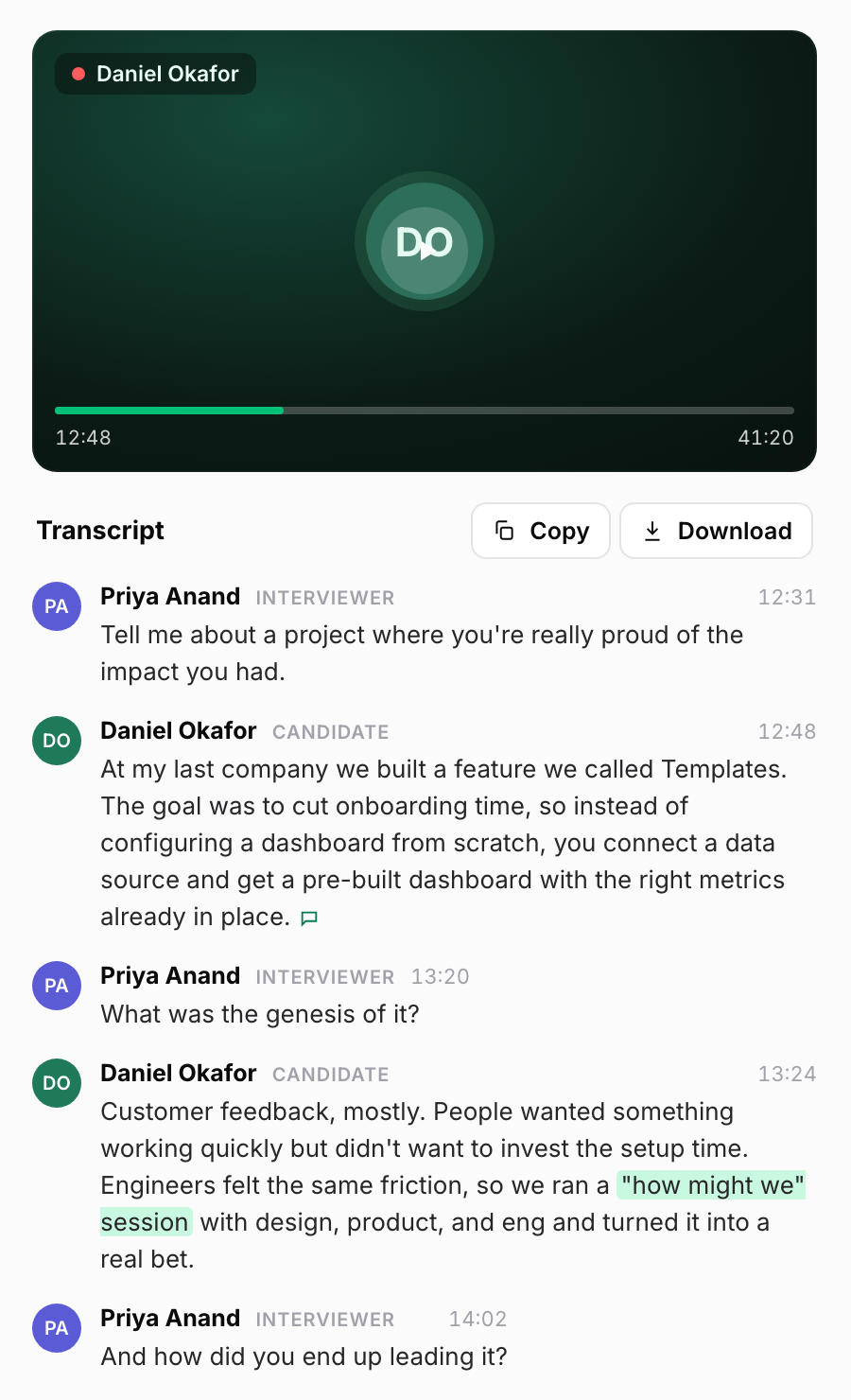
In a capped sample of 120,000 scorecards created in Metaview, the ones that started as a Metaview draft were submitted 50.3% of the time, against 28.6% for ones interviewers wrote from scratch.² The comparison doesn’t prove the draft is the reason, since teams that use drafts may already be more careful with scorecards.
Across the interviews captured on Metaview, only 31% received a scorecard at all.³ Where there’s no scorecard, there’s nothing written to compare a referred candidate against.
Get referrals from the right people.
Ask your strongest people first, and ask about specific people they’ve worked with. “Anyone you know?” is likely to get you whoever comes to mind.
A bonus helps, but bigger isn’t better. In a randomized trial at a European grocery chain, asking for referrals without a bonus produced none at all, and bigger bonuses brought in more referrals but weaker ones.
And watch who your referrals bring in. People tend to refer people like themselves: in a recent Swedish study of business students, 75% of men referred a man and 71% of women referred a woman. That can narrow the pool a diversity sourcing strategy is trying to widen.
If you want a longer list to ask about, Metaview’s AI Sourcing can build one from your own team. Paste in a job description, and Metaview finds relevant past hires in your applicant tracking system and shows people in their professional networks, with the evidence for each possible connection.
You can also name the employees whose networks it should start from. Either way, a possible connection isn’t a recommendation, so ask the employee whether they know the person well enough to vouch for them before anyone reaches out.
How to tell whether referrals pay off on your team.
Most of this is already in your hiring data:
- Where referrals pull ahead: compare pass rates at each stage for referred candidates and everyone else. Note how many people each rate covers, since on a small team one hire can swing it.
- What happens at the offer: if referrals only pull ahead at the final decision, check that the referral is being weighed for what the referrer saw rather than as a favor.
- Interview scores: compare scorecard ratings only where everyone had the same interview and template.
- Who made the referral: see whether referrals from your strongest people do better than the rest.
- Who stays: ask for six-month and twelve-month retention by source of hire.
- Who is in the pool: compare who your referrals bring in with who your other sources do.
If your referred candidates pass more often, score about the same, and stay longer, your referrals are working the way the research says they should. And because every interview ran on one scorecard, your scorecards can tell you whether, among the people you interviewed, referred candidates really interview better.
Score every candidate on what they said.
Book a demo to see how Metaview turns an interview into notes and a draft scorecard.
Frequently asked.
Do referred candidates accept offers more often?
In Burks and colleagues’ study of nine large companies, they did. Referred applicants were more likely to accept an offer in all three industries: by 5.1 percentage points in call centers, 7.3 in trucking, and 2.7 at the tech company.
Do employee referral programs help retention?
They can, even for the people they don’t bring in. In a randomized trial at a European grocery chain, published in the Journal of Political Economy, stores given a referral program saw attrition among their existing workers fall by 19%. The explanation managers and workers chose most often was that people felt respected being involved in hiring, or liked having a say in who they’d work with.
Are referred candidates the same as internal candidates?
No. A referred candidate comes from outside the company, with someone inside vouching for them. An internal candidate already works for you. Whether internal candidates interview better is a separate question, with its own research.
What share of hires come from referrals?
It varies a lot by platform and industry. Greenhouse’s 2026 benchmark report, covering more than 6,000 North American employers on its platform, put referrals at 11.6% of their 2025 hires. SmartRecruiters’ Recruiting Benchmarks 2026, based on its customers’ hiring in 95 countries from September 2023 to August 2024, put the share at 16% in technology and 2% each in retail and hospitality.
Do referrals work as well for senior roles?
The evidence is thinner for senior hires. In Brown, Setren, and Topa’s study of an American financial firm, referral effects looked stronger at lower skill levels.
Sources.
¹ ² ³ Aggregated and anonymized Metaview interview data, described in the note below. Every other figure comes from the study or report named in its sentence.
