

When a rejected candidate reapplies, the hiring team often splits into two confident stories. One side sees someone who returned hungrier and improved. The other sees a candidate who already failed once.
Neither story has been measured. This article draws a clear line between what the data can say and what it can’t say. The checkable input available when a candidate returns is the record from the first interview loop, provided it preserves the earlier gap and the evidence behind it.
Reapplicant performance is still folklore
Hindsight makes it easy to fit a story to a decision that’s already been made. Metaview’s analysis didn’t measure whether the returning candidate had improved or whether the first rejection was correct.
The claim that reapplicants make better hires is a comparative claim. It requires a defined group of returning candidates, an appropriate comparison group, and a post-hire outcome. Those ingredients aren’t available: the analysis doesn’t link applications across time and contains no post-hire outcome data. There’s no basis for saying reapplicants perform better, stay longer, or become stronger hires. The evidence doesn’t support the reverse claim either; the record is silent on that outcome. A negative claim needs evidence too.
Recruiting operations shouldn’t replace one unsupported story with another. The useful move is to narrow the question to something the hiring team can inspect: when this candidate returns, did the first interview loop leave enough evidence to evaluate what changed?
Why 5.2 million interviews still cannot answer the question
Metaview’s analysis includes 5.2 million captured candidate interviews. That’s a large body of interview material, but size doesn’t create variables that were never collected or connected.
The analysis contains no reapplication queries. It doesn’t link a candidate’s applications across time, so it can’t identify a rejected-then-returned cohort. It also contains no post-hire outcome data. There aren’t any quality-of-hire, retention, or performance-review outcomes to compare.
The denominator matters. The unit cited here is the captured candidate interview. A reapplicant cohort would require a different unit, and the analysis never built one. The analysis can’t support or refute the belief that reapplicants outperform.
Interview data can show whether the first loop preserved evidence that lets a team assess a returning candidate consistently.
The first loop is useful only when it leaves a record
A returning candidate gives the team a potential advantage: earlier conversations may already exist in reviewable form. But that’s conditional. If the first loop didn’t produce a scorecard or a documented gap, or if the feedback lacked concrete evidence, the team isn’t meaningfully starting ahead.
In a 120,000-scorecard sample, 28.6% of manual scorecards were submitted versus 50.3% of AI-generated ones. Coverage is a separate measure: across 5,207,185 captured candidate interviews, 1,624,988, or 31.21%, had at least one scorecard. That denominator counts interviews. Measuring candidates with complete histories would require a different denominator that the analysis didn’t create.
The decision data shows a related problem. Among 296,555 advancing candidates, 41.9% had no submitted scorecard, while 11.8% advanced from a multi-interviewer loop with only one scorecard. Together, the figures show how often hiring can advance while the written record remains incomplete. They don’t identify candidate reapplications or show any post-hire result.
The written-feedback distribution was bimodal: the typical entry was long, while about a quarter were effectively empty. In the n=13,382 sample, written feedback had a mean of 412.8 words and a median of 365, yet 26.6% was 5 words or fewer. Among 9,832 nonempty entries from the same sample, 52.3% contained evidence-marker language. That measure detects the language only; it doesn’t assess whether the evidence was sound.
Reapplicant quality would need its own linked measure, beyond what these figures capture. Scorecard presence directly measures record completeness, while word count and evidence-marker language provide proxies for specificity.
What the earlier record can show
Documented evaluations at different stages diverge often enough that the written record isn’t redundant with itself. The direction-agreement comparison draws on 139,336 candidates with both an early-round and a later-round scorecard. The two recommendations agreed on direction 54.4% of the time. The analysis doesn’t test which evaluation was correct or why the recommendations differed.
When a candidate reapplies, the team should review the earlier conversation, the evidence behind the earlier rating, and the gap documented at the time. How the team uses that record is a process judgment.
Compare current evidence with the earlier gap
The first question is whether current evidence speaks to the earlier documented gap. Where evidence runs out, a written rule has to take over. Start by deciding a reapplication window and writing it down. No dataset here supports a universal interval, so the choice is a policy decision. What matters is that it’s written down and applied the same way every time. A returning candidate should enter a defined process rather than trigger an improvised exception.
When a reapplication arrives, pull the prior notes and scorecards before the new screen. Find the gap documented in the first loop. The new review should compare current evidence with that gap, without measuring the person against a fictional fresh-candidate baseline and without relying on a recruiter’s memory of the old process.
Keep the old verdict out of the new loop’s scorecards. The new interviewers should document what they hear in the current conversations, and the second read should stand on its own. The earlier record remains available for the explicit comparison of what changed. The rating and the hiring decision stay with the interviewer and the hiring team.
If the first loop left no usable record, treat that as the process finding. Don’t reconstruct the rationale from memory or turn the prior rejection into evidence. The team can still run its current process, but there isn’t an earlier documented gap to compare with the current evidence.
What Metaview can do here and what it cannot
Metaview’s candidate-facing copy says: "Being recorded is not required, and your choice will have no bearing on your interview outcome. If both you and the interviewer consent, you will see a ‘Metaview Notetaker’ appear as a participant during the interview." Consent remains a precondition the buyer must obtain under its policy and local law. Metaview does not obtain or guarantee that consent.
For captured interviews, Metaview captures every spoken word and produces a transcript and structured notes. That complete verbatim record lets a later reviewer find the gap the first loop documented instead of relying on someone’s memory of it. Multi-source notes can synthesize several attached conversations and documents, including a resume, job description, and ATS files, into one notes document. The synthesis reflects the conversations and documents attached to it; the rest of the hiring process remains outside its scope.
Use Metaview Reports in the product or through the Metaview MCP to query the organization’s own interview data. Filter hiring conversations by:
- Department
- Interview stage
- Hiring manager
- Location
Download a CSV from the Actions tab. Reports shows what happened inside the recruiting process, but it doesn’t contain a post-hire outcome dimension.
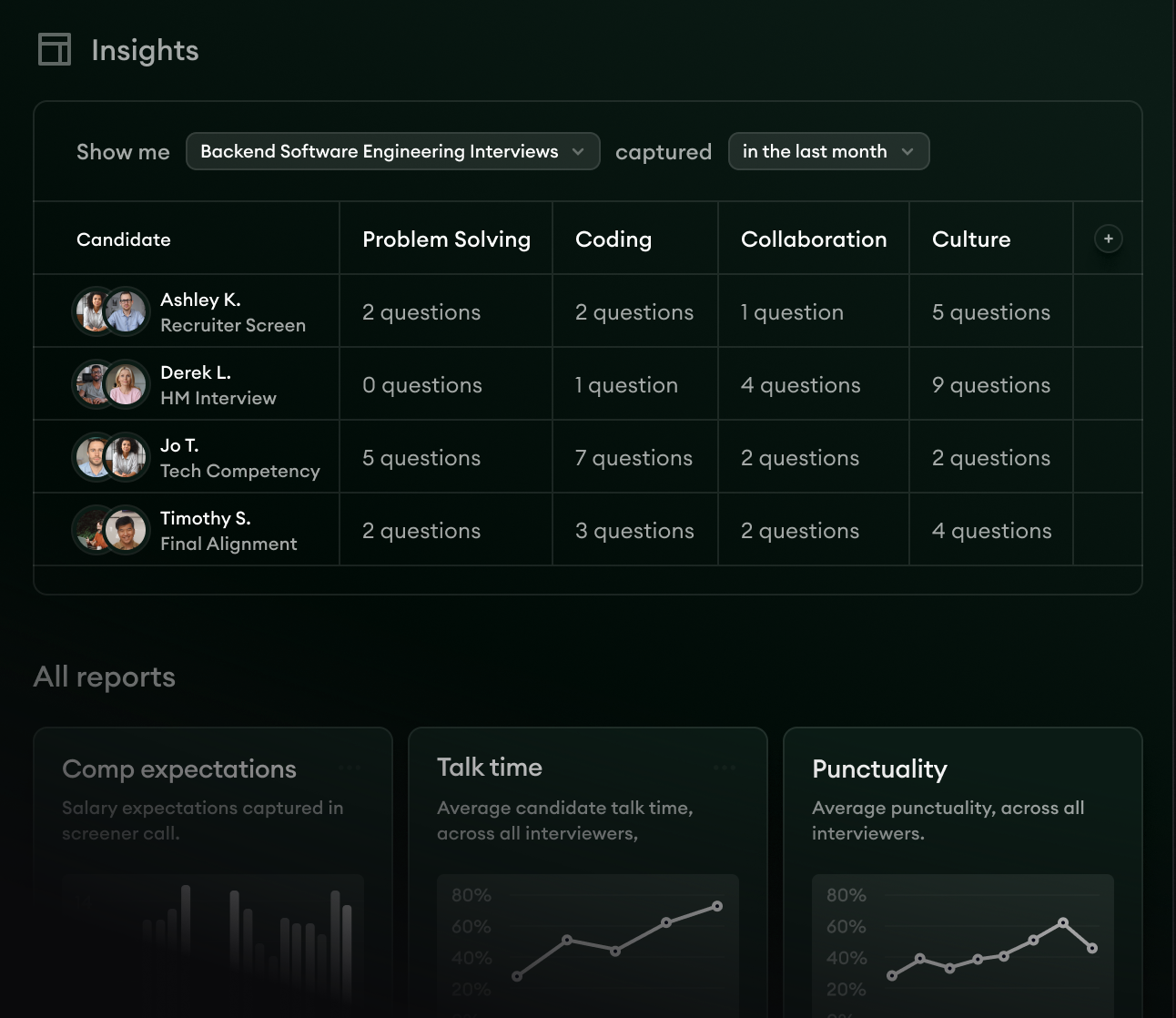
- 1The query bar defines the interview set: Backend Software Engineering interviews captured in the last month.
- 2Question counts for each competency show where a candidate’s interview record is thin.
- 3The saved reports listed below are Comp expectations, Talk time, and Punctuality.
These features make prior material retrievable. They don’t measure reapplicant performance. Interviewers provide ratings, and people make hiring decisions.
Audit the record in your own pipeline
The reapplicant performance question hasn’t been measured, but the condition of your interview record is available for inspection now.
Scorecard-submission visibility, including the Scorecard Submission Time filter and column, requires a connected ATS integration that supports scorecards. For the audit, admins should open the Missing Scorecards default report, which shows all job interviews from the past week where a scorecard has not been submitted. A scorecard appears as unsubmitted only when it hasn’t been submitted anywhere; submissions made outside Metaview still count.
With submission checked, read the written feedback for a concrete example or quote. Ask whether the record names the gap clearly enough for a later reviewer to see how the current evidence differs from what the first loop documented.
This audit doesn’t make any claim about what happens after a candidate is hired. It shows whether scorecards were submitted and whether written feedback includes an example or quote. The hiring team must still judge whether that material is sufficient for the current review. If the team’s own review finds a record missing, too thin, or too unspecific to support the decision, that is a recruiting-operations problem the team can address.
This analysis can’t answer the cohort question of whether reapplicants make better hires, regardless of how complete the interview record is. A usable first-loop record can still support the case-level judgment a team makes when a candidate returns. The team controls whether the first interview leaves a concrete concern that a later reviewer can compare with the new evidence.
Make earlier interviews usable when candidates return.
Recorded conversations, structured notes, multi-source notes, and Reports, with the rating and the decision left to your interviewers.
Frequently asked questions
Does a shorter gap between applications mean the candidate is more likely to have improved?
Nothing in this analysis shows that a shorter gap predicts improvement or a better hire. A team can set different reapplication windows by role, but the interval remains a policy choice unless the company measures its own linked outcomes.
How should we tell a candidate what changed the team’s mind?
Explain which current criteria the candidate met and what evidence changed the decision. Keep other candidates’ information and confidential interviewer notes out of the explanation. If the earlier process left no clear gap, say that the new decision rests on the current loop.
How should we handle a reapplication when the role itself has changed?
Assess the candidate against the current role and its current rubric. Record which earlier gaps still apply and which became irrelevant because the job changed. That keeps a change in the role from being mistaken for a change in the candidate.
What should a team do when a reapplicant has no scorecard from the first loop?
Treat the new loop as the evidence base and apply the current rubric. Record any remaining gap with the supporting interview evidence so the next review has a usable record.
Sources
- Metaview’s 2026 analysis covers 5,207,185 captured candidate interviews, the denominator for the scorecard-coverage measure. The advancing-candidate measure covers 296,555 advancing candidates. The direction-agreement comparison covers 139,336 candidates. The manual versus AI-generated submission comparison uses a 120,000-scorecard sample. The written-feedback measures use a 13,382-entry sample, including 9,832 nonempty entries. Every measure in this bullet comes from the same analysis. The candidate, scorecard, and feedback-entry samples are cuts of activity within the 5,207,185 captured interviews. Candidates, scorecards, and feedback entries are each counted in their own unit.
- Metaview product information describes recording, transcription, structured notes, multi-source notes, and Reports.
