
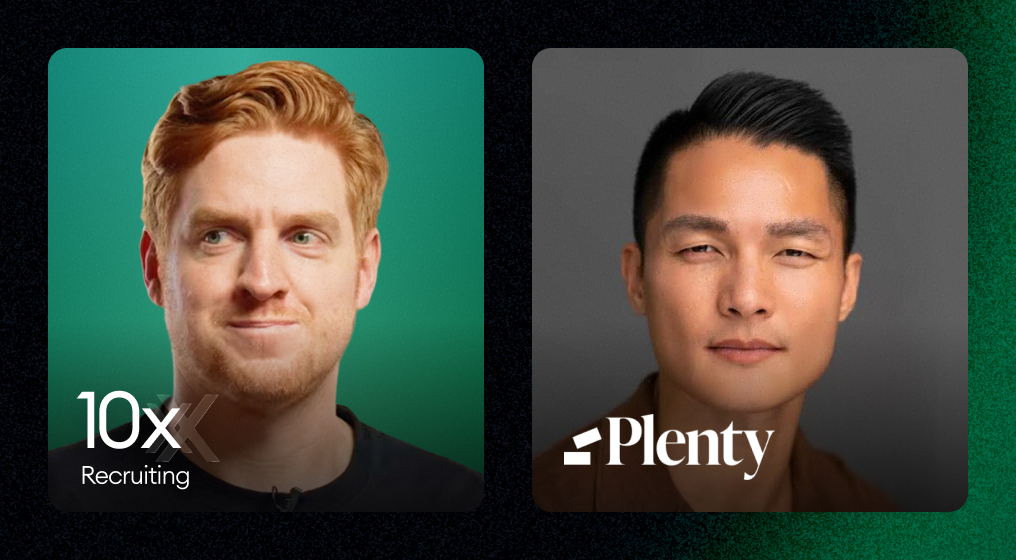
Big tech can outspend and out-brand almost any startup. So how do the best companies actually win on talent? By treating people like a product, not a pipeline metric.
That is the throughline of the 10x Recruiting episode where Thach Nguyen, founder of Plenty Search and former recruiting leader at Google, Airbnb, and Sword Health, sits down with Nolan Church, CEO of Continuum and former CPO at DoorDash. They cover what recruiting can learn from sales, why most recruiter roles are set up to fail, and how to find the undiscovered talent that compounds.
One year on, the argument hits harder. According to Metaview's 2026 AI & Hiring Alignment Report, surveying 505 recruiting leaders and hiring managers across North America and EMEA, only 58% of recruiters and hiring managers say they trust each other. That trust gap is exactly where talent density breaks down. The companies that build a real moat in 2026 will be the ones that fix the partnership, not the ones that buy a new tool.
Treat people like a product
When Thach joined Sword Health, the company had zero customers, zero revenue, and zero U.S. employees. Six years later, Sword was valued at $3 billion. The reason, in Thach's read, was talent.
"Companies with the highest growth and largest revenue aren't necessarily the ones with the best sales teams. Your sales teams are only as good as your product. And for recruiting, your product is your people."
The implication is uncomfortable for anyone running recruiting like a fulfillment desk. Filling roles is not the job. Building an employee experience that great people want to join, and stay in, is the job. Like any product, your talent offering needs to deliver real value. Learning, high-impact work, career-defining challenges. These are the things that get top candidates to say yes when a better-known competitor is also in the room.
I've seen that talent is a huge differentiator. When you see it with your own eyes, it's actually pretty incredible. It's not just this commonly used cliche phrase. It's pretty amazing to see how hiring the right people can change the trajectory of your business right before your eyes.”
Stop throwing recruiters in the deep end
Most companies put new sales hires through weeks of structured onboarding. Bootcamps, product training, call scripts, messaging practice, the works. New recruiters, by contrast, "get a LinkedIn license and an email address and are told to start hiring."
It is a broken setup, and the cost shows up in trust. Per the 2026 report, 90% of recruiters and 89% of hiring managers say a productive partnership matters, but only 58% trust each other. That gap is not an alignment problem you can paper over with another meeting. It is what happens when one side of the partnership has been trained and the other has been handed a tool.
The fix is not complicated. Set up the recruiting team the way you set up sales. Provide a company overview. Train them on the product. Introduce them to your top performers. Walk through who your competitors are and why candidates might choose them instead. Context creates confidence, and confidence creates better hires.
Fix the recruiter role before you fix the funnel
You cannot expect one person to do ten jobs well. Both Nolan and Thach agree it is time to rethink what the recruiter role even is. At a minimum, Thach argues, recruiters should be excellent at two things: building strong relationships with candidates and hiring managers, and understanding the role deeply enough to identify who will succeed. Everything else is a candidate for automation or reassignment.
Scheduling, automate it, sourcing high-volume top-of-funnel. Offload it or block real focus time. Admin chasing? Eliminate it. The role gets sharper when recruiters can spend their hours on the parts that compound.
Recruiters also need permission to tell the truth, even when it slows things down. As Nolan puts it, "We all get into sell mode. We want you to come work here, and we give you a bear hug after your offer. What's more interesting is being truly earnest about the issues within a company. What it's like working with the hiring manager." A recruiter who pushes back on a bad hire is protecting the business. That judgment should be celebrated, not penalized by metrics that incentivize short-term thinking like offer acceptance rate or interview quality proxies that miss the long-term fit.
- Recruiters measured on req close rate and time to fill
- Generic onboarding that skips business context
- Sell-mode pitches that paper over the hard parts of the role
- Pipelines built around prestige logos and polished resumes
- Recruiters measured on quality of hire and 12-month retention
- Structured onboarding with product, P&L, and competitive context
- Honest, candid pitches that let candidates self-select
- Pipelines built around grit, adaptability, and undiscovered talent
Find the undiscovered people
Startups should not try to win the same resumes as OpenAI or Stripe. They will lose on brand and comp every time. The advantage, Thach argues, comes from finding people before they are obvious. He points to Airbnb, where several leaders who scaled the company to IPO had never worked in tech. At Plenty, his right-hand operator had previously been an HR generalist at a manufacturing company. "She had this spirit. She wanted it so bad. She was so smart and had all the ingredients. She just hadn't had her big break yet."
Three moves make this real in practice. Use contract-to-hire to evaluate nontraditional candidates without betting a full-time req on them. Prioritize grit and adaptability over polished resumes. Watch for raw problem-solving ability and curiosity in the work samples, not just the interview answers. Rigid role requirements are the single biggest blocker to density. If you only hire people with tier-one logos, you are competing in the most crowded talent market on earth, and you are letting other teams find your future leaders first.
These hires also tend to bring more loyalty. They stay longer. They need less managing. They are in it to prove something, and that energy compounds across a team faster than any single star hire.
Great recruiters think like operators
The best TA leaders understand the business. Not just headcount. Not just hiring goals. The actual mechanics of how the company runs. "Most Chief People Officers I talk to can't read a financial statement," Thach says. "And that scares me."
Nolan offers concrete moves for any recruiter who wants to level up. Sit with your finance team and ask them to walk you through the P&L. Shadow customer success, ops, or product. Understand what those teams do and how they think. Learn how the business makes money and how your hires actually impact it. At DoorDash, Nolan spent time dashing, working customer service tickets, and joining live sales calls. "It wasn't a gimmick. It was how I learned what the business actually needed." Those insights made him a better recruiter, a better manager, and a better strategic partner to the executive team.
This kind of business literacy is what separates a recruiter who fills roles from a TA leader who shapes the company. If you want to be taken seriously, start by taking the business seriously. It also changes how you sell the role to candidates. You can talk about strategy, P&L, and the actual stakes, instead of the vague mission language every other founder is already using.
So many founders say the same things. The opportunity to 'build something,' to be a part of a 'bigger mission.' These are descriptive of all your talent competitors and are not unique at all.”
Where AI gives recruiting teams use

Surface the undiscovered candidates Thach is describing. The system reads your highest-performing hires and finds more like them in places your recruiters never had time to search.

Triage inbound applications against an ICP that includes grit and adaptability signals, not just keyword matches. Application Review protects the recruiter's time for the relationships that actually compound.

Capture intake kickoffs and interviews verbatim, so the recruiter and the hiring manager are working from the same source of truth. Notetaker kills the drift that erodes trust.

Tie hires to retention, performance, and business outcomes. Reports gives TA leaders the operator-grade view of quality, not just speed.
The point of these surfaces is not "more output." It is more time on the parts of recruiting that build density: relationships, intake clarity, candid feedback, and the long tail of nontraditional candidates who are easy to miss in a 200-applicant inbox. AI as a co-worker, not a co-pilot.
The same report data backs the use case. The numbers point to where AI is mattering inside the recruiter-HM partnership, not just at the top of funnel.
The math is simple. The teams that close the trust gap, and use AI to spend more time on the work only humans can do, hit their hiring goals at a meaningfully higher rate than the teams that do not.
The operating shift
The Thach and Nolan conversation is one year old. The thesis is older than that. What changed in 2026 is that the partnership the thesis depends on, between recruiters and hiring managers, is now measurable, and the gap is wide. Closing it is not a cultural exercise. It is an operating shift.
One: redefine what the recruiter does. Strip the role down to relationships and role understanding. Automate or offload the rest. Treat the job description like a product spec, not a tradition.
Two: rebuild the partnership at intake. Capture every kickoff verbatim with Notetaker, so the recruiter and the hiring manager are aligned on the same words, not their memories of the meeting. Most accurate sourcing coworker work starts here.
Three: hire for density, not for headcount. Tie recruiter metrics to retention and 12-month performance. Make space for the contract-to-hire bets on undiscovered candidates. Reward the recruiter who says no to the wrong hire.
Four: train recruiters like operators. P&L literacy, product fluency, and competitive context are the difference between a TA team that fills roles and a TA team that runs the function. Customers building this way show up on the Wall of Love for a reason.
Bring Metaview into your hiring stack.
Live notes, structured scorecards, and ATS sync - set up in under 10 minutes.
Frequently asked questions
What is talent density and why does it matter in 2026?
Talent density is the share of high-performing people on a team relative to the total. It matters because great hires compound. Per Metaview's 2026 AI & Hiring Alignment Report, teams with strong recruiter and hiring manager alignment are three times more likely to hit their hiring goals. Building density is the most durable competitive moat a company can build, especially when bigger competitors can outspend on comp and brand.
How can smaller teams compete for talent against big tech?
By finding people before they are obvious. Use contract-to-hire to evaluate nontraditional candidates, prioritize grit and adaptability over polished resumes, and watch for raw problem-solving ability. Thach Nguyen credits this approach for the leaders who scaled Airbnb to IPO, several of whom had never worked in tech before.
What are the two things every recruiter should be excellent at?
Building strong relationships with candidates and hiring managers, and understanding each role deeply enough to know who will succeed in it. Everything else, including scheduling, admin, and high-volume top-of-funnel sourcing, should be automated or offloaded so recruiters can spend time on the work that compounds.
How should recruiters be onboarded?
The same way sales teams are. Provide a company overview, train on the product, introduce them to top performers, and walk through the competitive set and why candidates might choose competitors instead. Most companies hand new recruiters a LinkedIn license and an email address. That is why trust between recruiters and hiring managers sits at 58%.
Where does AI fit into building talent density?
AI co-workers free recruiters to spend more time on relationships and role intake, which is where density is built. Metaview surfaces this across Sourcing (find more candidates like your best hires), Application Review (triage against an ICP), Notes (capture intake and interviews verbatim), and Reports (tie hires to retention and business outcomes). Teams using AI in the partnership report better hiring outcomes 79% of the time.
