
Most hiring managers think they're great at interviewing because they assess people in everyday life. They aren't. Great interviewing is trained, not instinctual, and the companies that win at it treat it like a performance lever, not a soft skill. Jordan Mazer has spent his career building that muscle at scale.
Jordan Mazer (Head of Talent at speedrun, Andreessen Horowitz's early-stage gaming accelerator, formerly Amazon and Riot Games) joined Nolan Church on 10x Recruiting (more episodes on the 10x Recruiting hub) for the first episode of the show, laying out a practical blueprint for building a world-class interviewing culture from the top down. The conversation covers why Amazon-style hiring discipline matters, why most companies don't include interviewing as part of performance reviews, why interviewers should not be assessing overall candidate fit, and how recruiters build credibility with hiring managers by delivering value.
This recap walks through the structural moves great interviewing cultures make: how leadership reinforces the bar, why role clarity matters more than candidate gut feel, when hiring committees and work trials add signal, and the cost-versus-investment mindset that separates the teams that hire well from the ones that just hire fast.
Why great interviewing is overlooked.
Most companies do not prioritize interview quality because they operate from a false assumption: good judgment is natural, people assess each other every day, therefore interviewing is just an extension of an existing skill. Interviewing well is not instinctual. It is a trained skill that takes structure, role clarity, and practice.
Interviewing is not a naturally occurring capability. Most people want to believe their ability to assess others is high quality because it's relevant in every part of their life. They want to believe they have a good read on people. But when they get into an interview context, it's not natural to do a good job without training, thought, and practice.”
The second reason interviewing gets neglected is that building a rigorous interviewing culture is expensive. Vetting interviewers, reviewing scorecards, aligning on standards, holding people accountable when the bar is missed: few companies are willing to invest the time. The cost only becomes visible after a bad hire ships, and by then the damage is already compounding.
Jordan's framing for new hiring managers and founders: most people have to "touch the stove" themselves to internalize the consequences. The pressure to move fast outweighs the desire to hire right, until the team has lived through one low performer (missed deadlines, cultural drag, team churn, eventual exit). That is the moment the lens shifts.
World-class interviewing needs to come from the top.
The pattern Jordan saw at Amazon was institutional. Hiring was not just important; it was a measured performance dimension. Three structural pieces made it stick:
Interview feedback was reviewed by external "bar raisers" (interviewers from outside the hiring team whose only job was to enforce the consistent bar). Their reviews carried weight in the final hire decision.
Employees were expected to participate in hiring and do it well. Refusing to interview, or interviewing badly, was a career-limiting move. Interview participation was tracked.
Poor interviewing could stall a career or end it. Real consequences for failing to hold the bar, not just polite feedback in a year-end review.
This worked because Amazon's leadership reinforced the message top-down. Hiring was part of company values, not in theory but in measurable outcomes. Without executive support, every interviewing process improvement collapses within 18 months.
Jordan contrasted that with companies where interviewing is technically encouraged but actually penalized. At one previous org, employees who tried to improve the hiring process often found themselves dinged for prioritizing it over immediate deliverables. The implicit message becomes "don't slow down to hire well," and the culture follows.
The cost-versus-investment mindset.
Most interview culture failures trace back to a single framing problem: leadership treats hiring as a cost to minimize rather than an investment to optimize. The teams that hire badly are not lazy; they are operating from the wrong mental model.
The cost mindset rushes interviews, under-resources prep, treats scorecards as box-checks, and rewards speed-to-hire as the headline metric. The investment mindset budgets prep time, treats scorecards as decision documents, and measures whether the hires made are still performing 12 months in.
Once you've managed any number of low performers, you come to realize the challenges presented by having the wrong person are far worse than having no person at all.”
Nolan shared the DoorDash version of the same lesson. Engineering managers there initially resisted spending more time interviewing. Instead of forcing the issue, Nolan asked them to help source candidates themselves. Experiencing the inbound silence firsthand built the empathy that no recruiter PowerPoint could have produced. The managers came back, committed real time to the interview process, and the hiring flywheel started turning.
Interviewers are not assessing candidate fit.
Jordan's most counterintuitive take, and arguably his most important: individual interviewers are not there to assess overall candidate fit. They are there to evaluate one specific competency, cleanly.
When interviewers go off-script (chasing red flags outside their assigned area, trying to assess the candidate holistically, sharing opinions on things they were not asked to evaluate) they introduce noise. Worse, they often skip the signal they were supposed to gather in the first place. The hiring manager then has to synthesize a mess of overlapping and contradictory inputs instead of clean per-competency signal.
The hiring manager is the only person with enough context to make the final call. Interviewers should stick to their module, deliver crisp signal, and trust the rest of the panel to do the same. Hiring committees can work, but only when they synthesize signal rather than re-interviewing the candidate from scratch.
The cultural fix is subtle: interviewers have to trust their colleagues to do their jobs. The "I'll evaluate everything just in case nobody else does" instinct is what poisons most interview loops. See Good Interviewer/Bad Interviewer for the practical version of this.
What the best interview cultures do differently.
Across companies that get this right, six components show up consistently:
Leadership buy-in. Recruiters cannot install interview discipline alone. Executive sponsorship is the prerequisite for everything else.
Performance accountability. Interview quality tied to promotions, performance reviews, and career outcomes. Without consequences, the bar drifts down.
Clear role definition. Each interviewer knows exactly what they are evaluating and what they are not. Non-overlapping signal is the goal.
Real consequences. Consistently poor interviewers come off panels. If hiring matters, the consequence has to be visible.
Enough time. Budget for prep, structured feedback, and talent calibration. Rushed interviews produce noise.
Smart structure. Work trials and project-based assessments add signal, especially at early-stage companies. Just weigh the candidate-experience and competitive cost as you scale.
Where AI gives recruiting teams use.
The Jordan playbook depends on real signal at every interview stage. AI is the layer that makes consistent signal capture possible across many interviewers and many searches simultaneously.
Metaview Notetaker captures every interview verbatim so scorecards get filled with real evidence, not three-day-old recall. Application Review handles the inbound volume so senior recruiter hours go to the candidates who need real conversation. Reports tracks whether the hires you made are still performing 12 to 18 months in, closing the investment-versus-cost loop. For the AI-augmented-recruiter angle on this shift, see Claude for recruiters.
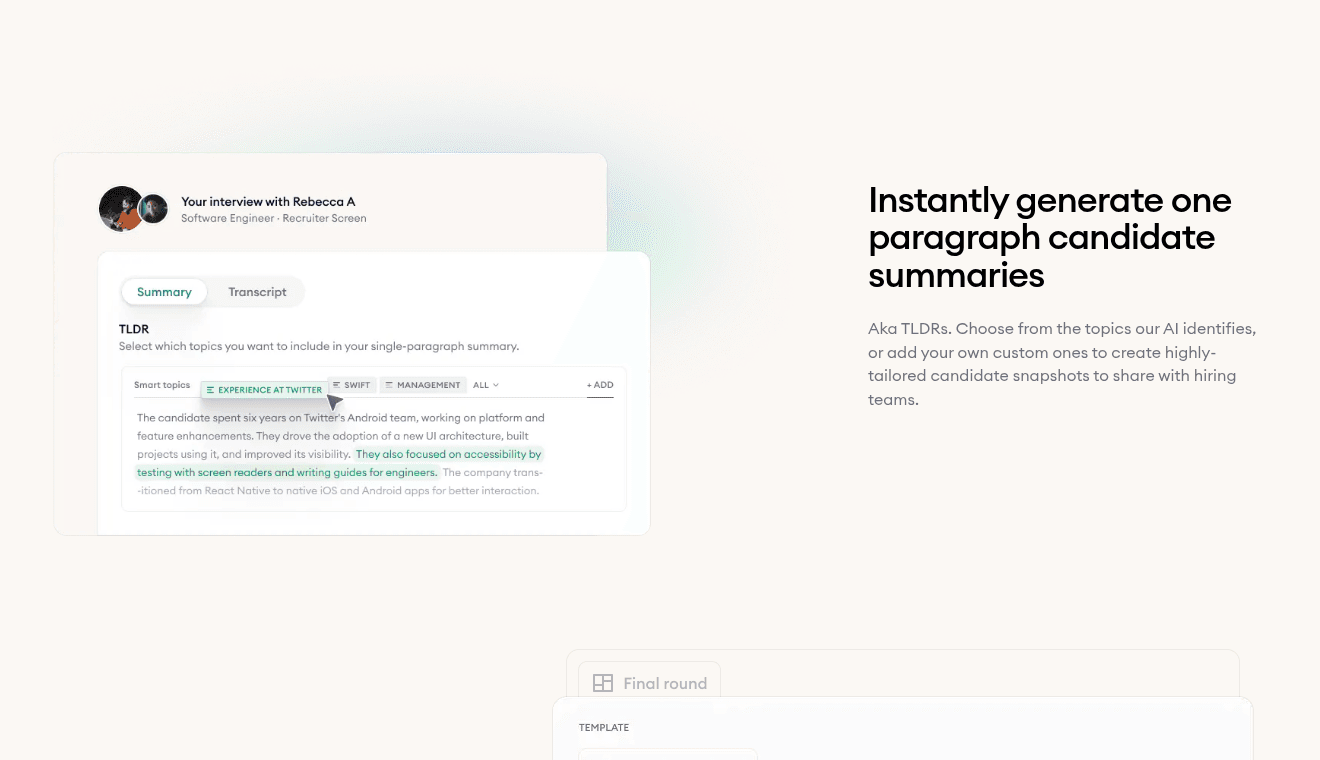
Numbers from the 2026 AI & Hiring Alignment Report, based on surveying 505 recruiting leaders and hiring managers across North America and EMEA. The 49% misalignment stat maps to Jordan's thesis: when interviewers are not aligned on what they're evaluating before the search begins, the signal they gather becomes noise - and the hire quality suffers all the way to the offer.
Tip: Before scheduling the first interview, write down the one competency each panel member is responsible for evaluating. If two interviewers can't describe their module without overlapping, fix that first. The "I'll assess everything just in case" instinct is what poisons most interview loops - Jordan's observation, and the data bears it out.
The operating shift.
Three concrete moves from Jordan's playbook for any TA leader building an interviewing culture from scratch:
One: get the CEO commitment in writing before you change anything else. Without executive sponsorship, every interview improvement gets reversed the first time a deadline slips. With it, the bar holds even under pressure.
Two: rewrite the interviewer role. One interviewer evaluates one competency, cleanly. Stop chasing red flags outside the assigned area. Trust the panel to do the same. Synthesis happens at the hiring-manager level, not in every interview slot.
Three: tie interview participation to performance reviews. Track it, measure it, promote on it. Until the consequences are real and visible, the team will keep treating interviews as the work that gets skipped when the calendar fills up.
The companies that internalize these three moves will hire better than the ones still relying on gut feel. That is the operating shift.




Bring Metaview into your hiring stack.
Live notes, structured scorecards, and ATS sync - set up in under 10 minutes.
Frequently asked questions.
Why does Jordan say interviewing is not instinctual?
Because most people assess others in everyday life and assume the skill transfers. It does not. Interviewing well requires training, structure, role clarity, and practice. Without those, even smart people deliver noisy signal and miss the candidates that matter.
What made Amazon's interviewing culture different?
Three things: external bar raisers reviewed every loop, interview participation was a tracked performance metric, and poor interviewing carried real career consequences. Leadership reinforced the message top-down so the bar held even when teams were under pressure to ship.
Why shouldn't individual interviewers assess overall candidate fit?
Because the hiring manager is the only person with the full context to make the final call. When individual interviewers go off-script and assess everything, they introduce noise and often skip the specific signal they were supposed to gather. Each interviewer should deliver clean per-competency signal; the hiring manager synthesizes.
What is the cost-versus-investment framing?
Teams that treat hiring as a cost minimize the time spent on every step (rushed interviews, thin scorecards, fast offers). Teams that treat it as an investment budget time, treat scorecards as decision documents, and measure quality 12 to 18 months out. The investment teams hire better; the cost teams hire faster and live with the consequences.
How do recruiters earn trust with hiring managers?
By delivering value early, not by asking for it. The bar is low across most recruiting orgs, so a recruiter who consistently surfaces strong candidates, runs tight loops, and closes well stands out fast. Influence follows results; results don't follow influence.
