
What happens when a candidate gives contradictory answers on your AI screening call? What does the AI screening agent do about it? Who picks it up? Who takes it forward? And does the candidate still move forward?
A contradiction is easy to miss. A start date can come early in the call and a notice period near the end, and the two don’t fit. Or a candidate describes leading a team, then gives an example of working alone.
Each answer sounds fine on its own. Side by side, they can’t both be true.
Conflicting evidence doesn’t always stop a candidate. In the interview loops captured on Metaview, 56.3% of candidates who advanced with scorecards from more than one interviewer had at least one scorecard recommending no or strong no.¹ Those loops wrote the disagreement down and moved on. A contradiction in a screening call can go forward the same way, but only if somebody writes it down.
My rule is to ask before you reject, and to write the contradiction down before the candidate moves on.
By the end of this, you’ll know who picks a contradiction up, who takes it forward, and what has to happen before the candidate moves forward.
What counts as contradictory answers in an AI screening call?
Two answers contradict each other when they can’t both be true. In a screening call they can sit several questions apart, which is why a single read can miss them.
Not every mismatch is worth your time. The ones worth it touch what the role needs: the requirements your team decided to screen for, and the claims those requirements rest on. Two answers about something the role doesn’t need can disagree without costing anyone anything.
Some mismatches aren’t contradictions at all, and the check below shows how to tell. First, who deals with one once the call is over.
Who deals with a contradiction after an AI screening call?
The AI screening agent runs the call. A person does everything after it.
What does the AI screening agent do?
It runs the call and hands you the record. After a completed call, Metaview Screening gives the recruiter the audio recording and a transcript laid out question by question. Metaview captures every spoken word of the call, so you’re comparing the candidate’s own words, and you can play both answers back when the wording alone doesn’t settle what they meant.
Deciding what a contradiction means stays with a person. For every completed call, a recruiter decides who moves forward, and Metaview does not make that decision.
Who picks up the contradiction?
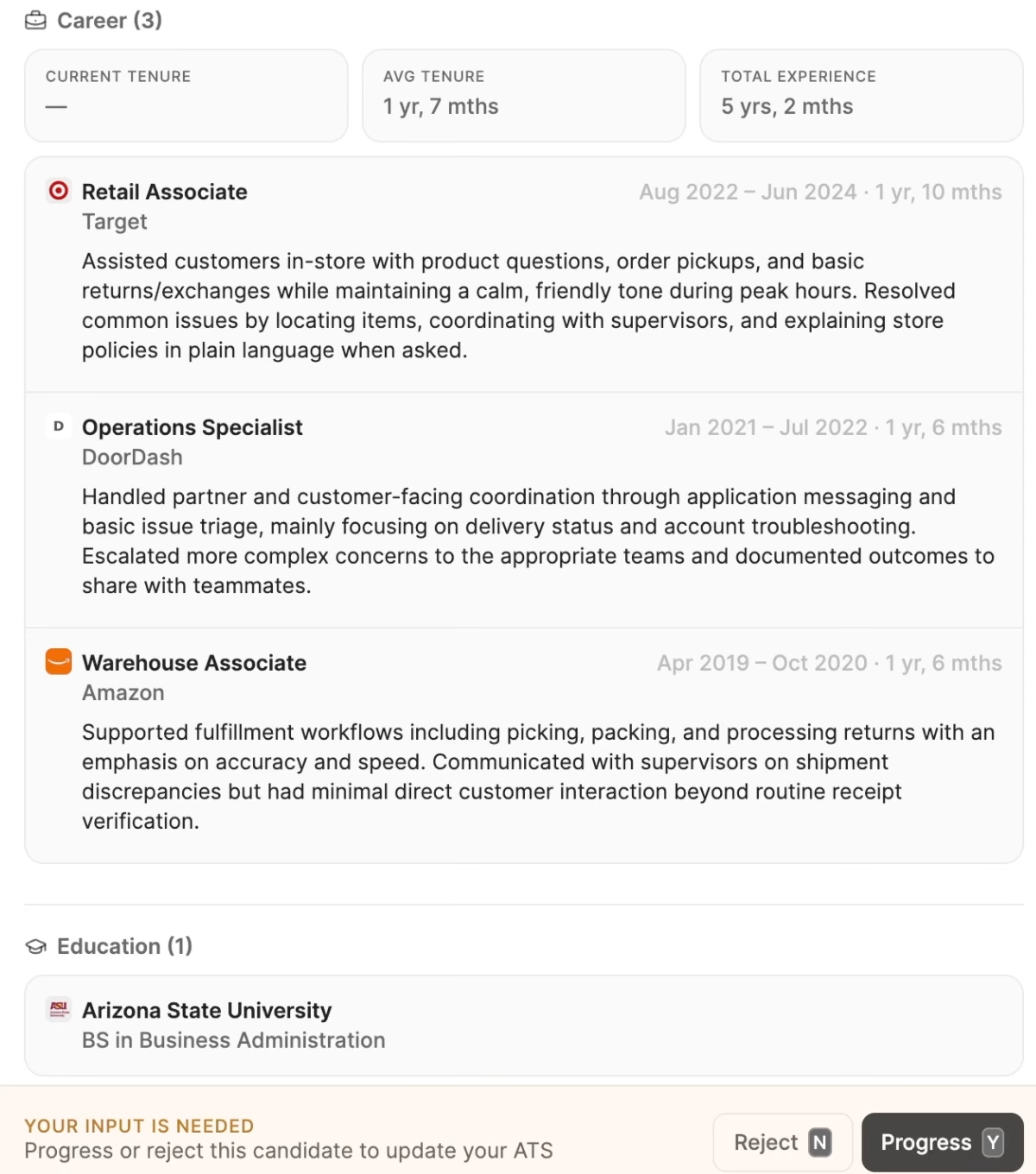
You do, if you’re the recruiter reviewing the call. You have both answers in front of you before anyone else does.
At Cockroach Labs, where recruiters run their own phone screens, recruiter Leslie Niiro describes the habit this depends on, going back to the record: “For me personally, I really appreciate being able to look at my notes and see exactly what we talked about.”
Who takes it forward?
You do, as one question. If the contradiction sits on a requirement, the question goes to the candidate before they move forward. If it’s a claim the next interview will test, it goes to that interviewer.
Does the candidate still move forward?
They can. A contradiction on its own isn’t a reason to reject anyone.
It becomes one when it sits on a requirement and the candidate’s reply to your question confirms the requirement isn’t met.
Until you hear back, a candidate with an open question on a requirement waits for one reply. A candidate with an open question on a claim moves forward, and the question goes with them. Reject before asking, and the decision is made on less information than the call collected.
I don’t think the answer to an information problem is making decisions with even less information.”

Here’s how to get that question asked.
How to check contradictory answers, step by step.
Five steps, from before the first call is read to the decision. They start once the call has ended: thin or unclear answers are a different problem, and follow-ups during the call are a subject of their own.
Write down which answers have to agree.
Before the first call on a role is read, write down the pairs of answers that have to agree. Keep it to the few that touch a requirement, so the check stays short:
| The pair | Why the two answers have to agree | How both answers can hold |
|---|---|---|
| The start date, and the notice period or other commitments | The team plans the start around the date, and a notice period that can’t meet it moves the plan | The candidate expects to negotiate an earlier release, or gave the start date as a preference |
| Where the candidate will work from, and the on-site days or shifts they said they can work | The working pattern is a requirement, and where the candidate lives decides whether it holds | A move already planned, or a commute the candidate already makes |
| Whether they will need sponsorship to work, if it comes up twice | An answer that changes between now and later changes what the team can offer | A permit that covers the role today and ends on a date the team can check |
| The experience claimed, and the example given for it | The example shows the size of the claim, and the size is what the role needs | A title that differs from the work, or a team led without formal reports |
| Pay expectations, stated twice | Two figures for one expectation leave the team unsure which one to build the offer around | Base pay in one answer and total pay in the other, or a range and a single figure |
Read the call twice.
Read it straight through first, in the order the candidate answered. Then take each pair from your list and put the two answers together, each beside the question that drew it.
Check it’s really a contradiction.
A mismatch sent out as a contradiction costs the candidate a reply and you a day. So before one goes anywhere, run three tests on the pair:
- Look for a later answer that goes back to the earlier one and replaces it. That’s a correction, and the later answer is the one to work from.
- Ask whether both can be true. Answers about two periods of the same job can both be right, and so can a formal title given once and a description of the work given later.
- Compare the questions. “When could you start?” and “What is your notice period?” ask different things, so a candidate who gave the earliest date they’d like to the first and the date their contract allows to the second has answered both honestly.
A candidate who rounded a number, or answered the question they thought they heard, has contradicted themselves on the page and told the truth both times.
If the pair survives all three, you have a contradiction. The transcript shows the candidate said both things. It doesn’t show which is true or why they differ, so you’re holding a question.
Send one question to whoever can settle it.
Who that is depends on the pair:
- A requirement goes back to the candidate before they move forward: one short question from the recruiter, sent the day the call is reviewed, quoting both answers.
- A claim the next interview will test goes to that interviewer, in the same form.
- A conflict outside your list stays where it is.
The note itself is short: the two answers, quoted, each with the question it answered, and the one question to ask. Word that question around the gap between the answers, the way a good follow-up question is worded around what an answer left out. That way it asks for information and implies nothing about why the answers differ.
I’d hurry the first route. Of the recruiting leaders and hiring managers surveyed for Metaview’s 2026 AI & Hiring Alignment Report, 67% said they lose qualified candidates to faster competitors every month.² That covers hiring speed in general and can’t price one held candidate. It’s still a reason not to add a wait of your own: ask the day you review the call, and the only wait left is the candidate’s reply.
The second route puts the question into the interview whose scorecard comes next, so the answer is written down with everything else that interviewer found. Across the scorecards captured on Metaview, 47.4% of those in which the interviewer recommended strong yes were followed by the candidate advancing, against 6.2% of those recommending no.³ Strong candidates sit behind both numbers, so the figures show scorecards and decisions moving together and nothing more. Put the question in that interviewer’s brief, and the answer lands on their scorecard with everything else.
Decide, and keep the answer on file.
Once each open contradiction has an answer, the call is ready for a decision. If the reply settles the pair, the candidate moves on. If it confirms a requirement isn’t met, you have your answer. Whichever way it goes, keep the question and its answer with the candidate’s record, so the next person in the loop starts from what was settled rather than from what was said.
How to tell the check is working.
Take the calls your team reviewed recently and ask four things of them:
- Did anyone read the pairs? If reviews went straight through and stopped, write the pair list for every open role before the next call is read.
- Where did the open contradictions go? If reviews found some and no interviewer’s brief carried one, give the brief a standing line for the quoted question.
- Was anyone rejected over a contradiction they were never asked about? If so, make one question to the candidate the step before any rejection that rests on a contradiction.
- How long did a requirement question take? If a candidate waited overnight for it, send it as part of the review.
I’d fix unasked rejections first, because a candidate rejected over a question they were never asked has no later step to rescue them. Then the interviewer brief, so that a contradiction moves forward as a written question instead of as someone’s memory.
What to do when nothing in the call adds up.
Sometimes the answers conflict almost everywhere. That’s a different problem from a contradiction or two, and it can have an ordinary explanation: a poor connection, nerves, or a set of misheard questions. Rule those out first. If it was a bad line, treat the call as incomplete rather than contradictory, and get the answers again before anyone decides.
If none of them explains it, the question becomes whether the candidate is who they say they are, and that belongs with your team’s fraud checks before any quoted question goes out.
On 10x Recruiting, Siadhal Magos talks about fake candidates and what teams are doing about them, from more in-person interviewing to interview questions without a median answer.
Until you know which it is, hold the quoted questions from that call.
Ask about the contradiction before the candidate moves on.
Metaview Screening returns a recording and transcript for every completed call.
Frequently asked.
How do you ask a candidate about a contradiction without sounding accusatory?
Put both answers back to the candidate in their own words and ask which one to plan around, or how the two fit together. Asked that way, it reads as planning, and the candidate isn’t asked to defend anything.
Doesn’t asking give a dishonest candidate the chance to fix their story?
It can: a candidate who hears both answers back can choose the one that suits them. On a single requirement that risk is still smaller than rejecting an honest candidate without asking, and the reply becomes one more answer the next interview can test. Where answers conflict almost everywhere, the fraud checks come first and the question waits.
What if a screening answer contradicts the candidate’s resume?
Run the same tests, and treat the resume as an answer given earlier, for a different audience: a title or an end date may have changed since it was written. Ask which version is current before reading anything into the gap.
Should the interviewer see the contradiction before the interview?
Yes, as the two answers and one question, with no reading of them attached. Any note can color an interview, which is why this one carries the question and leaves out the recruiter’s conclusion.
What if the candidate was answering in a second language?
Read a reworded phrase or a restated number as the candidate fixing an answer, unless the substance changes. Someone choosing words in a second language may restate an answer to get the meaning right, and the first test already counts that as a correction.
Sources.
¹ Aggregated and anonymized Metaview interview data: candidates who advanced with scorecards from more than one interviewer, and the share of them with at least one scorecard recommending no or strong no.
² Metaview, 2026 AI & Hiring Alignment Report: a 19-question survey of 505 recruiting leaders and hiring managers at companies with 200 or more employees in North America and Europe, the Middle East, and Africa, run with Cint.
³ The same anonymized interview data: of the scorecards captured on Metaview, the share followed by the candidate advancing, by the scorecard’s recommendation.
