
You know a good interview when you hear one. Teaching someone else to run one is harder.
Most teams train interviewers the same way: a few shadowed loops, the scorecard template, and then they’re on their own. What they don’t get is the interview itself: the follow-up they skipped, the ten minutes that went to small talk.
Interview recordings give them that, which is why we’d make them the core of interviewer training. A recording shows a new interviewer what a good interview sounds like, and it shows an experienced one where their own interviews drift.
Recordings also give a split panel something to go back to. Among candidates who advanced with more than one scorecard in interviews captured on Metaview, 56.3% had at least one scorecard recommending against them.¹
But every recording was made for a reason, and the candidate was told what that reason was. Training other interviewers usually wasn’t on the list.
Our position: train on moments from real interviews, and use no recording that way until its candidate has been told. This guide covers both sides, from which parts of an interview are worth teaching from to what candidates need to have been told first. You’ll finish knowing which moments to pull, how to build a session around them, and what to check in your candidate notice.
Why use interview recordings for interviewer training?
Interviewer training often runs on two things: shadowing, and feedback written after the fact. Both leave out the interview itself.
Shadowing puts a trainee in one live interview at a time, with a candidate in front of them. It doesn’t scale, and the trainee only sees whatever that one interview happened to contain.
Written feedback records the verdict. A scorecard says the interviewer rated communication a 3, but not which question they asked or how the candidate answered it.
A recording keeps both. You can play the exact question, the exact answer, and what the interviewer did next, so feedback gets specific. Instead of telling someone to probe more, you can play the answer that went vague and ask what they’d have asked next.
Good interviewers wish they could run an interview again because they could do better.”
Catawiki saw what recordings show across a whole team. Director of Talent Management James Lesner put it this way: “After bringing in Metaview, we were able to see that for the same role, we had interviewers asking very different questions. While some variety is good, it was to an extreme where the candidate experience heavily depended on the interviewer.” The case study says the team then “implemented relevant interviewer training.”
Watch James Lesner talk through how his team uses Metaview.
Where your team records with the Metaview Notetaker, it joins the interview as a visible participant, and it records and transcribes the interview only if consent is given. The conversation you want to teach from is there in full, in the candidate’s words and the interviewer’s.
Which parts of an interview teach the most?
You don’t need a whole interview to teach from. These are the five moments we’d start with.
The opening minutes.
Listen to how the interviewer starts. Do they say who they are, what the interview will cover, and how long it will run? Do they tell the candidate the interview is being recorded, and why?
The opening is also where a new interviewer learns to say the recording notice out loud, in their own words.
The first real question.
Compare the question the interviewer meant to ask with the one they asked. A question that asks for a specific example (“Tell me about a project you led”) tends to get evidence. A question that hints at the answer (“You’re comfortable with ambiguity, right?”) tends to get a yes.
Play one of each and a trainee hears the difference straight away.
The follow-up when an answer is thin.
A candidate gives a vague or rehearsed answer, and the interviewer either asks for more or moves on. This is the moment we’d replay most.
A good follow-up is short and specific, like “What did you do first?” or “What would you do differently?” In the sample interview below, the interviewer asks two follow-ups about the candidate’s project: where it came from and how they ended up leading it.
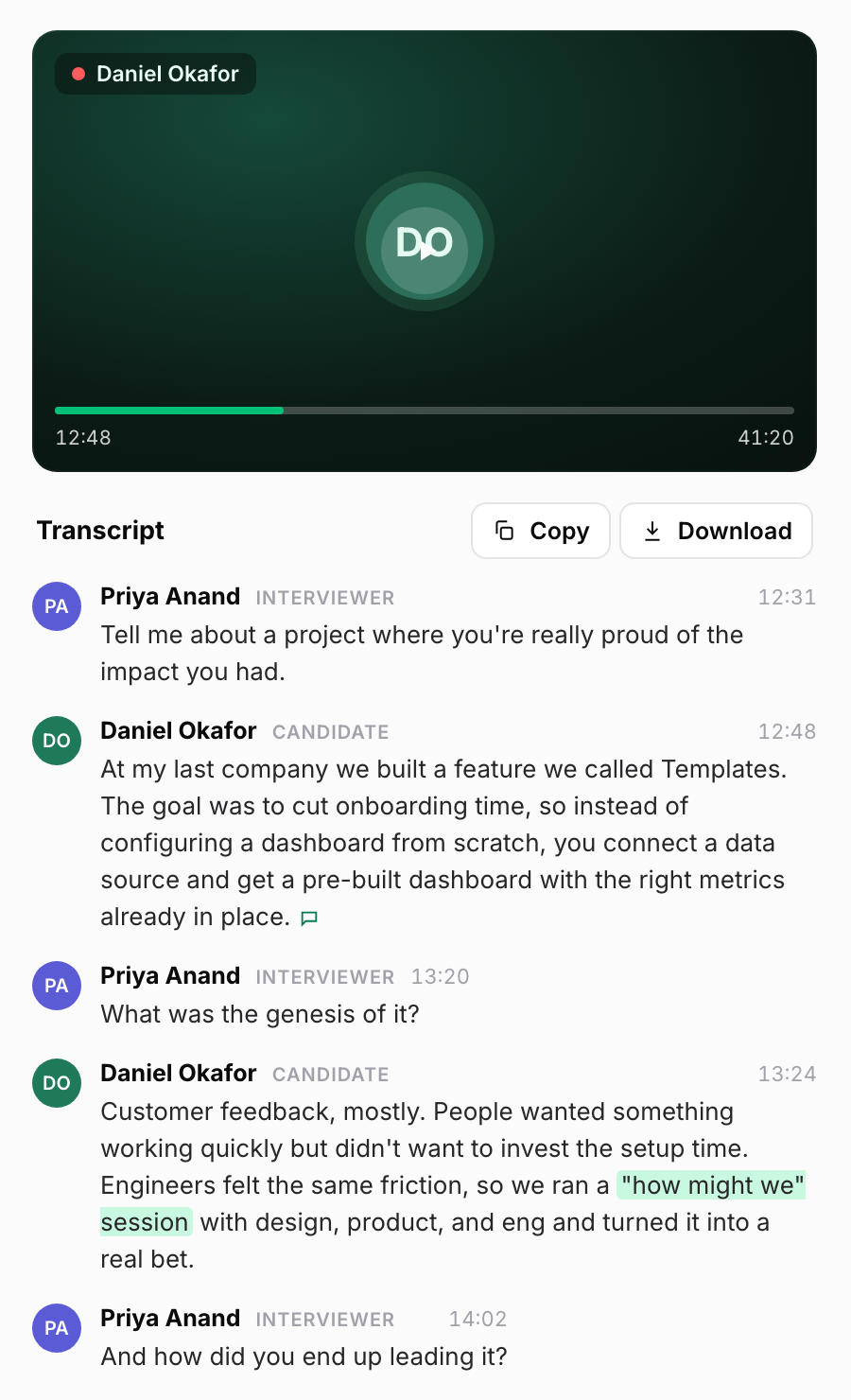
Teach trainees to notice the thin answer first. The follow-up only comes if they hear that the answer didn’t give them enough to score. When an interviewer struggles to fill in a scorecard afterward, check this moment first.
The answer two interviewers scored differently.
When interviewers split on a candidate, find the answer they scored differently and play it to both of them while the decision is still open.
Sometimes they heard different things, and sometimes they heard the same thing and weighed it differently. Either way, the conversation turns to evidence instead of impressions, and whatever they agree becomes a written lesson for the next panel.
Where the time went.
Interviews often run long. Among interviews captured on Metaview with a scheduled time, 54.3% ran past it, and among those that ran over, the median overrun was 11.9 minutes.²
An interview that runs over can eat into the next one, and into the candidate’s day. Play the middle of a long interview and ask the trainee where the time went: a question that could have been cut, or a tangent the interviewer let run.
How to build interviewer training from recordings, step by step.
Once you know which moments to use, here’s the order we’d go in to turn them into training people use.
Pick one moment per session.
Match the moment to the interviewer, since a new interviewer and a seasoned one need different lessons. We’d start new interviewers on openings and follow-ups, and experienced ones on the splits and the long interviews, where their habits show.
One moment, a few examples of it, and a short discussion make a session.
Check what the candidate was told.
Training is a new use of a recording, so before one goes into any session, check the notice it was recorded under. If that notice named the hiring decision and didn’t mention training, the recording isn’t ready to use yet. We’ll get to what to do about that after the steps.
Pull the exchange you need.
We’d rather play one exchange than a whole interview end to end. The median interview captured on Metaview runs 35.5 minutes,³ and a session needs a few minutes of it: the question, the answer, and what the interviewer did next.
Teach from the transcript where you can. The Notetaker captures every spoken word, so the exchange is already there as text, and a written excerpt can leave the candidate’s voice out of the room.
Write the lesson down.
The lesson should outlive the recording. After each session, write down what good looked like: the question worth asking, the follow-up that worked, and where the time went. That written standard is what new interviewers keep.
What candidates need to have been told first.
A candidate agreed to be recorded for a reason, and the notice they saw told them what it was. Using that recording to train other interviewers is a different use, and the rules follow the use.
The General Data Protection Regulation (GDPR) puts it plainly in Article 5(1)(b): personal data are “collected for specified, explicit and legitimate purposes and not further processed in a manner that is incompatible with those purposes.”
Article 13(3) adds that when a team means to use a recording for a new purpose, it tells the candidate before that use begins, with any relevant further information from Article 13(2), such as how long the data is kept and what rights the candidate has.
Four uses of a recording, and what each one needs.
Here’s how that plays out for four common uses.
| The use | Covered by a notice that named the hiring decision? | What it needs first |
|---|---|---|
| The hiring decision the interview was recorded for | Yes: it is the purpose the notice named. | Nothing beyond the notice and consent given before the call. |
| The same panel calibrating on its interviews while the decision is open | Yes, on our reading: it still serves the decision. | Nothing more, while this decision is open. |
| An internal library that trains other interviewers | No: training is a purpose the notice did not name. | Legal floor: the candidate told first, plus a basis of its own where the use isn’t compatible. Our policy: a yes before the whole recording goes in. |
| Anything that leaves the company | No. | Our policy: a composite in its place, or the candidate’s agreement to that use asked for on its own. |
Asking for the recording itself belongs before the call, and Metaview’s post on consent before the call covers it. Its sample line limits the use to “this hiring decision,” so a team that wants to train on recordings adds a training question beside it.
That second row is our reading, not the law’s, so write it down where you keep your reasoning. Here’s the test we use: can the replay still change the decision the recording was made for? For the panel on an open role, it can. For a hiring manager from another team who sits in to learn the bar, or for last quarter’s recording, it can’t, and that replay is training.
Training is a purpose a hiring notice didn’t name. Article 6(4) lists what a team weighs to decide whether a new purpose is compatible with the old one, among them:
- the link between the two purposes
- the context the recording was made in, including the relationship between the candidate and the company
- the nature of the data, including whether special categories of personal data are involved
- the consequences of the new use for the candidate
- the safeguards in place, which the article says may include encryption or pseudonymization
Recital 50 fills in the context factor with the part most relevant here: “the reasonable expectations of data subjects based on their relationship with the controller as to their further use.” A candidate told the recording was only for the hiring decision has little reason to expect it in a training session for people they’ll never meet.
Compatibility decides whether training can run on the basis the recording was made under. If it can’t, training needs a basis of its own, and for a recording made on consent that in practice means the candidate’s yes. Either way, the candidate is told first: Article 13(3) requires the information before the new use, and Recital 50 says the information “on those other purposes and on his or her rights including the right to object” should be ensured “in any case.”
What the notice says once training is on it.
For interviews not yet recorded, put training in the notice as a question of its own. Once it’s there, the notice covers five things:
- The purpose: That the recording may be used to train interviewers, asked about separately from the hiring decision. Article 13(1)(c) asks for the purposes and the legal basis, and where the basis is consent, Recital 32 says it should be given for every purpose.
- Who has access: The interviewers being trained and the people who train them, named plainly. Article 13(1)(e) asks for recipients or categories of recipients.
- How long it’s kept: How long training copies are kept, or, where no period can be set, the criteria that set it, as Article 13(2)(a) asks.
- The right to decline: How to say no to training without it touching the application. Recital 42 says consent isn’t freely given where the person can’t refuse it “without detriment,” and Recital 43 presumes it isn’t free where separate uses get no separate consent although separate consent would have been appropriate.
- Their data rights: That the candidate can ask for a copy of the recording, or for it to be deleted, rights whose existence Article 13(2)(b) asks the notice to state.
Asked that way, a candidate can say yes to being recorded for the decision and no to training. Count a missing answer as no, since Recital 32 doesn’t count silence or inactivity as consent.
A team relying on compatibility instead of a yes names its legal basis in the notice. Where that basis is a legitimate interest, the notice also names the interest and sets out the right to object on its own, apart from everything else (Articles 13(1)(d) and 21(4)). Whether that route is open at all for a consent-based recording is a question for counsel, and we wouldn’t build a library on it.
The frequently asked questions on Metaview’s integrations page say of candidates, “They’re automatically informed about Metaview through touchpoints you control and configure.” So what those touchpoints say about training is your team’s decision.
Recordings you already hold.
If your library was recorded under a notice that never mentioned training, here’s what you can still teach from, starting with the safest.
The legal floor is the same for any use of a recording that still carries the candidate. They’re told first (Article 13(3)), and the use either stays compatible with the first purpose or rests on a new basis. Our own rules sit on top of that floor, and the more identifying the material, the stricter they get:
- A composite: An exchange the team has heard often enough to teach, rewritten in its own words so it quotes no one and describes no one. Recital 26 puts information outside the regulation only where no one can be identified from it by the means reasonably likely to be used. Writing it still uses the recordings it draws on, so have counsel review the method once, including whether that step needs the candidates told first.
- A redacted excerpt: One candidate’s words, with anything that places them removed. Recital 26 still treats pseudonymized data as information on an identifiable person, and on our reading a voice or a face can be enough on its own. Use one only after the candidate has heard about the training use, on a basis counsel has confirmed, which for consent-based recordings may mean a yes.
- The whole recording: Only where its candidate has said yes to that use. The split decisions worth teaching from need the candidate’s answers in them, so they wait for a yes. Until one comes, teach the split as a composite: an answer of the kind panels read differently, with the two readings written out beside it.
- Anything that leaves the company: A recording shown at a conference or handed to another company’s course reaches people no hiring notice named (Article 13(1)(e)). Send composites by default, and ask the candidate separately where a real recording has to leave, since Article 4(11) makes consent specific. An outside trainer hired to run your own sessions works on your behalf and can be named among the notice’s recipients. If a recording has already left, bring in counsel first.
How to tell the training is working.
You’ll want to know whether the training changed anything before the next round of hiring. You can check each of these in the tools you already use:
- The reason for a split: If a panel disagrees, check whether its interviewers asked the same questions and weighed the answers differently, or asked different questions altogether. Catawiki’s case study describes the second kind.
- Follow-ups in the recordings: Play a trainee’s next few interviews and listen for whether vague answers get a second question.
- Scorecards with evidence: A scorecard that points to what the candidate said shows the interviewer heard enough to score.
- Interviews that finish on time: Check how often a trainee’s interviews run past their slot, before and after.
Write down where each sits today, so you have something to compare against.
Start with the notice, though. Every interview recorded after you add the training question comes with its candidate’s answer, a missing answer counting as no, so you’ll know which recordings you can teach from without going back to anyone. For everything already on file, the notice it was made under decides what the library may still teach from it.
See how the Notetaker joins an interview.
The Metaview Notetaker joins the interview as a visible participant, and it records and transcribes the interview only if consent is given.
Frequently asked.
Can interviewers review their own recordings?
Yes, while the decision is open, to write the scorecard. Reviewing it later to improve as an interviewer is training, and the same rules apply.
Is it too late to ask past candidates for permission?
A team can still ask, in a message about training alone that’s separate from anything to do with the application. The same message gives every candidate the information Article 13(3) calls for. Where no yes comes back, the whole recording stays out of training.
What if a candidate agrees and later changes their mind?
Article 7(3) lets them withdraw at any time and requires withdrawing to be as easy as agreeing. Withdrawal leaves what came before it lawful, so sessions already run stand, and the recording comes out of training from then on.
Can a candidate’s yes count when they want the job?
Recital 43 says consent shouldn’t be a valid ground where there’s a clear imbalance between the person and the organization processing their data, and an applicant talking to a prospective employer is a case to put to counsel. What the team can do is keep the training question separate from the application, with no effect either way.
Does the interviewer on the recording get a say?
Their words and voice are on the recording too, which makes it their personal data as well, so tell them how it will be used for training before it is, in the notice the company gives its staff.
Do these rules apply to candidates outside Europe?
Counsel decides which law reaches a given candidate. We read the GDPR here because it sets the rule out plainly, and we’d send at least the same notice wherever the team hires.
Sources.
¹ ² ³ Aggregated and anonymized Metaview interview data, described in the note below.
