
When a candidate complains about an interviewer, the complaint usually comes down to one sentence: something the interviewer asked, or something they promised. Before you reply, you need to know what was said.
A recording is the best record you’ll have. The median interview captured on Metaview runs 35.5 minutes,¹ which is a lot of conversation for two people to remember the same way, and the interviewer’s memory is an account with a stake in the answer.
Without one, you’re left with whatever notes exist. In a case a London employment tribunal decided in 2024 (2300628/2023), a vice president asked a candidate who had already signed her contract, “How old are your children?” There was no notetaker, and the employer produced no note of the meeting, so the candidate’s own note, made about a week later, was accepted as accurate. Her complaints, about the question and about the withdrawal of her signed contract, were upheld as sex discrimination.
So I’d make the reply wait for the record. One person secures it the day the complaint lands, and someone with no part in the hire listens to it first, before the hiring manager and before any reply goes out.
This guide walks through what to do between the complaint and your reply, step by step, from the day it lands to the finding you send back.
By the end of it, you’ll know what a recording can and can’t settle and what to tell the candidate, and you’ll have a one-page protocol for the next complaint.
What a candidate complaint about an interviewer can allege.
Most complaints fall into one of three kinds, and the table shows what a recording can settle for each.
| What the candidate says | What the recording can show | What it leaves to people |
|---|---|---|
| The interviewer asked me something they had no business asking. | Whether the question was asked, in what words, and what led up to it. | Whether anything could justify asking, and what the interviewer meant by it. |
| The interviewer promised me something. | What was said about pay, level, start date, or remote work, and whether it was put as settled or as possible. | What the team had agreed, which should sit in the requisition and the offer approval. |
| The interviewer was dismissive or rude. | The words used, and the order they came in. | Whether it was rude, which the finding leaves out. |
The first row is the one discrimination law addresses directly, because the Equal Employment Opportunity Commission (EEOC) says in its guidance on pre-employment inquiries that questions touching characteristics such as sex or age “may be used as evidence of an employer’s intent to discriminate unless the questions asked can be justified by some business purpose.” Disability is stricter still: the same page says employers “are explicitly prohibited from making pre-offer inquiries about disability.”
In a case the EEOC settled in April 2024, it alleged that an Olive Garden general manager asked an applicant for a busser job about his use of a cane, what was “wrong with” him, and how “bad” his disability was. The parties settled by consent decree before any findings.
The promise complaint is harder to close, because the recording can show that a promise was made and in what words and still leave open whether it was broken, which turns on what the team had agreed and what the offer said.
On the third row, the finding stops at the words and their order, because it has to hold up when anyone checks it against the recording. Why a question was asked isn’t on the recording either. The post on structured interview adherence stops at the same line for off-limits questions.
Secure the record before anyone replies.
The record is everything made at or about the conversation:
- The recording and its transcript, if the interview was recorded.
- The interviewer’s notes and scorecard, as they stood when the complaint arrived.
- The calendar invite.
- Any message about the candidate, sent before or after the interview.
One named person holds it from the day the complaint lands. From then on, no one in the hiring loop edits a note or a scorecard, however small the edit.
A recording may not exist, because recording depends on consent collected under the team’s own process. When a candidate declined, the record is the interviewer’s own notes and what people remember, and the file says so in its first line.
How long a recording is kept is a policy to set with counsel before any complaint arrives, since a complaint that comes in after that window has closed will find no recording at all. Metaview’s piece on recording interviews covers consent and access in more depth.
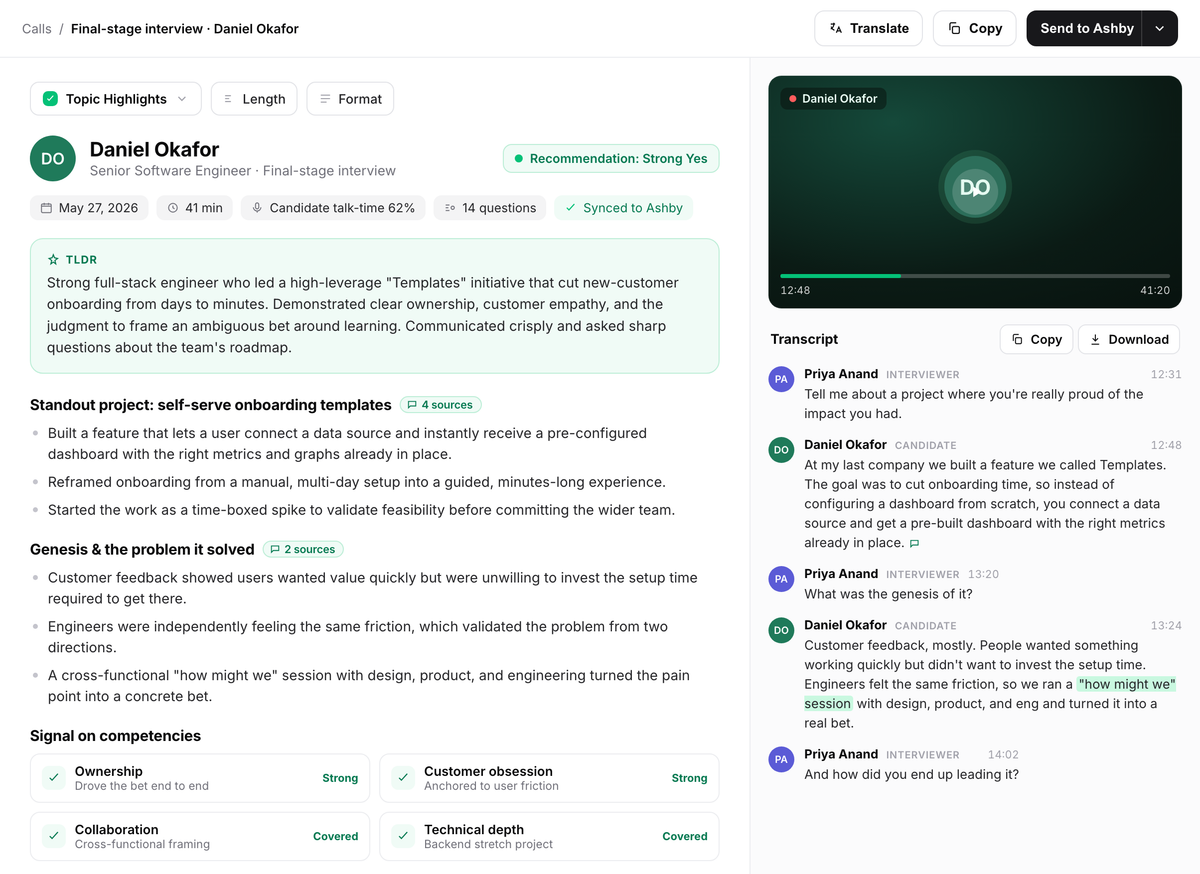
Where the team uses Metaview and consent was given, the Metaview Notetaker joins the interview as a visible participant and captures every spoken word in a recording it also transcribes, so the reviewer can listen to what the interviewer said. The finding stays with the reviewer.
Without a record, an interview is hard to see into afterward, however much rides on it. Metaview’s co-founder and chief executive, Siadhal Magos, put it this way:
It was clear to us that the most important part of the hiring process is the interviews, but also the most opaque and unreliable part”
Reviewing a complaint is one more use of that recording, so I’d check with counsel or the privacy lead that it sits within what candidates were told the recording was for.
I’d also bring counsel in as soon as an allegation touches a protected characteristic, and before any written finding goes to the candidate.
Give the review to someone outside the hiring loop.
Everyone in the hiring loop has a stake in the answer. The interviewer’s standing is on the line, and the hiring manager is in effect judging their own panel. Each person in the loop gives an account before they hear the recording, and the reviewer hears it first, before any of them.
In the tribunal case, the employer’s own account moved. An internal message from the vice president’s assistant, sent during the proceedings, denied that the question had been asked and suggested that “probably the candidate mentioned her work experience and brought it up voluntarily.” The employer first acknowledged the question in its closing submissions, which is a late point in a case to settle what your own vice president said.
The reviewer has no say in this hire. Where the company has an employee relations or people team, I’d give a discrimination allegation to them.
Otherwise, a talent lead from another team can take it, as long as they don’t report to this hiring manager. Their job is to establish what was said and write it down so the candidate can be told.
The strongest objection to an outside reviewer is context, since the hiring manager knows what was agreed about pay and the role. The reviewer gets that context after listening and tests it against the recording; it should come from the requisition and the offer approval.
Listen to that one conversation, and only for what the complaint alleges.
Write the scope down before anyone listens: this conversation, and each allegation in the candidate’s own words. If the reviewer hears something else in this conversation that touches a protected characteristic, it goes to counsel separately.
The interviewer’s other interviews stay out of it, because a pattern across them needs a separate review, which a confirmed finding may be reason to start. Any search across them is its own decision, made under your team’s transcript search policy.
The review answers the complaint and leaves the hiring decision with the people who own it, with one change. Where it finds the interviewer asked about a protected characteristic, I’d take that interviewer’s scorecard out of the decision and ask the hiring manager to write down what the decision rests on. The tribunal drew that line itself: the question was one of the facts from which it inferred that the candidate’s sex had influenced the decision to withdraw the offer.
Listen to the whole conversation, because what came before a question is part of what the recording shows about it. The tribunal read the question in that light: childcare had come up at the start of the meeting, and it found that the candidate’s childcare responsibilities were important to the vice president’s assessment of her suitability for the role.
The calendar invite shows when the interview was booked to end, which is no guide to when the conversation did. Among interviews captured on Metaview with a scheduled time, 54.3% ran past it, and among those that ran over, the median overrun was 11.9 minutes.²
For whoever reviews the recording, that means the slot on the calendar can’t mark where the conversation ended. Before a finding says the words aren’t in the recording, check that the recording runs as long as the conversation did.
Teams already go back to what was said for everyday questions, well short of a complaint. At Brex, Business Recruiter Lydia An described going back to check whether a recruiter or a hiring panel went deeper on a topic: “Being able to go back to Metaview, pull those exact notes, and see exactly what was said has been really helpful.”
For a complaint, I’d go one step further than the notes, because each finding rests on the audio. A transcript is quicker to read, so the reviewer may use it to find the passage, and listens to the whole conversation either way.
Each allegation ends in one of three findings:
- The recording has the words, or words close to them, and the finding quotes the recording beside the candidate’s account.
- The recording covers the whole conversation, and neither the words nor anything close to them is in it.
- The recording doesn’t settle the allegation, because the moment fell outside the recording, part of the call went unrecorded, or the audio is unclear.
The second finding clears the interviewer of those words and of nothing else. How the interview felt to the candidate stays their account, and the reply doesn’t argue with it.
Reply to the candidate with what the record shows.
Acknowledge the complaint the day it arrives and say that someone outside the hiring team will review it. Give a date for the finding, and pick one the team can keep. I’d send nothing reassuring in the meantime, because a reassurance sent before the review is a promise about a review no one has done yet.
The reply names the conversation that was reviewed and gives the finding for each allegation. Then it says what changes for the candidate. Where the finding is that an interviewer promised something the team never agreed, the team decides whether the promise stands and tells the candidate which, before the offer stage tells them instead.
I’d rather send a plain finding, even one that goes against the interviewer, than a careful reassurance. Counsel reads every finding on an allegation that touches a protected characteristic before it goes out, whichever way it goes.
If the candidate also asks for a copy of the recording, or of what the company holds about them, route it to whoever handles data requests. In the European Union, Article 15(3) of the General Data Protection Regulation can entitle a candidate to a copy of the personal data being processed about them. The United Kingdom’s version keeps that right, limited to what a reasonable and proportionate search can find.
Both versions say the copy must not adversely affect the rights and freedoms of others, and the interviewer is on the recording too, so counsel or the privacy lead decides what the request reaches. The reply with the finding should never read as a refusal of it.
What the team does after a candidate asks why can become a claim of its own. The EEOC settled a case in August 2025 in which it alleged that a Washington staffing agency disqualified an applicant from future work after he asked the agency to confirm that he had been turned down over a request for time to pray. Its suit was for retaliation as well as religious discrimination.
The candidate sees the acknowledgment and the reply, and I’d write both knowing they may become that candidate’s account of how the company handles a problem raised against it.
Keep coaching off the complaint file.
The complaint file holds the review and nothing else:
- The allegation, in the candidate’s words.
- The record that was reviewed, the accounts taken, and anything missing.
- The reviewer’s name and role, and whether counsel is involved.
- The finding for each allegation and the passage behind it.
- The acknowledgment and the reply as sent.
Coaching the interviewer happens in a separate conversation with its own notes, and none of it goes here. The two records answer different questions: the complaint file says what happened in one interview, and coaching is about what the interviewer does in the next one. Using the same recordings for interviewer training later depends on what candidates were told when they agreed to recording.
When the recording clears the interviewer of the words alleged, that finding goes in the file with the same care, which protects an interviewer who didn’t say them: they have a record to point to.
Two lines in every interviewer’s brief deal with the first two rows of the complaint table:
- The subjects they leave alone, such as children or family plans. Before an offer, that includes health and disability altogether.
- What they say when a candidate asks about pay, level, start date, or remote work: the position the team has agreed, or that the recruiter will confirm it.
Those two lines are a brief, and the habit behind them is how a company treats interviewing. In the first episode of 10x Recruiting, Jordan Mazer, head of talent at Andreessen Horowitz’s speedrun, says what it takes to build that culture, and why getting hiring right means changing how a company thinks about interviewing.
Run the protocol on the next complaint.
The protocol fits on one page, and I’d write it down before the next complaint arrives.
| Step | Who owns it | What goes in the complaint file |
|---|---|---|
| Acknowledge | Whoever received the complaint | The complaint as received, and the acknowledgment with its date for the finding. |
| Secure the record | A named holder outside the hiring loop | The recording and transcript, or a line saying none exists. The notes and scorecard as they stood. |
| Bring in counsel | The head of talent, as soon as an allegation touches a protected characteristic | That counsel is involved, and from what date. |
| Assign the reviewer | The head of talent or the people team | The reviewer’s name and role, and that they played no role in this hire. |
| Review | The reviewer | The accounts, then each allegation with its finding and the passage behind it. |
| Reply | The reviewer, or a talent lead outside the hiring loop | The reply as sent, including whether any promise stands. |
Then check the last complaint your team handled against the protocol:
- Who heard the recording first. If it was anyone in the hiring loop, name the outside reviewer now, so the next complaint has one on the day it lands.
- What the reply said. If it reassured the candidate without a finding, rewrite the reply template around the three findings.
- Whether the hiring decision moved. If the interviewer’s scorecard stayed in a decision the review questioned, raise it with counsel before anything in that decision changes.
- What the complaint file holds. If coaching notes sit in it, keep the next interviewer’s coaching in a place of its own.
I’d fix the first check before any of the others, because every later step inherits whoever listened first, the reply to the candidate included.
Review the recording before you respond to a complaint.
Where consent is given, the Metaview Notetaker records and transcribes the interview, so the reviewer can go back to what was said.
Frequently asked.
What happens if the interview wasn’t recorded?
The review runs on the written record that exists and on an account from each person in the room, taken separately and before anyone has read another’s. The finding then says what those show, and that no recording covers the moment.
Should the interviewer hear the recording before the review is finished?
Only after they’ve given their own account. Then I’d let them hear the passage the finding rests on before the candidate hears back, so they can answer it.
Should the candidate’s process pause while the complaint is reviewed?
Their application carries on, with a different interviewer for any rounds that remain. Dropping a candidate because they complained of discrimination can invite a retaliation claim on top of the first one, and if they were already turned down, the review asks whether the interviewer’s assessment fed that decision.
What if no one outside the hiring loop can review it?
Borrow a reviewer: a people lead from another part of the company, or an outside investigator counsel recommends. The review needs a first listener with no stake in this hire.
What if the complaint names more than one interviewer?
Each allegation gets its own scope and its own finding. One reviewer can take all of them, as long as that person stayed out of this hire.
What if the candidate complains in public before the review is done?
Reply in the same place with a short line and a private way to reach the team. Everything about the complaint and the review stays out of public view.
Sources.
¹ Aggregated and anonymized Metaview interview data: the median length of interviews captured on Metaview, across 5,403,960 interviews.
² The same anonymized data, for interviews with a scheduled time: the share of 174,558 that ran past it, and the median overrun among the 94,823 that ran over.
