
A hiring manager questions a candidate rating two days after the interview. The evidence that would settle it is somewhere in the recording, so someone opens the file and starts scrubbing.
People replay interviews because the evidence was never indexed against the scorecard. The only route back to an answer is to hunt for it. Fix the indexing and the hunt goes away.
Rewatching is a search problem.
A recorded interview is a long, unstructured file. The claim you need sits somewhere inside it, and the interface gives you a scrubber and your memory of when it came up. So you watch at 1.5x and hope you recognize it as it passes.
The scorecard is where that claim belongs. A rating with no link to its evidence sends the reader back to the recording. The recording becomes the system of record by default, and every question costs a replay.
That's expensive for you. It's worse for the hiring manager who never had time to watch the interview once.
Watching every single interview back is unsustainable. But being able to build the dashboards within Metaview to see did you actually assess for the skills you wanted to assess for, and provide a report at the end, that's a massive perspective shift.”
About the data.
The two figures below come from an analysis of scorecards on interviews captured on Metaview.² It compares scorecards people created themselves against scorecards Metaview generated a first draft for.
The submission comparison covers 26,498 manually created scorecards and 93,502 AI-generated ones, a capped sample totaling 120,000. The field-count comparison covers 11,210 manual and 68,790 AI-generated, capped at 80,000. Both field counts are means, so a few heavily filled scorecards pull them up.
Two limits matter before you read them. Neither figure compares interview formats, so nothing here says video interviews score better or worse than any other kind.
This is platform data, which shows association and not cause. Teams that switch generated scorecards on may already run tighter processes, so the gap isn't the effect of drafting alone.
The analysis holds no post-hire outcomes. It can say what got documented. It says nothing about how anyone performed once hired.
What changes when the first draft is generated.
Interviewers submitted only 28.6% of the scorecards they created themselves. Of the scorecards Metaview drafted first, 50.3% were submitted.²
Generated scorecards also carried more filled fields: a mean of 7.85 against 2.61, three times as many.²
Both figures measure documentation, which is what makes them useful. A scorecard that started as a generated draft was more likely to get filed, and carried more of the interview. It doesn't mean the rating was better, and completion is not accuracy.
Build the scorecard from the record.
Work through these in the order they happen. None of them asks you to change where you interview.
Get every recording into one place.
Metaview's Notetaker joins as a visible participant and records the call. Getting consent first is your process to run, under your own policy and local law.
For interviews it didn't join, you can upload a recording from your machine or paste a URL. That covers most publicly hosted video, including public Google Drive and Zoom download links, and Loom.
Metaview doesn't take Gong or BrightHire downloads, so those stay outside this workflow.
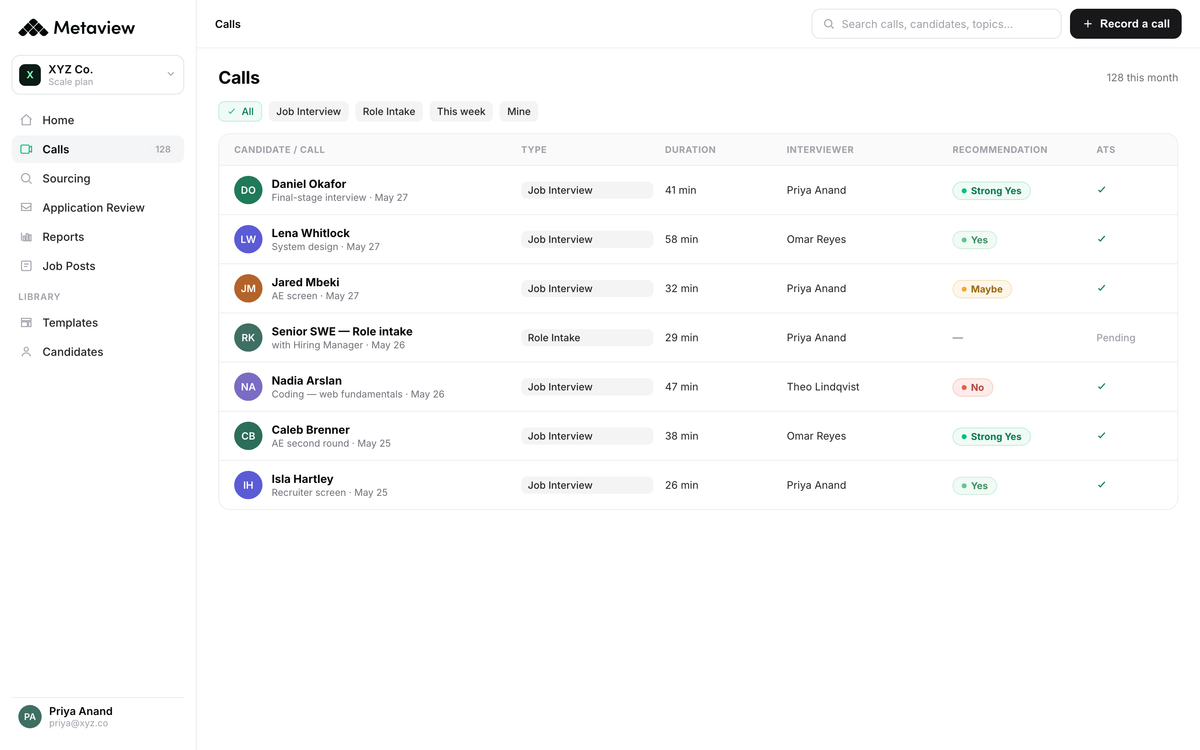
- 1Every captured call sits in one list with its length. Nothing lives only in someone's calendar.
- 2The recommendation column shows where a verdict has been recorded.
- 3The ATS column shows what synced and what is still pending.
Read the notes instead of the recording.
Metaview captures every spoken word. That means the notes can carry a pointer to their own source instead of a summary you have to trust.
Each section of the notes shows how many moments built it. Click one and you land at that point in the transcript and the recording.
This is the step that removes the replay. You read a claim, and if you doubt it, you jump to the seconds behind it instead of searching for them. For a fuller treatment of the capture side, see our guide to running video assessments.
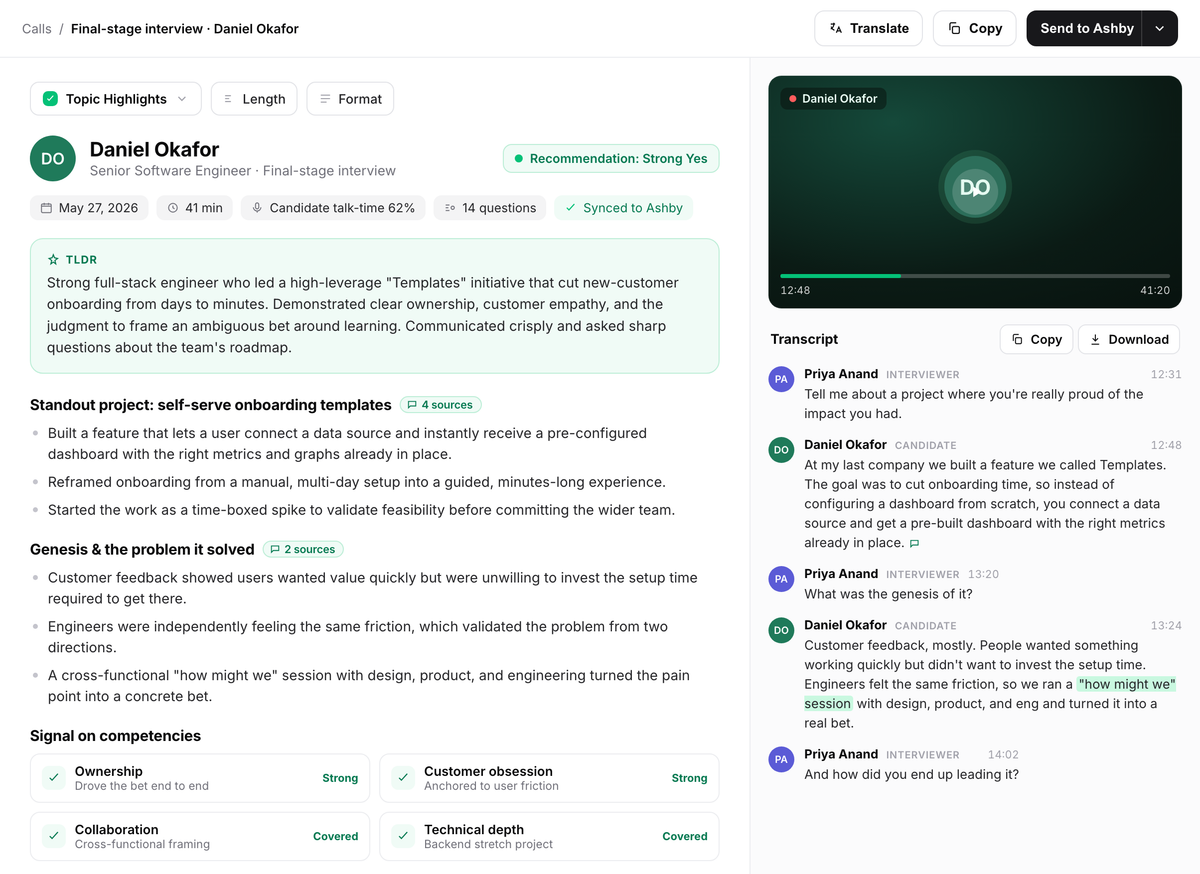
- 1Each note section names how many moments in the interview it was built from.
- 2The player sits at the moment being cited rather than at the start of the file.
- 3The matching passage is marked in the transcript, so the wording can be checked.
Let the scorecard arrive already drafted.
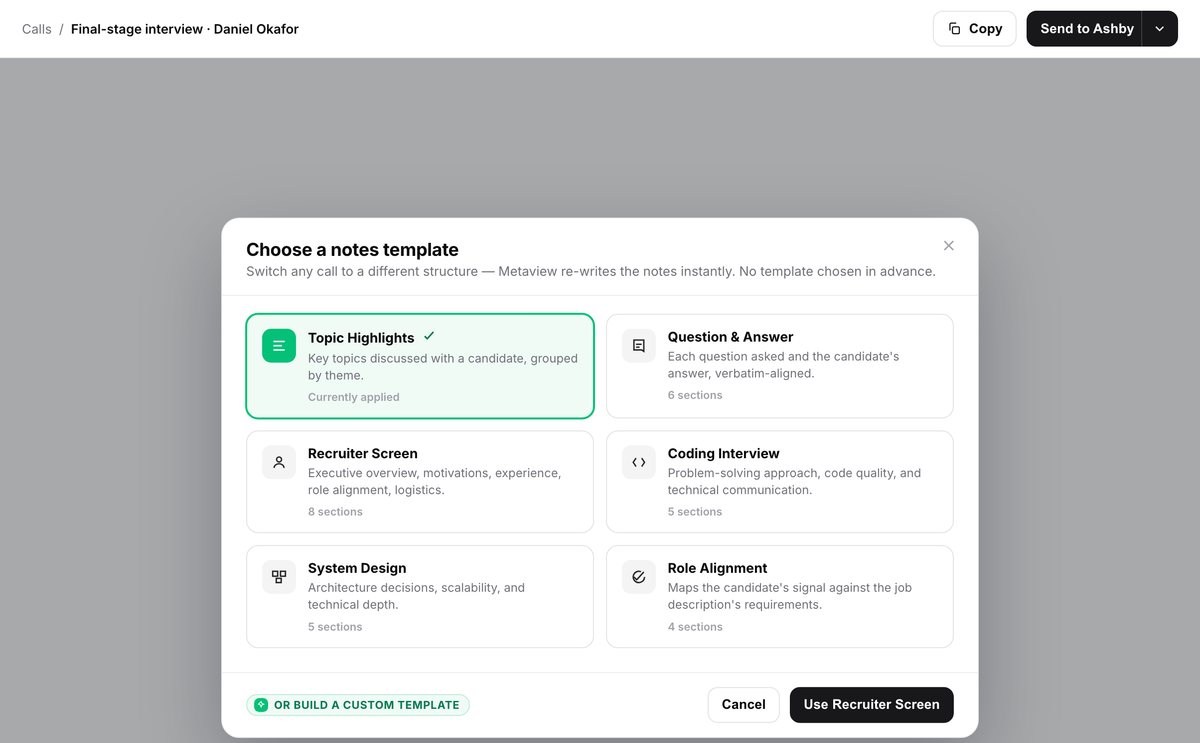
Assign a scorecard template to the interview. Metaview then pre-fills the competencies from the transcript, so what lands in front of you is a draft rather than an empty form. The verdict is still yours.
The trail back to the interview sits in the notes, which link to the moment they were built from. That is the part that saves you the replay.
Metaview captures the evidence, and recruiters and hiring managers add the judgment. You edit the ratings and you submit the scorecard. If you want the reasoning behind the fields themselves, our piece on interview rubrics covers how to build ones worth filling.
Push it to where the decision gets made.
A scorecard your team can't find in the ATS may as well not exist.
Ashby, Lever, and Gem accept a submitted scorecard from Metaview. With Gem you can also pull a scorecard in from the ATS. Fill it in Metaview and push it back.
Greenhouse doesn't support direct scorecard submission. The Chrome extension autofills the objective sections and leaves the subjective ones to you, or you can paste the scorecard across. Open in ATS takes you to the right candidate page.
Lever has one wrinkle you should be aware of, though. It won't overwrite a field someone already submitted, and the interviewer has to submit in Lever first before their notes appear.
Check what never arrived.
Reports carries a Missing Scorecards view, listing the past week's interviews with no scorecard submitted. It also carries a Scorecard Submission Time column, so you can track whether the lag is shrinking.
Both need an ATS connection, because Metaview can't see a submission without one. For scorecards submitted before you switched the column on, it covers only the ones that went through Metaview.
| The moment | Working from the recording | Metaview |
|---|---|---|
| Checking one disputed claim | Scrub until you hit it | Jump from the note to the timestamp behind it |
| Filling a competency | Retype it from memory | Arrives pre-filled from the transcript |
| Getting it into the ATS | Copy it across by hand | Submit direct to Ashby, Lever, or Gem |
| Spotting a gap | Chase people and hope | Missing Scorecards lists the week's gaps |
The teams running this describe the payoff in hours saved. At Engine, VP of People Laura Stapleton describes scorecard work that "would take 45 minutes" and now "probably takes five".³ She says the team no longer blocks out the end of the day to get them filed.
The most clear impact is the time saved. Recruiters save 20 minutes per interview from wrangling notes and submitting scorecards. Per month, that's 53 hours saved in total.”
Where this stops helping.
Half the value of that submission figure is knowing what it leaves on the table. The rise is a real improvement, and close to half of generated scorecards still never get submitted.
Removing the writing burden clears one obstacle. It doesn't create the habit of closing out an interview, and no amount of pre-filling will.
The same caution applies to the field counts. A scorecard with 7.85 filled fields is better documented than one with 2.61. That's a statement about the record, nothing more.
If your interviewers are rating candidates on the wrong competencies, this workflow will help them do it more often and in more detail.
The comparison isn't controlled. Teams that turn generated scorecards on may already be the teams that cared about scorecards, which could be enough on its own to open the gap.
Make the next debrief checkable.
Pick one live role this week. Assign a scorecard template to its interviews and let the notes carry their source counts.
Then, when the hiring manager pushes back on a candidate, send the timestamp instead of the recording.
That's the whole change. The interview you were going to run anyway comes out of the room already indexed, and the question that used to cost you a replay costs you a click.
Bring Metaview into your hiring stack.
Structured interview notes, draft scorecards, and ATS sync.
Frequently asked.
Can Metaview score an interview it did not record?
Yes. Upload the file from your machine, or paste a URL if the video is publicly hosted. Metaview then works from that recording the way it works from a call it joined. What it cannot recover is audio the recording never captured, so one that starts late misses that part for good.
Which ATS platforms accept a scorecard from Metaview?
Ashby, Lever, and Gem take a submitted scorecard from Metaview. Greenhouse takes a paste, or the Chrome extension, which autofills the objective sections and leaves the subjective ones to you. Lever is the one to plan around: the interviewer submits there first before their notes appear, and Metaview will not overwrite a field someone has already submitted.
Does the AI decide the candidate rating?
No. Metaview drafts the scorecard from the interview transcript. The interviewer edits the ratings and submits the scorecard, so the judgment and the decision stay with a person.
How do you find interviews that never got a scorecard?
Reports includes a Missing Scorecards view showing the past week's interviews with no scorecard submitted. It needs an ATS connection, because Metaview cannot tell whether a scorecard was submitted without one. The view covers the past week, which makes it a weekly habit rather than a quarterly audit.
Can you measure whether scorecards are being submitted faster?
Reports carries a Scorecard Submission Time filter and column, for workspaces whose ATS integration supports scorecards. Where one session has several scorecard submissions, the times are averaged. Scorecards submitted before you switched the column on are covered only if they went through Metaview.
Sources.
¹ Deel podcast recap with Alan Price
² Metaview aggregate scorecard data, July 22, 2026 data pack: submission rate and mean fields filled for AI-generated versus manually created scorecards.
