
A job post gets written before the team has met a single candidate. Then the interviews start, and the role changes.
Nothing in a normal hiring process puts those two things side by side. The post sits where it was while the requirements interviewers raise keep moving.
We can't put a number on that gap. Comparing a published requirement set against the questions asked in the room isn't something our data measures well enough to publish, and we'd rather say so than dress up a weak proxy.
What we can measure points the same way. The median interview probes 18 competencies, and the topics interviewers raise keep moving, while the post that started the search stays put.
How the role changes once interviews start.
A job post is a forecast. The team writes down its best guess at what the job needs, before the search has taught them anything.
Then the interviews start and the team learns. The first few conversations show which requirements matter and where strong candidates fall short. Some published bullets turn out to be wishes.
None of that learning goes back into the post. The post still describes the original guess while the interviews close in on a sharper version of the role. The two drift apart, and nothing in the process records it.
The title never changed and the post never moved. But the requirements in the room did move, and the room is where the hiring decision gets made.
What job description drift means.
Job description drift is the gap between the requirements you published and the requirements you assess once interviews begin. It's the difference between two documents, and it blames neither.
It shows up in two directions. Some requirements get added: must-haves and nice-to-haves that interviewers probe hard but that never appeared in the post.
Others get dropped. A requirement makes the published list, then goes untested across the whole loop, because once real candidates show up the team finds it doesn't matter the way the forecast assumed.
The gap has consequences on both sides. Candidates read the post and decide whether to apply, so a post that no longer matches the role can put people off over requirements the team has already dropped.
The candidates who do apply then get screened against those same requirements, while the sharper version of the role stays in the interviewers' heads.
That makes drift a measurement problem. You've got two records of the same role and no habit of reading one against the other.
How much ground the interview covers.
The clean version of this study would hold two documents side by side: the requirement set in the published post, and every requirement an interviewer raised in the room.
We wrote a query to get at it and it didn't produce a usable result. Matching a bullet on a page to a question in a conversation was too loose to carry a number.
What survives the scrutiny is less direct and still tells you something. Across 331,872 interview sessions where we could detect the topics discussed, the median interview probes 18 distinct competencies.
Hold that against your own job post. Count the requirements you published, then count the competencies your interviewers reached. This study can't make that comparison at scale, but you can make it on one role.
The number that survives:
The topics themselves have moved too. Over the two years to Q2 2026, discussion of a candidate's reasons for job searching rose 10.97 percentage points. Discussion of AI usage rose 4.21 percentage points from Q3 2025, the earliest quarter the study tracks it.
Those are conversations changing shape inside roles whose titles and posts didn't change. A team that wrote a description two years ago wrote it for a set of questions that has moved since.
What these two figures show is a mismatch in shape, not proof that any particular post is out of date. The post gets written once. The conversation it's meant to describe keeps changing.
Why the post never gets updated.
Teams write the job post once and seldom reopen it. No step in the process compares the interviews back to it, so the post and the room drift in parallel.
In our 2026 AI and Hiring Alignment Report, a survey of 505 recruiting leaders and hiring managers across North America and EMEA, we asked how searches begin and how the two sides rate each other.
Most people rate the relationship well, and a majority still wish they could route around their counterpart at least sometimes. The surface reads healthier than the spec underneath it, which is what makes drift easy to miss.
Those first two figures measure alignment at the start of a search. Drift is a second way the two can come apart, later on. When the post says one role and the interviews assess another, the recruiter and the hiring manager end up working from different definitions of the job.
Drift stays invisible because nothing puts the post and the interviews on the same page. Once they sit side by side, the gap turns into something a team can read and close.
Where to find the requirements interviewers raise.
You can't realign a post to a spec you can't see. The requirements interviewers raise have been invisible for a plain reason: nothing captured them anywhere you could set against the published post.
That's the gap we close. Our Notetaker joins the interview as a visible participant, with everyone's consent. It captures every spoken word, so every must-have an interviewer probes stays on the record instead of fading when the call ends.
Once the requirements are on the record, you can see how far the room has moved from the page. What usually turns up is one shared list read several different ways, with each interviewer working hard against their own version of it. LC Dyas ran into exactly that at EvenUp:
There were six items hiring managers were supposed to assess for, but they all had their own questions. We’d never calibrated on what a good answer looked like.”
A published list on one side, every hiring manager asking their own questions against it on the other. That's drift inside a single loop, and it stayed invisible until someone read the interviews against the rubric.
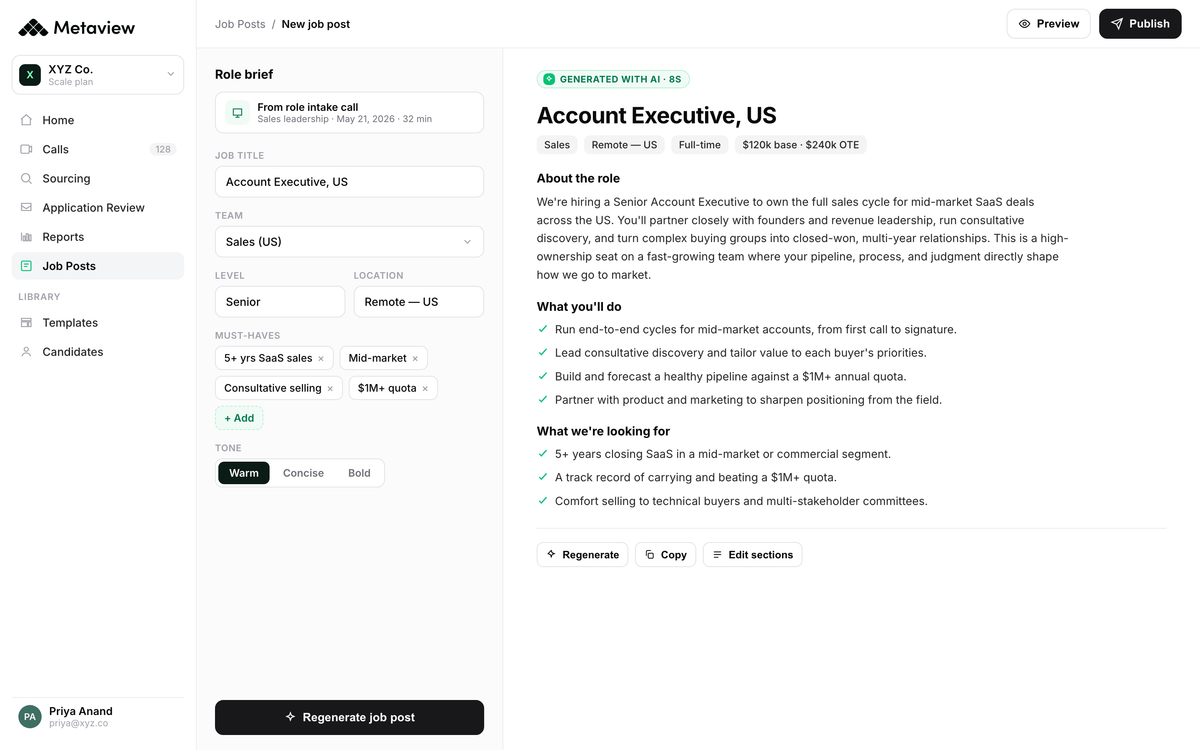
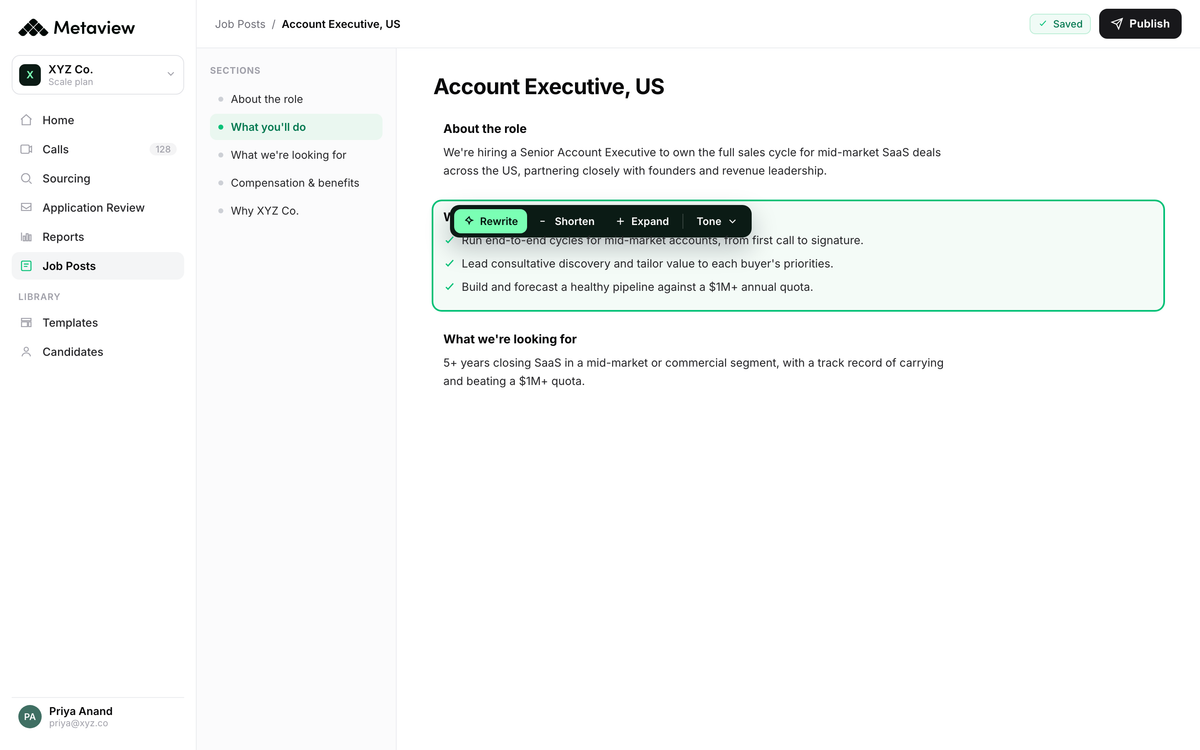
AI Job Posts generates suggestions to improve a job post based on the interviews and intake calls we recorded, so the post stays aligned with what recruiters and hiring managers are interviewing for.
Nothing goes out on its own. The suggestions land in an editable post, and the recruiter and hiring manager decide which ones describe the role they want to hire for.
Once you can read both versions, you can decide which one is the role. That's the difference between hiring for the post and hiring for what the team is now assessing.
- Written before the team met a single candidate.
- Can list requirements the team no longer tests, and miss ones it now probes hard.
- Candidates read it and apply against a version of the role the team has moved past.
- Built from what interviewers raised, call by call.
- Turns those recorded conversations into suggestions for the job post.
- The recruiter and hiring manager edit the post to match the role they're assessing.
What to do when the post has drifted.
Roles change once a team starts meeting candidates. The useful response is to let the published post keep up.
- A week into the search, list the requirements your interviewers are raising and set them against the ones you published. The gap tells you whether the post still describes the role.
- Once those requirements have settled, pull the published description back toward them. Candidates still in the funnel are reading the old version.
- The requirements that show up in interviews but never in the post are the ones worth promoting into your template, so the next search starts closer to the role.
One caveat on updating mid-search. Changing a live posting has fairness implications: the people who already passed on the role never saw the new version. Where the change is material, reopen the funnel instead of editing the page in place.
The post and the interviews are two records of the same role. Read them against each other and job description drift turns into something you catch during the search, not something you discover at the offer stage.
Bring Metaview into your hiring stack.
Live notes, structured scorecards, and ATS sync - set up in under 10 minutes.
Frequently asked.
What is job description drift?
It's the gap between the requirements in your published job post and the ones interviewers assess once the search is running. It differs from a scope change, where a team rewrites the role on purpose. With drift, the post stays put while the interviews move.
Why do job descriptions change once interviews start?
Because the post gets written before anyone has met a candidate, and the search itself teaches the team what the role needs. Most of that learning happens early, so a re-read a week or two in catches the bulk of it. After that, check again whenever the panel changes or the role sits open longer than planned.
Can you measure the gap between a job description and what's assessed in interviews?
On your own roles, yes. Take the requirement list from the published post, then write down the competencies your interviewers probed across the first few loops. Anything on the second list but not the first is a candidate for the post, and anything published that went untested is a candidate for deletion. At scale the same comparison is harder, which is why this study puts no number on it.
Can Metaview rewrite a job description automatically?
No. We generate suggestions for the job post based on the interviews and intake calls we recorded. They land in an editable post, and a person publishes it. If you take them mid-search, decide separately what to do about candidates already in the funnel: they applied against the old version.
How does measuring drift improve hiring?
It gives the team one version of the role to work from. With the post and the interviews side by side, a recruiter and hiring manager can see where they disagree about the requirements and settle it. The requirements that keep coming up are also the ones worth carrying into the next search.
