
The most common excuse a recruiter gives me, when I ask why a technical req is stuck, is some version of the same sentence: I am not an engineer, so I cannot really tell. The line has been around since the first non-technical recruiter tried to fill the first software role, and it is still the framing that costs the most companies the most senior engineers every year. It is also wrong.
The problem with technical recruiting is not that the recruiter is not an engineer. The problem is that nobody captured what the engineer said. The senior interviewer ran the call, the candidate answered three systems-design questions with real depth and two with conceptual sloppiness, and 30 minutes later the interviewer’s memory of the conversation is the only record. The recruiter has to debrief from that memory. The hiring manager has to debrief from that memory. The next interviewer in the loop has to calibrate against that memory. Every downstream decision is downstream of recall, and recall is the worst data source in recruiting.
This guide is about the version of technical recruiting that works without an engineering degree on the recruiter side, because the substrate is right. What you will get below: why the credentials framing is the wrong one, the five capture points an evidence-based interview system has to have, how Metaview’s technical-interview mode changes what the recruiter can read after the call, the ‘show me the moment’ debrief pattern that turns gut feelings into queryable signal, how the same captured language feeds outbound sourcing, and a 15-question intake template you can use on your next req.
What technical recruiting actually is (a capture problem, not a credentials problem).
Define technical recruiting in functional terms and the picture is the same on every team. It is the discipline of moving a senior engineer, a product engineer, a data engineer, or a platform leader from a passive state into a structured evaluation, then through an interview loop that produces enough signal to make an offer the hiring manager can stand behind. The candidates are scarce, the loops are expensive, and the signal that comes out the other end is the most under-instrumented part of the whole pipeline.
The auditor on the original draft of this article asked us to stop describing the role abstractly and start describing what changes when the interview is captured properly. We agree. The five-stage funnel for technical hiring is well known. The places it leaks are well known. The thing almost no team has wired correctly is the structured interview record underneath. Without it, the recruiter is running on the interviewer’s recall, the hiring manager is running on the recruiter’s recall, and the offer letter is running on a game of telephone.
The reframe we want to land in this section is the one in the heading. Technical recruiting is a capture problem, not a credentials problem. The recruiter does not need to have shipped production Go to fill a senior backend role. The recruiter needs the panel’s actual exchange, structured against the rubric the hiring manager defined at intake, in a format the recruiter can read after the call. Get the substrate right and the recruiter is the most informed person in the room, not the least.
- Recruiter shortlists on company logo, GitHub stars, and a 30-second résumé scan. Anything spoken in the interview evaporates with the call.
- Hiring manager debrief runs on memory. The recruiter cannot push back, because the recruiter never heard the technical exchange in detail.
- Two interviewers on the same panel ask different questions and assess the same competency at different bars. The recruiter has no way to see the drift.
- When a candidate is rejected, the recruiter cannot recover the specific moment that caused the no. Coaching, calibration, and candidate-side feedback all suffer.
- Every interview is captured at stage, structured against the rubric for the role. Code and systems-design talked through on the call show up as searchable notes after.
- Hiring manager debrief opens with the timestamped clips that decided the no, not a recall game. The recruiter can adjudicate because the recruiter has the same record.
- Panel coverage of competencies is visible by interviewer. Drift becomes a coaching conversation in week one, not a hiring miss in month six.
- Rejections come with a moment, not an adjective. Candidate-side feedback gets sharper, calibration debriefs get shorter, and recruiter-to-hiring-manager trust gets earned.
Why non-technical recruiters mis-evaluate technical interviews.
Here is the failure mode most non-technical recruiters fall into. The technical screen happens, the interviewer says ‘solid candidate, push to onsite,’ and the recruiter writes a five-line summary into the ATS that reads like a vibe check. The recruiter is not lazy. The recruiter is filling in the gap between what was said on the call and what the recruiter is qualified to interpret, and the gap is wider than the recruiter has time to close. So the gap gets papered over.
What works instead is to remove the gap. If the call is captured against a rubric, the structured notes after the call do the interpretation work that the recruiter would have had to fake. The recruiter does not have to know whether the candidate’s answer to the bipartite-matching question was strong or weak. The recruiter has to know that the question was asked, that the answer was captured, that the rubric line was scored, and that the interviewer’s reasoning lives on the same record. The recruiter is instrumenting the conversation, not adjudicating it.
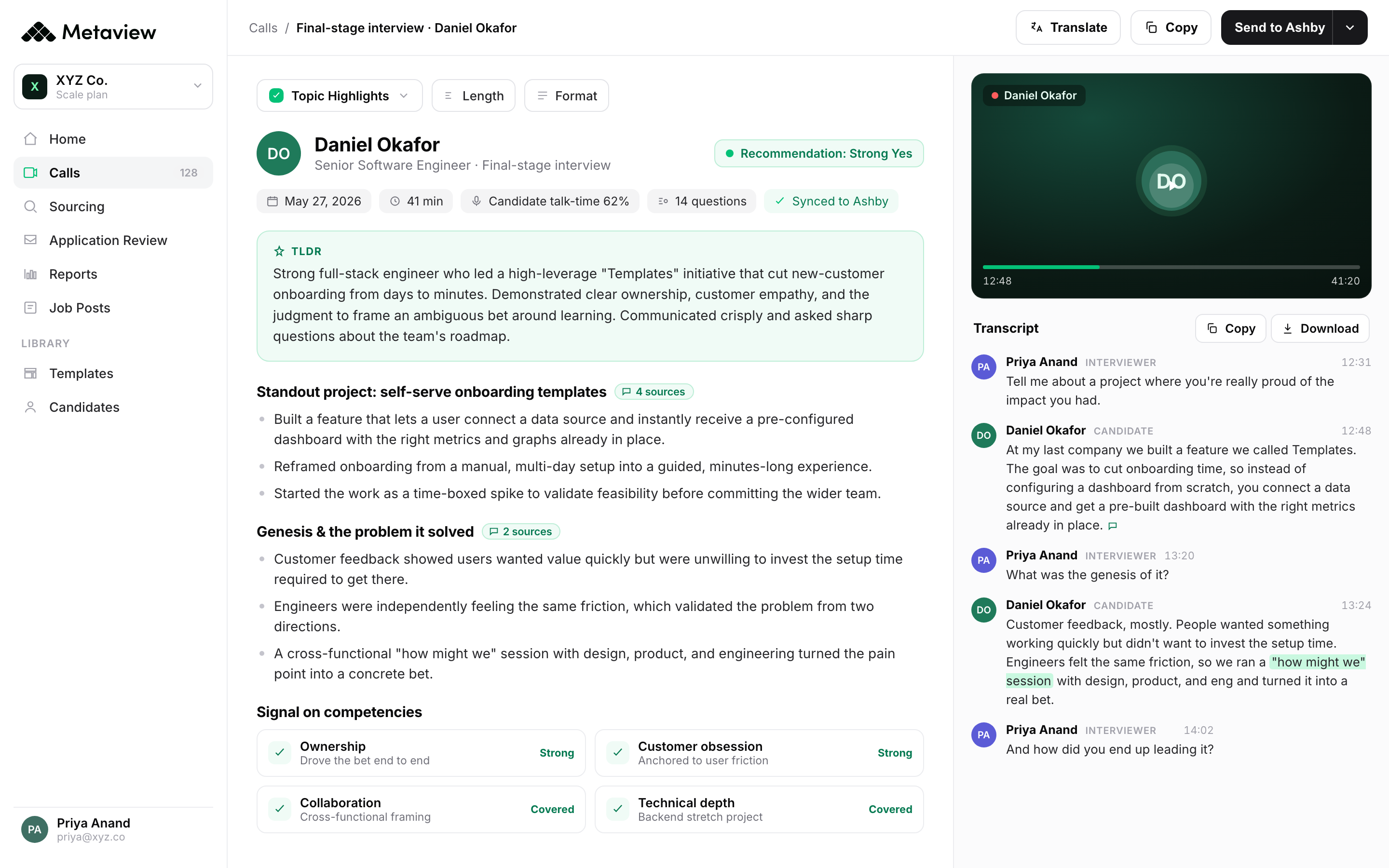
Metaview shipped dedicated technical-interview conversation types in late January 2026. The model reads code talked through on the screen and systems-design whiteboards drawn during share, and folds both into structured notes the recruiter can scan in two minutes after the call. The recruiter does not have to read the transcript line by line. The recruiter scans the rubric line by line, sees which competencies got real engagement and which got skipped, and walks into the debrief with the same picture the interviewer has.
The case for instrumenting the substrate is now data-backed, not hypothetical. According to Metaview’s 2026 AI & Hiring Alignment Report - surveying 505 recruiting leaders and hiring managers across North America and EMEA, 85% of companies exceeding their hiring goals use AI in hiring, and teams using AI are 3.8x more likely to rate their cross-functional relationship as excellent. The compounding lives in the captured signal, not the chat tool wrapped around it.
My background is in economics. I used to be a teacher. I don't know anything about Python coding. I'd see feedback coming in and I wasn't technical enough to question it in the room. Now I prompt Talent Atlas: is this person being evaluated correctly? It scales technical expertise to me through AI.”
The 5-stage evidence trail (for recruiters without an engineering degree).
The evidence-based version of technical recruiting has five capture points. None of them is exotic. All of them are skipped on the average team. Here is the order, with the specific artifact each stage produces and the rubric line that comes out the other side.
- Intake call (recruiter and hiring manager). Capture the hiring manager’s definition of ‘good’ for the role in their own language. The artifact: the 15-question intake template scored against the role rubric, with hiring-manager voice quoted verbatim. This is the source document every downstream stage runs against.
- Phone screen (recruiter and candidate). Capture the candidate’s technical vocabulary, recent project depth, and stated trade-offs. The artifact: a structured screen note bound to the role rubric, with candidate language quoted. The recruiter is not assessing technical depth here. The recruiter is checking whether the candidate’s vocabulary maps to the hiring manager’s.
- Technical screen (engineer and candidate). Capture the candidate’s engagement with concrete technical scenarios. The artifact: structured notes on the specific problems posed, the candidate’s answers, and the interviewer’s reasoning for each rubric line. Code on screen and systems-design whiteboards are folded into the same record.
- Onsite panel (multi-interviewer loop). Capture coverage across the rubric, drift between interviewers, and competency-by-competency signal. The artifact: a panel-level report that shows which rubric lines got real engagement and which got skipped. Coverage gaps are visible before the debrief, not after.
- Debrief (recruiter, hiring manager, panel). Capture the specific moments that decided the call. The artifact: a debrief grounded in timestamped clips from the panel, not panel memory. Offer recommendations cite the moment, not the adjective. The same record becomes the candidate-side feedback if the answer is no.
Skip any one of these five and the next stage runs on recall. The candidate-side cost is bad feedback and a weaker employer brand. The team-side cost is calibration drift, debrief drift, and offer letters that do not match the conversation the candidate had. Capture all five and the recruiter sits in the middle of the highest-resolution picture of a hiring loop the team has ever had.
How Metaview captures what engineers actually say.
Metaview is the layer that runs across all five capture points. The interview joins on the panel’s calendar, listens through the call, and produces structured notes after, against the rubric for the role. The recruiter, the hiring manager, and the next interviewer in the loop all read the same record.
The combined effect is that the recruiter walks into the debrief carrying the same evidence the panel does.
The ‘show me the moment’ debrief.
There is a specific pattern in the panel debrief where evidence-based technical recruiting either lands or falls apart. Five panelists walk into the room. Two say strong hire, two say no, one says lean no. The recruiter has to facilitate. Without the substrate, the recruiter has to take the strongest opinion in the room and call it the panel decision, because nobody can adjudicate at the level of detail required to actually reconcile the panelists.
With the substrate, the recruiter opens the debrief differently. ‘Let me show you the moment the no votes are pointing to. Here it is at 18 minutes in. Then here is the moment the strong hires are pointing to, at 47 minutes in. Are we talking about the same competency in both clips, or two different ones?’ That is the conversation that moves the panel. Lydia An at Brex described it precisely in her case study, in the section about going back to the panel record to see what was actually said. The screenshot below is the artifact that conversation runs on.
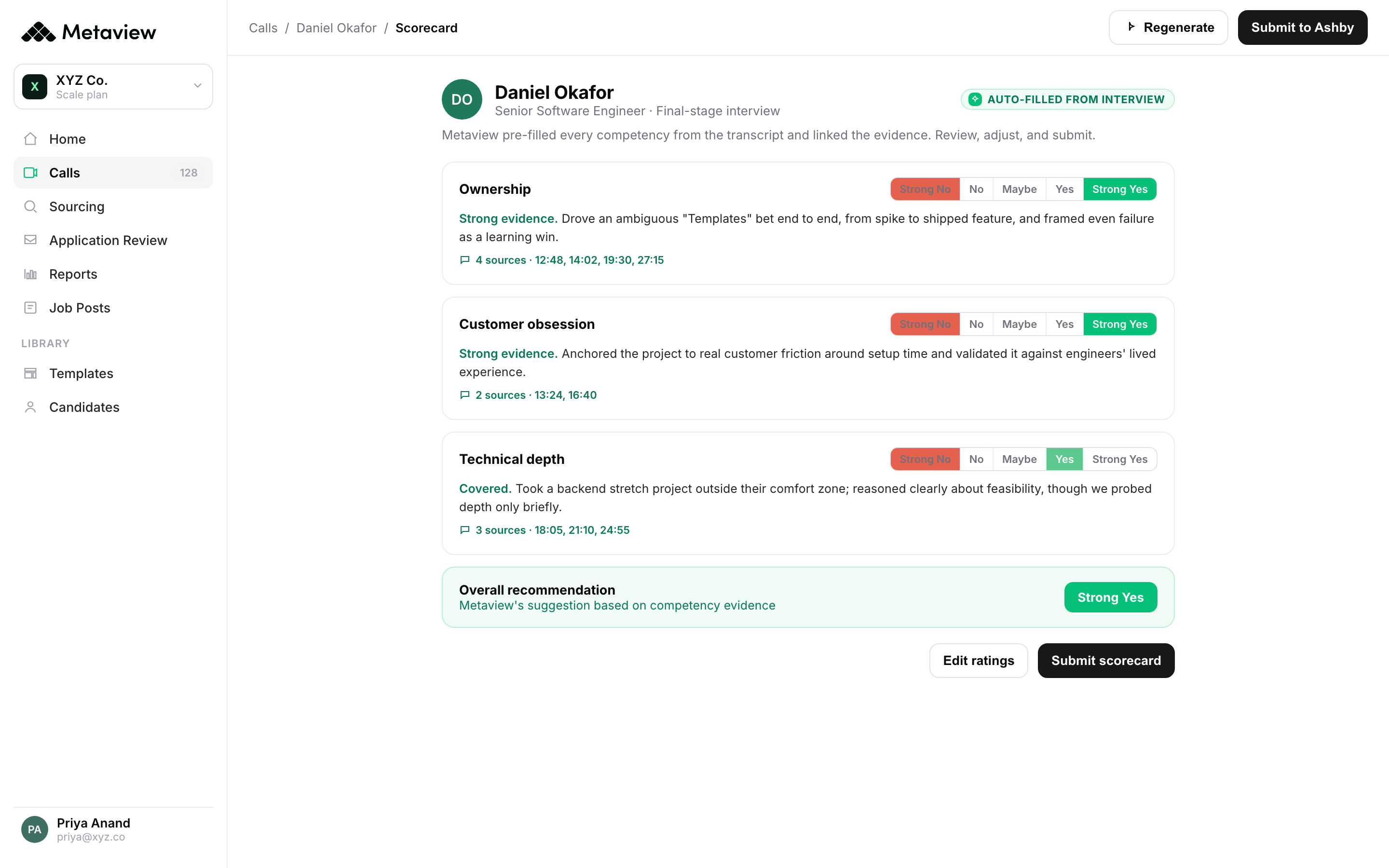
- 1Structured Q&A capture. The candidate’s answer is bound to the specific question asked, not a free-text blob the recruiter has to interpret later.
- 2Skill tags surface inline. Recruiters who never wrote production code can still tell which competencies the candidate engaged with, and which the panel never asked about.
- 3A timestamped moment, shareable as a clip. This is the artifact the hiring manager can scrub to during debrief, instead of running the conversation on memory.
The shift is small in mechanics and large in outcome. The debrief stops being a contest of recall and starts being an adjudication against shared evidence. The recruiter is the one who has the evidence ready, because the recruiter is the one with the rubric and the record loaded on the same screen.
On the question of what actually makes a great interviewer great, and how you read what is happening inside their head while they run a panel, this short 10x Recruiting episode is the best one we have seen. The capture argument lands harder once you have heard it described from inside the interview itself.
Sourcing without deep domain knowledge.
The sourcing version of the same problem is that the recruiter has to write outbound copy that gets read by a senior engineer who has 60 messages in their LinkedIn inbox already. The shortcut almost every recruiter tries is to paraphrase the role into ‘recruiter-friendly’ language. The senior engineer reads two lines, recognizes the paraphrase, and deletes the thread. The shortcut that works is the opposite: lift the hiring manager’s actual intake-call language and use it verbatim.
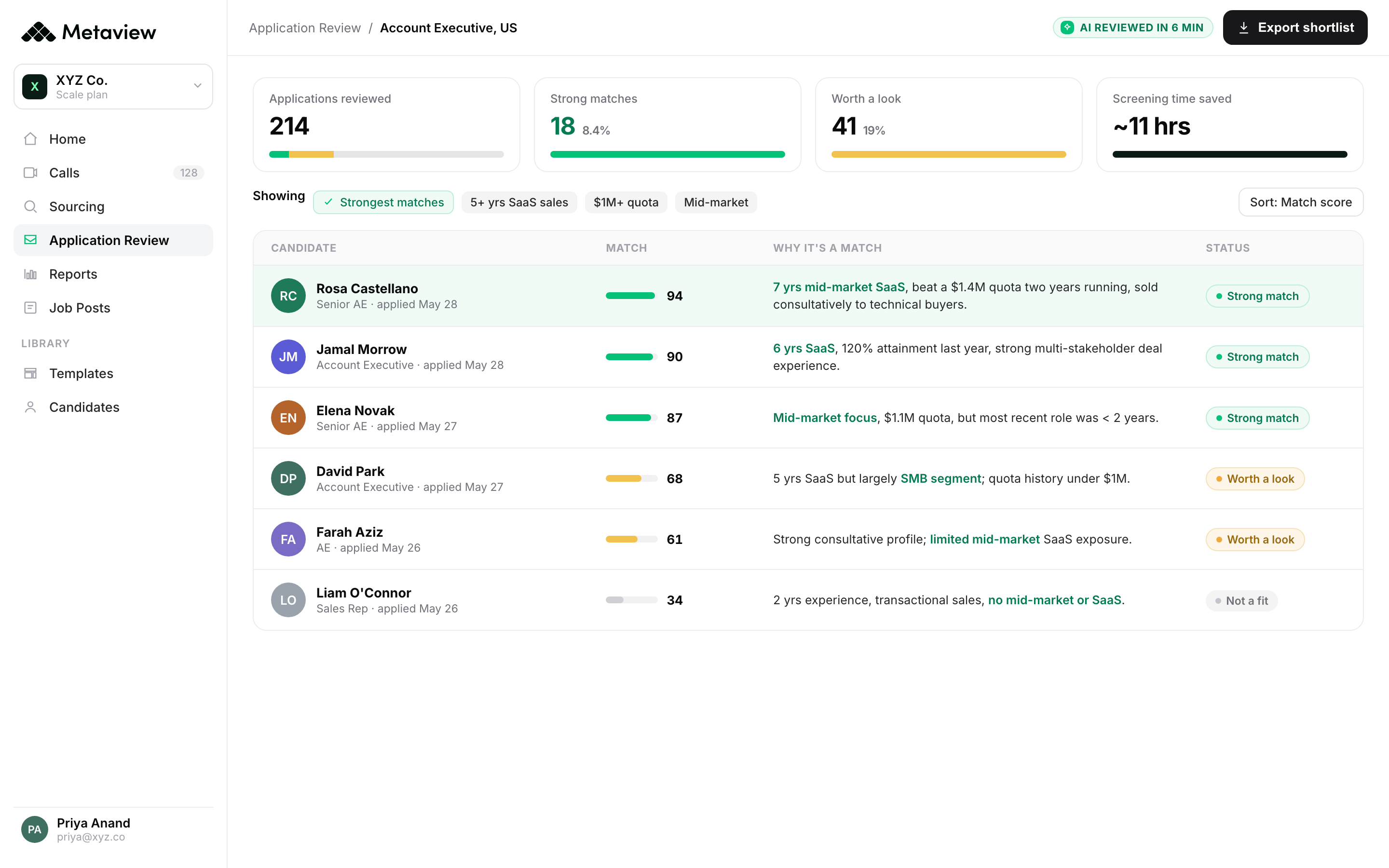
On the inbound side, the same intake-call language drives the rubric Application Review runs against. Application Review ranks inbound applications against the ideal-candidate profile the hiring manager actually described, with flags for AI-generated answers and fabricated experience. The technical-recruiting audit problem (candidates who pass screen on a polished pitch and fail on substance) gets diagnosed before the recruiter wastes a phone screen on it. The screenshot below shows the Application Review surface with the AI-generated and fraud flags called out.
We may need to know whether a recruiter or hiring panel went deeper on a certain topic. Being able to go back to Metaview, pull those exact notes, and see exactly what was said has been really helpful.”

The 15-question technical intake template.
The 15-question template is a 30-minute intake conversation, run by the recruiter on a hiring manager, that produces a working rubric the panel can stand behind. The point of the template is that the recruiter does not need to know the right answer in advance. The recruiter needs to capture the hiring manager’s answer, on the record, in language the panel can recognize. The 15 questions cluster into five themes. Each theme below opens to the questions in that group, with a short scoring guide on what to listen for.
The role definition (questions 1 to 3)
Before you write a single outreach message, the recruiter has to know what the hiring manager will actually accept and what they will absolutely reject. These three questions pin that down on the record.
Signals from past hires (questions 4 to 6)
The pattern in past panels is the rubric in disguise. Three questions to surface what the bar actually is, not what the job description says it is.
The technical bar (questions 7 and 8)
Two questions to turn an abstract role description into a concrete bar the panel can agree on. The technical screen runs against these answers.
The panel and the process (questions 9 to 11)
Three questions to map who is on the panel, how they calibrate, and what the candidate-side experience looks like at every decision point.
The close (questions 12 to 15)
Four questions to close the loop from offer to 90-day retention, so the recruiter knows the ceiling, the pitch, the competitive landscape, and how the team will measure whether the hire actually worked.
Captured properly, the answers to these 15 questions become the source of truth every downstream stage runs against. The rubric for the technical screen comes from question 7. The anti-pattern flag in Application Review comes from question 3. The candidate-side feedback at offer rejection comes from question 11. The offer pitch at acceptance comes from question 13. The recruiter is not guessing on any of it. The hiring manager said it, on the record, in week one.
- 01 The three competencies you will absolutely hire on, in priority order
- 02 The two competencies you would accept ramping on, given the right candidate
- 03 The anti-pattern that immediately disqualifies a candidate at this level
- 04 The last senior engineer hired into this team and what the panel said
- + 11 more questions, with scoring scales and example answers
The 15-question technical intake template.
The exact 15 questions to ask a hiring manager at intake so the recruiter walks out of the call with a working rubric, not a vibes-based brief. Plus the scoring scale we use to calibrate panels in week one.
Unsubscribe with one click.
Frequently asked.
Do technical recruiters need to be engineers?
No. The argument that a recruiter must have shipped production code to recruit engineers conflates two different jobs. The engineer’s job is to evaluate technical depth in real time. The recruiter’s job is to capture, structure, and adjudicate the signal that comes out of those evaluations. Recruiters who instrument the capture layer correctly out-recruit engineering recruiters who run on memory. The bar is rubric discipline, not Stack Overflow reputation.
What makes a technical interview process effective?
Three things in this order. A rubric that maps to the hiring manager’s actual definition of ‘good’ for the role (the intake-template part). Coverage across the panel so every competency in the rubric gets at least one real exchange (the panel-coverage part). And a debrief that runs off the structured signal of who said what, not the freshest memory in the room (the capture part). Skip any one and the process is structured on paper but unstructured in practice.
How can non-technical recruiters evaluate technical interviews?
They do not evaluate the technical answer directly. They evaluate whether the panel covered the competencies in the rubric, whether the candidate’s engagement on each competency matched the bar in the intake template, and whether the hiring manager’s scorecard cites a specific moment from the call. If the recruiter has a structured record of the conversation, a timestamped clip for each scorecard line, and the rubric to map them against, the recruiter can adjudicate any technical interview without writing a line of code.
Why do technical hiring decisions often feel subjective?
Because they usually run on recall. Two interviewers walk out of the same loop with two different stories about the same candidate, and there is no shared record to reconcile them. Capture changes the room. When the debrief opens with the panel’s actual exchange instead of the panel’s actual memory, ‘I felt’ gets replaced by ‘at 22 minutes in, here is what the candidate said,’ which is a different kind of conversation.
How can recruiters improve technical sourcing without deep domain knowledge?
By treating the hiring manager’s intake-call language as the source for outreach copy. The same vocabulary the hiring manager used to describe the role (the systems they care about, the trade-offs they want to see candidates engage with, the anti-patterns they reject) is the vocabulary that gets responses from senior engineers. If the intake call was captured and tagged, the recruiter can lift the language straight from the transcript instead of paraphrasing it into a sourcing-friendly version that no engineer will recognize.
How do you build a 15-question technical intake without an engineering background?
You hold a 30-minute intake call with the hiring manager and you ask the questions the template covers: the three competencies they will hire on, the two competencies they will accept ramping on, the anti-patterns that disqualify, the senior engineer they hired last whose loop went well, the senior engineer they passed on whose loop also went well (and why), the technical signal that decided each, and so on. The point of the template is not that the recruiter answers the questions. The point is that the hiring manager answers them, on the record, in language the panel can stand behind. The recruiter’s job is to capture and structure, not to know the answer in advance.
