
Walk into any 200-person hiring function in 2026 and you can guess what's missing inside the first hour. Recruiters know the candidates, hiring managers know the role, leadership knows the goals, and yet the function still feels brittle. Intake calls drift. Scorecards live in six different formats. The ATS holds half the truth, a spreadsheet holds the other half, and the question did we actually assess what we said we'd assess? has no clean answer. That gap is what talent acquisition operations exists to close.
And the data backs the urgency. According to Metaview's 2026 AI & Hiring Alignment Report - surveying 505 recruiting leaders and hiring managers across North America and EMEA - 58% of recruiting leaders and hiring managers actively wish they could work around their counterpart, 79% of teams with high alignment exceed their goals, and 85% of companies exceeding hiring goals have AI core to their hiring process. The teams winning aren't the ones with more recruiters. They're the ones with an operating layer that captures the right signal at every stage and feeds it back to the people making decisions.
This guide is the operator's view of that layer. The 5 jobs the role actually owns. The 6 triggers that tell you it's time to hire one. The 90-day install plan that turns ad-hoc recruiter admin into compounding hiring infrastructure. And the place Metaview sits inside the stack - as the signal layer that makes ops viable in the first place.
What talent ops actually is (and isn't).
Talent ops, talent acquisition ops, recruiting operations, RecOps - the labels overlap enough that most TA leaders use them interchangeably until the day they actually hire for the role. Then the difference matters. Talent acquisition operations is the operating layer beneath a hiring function: workflow design, tooling decisions, data instrumentation, interview consistency, and the cross-functional reporting that lets leadership see what's happening in hiring without anyone exporting a CSV at 11pm on a Sunday.
What it isn't: a fancy coordinator title, an extra recruiter, or a people-ops generalist who also runs hiring on the side. Talent ops sits in the same relationship to recruiting that platform engineering sits to product engineering. The platform team doesn't ship features. It builds the rails that make the feature team's work compound. Talent ops doesn't run requisitions. It builds the rails that make the recruiter's work compound, interview by interview, panel by panel, quarter by quarter.
The cleanest test: if a process improvement only lives in one recruiter's head, that's not talent ops yet. The role exists to turn ad-hoc improvements into standardized, instrumented, and inheritable infrastructure that every recruiter benefits from, including the recruiter you haven't hired yet.
The 5 jobs of a talent ops function.
Five things sit on the desk of a real talent acquisition operations lead. Smaller teams compress them into one part-time scope. Larger teams split them across a 3-4 person ops function. The shape of the role changes with company size. The shape of the work does not.
1. Process design and optimization.
The job is to be the one person in the team who can answer, on demand: what is our intake process for an exec hire, and how does it differ from a backfill? That means owning the steps from kickoff to offer, naming who does what at each stage, codifying what good looks like for interviewer prep, scorecard submission, and debrief, and killing the steps that aren't load-bearing. Without process ownership, every requisition becomes a custom build.
2. Tools and technology management.
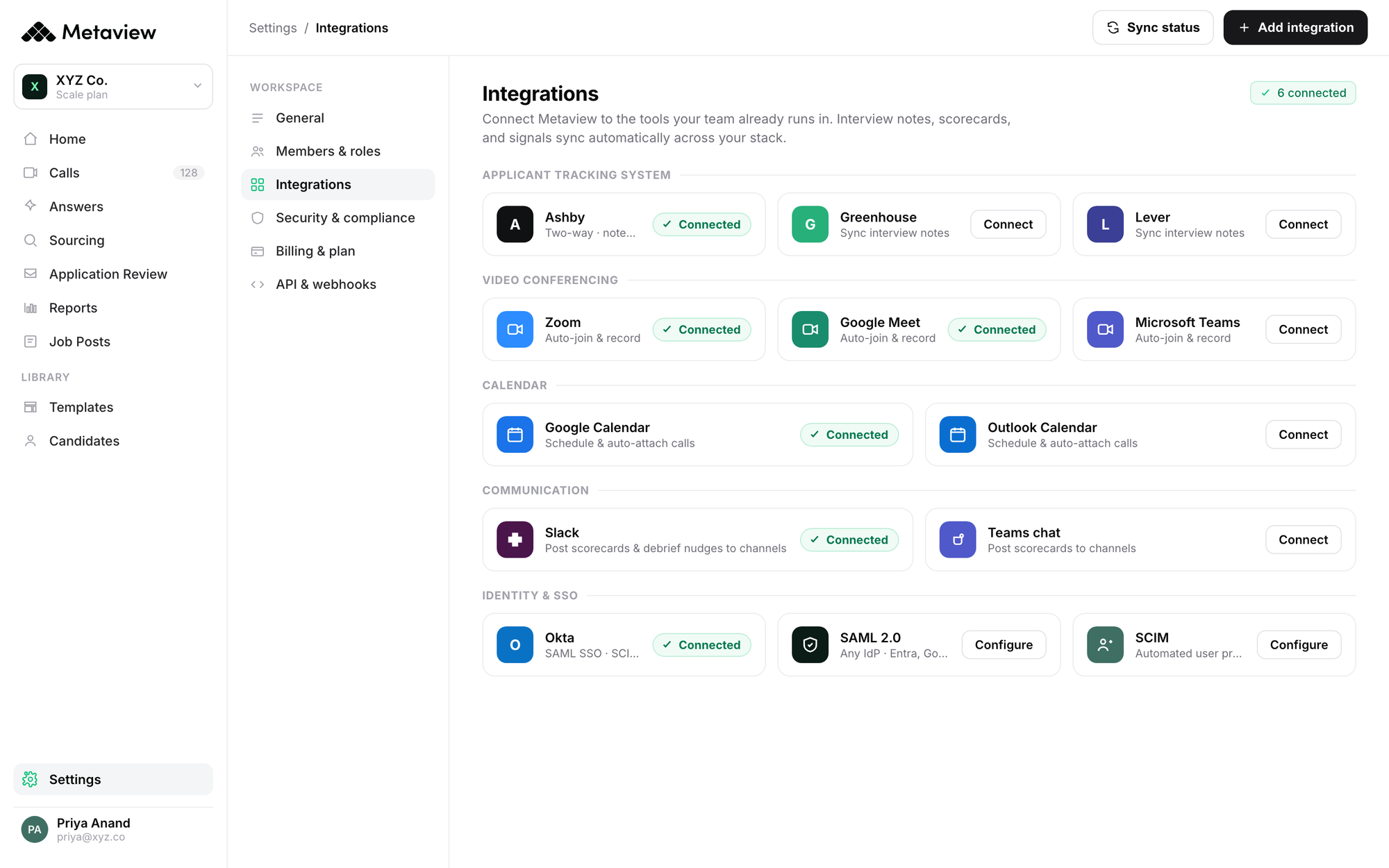
The job is to own the recruiting tech stack the way a head of platform owns engineering infrastructure. That means deciding what the ATS does and doesn't own, picking the interview intelligence layer, sunsetting the sourcing tool nobody opens anymore, and negotiating the integrations that make data flow between systems. The average hiring team is running 11+ tools by 2026. Without an owner, every recruiter ends up running a personal stack on top of the shared one.
3. Data, reporting, and insights.
The job is to make hiring data legible to the CFO and the Head of TA without anyone manually exporting CSVs. That means setting up the reporting layer, defining the metrics that actually move (time-to-fill, offer-acceptance, interviewer talk-ratio, scorecard submission rates, source effectiveness), and giving leadership a way to ask questions of the data in natural language instead of waiting for a quarterly slide. This is where the role earns its keep most visibly.
4. Interview operations and quality.
The job is to make every interview consistent enough that signal compounds across a panel. That means owning the interview template library, the scorecard rubrics, the assessment criteria for each role family, and the calibration loop that catches drift before it shows up in offer-acceptance. Interview operations is where weak talent ops teams underinvest. Strong ones make it the centerpiece.
5. Cross-functional coordination.
The job is to be the glue between TA, hiring managers, ATS admins, Finance, IT, and the people analytics team. That means owning the kickoff template, the weekly hiring syncs, the headcount planning ritual, the comms with Finance on offer approvals, and the relationship with IT on integrations and SSO. Cross-functional work is unglamorous but it's what turns hiring from a department into a system the business can rely on.
For every candidate Gasper gave a strong yes, 87% ended up with the offer. Doesn't matter if it was a values or coding interview, strong yes meant offer. So I dumped all his transcripts into ChatGPT to extract the actual behaviors that distinguished strong-yes from yes from fail. Three hours of work on a Friday night.”

Why the role is exploding in 2026.
Three structural shifts are pulling the role into the center of every serious TA org in 2026. None of them are about "hiring more recruiters." All of them are about who owns the operating layer.
The stack got too big to run from anyone's notebook. Recruiting teams average 11+ tools by 2026 - ATS, sourcing, scheduling, assessment, interview intelligence, video, BI, comms, agencies, contractor management, plus whatever vertical-specific stack the business runs. Without an owner, every recruiter assembles a personal version of the workflow and the data layer fragments by individual.
AI made coordination harder, not easier. The 2026 Alignment Report's headline finding is the trust gap inside hiring functions, and the report's prescription is blunt: organizations seeing the worst results are the ones with individual copilots that make each person faster in isolation. The ones seeing the best results have shared systems that help teams work from the same reality. That work doesn't happen by accident. Somebody has to own it.
Leadership wants legible hiring data, not vibe checks. Boards and CFOs are starting to treat hiring the way they treat sales pipeline: as a measurable function with leading indicators and a forecast. That conversation requires somebody who can answer questions like which interviewers carry the highest false-positive rate? and how does scorecard submission time correlate with offer-acceptance? in real numbers. Recruiters can't take that work on without giving up sourcing time. So a new role appears.
How talent ops compounds across the hiring stages.
Talent ops is most visible at the level of single fixes - a cleaner intake template, a tighter scorecard - but the role pays back at the compounding level. Every hiring stage produces signal. Either an operating layer captures that signal, makes it legible, and feeds it back into the next stage, or it leaks into nobody's head and the team relearns the same lesson on the next requisition.
The 5 stages of a typical hiring flow each have a signal leak that ops closes:
- Intake. The job spec is built off whatever the hiring manager said in a 30-minute meeting. Ops captures the meeting, turns it into a structured rubric, and feeds the rubric into the screening agent and the interview template library.
- Screening. Recruiter phone screens produce notes that vary in quality by recruiter. Ops captures every screen, auto-fills the scorecard, and surfaces the recruiter-talk-time and competency-coverage stats nobody used to see.
- Panel. Each interviewer prepares from a different version of the rubric. Ops standardizes the template, auto-builds the scorecard from the conversation, and posts everything into the ATS without anyone copy-pasting.
- Debrief. Decisions get made on the most recent panel's strongest impression. Ops surfaces cross-panel summaries with the candidate's quotes and competency scores in one view, so the decision is based on the whole record, not just the loudest interviewer.
- Offer + post-hire. Whatever made the candidate compelling never gets fed back to onboarding or to next quarter's calibration. Ops closes that loop through the reporting layer and the rubric library.
Each fix is incremental on its own. Together they compound. The compounding is what makes the role pay back.
- 1Intake quality: surface the intake-meeting clauses that drove rubric drift.
- 2Screen consistency: per-recruiter talk-ratio and competency coverage.
- 3Panel calibration: variance flags when two interviewers disagree on the same competency.
- 4Debrief inputs: cross-panel quote summaries already structured by competency.
- 5Post-hire loop: the strong-yes behaviors that predicted offer-acceptance, ready to feed back into the rubric.
6 triggers: when to hire your first talent ops role.
Companies usually wait too long to hire the first talent ops role, which means by the time they hire, the function is already firefighting. The 6 triggers below show up roughly in order. By the second one, it's time to start scoping the role. By the fourth, you're behind.
- Recruiters are spending more than 30% of their week on admin instead of conversations. Notes, scorecard chasing, scheduling exceptions, ATS data hygiene. Recruiters can carry this load for 6 months, not 18.
- Hiring managers complain that interviews "feel different" depending on who runs them. Translation: scorecards aren't being filled the same way, rubrics drifted, and nobody owns calibration.
- Half your hiring data lives in spreadsheets that nobody trusts. If the answer to what is our offer-acceptance rate by source last quarter? takes more than a day to produce, the role is overdue.
- Onboarding a new recruiter takes more than six weeks to full ramp. That means there is no documented playbook, only tribal knowledge. Talent ops is the function that turns tribal knowledge into a recruiter handbook.
- Your tools are fragmented and nobody owns the stack. Each recruiter has a slightly different setup, integrations are flaky, and renewals get pushed because nobody can defend usage.
- Leadership is asking questions you can't answer in 24 hours. CFO wants cost-per-hire by function, board wants forecast confidence, CEO wants to know which interviewers carry the highest false-positive rate. If those questions take a week each, you needed talent ops two quarters ago.
The Metaview signal layer for talent ops.
Talent ops without a signal layer is mostly process work. Templates, checklists, manual rollups, hours-long calibration meetings. The work moves the function forward but the operating leverage stays low because every artifact has to be produced by hand. The role doesn't compound until there's an underlying capture-and-structure layer that turns the raw material of hiring - interviews - into ready-to-use signal. That's where Metaview sits.
Each of the 5 jobs maps to a Metaview surface that's already shipping:
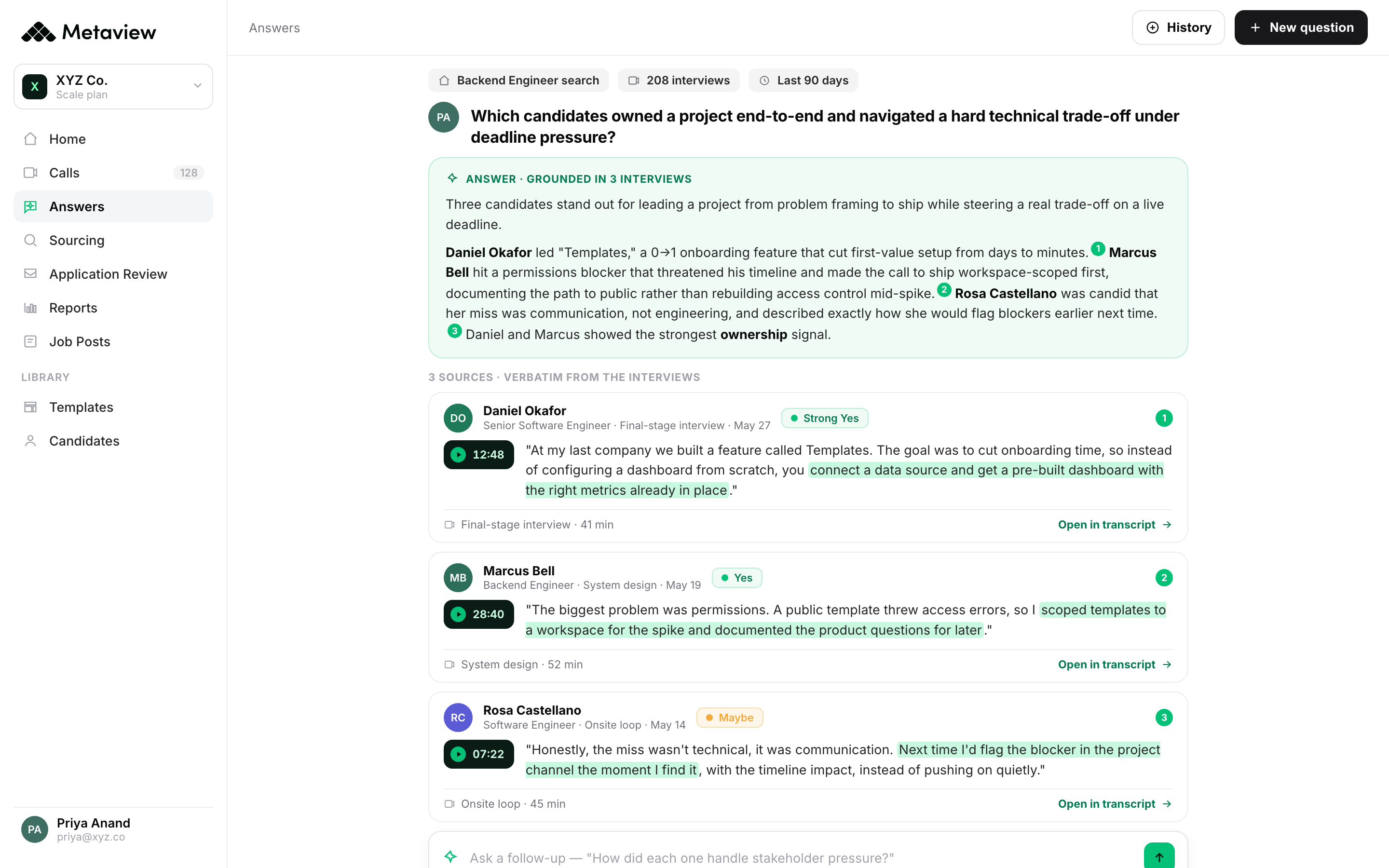
- Process design + interview ops. Meeting auto-detection picks up the interview, the template library auto-loads the right rubric for the role family, the AI captures the conversation, and the Scorecard Autofill writes the structured assessment back to the ATS without anyone typing it twice.
- Tools and technology management. Native integrations with Ashby, Greenhouse, Lever, SmartRecruiters, Teamtailor, Workable, and Gem mean ops decides where data lives once and stops re-deciding per requisition.
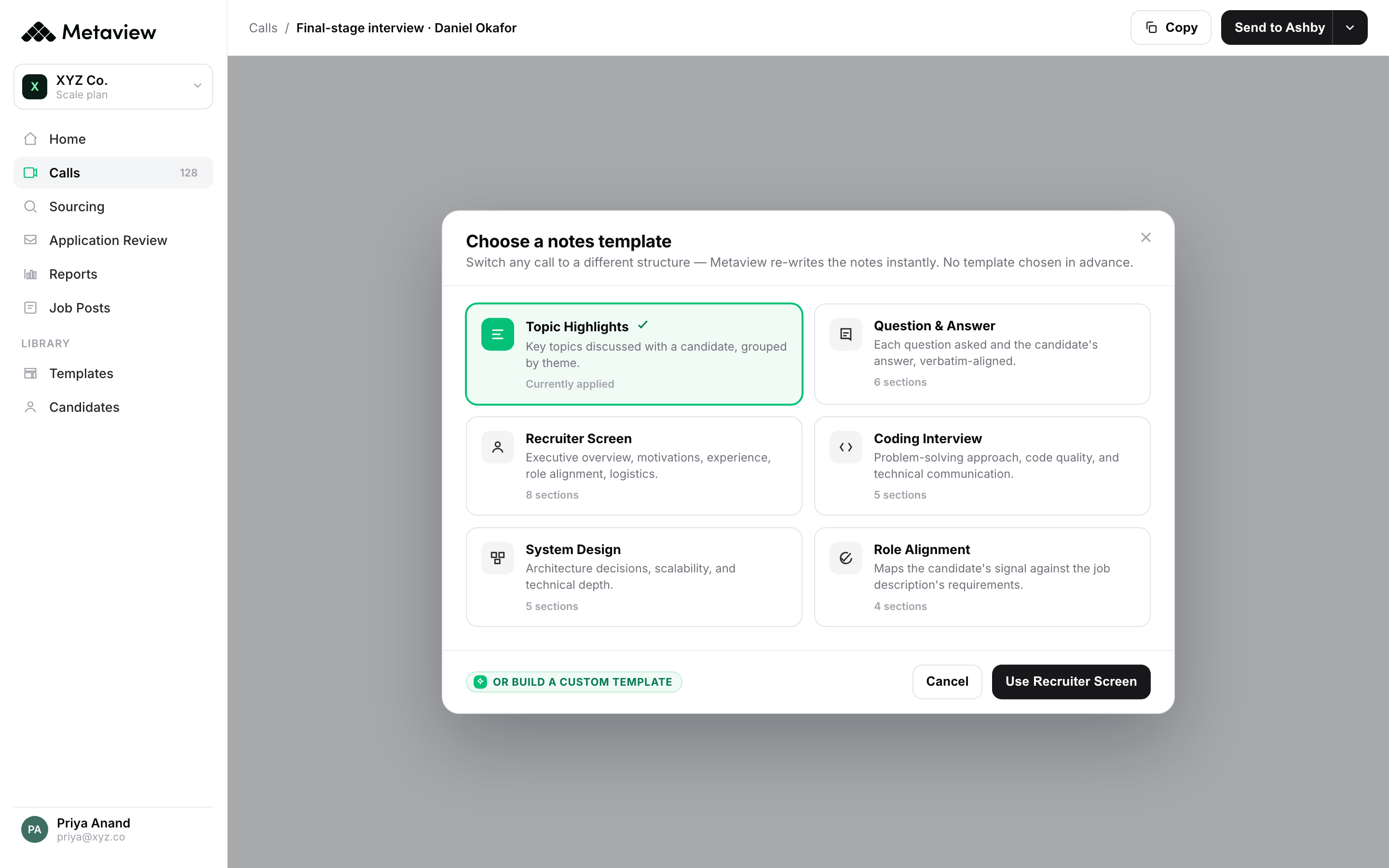
- Data, reporting, and insights. Reports gives you the hiring data layer your CFO actually wanted. The Reports MCP lets agents (and your ops lead) query interview data in natural language - which interviewers carry the longest talk-time?, what's our scorecard submission SLA by recruiter? - without writing a SQL line.
- Cross-functional coordination. AI Filters lets hiring managers, ops, and TA leadership pull the same view of the data with whatever filter combination they need (employment type, seniority, source, custom ATS fields). When everyone is querying the same source of truth, the alignment problem stops being structural.
- Top-of-funnel process design. Application Review screens inbound applicants against the ICP you built in intake, re-ranks on Metaview's calibration data from completed interviews, and surfaces fraud + AI-generated application detection before the recruiter wastes a screening slot.
| Dimension | Without talent ops | Reactive RecOps | Talent ops, no signal layer | Talent ops + Metaview |
|---|---|---|---|---|
| Workflow design | Recruiter-by-recruiter | Fixed in flight when something breaks | Documented, manual to maintain | Documented, instrumented, auto-enforced via templates |
| Tooling decisions | Nobody owns the stack | Renewals owned, integrations not | Stack rationalized, data still fragmented | Stack rationalized, ATS + interview + reports one fabric |
| Data layer | Spreadsheets nobody trusts | Quarterly slide deck | Dashboards that need manual rollups | Self-serve natural-language queries on live interview data |
| Interview consistency | Drift by interviewer | Drift caught at debrief | Templates standardized, scorecards manual | Templates standardized, scorecards auto-filled, calibration loop closed |
| Cross-functional reporting | CFO waits a week | CFO waits 24 hours | CFO gets the deck | CFO asks the agent and gets the answer in minutes |
The most clear impact is the time saved. Recruiters save 20 minutes per interview from wrangling notes and submitting scorecards. Per month, that's 53 hours saved in total.”

The 90-day install plan.
Walking into a function that needs talent ops, the work compresses cleanly into a 90-day plan. The phases overlap but the gating decisions go in this order:
Days 1-30: Audit and decide.
- Map the current state. Tools in the stack, who uses what, what data exists where, what's documented and what lives in someone's head.
- Pick the first 3 leaks to plug. Usually: intake quality, scorecard consistency, and reporting latency. Resist the urge to fix everything at once.
- Get the interview intelligence layer + the ATS talking. This is the foundation everything else compounds on top of.
Days 31-60: Install the signal layer.
- Standardize the interview template library against the role families that drive 80% of your hiring volume.
- Deploy capture + scorecard autofill so the recruiter never types a scorecard from scratch again.
- Build the reports layer. Pick 5 metrics that move the business, expose them as dashboards, and decide who owns the answer when each one moves.
Days 61-90: Compound.
- Run your first proper hiring-velocity review off the new dashboards. Calibrate. Decide what's automated, what's owned by ops, what goes back to recruiters.
- Close the post-hire loop. Pull 90-day quality-of-hire signal back into the rubric library for the next round.
- Hand recruiters a documented playbook. The test of success is that the next recruiter you hire ramps in 3 weeks instead of 6.
 Siadhal Magos
See how the signal layer fits behind talent ops - live capture, auto-scorecards, and ATS sync in one fabric.
Frequently asked questions.
What's the difference between talent acquisition operations and recruiting operations (RecOps)?
The labels overlap. In practice, talent acquisition operations is scoped to hiring outcomes - workflow design, tooling, interview consistency, and the data layer specific to hiring. RecOps is sometimes used as a synonym, sometimes used to describe a broader ops function that also covers sourcing infrastructure, onboarding handoff, and recruiter enablement. Write your JD against the hiring outcomes you want to move and don't get stuck on the label.
Do small companies need talent ops?
Companies under 200 employees usually don't need a full-time talent ops hire. They do need the work to get done by somebody - typically the Head of TA or a senior recruiter wearing the ops hat part-time. The trigger to graduate to a dedicated role is when the part-time owner can't keep up, hiring managers stop trusting the data, and onboarding new recruiters takes longer than six weeks. After that point, every quarter you wait costs you more than the role would have.
Does Metaview replace a talent ops hire?
No, and that's the wrong way to think about it. Metaview is the signal layer that makes talent ops viable - capture, scorecard autofill, reports, AI Filters, and integrations into your ATS. The talent ops lead is the role that decides how that signal gets used: which templates, which metrics, which interviewers need calibration, which roles need a different rubric. Tooling without an owner stagnates. An owner without tooling burns out.
What metrics should a talent ops lead own?
The core set is: time-to-fill (with leading indicators broken out), offer-acceptance rate, interviewer talk-ratio, scorecard submission time, source effectiveness, and 90-day quality-of-hire signal. Underneath those, a strong ops lead also tracks calibration variance per role family, recruiter ramp time, and the percentage of requisitions running on the standard template vs. custom one-offs.
How do you justify the talent ops headcount investment to leadership?
Anchor on three numbers: recruiter time-back (20 minutes per interview, 53 hours per recruiter per month is the published Automattic benchmark), reduced ramp time for new recruiters (3 weeks vs 6), and reporting latency (CFO answer in minutes instead of a week). When you can show those three numbers moving by quarter end, the role pays for itself inside the first two hires it makes possible.
