
There's a quiet advantage on the teams hitting time-to-hire targets. An opted-in audience of candidates who already know the brand. They didn't source them last week. They've been talking to them for months.
That audience is the talent community. It's the brand-engagement layer upstream of every channel you already run, and it's why some recruiting teams start every req warm while others start from zero.
The playbook below runs in five steps. CRM is where the community lives, engagement is what tells you who's ready, and content cadence is what keeps both alive.
How a talent community is different from a hiring pipeline.
The instinct is to lump everyone interested in your company into one pipeline. That's a category error. The pipeline is a working list of candidates for an open req. The community is the upstream hiring pool you draw on when reqs open.
Pipelines live in your ATS, last weeks, and close when the req closes. Communities live in your CRM, last years, and grow over time. Pipelines measure conversion to offer. Communities measure engagement and readiness.
The implication for your sourcing motion is direct. Every req opens warm, then sourcing fills the gap. If the community is well-stocked and well-engaged, the gap is small. If you've ignored it, sourcing starts cold every time.
The 5-step playbook for building a talent community.
The playbook runs in five steps. Each one tightens what came before. Run them in order, and revisit when a new role family enters your hiring plan.
1. Define the audience by the roles you repeat.
Communities scale by depth, not reach. You can't usefully nurture every role you might one day hire. Pick the 3 to 5 role families you hire over and over.
A healthcare provider might prioritize nurses, technicians, and administrative staff. A tech company might pick engineers, product managers, and customer success. The narrower the role family, the easier every later step gets.
A community of "engineers" is too broad to segment and too generic to engage. A community of "platform engineers with payments background" is operationally useful. You can name what content matters, what events draw them, and who in your engineering team they'd want to hear from.
2. Make joining frictionless across every surface.
The lowest-effort opt-in beats the most polished landing page. One checkbox in a job posting. One link in a recruiter follow-up. One QR code at a careers event.
Embed sign-up on the careers page, in job-post descriptions, at the bottom of every rejection email, and on every conference handout. For in-person events, flyers can also include a QR code that takes candidates straight to the sign-up form. Each surface adds members for free, and missing surfaces leaves opt-ins on the table.
The sign-up question matters less than the sign-up count. Get them in, then profile them later through engagement signals and progressive enrichment. The form itself should still be easy to finish: keep it short and accessible, make the landing page behind each QR code work on a phone, and if your careers site needs that work, web design experts can build it.
3. Segment by skill family and interest.
A marketing leader doesn't want engineering updates. A passive senior IC doesn't want entry-level role alerts. Segmentation is what makes the community useful to its members, not just to you.
Beamery, Lever, and Ashby all carry CRM modules that segment by role family, seniority, geography, and engagement state. The minimum-viable segmentation is two axes: role family plus engagement recency. Anything richer comes later.
Done right, you can run a quarterly campaign per role family at near-zero marginal effort. The segments live in your CRM, and the messages route themselves.
4. Deliver content the audience opens.
Your nurture content has to earn the open. The bar is the same as any marketing email landing in a busy inbox, and the cost of getting it wrong is the unsubscribe.
The formats that consistently work: employee stories from inside the role family, hiring-manager AMAs, role-family deep-dives ("what we've learned recruiting platform engineers in the last year"), and conference-talk recordings from your engineering team. Skip the job-board spam.
Frame everything for the specific role family. The same employee story can run twice with different framings: once for engineering ("what platform engineering looks like at Acme"), once for design ("how design and engineering collaborate"). Same source, two reads.
5. Track engagement as the readiness signal.
Open rates, event attendance, and content clicks aren't vanity metrics in this context. They're the readiness signal. The people engaging are the people closest to applying.
The signal stack to watch is straightforward: 3 or more email opens in the last 30 days, plus an event RSVP or a content click in the last 60. People who hit both are your warm list. Surface them first when a role opens in their family.
That's the loop. Community in. Engagement tracked. Warm list surfaced. The hiring manager hears a name they could interview next week, instead of starting from zero.
The proof.
The pattern shows up in the data on hiring teams that treat the work as a coordinated system.
According to Metaview's 2026 AI & Hiring Alignment Report, surveying 505 recruiting leaders and hiring managers across North America and EMEA, the teams that wire community, alignment, and signal together outperform the rest at every measurable layer.
Each number points the same way. Teams that run hiring as a coordinated system, with community upstream, alignment at kickoff, and AI-supported signal at every stage, beat the rest. The community is the layer that earns those gains earliest.
The marketing-meets-recruiting framing isn't new. The teams running it well say it the same way.
Marketing and talent should be hand in hand. If you're in talent acquisition and you don't have a great relationship with your marketing organization, go take them to lunch right now. There's one brand. Both influence sentiment from investors, customers, and employees.”

How Metaview turns interview signal into community insight.
The hardest part of running a useful talent community is keeping it relevant. New roles open, your hiring spec shifts, and content that worked last quarter goes stale. The loop closes when the signal from real hiring informs what the community hears next.
That's where Metaview earns its place. Our Notetaker captures the structured signal of every interview, and the patterns surface in Reports. So the content angles that resonate with your strongest hires become the content angles you use to nurture the next wave.
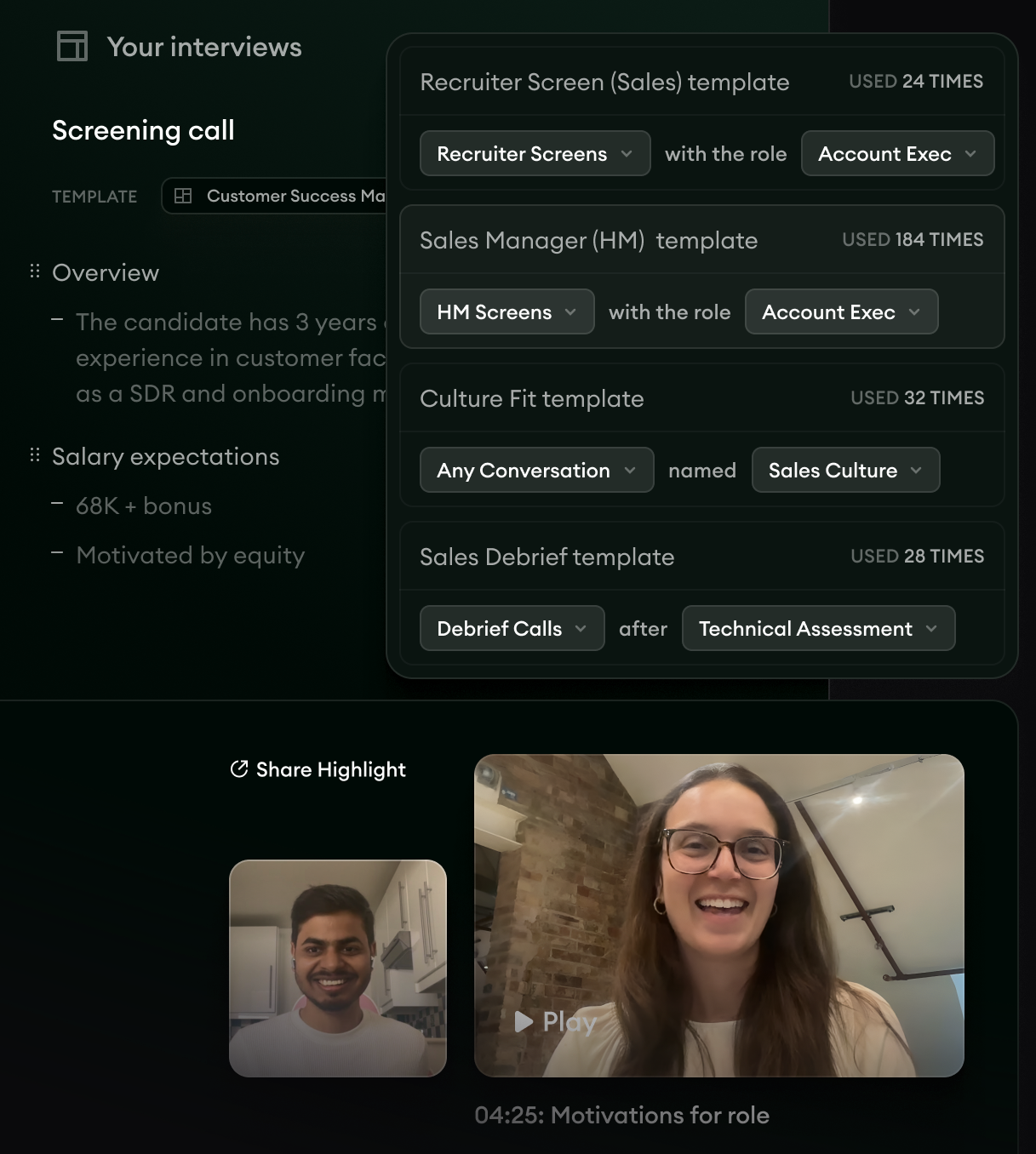
- 1Every interview ships structured notes against your rubric, with the candidate's own language preserved.
- 2Highlights surface in the right rail so the recruiter can pull the next community content angle in seconds.
- 3Auto-generated summaries route into the shared interview record without manual write-up time.
Reports closes the second half of the loop. Insights aggregates patterns across every interview on your account, so the recruiter writing next quarter's community content sees what your best hires said and which themes keep showing up in the strongest candidates.
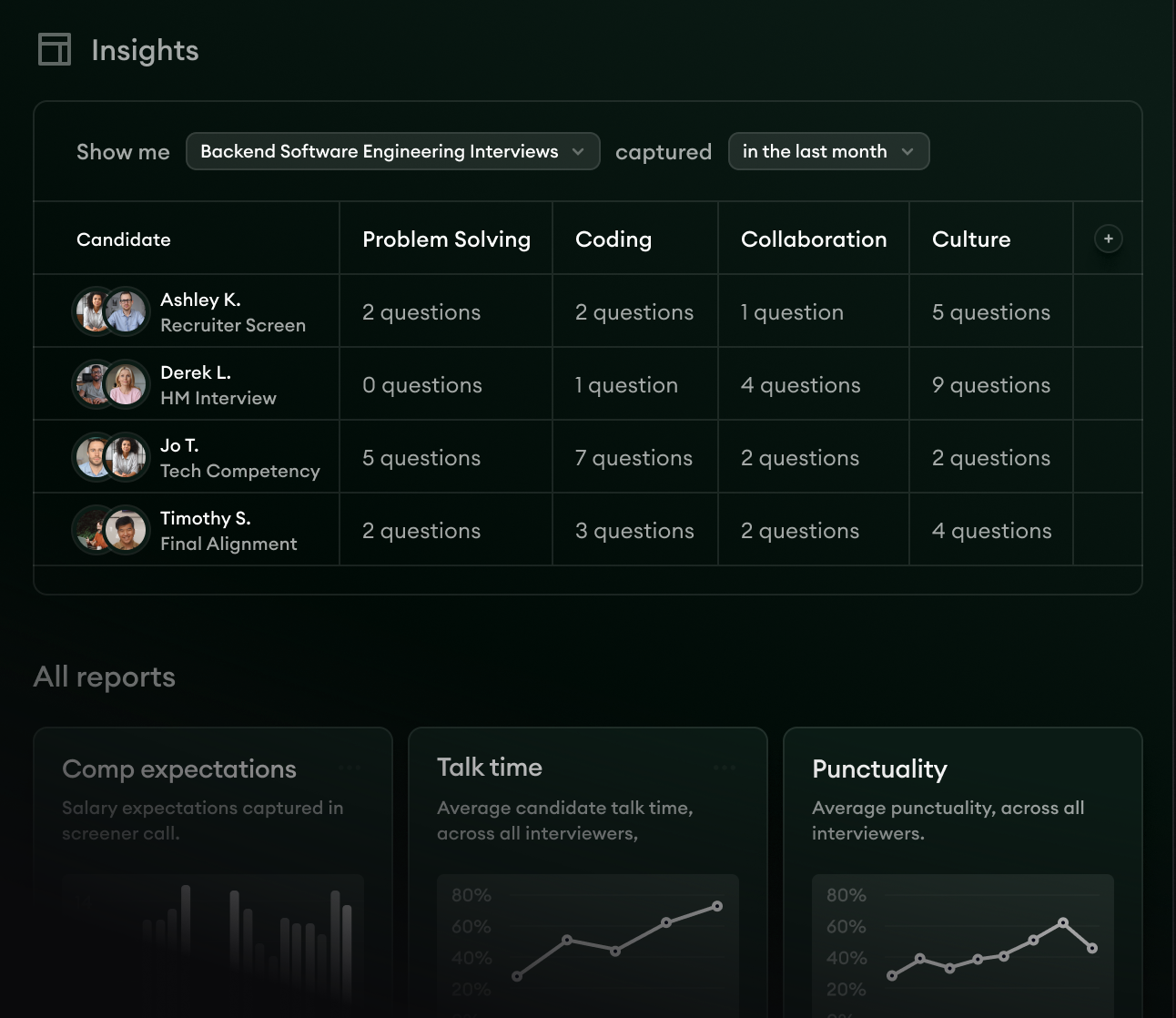
- 1Per-competency capture rates show which themes your strongest hires consistently raise.
- 2Filter by role family and time window to pull the signal that maps to your community segments.
- 3Export the themes into next quarter's content calendar without manual analysis.
And when a community member finally applies, Application Review surfaces their fit at the top of the inbound queue with the reasoning trail attached. The handoff from community to active candidate doesn't get lost in a generic ATS triage stack.
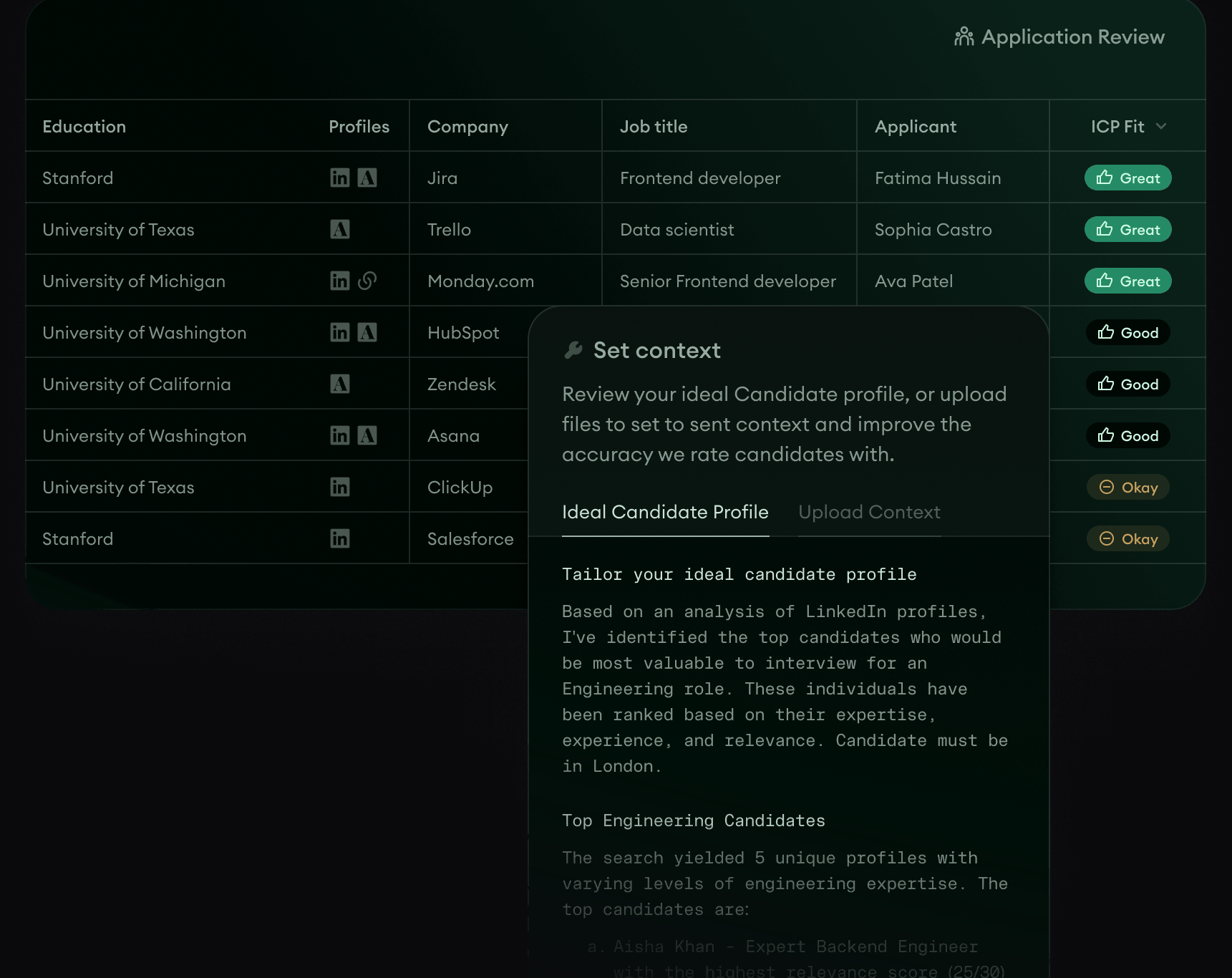
- 1Application Review sorts inbound against your ICP, so community members who apply rise to the top.
- 2Reasoning trail attached to every fit score makes the recruiter's first-look decision faster.
- 3Fraud and AI-generated patterns flagged so the warm list stays clean.
A talent community is an asset you build month over month, the same way marketing teams build email lists or product teams build user bases. The lift comes from running it like infrastructure, not like a campaign.
Pick the role families. Make joining frictionless. Segment by skill. Deliver content that earns the open. Track engagement as the readiness signal. Five steps, repeated quarterly, that turn a careers-page checkbox into a warm pool you can hire from on demand.
Bring Metaview into your hiring stack.
Live notes, structured scorecards, and ATS sync - set up in under 10 minutes.
Frequently asked.
What's the difference between a talent community and a talent pipeline?
The community lives in your CRM and spans years. The pipeline lives in your ATS and closes when the req closes. Community measures engagement over months. Pipeline measures conversion over days. Different tool, different metric, different cadence.
How small does my team have to be to start one?
One careers-page checkbox plus a quarterly newsletter is enough to start. Plan on around 30 minutes per week for the first three months to add sign-up surfaces, write the first three updates, and pick the engagement metrics you'll watch. The community doesn't need a team. It needs a cadence.
What's the right content cadence?
One substantive update every 4 to 6 weeks per segment is the floor. Less often and the community goes cold. More often and the unsubscribes start. Quarterly hiring-manager AMAs are the highest-engagement format teams report, so build cadence around them and fill the gaps with employee stories and role-family insights.
How do I know who in the community is hire-ready?
Watch two signals together. Three or more email opens in the last 30 days, plus an event RSVP or a content click in the last 60. People who hit both are your warm list. When a role opens in their family, outreach starts with someone who already knows the brand instead of a cold introduction.
